


The Real Numbers Behind SMS Marketing ROI
Let’s dive into the metrics that truly showcase the power of SMS marketing. We’ll move beyond the hype and focus on the tangible results you can achieve. Strong engagement and conversion rates often lead to a boost in revenue. Understanding the interplay of these metrics is crucial for maximizing your SMS marketing ROI.
Key Metrics to Track
To truly harness the potential of SMS marketing, it’s essential to look beyond superficial numbers. Focus on these key performance indicators:
- Delivery Rates: This fundamental metric shows the percentage of messages successfully delivered. A high delivery rate ensures your message reaches your target audience.
- Open Rates: SMS boasts significantly higher open rates than email, often surpassing 90%. This means most of your customers are seeing your message.
- Click-Through Rates (CTR): If your SMS message includes a link, the CTR measures how many recipients clicked on it. This indicates engagement and interest in your offer.
- Conversion Rates: This is the ultimate metric. Your conversion rate tracks how many recipients completed the desired action, whether it’s making a purchase, signing up for a newsletter, or something else entirely.
Why SMS Outperforms Other Channels
SMS consistently outperforms other marketing channels when it comes to engagement and ROI. Several factors contribute to this impressive performance. The immediacy and personal nature of text messages contribute to higher open and response rates. The concise format also encourages clear and compelling calls to action. Learn more about mastering SMS marketing in this helpful article: How to master SMS marketing.
Calculating Your SMS Marketing ROI
Calculating your SMS marketing ROI is straightforward. Compare the revenue generated from your SMS campaigns to the cost of running them. This simple calculation gives you a clear picture of your returns. If you’re incorporating SMS into a broader marketing strategy, consider how it interacts with other channels. You might find this resource helpful: Maximize Social Media Return on Investment.
SMS marketing consistently delivers a high return on investment (ROI). Reports indicate that in 2025, businesses earned approximately $71 for every $1 spent, representing a 7100% ROI. This is a substantial increase from previous years, where the ROI typically ranged from $21 to $41 for every dollar spent. For more detailed statistics, check out this resource: SMS Marketing Statistics. This remarkable ROI makes SMS a powerful tool for business growth. You might also find this article relevant: How to master SMS marketing pricing for ecommerce.
Making the Business Case for SMS Marketing Investment
Why are savvy marketers shifting their budgets to prioritize SMS marketing? This section unveils the compelling financial rationale behind this trend, supported by current market data and future growth forecasts. We’ll examine how businesses, from large retailers to emerging SaaS companies, are adapting their strategies to harness the power of SMS and the remarkable returns they’re seeing.
Understanding the Financial Benefits of SMS
Building a robust business case for SMS marketing involves addressing stakeholder questions and establishing attainable goals. This means grasping the overall cost structure of SMS in comparison to other channels and pinpointing industry-specific standards. For instance, while email marketing may have lower initial costs, SMS often delivers higher engagement and conversion rates, resulting in a greater overall return.
Furthermore, SMS offers a distinct level of immediacy and personalization, enabling businesses to forge connections with customers in ways other channels simply can’t replicate. This translates to a significant return on investment for many businesses. The infographic below visually represents the difference between SMS and email marketing ROI, and also showcases the impressive SMS conversion rate:
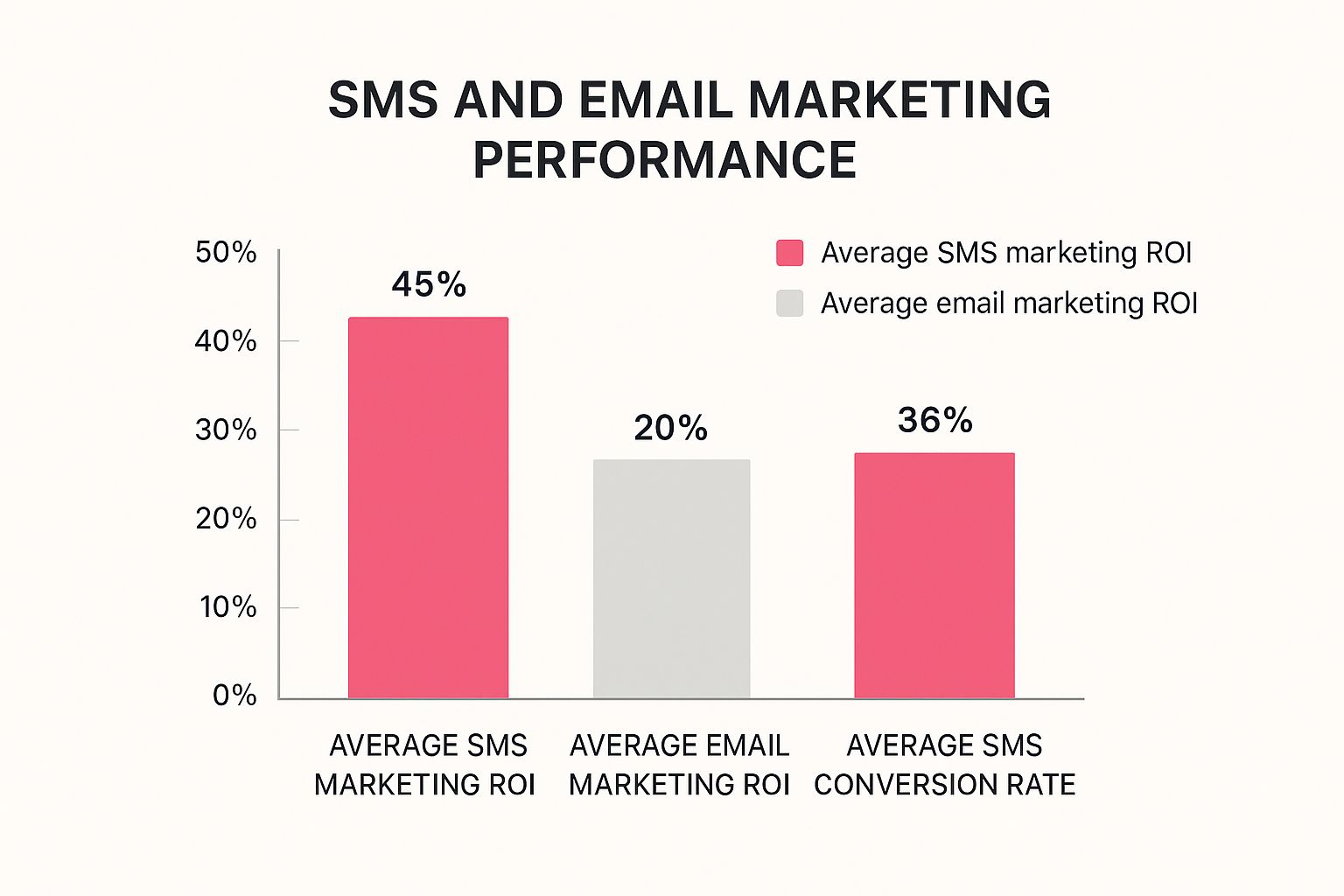
As the infographic illustrates, SMS marketing boasts a substantially higher average ROI (45%) compared to email (20%), reinforcing its status as a top-performing marketing channel. The robust 36% average conversion rate for SMS further highlights its effectiveness in prompting desired customer behaviors.
To further illustrate the ROI of SMS marketing compared to other channels, let’s examine the following table:
SMS Marketing ROI Comparison Across Marketing Channels
This table compares key performance metrics and ROI across different marketing channels to highlight the superior returns of SMS marketing.
| Marketing Channel | Average Open Rate | Average Response Rate | Average ROI | Cost Per Acquisition |
|---|---|---|---|---|
| SMS Marketing | 98% | 45% | 4500% | $0.01-$0.05 |
| Email Marketing | 20% | 2% | 4000% | $0.03-$0.10 |
| Social Media Marketing | <1% | <0.1% | <0.01% | $0.50-$2.00 |
| Paid Search Marketing | Varies | Varies | Varies | $1.00-$10.00 |
As you can see, SMS marketing boasts significantly higher open and response rates, leading to a higher ROI. Although the cost per acquisition can vary based on several factors, SMS marketing generally remains a cost-effective channel.
Growth and Adoption of SMS Marketing
The rising adoption of SMS marketing by businesses globally contributes significantly to projected market expansion. This growth is driven by the tangible results businesses experience. The global SMS marketing market is forecast to reach $38.4 billion by 2030, expanding at a compound annual growth rate (CAGR) of 20.8%. Currently, almost 40% of businesses utilize SMS marketing, with nearly 50 million people worldwide subscribing to receive business SMS messages. For more detailed statistics, explore this resource: Text Marketing Statistics.
Scaling Your SMS Program for Continued Success
As your SMS marketing performance improves, scaling your program becomes crucial. This involves progressively increasing your SMS marketing budget, broadening your subscriber base, and honing your targeting strategies.
However, maintaining a data-driven approach is essential. Continuously analyzing your ROI and adapting as needed ensures your SMS marketing efforts remain a profitable and effective element of your broader marketing strategy. You may find this helpful: How to Master SMS Marketing Pricing for E-commerce. By understanding the financial justifications, addressing stakeholder inquiries, and scaling strategically, you can fully realize the potential of SMS marketing and fuel significant business growth.
Creating SMS Campaigns That Actually Convert

What separates a truly successful SMS campaign from one that falls flat? It comes down to understanding what motivates people to engage with their mobile devices and applying that knowledge to create effective campaigns. By studying winning campaigns across different industries, we can see how structure, timing, and personalized messaging dramatically affect conversion rates.
The Power of Personalization and Timing
True personalization is much more than just using a customer’s name. It involves tailoring offers to their specific interests and past purchases. Think about it: a customer who regularly buys running shoes is far more likely to respond to a text about new running shoe arrivals than a general promotion.
Timing is equally vital. A well-timed text message can make all the difference. Imagine receiving a text offering a coffee discount just as you pass your favorite coffee shop. The chances of that message converting are significantly higher than if you received it at a less relevant moment. Understanding your audience and their daily habits is key to maximizing conversions.
Crafting the Perfect SMS Message
Creating messages that convey urgency without being overly pushy is a delicate art. Use strong calls to action, but avoid excessive exclamation points or aggressive language. Focus instead on creating a sense of scarcity or exclusivity. Most importantly, make sure your offers truly benefit the customer and align with their needs.
Think carefully about message length and formatting. Shorter messages tend to be more effective, respecting the recipient’s time. Clear, concise language is essential. Using formatting like emojis or bold text can highlight key information and make your message visually engaging.
Segmentation and Cadence: Finding the Right Balance
Blasting generic messages to your entire contact list is rarely effective. Segmentation allows you to divide your audience into smaller groups based on shared characteristics, enabling you to send highly targeted and relevant messages. This personalized approach resonates with recipients and leads to higher conversion rates. For more information on SMS best practices and campaign launches, check out this helpful resource: How to master SMS best practices and launch campaigns.
The frequency of your messages is also crucial. Too many texts can lead to customer fatigue and high opt-out rates. Too few can mean missed opportunities. Experiment to find the right cadence for your audience. Finding the sweet spot between providing valuable information and respecting your customers’ time is a cornerstone of effective SMS marketing.
This balance is particularly important considering that 72% of people have made a purchase after receiving a brand text. This number varies slightly by region, with 74% in Europe and 69% in APAC. For more detailed statistics, see: SMS Marketing Stats. By combining these techniques, you can significantly improve your SMS campaign conversion rates and achieve a strong SMS marketing ROI.
Measuring What Matters: SMS Marketing ROI Analytics

Open rates and click-through rates are important, but they only scratch the surface. Truly understanding your SMS marketing performance requires a deeper dive into the metrics that drive ROI. This involves pinpointing the key performance indicators (KPIs) linked to business growth and establishing systems to accurately connect revenue with your SMS campaigns.
Key Metrics for Measuring SMS Marketing ROI
Several metrics provide valuable insights into your SMS campaigns’ effectiveness. Calculating customer acquisition cost (CAC), determining the lifetime value (LTV) of SMS subscribers, and using multi-touch attribution models are crucial for understanding your return.
- Conversion Rate: This measures the percentage of SMS recipients who take a desired action, such as making a purchase. A high conversion rate translates directly into increased revenue.
- Customer Lifetime Value (LTV): Knowing the LTV of your SMS subscribers allows you to evaluate the long-term profitability of your SMS strategy.
- Customer Acquisition Cost (CAC): Calculate the cost of acquiring a customer through SMS to evaluate campaign efficiency. A lower CAC indicates a more cost-effective approach.
- Return on Ad Spend (ROAS): This metric shows the revenue generated for every dollar spent on SMS campaigns. A high ROAS is a clear sign of success.
For tips on boosting overall performance, explore resources like Shopify Conversion Rate Optimization Tips. Improving conversion rates across your marketing channels can positively impact your SMS efforts as well.
High open rates are a great starting point. Learn more about maximizing this metric in the article How to master open rates in SMS marketing.
The table below summarizes essential SMS marketing ROI metrics, providing formulas, benchmarks, and their impact on ROI.
To accurately measure the ROI of your SMS marketing campaigns, you need to understand the key metrics involved. The following table outlines essential metrics, formulas for calculating them, industry benchmarks, and how they ultimately impact your ROI.
| Metric | Formula | Benchmark | Impact on ROI |
|---|---|---|---|
| Conversion Rate | (Number of Conversions / Number of SMS Messages Sent) * 100 | Varies by industry, but aim for 2-5% or higher | Higher conversion rates directly increase revenue and ROI. |
| Customer Lifetime Value (LTV) | Average Purchase Value * Average Purchase Frequency * Average Customer Lifespan | Varies greatly by industry | Higher LTV means more revenue generated per customer, improving ROI. |
| Customer Acquisition Cost (CAC) | Total SMS Marketing Costs / Number of New Customers Acquired via SMS | Should be significantly lower than LTV | Lower CAC improves profitability and ROI. |
| Return on Ad Spend (ROAS) | (Revenue Generated from SMS / Total SMS Ad Spend) * 100 | Aim for 400% or higher | Higher ROAS demonstrates a positive return and efficient ad spend. |
By monitoring these metrics, you can gain a clearer understanding of the effectiveness of your SMS campaigns and identify areas for improvement.
Utilizing Analytics Tools for SMS Marketing
Several analytics tools can simplify tracking these essential metrics. These tools provide in-depth reports and dashboards, making it easy to visualize and analyze your data. They can also help identify trends and patterns in customer behavior, enabling you to optimize future campaigns.
A/B Testing for SMS Campaign Optimization
A/B testing is a crucial technique for SMS campaign optimization. By testing variations in message copy, sending times, and calls to action, you can pinpoint what resonates best with your audience. For instance, comparing two different calls to action can reveal which drives more conversions. Testing different send times helps identify when your audience is most receptive.
Turning Data into Actionable Insights
Analyzing SMS marketing data is vital. By tracking these key metrics and running A/B tests, you’ll gather valuable insights to shape future strategies. This data-driven approach allows you to continuously refine your campaigns for maximum impact and higher ROI. Regularly review your analytics and implement data-backed changes to ensure long-term SMS marketing success.
Fine-Tuning Your SMS Strategy for Maximum Returns
Optimizing your SMS marketing strategy is essential for getting the most out of your investment. While a basic approach might bring in some results, fine-tuning key components can significantly increase your SMS marketing ROI. This involves going beyond simply sending out messages and focusing on strategic enhancements that deliver tangible results.
Building a High-Value Subscriber List
The cornerstone of any successful SMS marketing campaign is attracting the right subscribers. Concentrate on building a list of engaged customers who have a genuine interest in your offerings. One effective method is offering exclusive incentives for signing up, such as a discount code or early access to new products. Clearly communicating the benefits of joining your SMS list is crucial for attracting these high-quality subscribers.
The Power of Segmentation
Sending generic messages to your entire list is rarely effective. Segmentation allows you to divide your audience into smaller, more focused groups based on factors like demographics, purchase history, or other relevant criteria. This allows for tailoring messages to these specific segments, making them more relevant and engaging. For example, you could send a promotion about new winter coats exclusively to customers who have previously purchased winter apparel.
Optimizing Content for Maximum Engagement
Even with a segmented list, the content of your messages remains paramount. Consider what truly resonates with your audience. Craft concise, compelling messages that offer real value. A clear and direct call to action (CTA) encourages immediate responses. Experimenting with different CTAs to determine what works best for your audience can significantly improve results.
Also, pay attention to message length. Shorter texts are generally more effective, especially on mobile devices. Get straight to the point and avoid overwhelming your audience with unnecessary information.
Leveraging Behavioral Triggers
Behavioral triggers automate messages based on specific customer actions. For instance, you might send an abandoned cart reminder via SMS shortly after a customer leaves items in their online shopping cart. Alternatively, you could send a personalized welcome message immediately after someone subscribes to your SMS list. These timely, automated messages capitalize on moments of high customer intent.
Reducing Opt-Out Rates
High opt-out rates can negatively affect your SMS marketing ROI. To minimize them, be upfront about your messaging frequency and the types of messages subscribers will receive. Always provide an easy way for customers to unsubscribe. Respecting your customers’ preferences and sending only valuable, relevant content builds trust and encourages them to remain on your list.
You might find this helpful: How to master SMS marketing for Ecommerce. This guide offers valuable insights into developing impactful campaigns that resonate with your audience and boost your ROI.
Practical Techniques for Improvement
Implementing these strategies doesn’t need to be complicated. Begin with small changes and track their impact. Experiment with different approaches to determine what performs best for your specific audience. Continuously analyze key metrics, such as click-through rates and conversion rates, to refine your approach. Even minor adjustments can lead to significant improvements in your overall SMS marketing ROI. By focusing on these tactical optimizations, you can elevate your SMS marketing from adequate to exceptional.
Weaving SMS Into Your Marketing Ecosystem for Better ROI
The real power of SMS marketing lies in its ability to integrate seamlessly with your broader marketing strategy. This approach allows brands to leverage SMS as a vital component of a multi-channel approach, ultimately creating a more unified and engaging customer experience.
Building a Cohesive Customer Journey With SMS
Imagine your customer’s journey as a story unfolding. SMS can act as a crucial touchpoint at various stages of this narrative. For instance, a welcome SMS message after a customer subscribes to your email list can foster early engagement. Similarly, a well-timed SMS reminder about an abandoned online shopping cart can effectively recover a lost sale. By strategically combining SMS with email, social media, and other channels, you can create a smooth, integrated experience that guides customers toward conversion.
SMS Across the Marketing Funnel
SMS provides unique benefits at each stage of the marketing funnel. At the awareness stage, a carefully crafted SMS can introduce your brand to potential customers. During the consideration phase, targeted SMS messages can showcase product features and advantages. When customers reach the decision stage, SMS can deliver timely offers and promotions. And finally, in the retention stage, personalized SMS messages can nurture loyalty and encourage repeat business.
Sequencing and Timing: Preventing Message Fatigue
Effective sequencing of messages across different channels is essential. Overwhelming customers with the same message on every channel can lead to message fatigue and increased opt-out rates. Instead, focus on how each channel can complement the others. For example, you could announce a new product launch via email, followed by a targeted SMS message offering an exclusive discount to a specific customer segment. This personalized, targeted strategy improves the customer experience and boosts conversion potential.
Adapting to Channel Constraints
While maintaining consistent messaging is important, remember that each channel has its own unique characteristics and constraints. Email is ideal for longer, more detailed content, while SMS requires brevity and impact. Tailor your message to the specific channel while staying true to your brand voice and overall messaging. A concise and engaging SMS message can effectively reinforce a key point delivered in a more detailed email.
Creating a Seamless Multi-Channel Experience
The ultimate objective is to craft a unified and compelling customer experience. Each channel should contribute to a cohesive narrative, guiding the customer through the sales funnel. This necessitates careful planning and execution. Consider the specific role of each channel and how they work together to create a seamless brand experience. By strategically integrating SMS with your other marketing efforts, you can maximize conversion opportunities and build stronger customer relationships.
Ready to turn abandoned carts into profit and boost your sales? Discover how CartBoss can help your eCommerce business thrive.