


The Hidden Costs Of Customer Loss (And Why It’s Getting Worse)
Losing a customer isn’t just about a single missed sale. It sets off a chain reaction that can impact your entire business. Many businesses prioritize customer acquisition, sometimes at the expense of overlooking the substantial financial impact of losing existing customers. Understanding this cost is the first step to winning them back.
Beyond The Immediate Sale: Calculating The True Cost
The most immediate cost is the loss of that customer’s purchases. But the real cost goes much deeper. Consider the marketing investment you made to acquire that customer. If they leave, that investment is essentially wasted. You also lose out on potential future purchases and the overall lifetime value (LTV) they could have brought to your business.
Accurately calculating the true cost of customer loss requires a more comprehensive view. It’s not just about the immediate lost sale, but also the cost of acquiring new customers to replace them and the potential revenue lost from repeat business. This calculation can be quite revealing, showing the significant impact of even seemingly small churn rates.
The Escalating Cost Of Lost Customers
One alarming fact is the escalating financial burden of customer loss. As of 2025, losing a single customer costs companies roughly $29, over three times the $9 cost a decade earlier. This dramatic increase underscores the growing difficulty businesses face in retaining customers. Acquiring a new customer is approximately five times more expensive than keeping an existing one, highlighting the importance of customer retention. Even a small 2% increase in customer retention can have the same positive effect on your bottom line as a 10% cost reduction, making it a vital metric for success. For more statistics on customer retention, visit The Petrova Experience.
The Ripple Effect Of Lost Customers
The costs continue to mount. Lost customers are less likely to recommend your business to others, impacting your organic growth. Negative word-of-mouth from dissatisfied former customers can tarnish your brand reputation, making it harder to attract new customers. This can set off a domino effect, where losing even a few customers triggers a cycle of rising acquisition costs and falling revenue.
For instance, consider a loyal customer who regularly bought from your online store and often recommended your products. When that customer leaves, you lose not only their direct purchases but also the potential revenue from those referrals.
To understand the financial implications further, let’s look at a cost comparison across different industries:
Customer Loss vs. Acquisition Costs Comparison
A detailed cost analysis comparing customer retention expenses versus new customer acquisition across different industries.
| Industry | Customer Acquisition Cost | Retention Cost | Cost Difference | ROI Impact |
|---|---|---|---|---|
| Retail | $100 | $20 | $80 | High |
| Software | $500 | $100 | $400 | Very High |
| Banking | $250 | $50 | $200 | High |
| Telecom | $150 | $30 | $120 | Medium |
This table uses illustrative figures. Actual costs can vary widely based on specific market conditions.
This table clearly illustrates the substantial cost difference between acquiring a new customer and retaining an existing one. The potential ROI impact is significant, especially in industries like software and retail where acquisition costs are high. Investing in retention strategies can offer a much higher return than focusing solely on acquisition.
Why Win-Back Strategies Are Essential For E-Commerce
In the competitive world of e-commerce, winning back lost customers isn’t just a nice-to-have; it’s a necessity. The rising cost of acquiring new customers, combined with the increasing financial impact of customer loss, makes customer retention a top priority. By concentrating on strategies to win back lost customers, e-commerce businesses can minimize these costs, bolster their profits, and create a more robust and sustainable business model. Effective win-back campaigns, such as targeted SMS messages through platforms like CartBoss, can be vital in re-engaging lost customers and turning them back into active buyers. This proactive approach to customer recovery is crucial for sustained success in the e-commerce sector. The value of a recovered customer goes beyond a single repurchase; they often become even more loyal and valuable, recognizing your commitment to their satisfaction.
Uncovering Why Customers Really Leave (The Detective Work)
Before you can win back lost customers, you need to understand their reasons for leaving. This goes beyond simply skimming exit surveys; it requires a thorough investigation into the root causes of customer churn. Think of yourself as a detective, meticulously gathering clues to solve the mystery of customer departures.
Beyond Exit Surveys: Digging Deeper
Standard exit surveys often yield generic responses like “better price elsewhere” or “found a different product.” These responses offer a starting point but rarely tell the whole story. A customer might cite price, but the underlying issue could be a perceived lack of value in your product or service. This is where the real detective work begins.
You might be interested in: How to reduce customer churn.
Conducting Effective Exit Interviews
Exit interviews are a powerful tool. Conducted effectively, they uncover valuable insights. The key is asking open-ended questions that encourage honest feedback. Instead of asking, “Were you satisfied with our service?”, try, “What could we have done to improve your experience?” This approach elicits more detailed and revealing responses.
Analyzing Customer Behavior
Analyzing customer behavior before they churn is crucial. Look for patterns in their engagement with your product or service. Did their usage decline? Did they stop opening your emails? Did they contact customer support with complaints? These behavioral clues often predict churn. Tracking website activity and purchase history can further illuminate the customer journey and identify potential pain points.
Significantly, 59% of US consumers report lifelong loyalty to a brand after committing, while 32% would abandon a brand after a single negative experience. This underscores the importance of customer satisfaction, as repeat customers tend to spend more and drive revenue growth. Find more detailed statistics here.
Segmenting Lost Customers for Targeted Strategies
Successful companies segment lost customers based on their reasons for leaving and potential for recovery. This allows for targeted win-back strategies. Customers who left due to a temporary issue, like a billing problem, are more likely to return than those who switched to a competitor offering a feature you lack. Understanding why customers leave is crucial. You should analyze the true cost of customer churn.
Identifying Early Warning Signs
Analyzing customer behavior and feedback helps identify early warning signs of potential churn. This proactive approach allows for intervention before customers leave. For example, if a customer suddenly stops using a key feature, it could indicate dissatisfaction. Reaching out proactively to understand their needs can prevent churn.
This investigative approach transforms generic win-back attempts into targeted campaigns. Addressing the root causes of customer departure leads to more effective and sustainable strategies. This increases the chance of recovering lost customers and strengthens overall customer retention efforts. Read also: How to win back lost customers.
Crafting Win-Back Campaigns That Actually Get Responses

Generic “we miss you” emails often miss the mark. They lack the personal touch needed to truly re-engage a lost customer. In fact, these impersonal emails can even harm your brand image by appearing insincere. This section delves into the strategy and psychology of creating win-back campaigns that resonate with customers, transforming them from lost prospects back into loyal patrons.
The Psychology of Winning Back Lost Customers
Winning back a customer starts with acknowledging their departure without dwelling on it. Effective campaigns focus on providing value and showing customers you understand their needs. This means offering more than just simple discounts. Instead, focus on personalized solutions that address the reasons they left in the first place.
For instance, if a customer churned because your product lacked a specific feature, highlighting its recent implementation in your win-back message can be incredibly effective. Showing genuine empathy for their past experience is also essential in rebuilding trust and encouraging them to give your brand another chance.
Creating Compelling, Personalized Messages
Personalization is paramount. Address the customer by name and reference their past interactions with your brand. Perhaps mention a product they frequently bought or a service they often utilized.
This shows you value their individual relationship with your business. This personal touch helps your message stand out from generic marketing emails, fostering a genuine connection.
Segmenting your lost customers based on their value and reasons for leaving is crucial. This targeted approach enables more relevant and effective messaging. Customers who left due to a price increase, for example, might be receptive to a special discount or a loyalty program offer. For more insights on customer recovery, check out this resource: How to master abandoned cart recovery.
Proven Message Frameworks and Timing Strategies
Several proven message frameworks can inform your win-back campaign development. One effective strategy is the “acknowledge, empathize, incentivize” framework. This involves acknowledging their departure, empathizing with their reasons for leaving, and providing an incentive to return. Another strong strategy is highlighting new features or product improvements that directly address past customer pain points.
Timing your campaigns strategically is also essential. Sending a win-back message too soon can appear pushy, while waiting too long risks the customer forgetting your brand entirely. Experiment with different timeframes—a week after churn, a month after, etc.—to determine what works best for your audience. Personalized win-back campaigns see response rates 3.2x higher than generic approaches, with segmented campaigns based on departure reasons achieving up to 24% success rates. Learn more about this here.
Multi-Channel Approaches for Maximum Impact
A multi-channel approach can greatly amplify your win-back initiatives. This might involve combining email with SMS messages, targeted social media ads, or even personalized direct mail. CartBoss offers a powerful platform for automating personalized SMS messages, providing a very effective way to re-engage lost customers.
This integrated strategy reinforces your message and increases the likelihood of reaching your target audience. However, avoid seeming desperate or aggressive. Maintain a respectful and helpful tone in all your communications. By understanding the psychology of lost customers and using these strategies, you can craft win-back campaigns that resonate authentically and deliver real results, recovering lost revenue and fostering stronger, more sustainable customer relationships.
Understanding Industry Benchmarks And Global Churn Reality
Context is crucial when tackling customer churn. This section helps you understand your customer loss challenges by examining how different industries are handling increasing churn rates. We’ll also explore what makes some win-back strategies successful, while others fail. By looking at retention across both Business-to-Business (B2B) and Business-to-Consumer (B2C) markets, you’ll gain realistic expectations for your own win-back efforts. You’ll also pinpoint areas where even small improvements can offer significant competitive edges.
Benchmarking Your Efforts Against Industry Leaders
Winning back lost customers starts with understanding the bigger market picture. Globally, churn rates can reach as high as 30%, a substantial obstacle for businesses wanting consistent growth. The B2B sector, usually more stable, shows average retention rates between 76% and 81%. Even with this relative stability, preventing customer loss still takes work. This highlights the need for constant quality and proactive customer engagement. More detailed statistics can be found here. Benchmarking against industry standards gives you a valuable framework to assess your own performance and spot opportunities for improvement.
The Power Of Small Improvements In A Competitive Landscape
Even small gains in customer retention can become big competitive advantages. In highly competitive markets, a slight rise in your win-back rate can substantially affect your market share and profits. To improve your win-back campaigns, understand how to effectively re-engage your audience. Focus on personalized messages, targeted offers, and the right timing to boost your success.
Adapting Strategies To Current Market Realities
Successful businesses constantly adjust their win-back strategies to fit current market conditions. This means keeping up with industry changes, checking out what competitors are doing, and constantly refining their approach based on data and customer feedback. Changes in how consumers behave or shifts in the economy might mean you need to adjust your messaging, offers, or target audience.
Visualizing Win-Back Campaign Metrics
The infographic below shows key metrics from re-engagement email campaigns. These metrics include average open rates, click-through rates, and conversion rates.
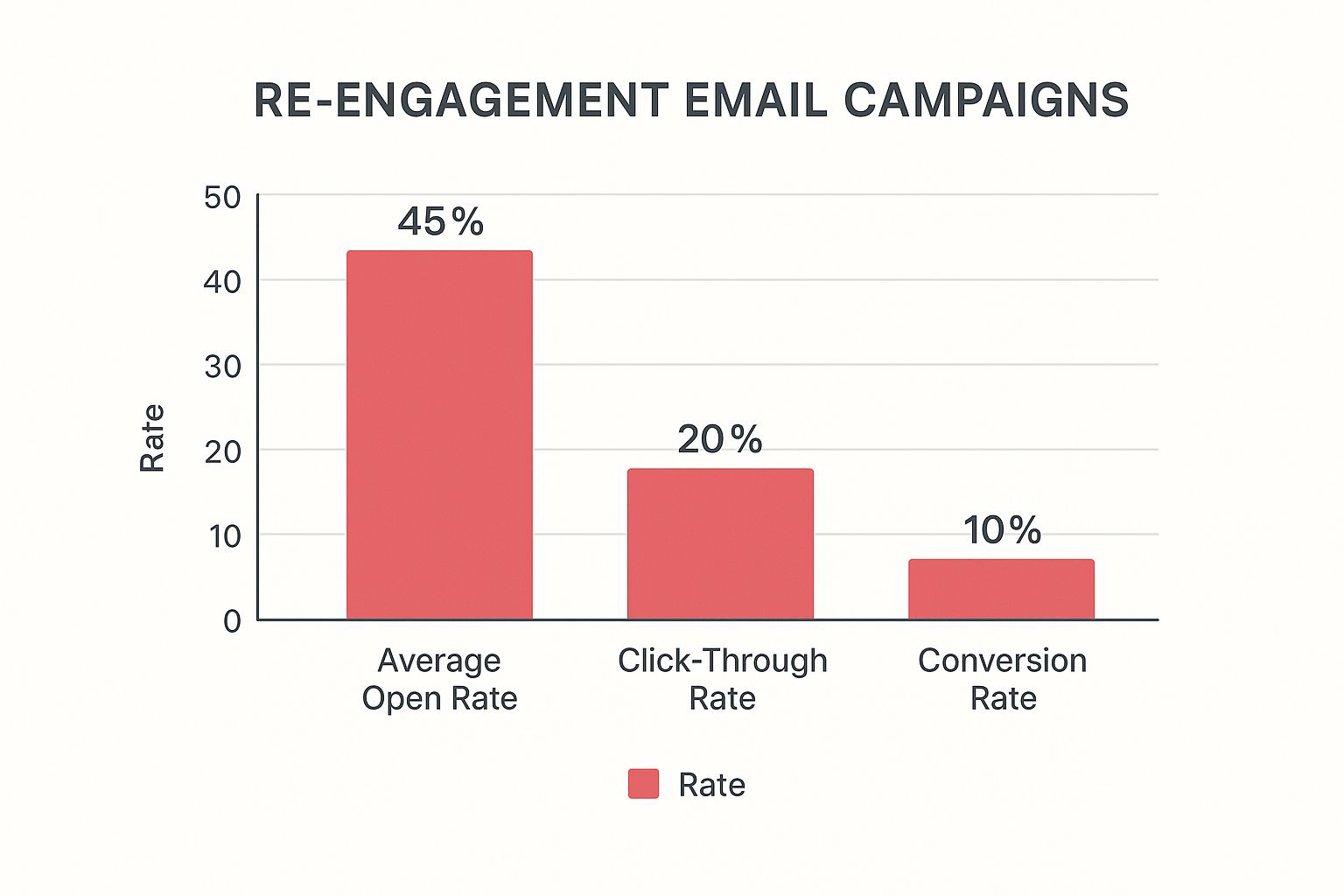
As you can see, open rates can be high, but click-through and conversion rates are often much lower. This underscores the need to optimize your email content and call-to-actions. Compelling subject lines, personalized email body content, and clear, valuable incentives for returning customers are all key to driving higher engagement and conversions throughout your win-back journey.
The following table provides a look at industry churn rates and win-back success:
Industry Churn Rates and Win-Back Success Rates
Comprehensive data showing average churn rates and successful win-back percentages across different industries
| Industry | Average Churn Rate | Win-Back Success Rate | Average Recovery Time | Best Practices |
|---|---|---|---|---|
| SaaS | 5-7% | 15-20% | 3-6 Months | Personalized outreach, incentives, value demonstration |
| E-commerce | 20-30% | 5-10% | 1-2 Weeks | Targeted offers, abandoned cart emails, loyalty programs |
| Media | 5-10% | 10-15% | 2-4 Weeks | Exclusive content, personalized recommendations, community engagement |
| Telecom | 15-20% | 20-25% | 1-3 Months | Competitive offers, bundled services, improved customer service |
Key takeaways from this data include the importance of personalized outreach and targeted incentives for win-back success. Also note the differences in recovery times across industries.
Positioning For Long-Term Success
Winning back lost customers isn’t just about quick wins. It’s about building lasting loyalty. By understanding why customers leave and addressing their specific needs, you create a stronger foundation for sustained growth. This means constant improvement, regular engagement, and being ready to adapt as the market changes. Ultimately, the companies best at winning back lost customers are those that see it as a core part of their overall retention strategy.
Building Automated Systems That Catch Customers Before They Leave

Winning back lost customers is often cheaper than finding new ones. But the real key is being proactive, not reactive. This means setting up automated systems to spot those at-risk customers before they churn. Addressing potential problems early can stop customers from leaving in the first place. Think of these systems as a safety net, catching customers before they slip through the cracks.
Early Warning Systems: Predicting Churn Risk
Effective early warning systems rely on monitoring important metrics. These could include things like engagement levels, customer satisfaction scores, and how they’re using your product. This data gives you valuable insights into customer behavior, helping you predict who’s likely to churn. For instance, a sudden decrease in product usage or a string of negative interactions with your support team could indicate growing dissatisfaction.
You might be interested in: How to master eCommerce checkout optimization.
The Technology Stack for Customer Recovery
Putting automated systems in place requires the right tools. This usually involves a Customer Relationship Management (CRM) system, analytics platforms, and marketing automation tools like Hubspot. Integrating these seamlessly with your current operations is vital for efficient customer recovery. A well-integrated system enables automated workflows, ensuring timely interventions and personalized messages.
This integration lets you trigger actions based on specific criteria. Say a customer’s engagement score falls below a certain level. An automated email sequence can be triggered, offering support or incentives. This automated approach ensures consistent and timely outreach, essential for effective customer recovery.
Standardized Processes for Consistent Recovery
Standardizing your recovery process is key for efficiency. While a personal touch is important, standardized processes ensure consistency and prevent anyone from being overlooked. This means clear protocols for identifying, contacting, and re-engaging churned customers. These standardized processes allow your team to focus on personalized communication, making each customer feel valued.
Businesses using automated early warning systems see a 67% reduction in unexpected customer departures and recover 41% more at-risk customers than reactive approaches. Explore this topic further here.
Maintaining the Personal Touch
Automation is powerful, but it shouldn’t replace human interaction. Even with automated systems, a personal touch is crucial. This could be personalized emails, phone calls, or even handwritten notes. This personal touch can make a real difference in winning back lost customers and rebuilding trust. It shows you value their business and are willing to go the extra mile.
By building these proactive systems, you can significantly reduce churn, increase customer lifetime value, and create a more sustainable business. This proactive approach not only saves you money but also strengthens customer relationships and builds loyalty. It’s a win-win for everyone.
Measuring Success And Optimizing Your Recovery Strategy
Winning back lost customers isn’t about sending a handful of emails. It requires a strategic, data-driven approach and continuous optimization. It means looking beyond simple response rates and diving deep into the metrics that truly matter.
Key Metrics for Tracking Win-Back Success
To understand your win-back campaigns, track several key metrics. Start with your conversion rate, the percentage of lost customers who make another purchase. Equally important is the long-term retention rate. Are recovered customers staying, or are they churning again?
Also, consider the lifetime value (LTV) of recovered customers. Are they spending as much, or even more, than before? This is crucial for calculating the true ROI of your win-back program. This data helps you accurately assess the long-term profitability of your initiatives and pinpoint areas for improvement. You might be interested in: How to master customer engagement.
Setting Realistic Benchmarks
Industry averages and typical win-back rates offer helpful benchmarks for your campaigns. Consider the specifics of your customer base, product, and industry. A high industry churn rate might mean a naturally lower win-back target.
Don’t let averages limit your goals. Focusing on specific customer segments and personalizing your approach can help you surpass benchmarks. Use detailed analytics to understand which recovery strategies work best for each segment. For instance, price-sensitive customers might respond to discounts, while others who left due to a missing feature might return after product updates.
A/B Testing for Maximum Impact
A/B testing is essential for optimization. Experiment with different messaging, timing, offers, and channels. Don’t hesitate to try new things. This ongoing refinement process maximizes the effectiveness of your efforts. A good A/B testing framework isolates and tests individual variables. Change one element at a time, like the email subject line or discount value, to accurately measure its impact.
This might involve testing different email subject lines, adjusting offer values, or exploring new channels. Consistent testing and iteration reveal what resonates best with your customer base.
Calculating the True ROI
Understanding your win-back campaigns’ true ROI is paramount. Calculate the immediate revenue from recovered customers and the long-term LTV impact. Organizations with robust win-back measurement frameworks see 156% better ROI on retention investments and recover customers with 23% higher lifetime value. Explore this topic further here. Subtracting campaign costs from this total value reveals the true profitability of your efforts.
Data-Driven Decisions for Optimized Spending
Data-driven insights are crucial for making smart decisions about your retention budget. Understanding which win-back strategies deliver the highest ROI helps you invest resources effectively. This targeted approach maximizes customer recovery and overall profitability.
By consistently monitoring your win-back program’s performance, you can identify and address underperforming areas and focus on what’s working. This continuous optimization unlocks the full potential of your efforts and achieves significant long-term gains.
Key Takeaways For Customer Recovery Success
Winning back lost customers isn’t just a tactic; it’s a vital strategy for sustainable business growth. This section offers a practical roadmap, actionable checklists, and step-by-step guides to implement effective win-back strategies that deliver measurable results. Think of this as your action plan, putting the strategies, tools, and insights discussed earlier into a usable format you can implement right away.
Understanding the Why: The Foundation of Customer Recovery
Before creating any win-back campaign, thoroughly investigate why customers leave. Generic exit surveys often provide surface-level reasons. Direct conversations with former customers, on the other hand, offer invaluable insights into their actual pain points.
This investigative work helps personalize future campaigns. For example, understanding whether a customer left because of pricing or a missing feature significantly informs your win-back strategy. Knowing the “why” is the key to effective customer recovery.
Segmentation and Targeting: Your Path to Personalized Campaigns
Once you understand why customers churn, segment them based on these reasons and their potential value. This allows for the creation of highly personalized campaigns that resonate with individual needs.
Imagine a customer left because a competitor offered a feature your business lacked. If you’ve recently added that feature, highlighting it in your win-back message might be the key to winning them back. This targeted approach transforms generic outreach into focused campaigns.
Crafting Compelling Communication: Reconnecting With Lost Customers
Your win-back messages should feel authentic. Acknowledge their departure without dwelling on it and focus on what’s new. Perhaps you’ve improved your product, added new features, or resolved a previous issue.
Highlighting these changes reassures former customers that you’re listening and adapting. This applies to your chosen communication channels as well. Explore more in our article about how to master eCommerce conversion rate optimization.
The Power of Incentives and Offers: Sweetening the Return
Addressing the reasons for departure is crucial. However, offering incentives can dramatically improve your win-back success. A timely discount, free shipping, or access to exclusive content can be the final push a former customer needs.
Remember to tailor incentives to the specific segment. A discount might attract price-sensitive customers, while early access to new features might entice those seeking innovation.
Timing and Persistence: Striking the Right Balance
The timing of your win-back efforts is essential. Reaching out too soon might seem aggressive, while waiting too long can convey indifference. Experiment to find the sweet spot for your audience.
Consider a series of messages over time, each offering increasing value or a different incentive. This persistent, yet respectful, approach keeps your brand top-of-mind.
Automation and Technology: Streamlining Your Efforts
Use automation to streamline your win-back campaigns. Automated email sequences, personalized SMS messages, and targeted social media ads can significantly improve efficiency and reach.
CartBoss can automate personalized SMS messages, a highly effective channel for re-engagement. This allows your team to focus on creating tailored messages and handling complex cases.
Measuring and Optimizing: The Path to Continuous Improvement
Track essential metrics like conversion rates, customer lifetime value, and campaign ROI. These insights are vital for continuous improvement. Regularly analyze your campaigns and conduct A/B testing to refine your messaging, timing, and offers. Consistent optimization is the key to maximizing the impact of your strategies.
Ready to turn abandoned carts into profit and win back lost customers? CartBoss offers a powerful SMS marketing platform designed to help you re-engage lost customers and boost sales. Transform casual buyers into loyal customers and maximize your revenue with automated SMS campaigns, targeted promotions, and pre-filled checkout forms. Start your free trial today!