


Ever had a conversation that jumps from a text message to an in-person chat without missing a beat? That’s the feeling an omnichannel marketing software platform brings to your business. It’s designed to weave every customer touchpoint—from DMs to in-store visits—into a single, seamless conversation.
Why Omnichannel Software Is No Longer Optional
Think about all the ways a customer interacts with your brand today: social media, email, your mobile app, maybe even a physical storefront. For most businesses, these channels operate in silos. The social media team has no idea what the email team is doing, and neither knows if a customer just walked out of your store.
This disconnect creates a clunky, frustrating experience. A customer might abandon a cart on your website, only to get a generic, unrelated email an hour later. The left hand simply doesn’t know what the right is doing. This is the classic pitfall of a multichannel strategy—offering many doors, but none that connect to the same room.
Moving Beyond Disconnected Channels
Omnichannel marketing software tears down those walls. It acts as a central hub, pulling in data from every single interaction to build a rich, unified profile for each customer. This allows your brand to deliver experiences that are not just personalized, but context-aware and consistent.
The real goal is to make the channel invisible to the customer. They aren’t having an “email conversation” or a “social media conversation”—they are simply having one continuous conversation with your brand, no matter where it happens.
This unified approach isn’t just a nice-to-have anymore; it’s becoming the standard. The market for these platforms is exploding, projected to grow from $7.8 billion to a staggering $25.2 billion by 2033. This massive growth signals a fundamental shift in how successful businesses think about their customers.
To help you see the difference, let’s compare these two approaches side-by-side.
Multichannel vs. Omnichannel Marketing At a Glance
| Aspect | Multichannel Marketing | Omnichannel Marketing |
|---|---|---|
| Core Focus | Brand-centric (broadcasting on all channels) | Customer-centric (creating a unified journey) |
| Channel Integration | Channels work in isolation (silos) | Channels are fully integrated and share data |
| Customer Experience | Fragmented and inconsistent | Seamless and consistent across all touchpoints |
| Data Usage | Data is siloed within each channel | A single, unified customer profile is shared |
| Primary Goal | Maximize reach on as many channels as possible | Deepen the customer relationship and LTV |
This table makes it clear: while multichannel is about being present everywhere, omnichannel is about being connected everywhere. The difference in results is dramatic.
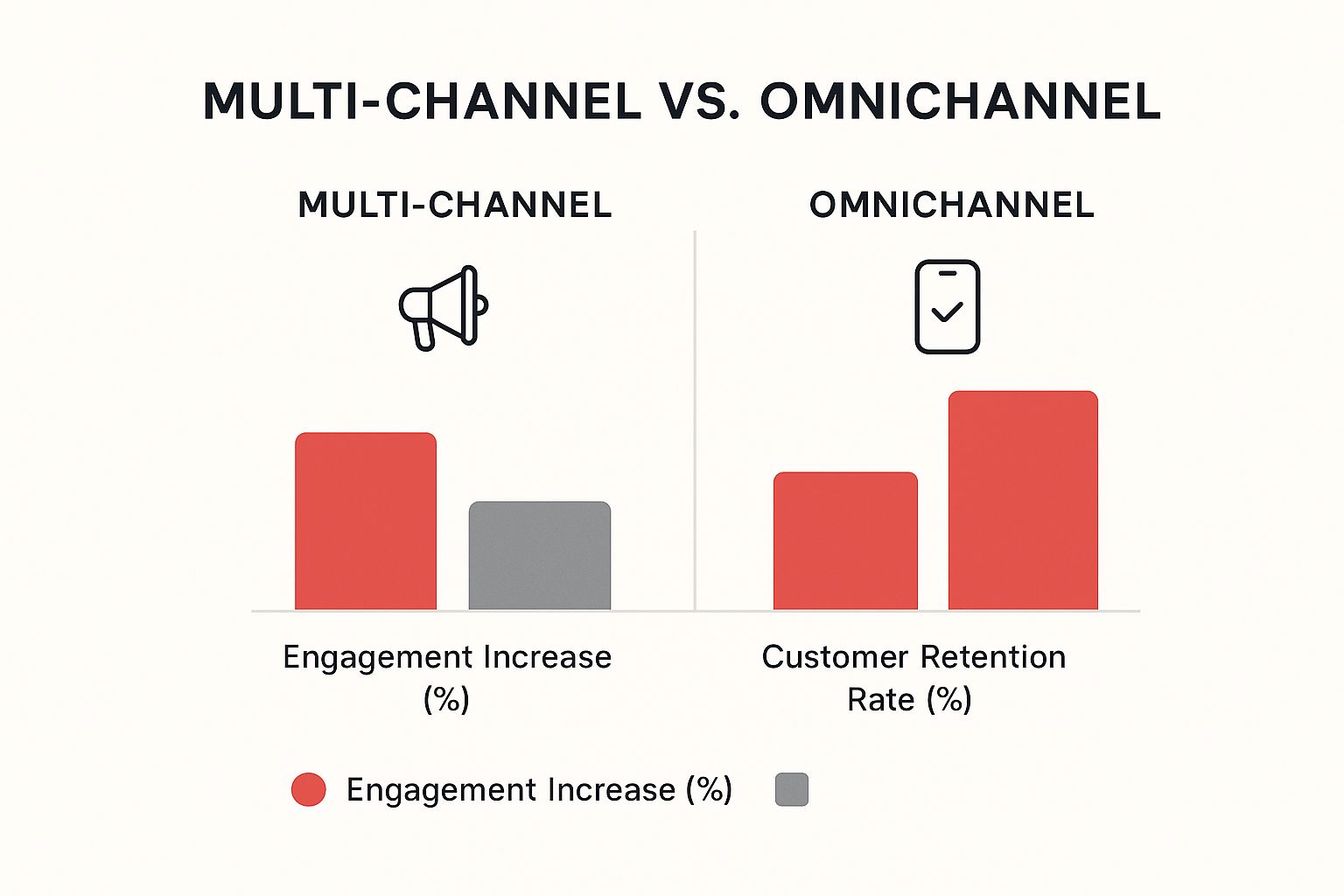
As the data shows, an integrated strategy drives significantly higher customer retention and engagement. It’s not just about better marketing; it’s about building a smarter, more resilient customer relationship.
The Real-World Business Impact
At the end of the day, this is more than a tech upgrade—it’s a strategic pivot to putting the customer at the absolute center of your business. It gives you the power to:
- Increase Customer Lifetime Value: When you understand a customer’s entire journey, you can deliver the right offers at the right time, keeping them coming back.
- Boost Loyalty and Retention: Customers who feel seen and understood stick around. A frictionless experience is one of the most powerful loyalty drivers you have.
- Drive Higher Conversion Rates: From intelligent cart recovery messages to context-aware promotions, a unified strategy has a direct and measurable impact on sales.
By creating a cohesive journey, you build trust and make it incredibly easy for people to buy from you, again and again. To go even deeper on this topic, check out our guide on creating a winning omnichannel customer experience.
Unpacking the Core Features of Top Platforms

To really get what makes omnichannel marketing software a game-changer, you have to look under the hood. We’re not just talking about a list of features here. Think of it as a set of interconnected gears in a machine built for one thing: creating a single, smooth customer journey. It’s the difference between owning a random box of tools and having a fully automated, state-of-the-art workshop.
The absolute foundation of any real omnichannel platform is the Centralized Customer Profile. This isn’t your average contact list. It’s a living, breathing record of every single interaction a person has with your brand.
Picture it like a digital scrapbook for each customer. It tracks their website visits, the emails they open, what they do in your app, any support tickets they’ve raised, and even their in-store purchases. This creates a “single source of truth” that every other part of the system pulls from, making sure every department is looking at the exact same customer.
Orchestrating a Unified Brand Message
Once you have that unified profile, the software can start running smart campaigns with Cross-Channel Campaign Management. This feature is like the conductor of your marketing orchestra, making sure every channel plays in perfect harmony.
You can map out a campaign that kicks off with an email, follows up with an SMS alert, and then shows a tailored ad on social media—all from one place. It gets rid of the old, siloed way of doing things where your email team has no idea what your social media team is up to.
For example, you can stop a customer who just bought a product from seeing an ad for that same item an hour later. Instead, the platform can automatically pivot the messaging to showcase complementary products or ask for a review. It’s just a smarter, more respectful way to engage with people.
From Mass Marketing to Meaningful Conversations
One of the most powerful tools in the box is Advanced Segmentation. This is where the platform takes all that rich data from the centralized profile and groups customers based on super-specific criteria—way beyond basic demographics.
You can build segments for things like:
- High-Value Customers: People who’ve spent over a certain amount in the last six months.
- At-Risk Users: Customers who haven’t logged in or visited your site in 30 days.
- Cart Abandoners: Shoppers who added a specific item to their cart but never checked out.
- Channel Preference: Folks who respond best to SMS versus those who are more likely to open an email.
This granularity lets you stop sending generic “email blasts” and start having genuinely personal, one-to-one conversations at scale. With this kind of insight, you can boost your eCommerce sales by delivering the perfect message to the right person at the right time.
True omnichannel marketing isn’t about shouting the same message on every channel. It’s about continuing the same conversation seamlessly from one channel to the next, using data to inform every word.
This intelligent approach is fueling some serious market growth. The omnichannel retail software market grew from $10.54 billion and is on track to hit $12.98 billion in the next year. With forecasts predicting it could surge to $29.61 billion within five years, it’s obvious that businesses are all-in on creating these connected shopping experiences.
Understanding What Truly Works
Finally, none of this would be complete without Analytics and Attribution. This is the brain of the whole operation, telling you not just what happened, but why. Solid analytics let you measure the performance of your entire omnichannel strategy, not just isolated channels. The best platforms often integrate tools for all your digital marketing, including comprehensive PPC services, to keep messaging and performance locked in across paid ads.
Attribution models are key here. They help you figure out which touchpoints were the most important on a customer’s path to buying something. Did the social media ad kick things off? Did the cart abandonment email seal the deal? Answering these questions lets you fine-tune your spending and double down on what’s actually working, giving you the clarity you need to prove your marketing’s value and make smarter moves next time.
How to Choose the Right Omnichannel Software
Picking the right omnichannel marketing software isn’t just about buying a new tool. It’s more like choosing a long-term business partner. The platform you select will become the command center for your entire customer experience, so getting this decision right is crucial.
Think of it like laying the foundation for a house. If you get it right from the start, everything else falls into place. If you rush it, you’re signing up for major headaches down the road.
The process doesn’t start with flashy demos or sales calls. It starts with a hard look in the mirror. Before you can figure out what any vendor offers, you first have to nail down what your business actually needs. This initial analysis is your roadmap, making sure you don’t get sidetracked by cool features that don’t solve your real problems.
Start With a Comprehensive Needs Analysis
Your first job is to map out your specific requirements. This isn’t just a wish list; it’s a detailed blueprint for what the ideal solution looks like for you. To do this right, you need to pull in people from marketing, sales, customer service, and even IT to get the full picture.
Here are a few questions to get the ball rolling:
- What are our biggest customer experience headaches right now? Are people complaining about repeating themselves to different teams? Are your marketing messages missing the mark?
- Which customer journeys matter most to our bottom line? Pinpoint the high-impact moments, like a new customer’s first few days, what happens after a cart is abandoned, or the follow-up after a purchase.
- Where does our audience actually hang out? Think about the channels your customers use today and where you want to meet them tomorrow. This includes the usual suspects like email and social media, but don’t overlook powerful channels like SMS. In fact, understanding the specifics of how you’ll communicate is key, so digging into strategies for SMS marketing for eCommerce is a smart move to prepare.
- What does winning look like for us? Define the specific, measurable key performance indicators (KPIs) you want to move. Are you trying to boost customer retention, jack up conversion rates, or increase the average order value?
Once you’ve done this internal audit, you’ll have a concrete checklist. It transforms a vague search into a focused mission, allowing you to measure every potential platform against what truly matters.
Evaluate Core Technical Capabilities
With your needs clearly defined, you can start digging into the technical side of things. The goal is to find a platform that works with your existing tools, not against them.
A great omnichannel platform should feel like a natural extension of what you already do, not some clunky, foreign system you have to wrestle with. It’s there to make your life simpler, not more complicated.
Pay close attention to these four critical areas:
- Integration Capabilities: This one is non-negotiable. The software must connect smoothly with your current tech stack. Check that it plays nice with your e-commerce platform (like Shopify or WooCommerce), your CRM, and any other tools you can’t live without. Bad integrations just create new data silos, which defeats the whole purpose of going omnichannel.
- Scalability: The platform you pick today has to handle your business tomorrow. Ask vendors point-blank how their system manages growth. What happens when your customer numbers double, or when you add five new channels? You need a partner that can grow with you, not one you’ll outgrow in a year.
- User-Friendliness: Your team will be in this software all day, every day. A confusing, clunky interface means people won’t use it, and you’ll have wasted your investment. Always ask for a sandbox or trial account so your team can get their hands dirty. If they can’t figure it out easily, it’s a no-go.
- Vendor Support and Training: A fantastic product with terrible support is a recipe for pure frustration. Do some digging on the vendor’s reputation for customer service. What does their onboarding process look like? Is there ongoing training and real technical support when things go wrong? A solid support system is worth its weight in gold, especially during that initial setup phase.
By methodically checking off these boxes, you’ll be in a much stronger position to choose a true partner that will help push your business forward.
The Impact of AI on Modern Omnichannel Strategy
For years, a solid omnichannel strategy has been a huge competitive advantage. But with new tech bursting onto the scene, it’s quickly shifting from a “nice-to-have” to an absolute must. The two biggest game-changers are Artificial Intelligence (AI) and the Internet of Things (IoT), and they’re completely redefining what’s possible with omnichannel marketing software.
Think of AI as the brain of your omnichannel platform. It’s the part that makes your system not just connected, but genuinely intelligent. Instead of just collecting data, AI actively understands it, finds patterns, and even starts predicting what your customers will do next. This is how you move past the buzzwords and achieve true hyper-personalization.
Instead of lumping customers into broad buckets, AI can sift through thousands of individual data points—past purchases, browsing habits, even the time of day they’re most active. From there, it can figure out their next move and automatically fire off the perfect message on the right channel. The result is an experience that feels like it was built just for them.
AI-Powered Predictive Analytics
One of AI’s biggest gifts to omnichannel marketing is predictive analytics. It’s like having a master strategist on your team who never sleeps, constantly poring over customer data to forecast what’s coming. This lets you get ahead of the curve instead of just reacting to what’s already happened.
For instance, an AI model can flag customers who are at a high risk of churning long before they actually disengage. It can then automatically trigger a re-engagement campaign, maybe with a special offer sent to their phone via SMS or a personalized ad on social media.
AI doesn’t just show you what your customers did yesterday; it helps you anticipate what they will want tomorrow. This foresight is the key to creating experiences that feel less like marketing and more like genuine assistance.
This predictive muscle also makes product recommendations way smarter. AI algorithms look at a user’s entire history to suggest things they’re statistically likely to buy, going far beyond the basic “people who bought this also bought…” suggestions.
The Role of IoT in Data Collection
If AI is the brain, then the Internet of Things (IoT) is the central nervous system, constantly feeding real-time information into your platform. IoT is simply the vast network of physical devices—from in-store beacons and smart shelves to connected appliances in your customers’ homes—that are all collecting and sharing data.
The explosion of these devices is a huge reason the omnichannel software market is growing. At the end of last year, there were about 16.6 billion connected IoT devices worldwide, and that number is expected to hit 18.8 billion by the end of this year. Each device provides a stream of valuable, real-time context that makes customer profiles richer and more accurate. You can read more on how IoT fuels the omnichannel market growth at blog.tbrc.info.
This constant flow of data unlocks some seriously cool, almost futuristic, levels of personalization. Here’s what that looks like in the real world:
- In-Store Beacons: A customer with your app walks into your physical store. A beacon picks up their signal and triggers a push notification with a personalized discount on an item they were just looking at online.
- Smart Product Usage: A customer’s smart coffee maker could send a signal that they’re running low on pods. That data point can trigger an automated email or SMS from your system with a timely coupon for a refill.
When you bring together the predictive intelligence of AI and the real-time data from IoT, your omnichannel marketing software becomes a truly seamless and brilliant system. It creates a loop where every single interaction is informed by the last one, no matter where it happens, making your brand feel both omnipresent and incredibly helpful.
Getting the Most Out of Your Omnichannel Software
So you’ve invested in a top-tier omnichannel marketing software. That’s a fantastic first step, but it’s just that—a first step. The real magic, the part where you see a serious return on your investment, comes from how you actually roll it out and use it. This is where your strategy truly comes to life, turning a powerful piece of tech into a growth engine for your business.
Think of it like getting the keys to a high-performance race car. Just having it in the garage won’t win you any trophies. You need a skilled pit crew, a solid race plan, and an intimate understanding of how to squeeze every ounce of performance out of it. It’s the same deal here. A successful launch needs everyone on board, working together.
The biggest roadblock for most businesses? Getting different departments to talk to each other. For years, marketing, sales, and customer service teams have often been stuck in their own little worlds, with their own separate goals and data. For an omnichannel platform to really sing, that has to change. These teams need to become one unit, sharing insights and working from the exact same customer profile.
Start Small, Scale Smart
The idea of completely overhauling your entire customer experience at once can feel like trying to boil the ocean. It’s just too much. The smarter move is to start small and scale smart.
Pick one or two crucial customer journeys to focus on first. This lets you work in a controlled space where you can test, learn, and prove the value of your new system without overwhelming your teams. A great place to start is often where you’re losing the most money.
For instance, tackling cart abandonment is a perfect first project. It has a high and immediate impact. You can map out a simple but incredibly effective flow: a customer leaves a cart, they get a friendly follow-up email, and a few hours later, a perfectly timed SMS pops up with a small incentive to finish their purchase. This one, focused project can deliver a quick ROI and build momentum for bigger things. To nail this, you’ll want to brush up on effective strategies for SMS-based abandoned cart recovery.
Build on a Foundation of Clean Data
Your omnichannel platform is only as good as the information you put into it. If your data is messy, outdated, or full of duplicates, your personalization efforts will fall flat and you’ll just end up with confused, frustrated customers. Before you even think about going live, you have to get serious about data hygiene.
This means rolling up your sleeves and:
- Auditing your current data sources: Figure out where all your customer info lives and check its quality.
- Cleaning and de-duplicating everything: Merge those duplicate profiles and fix any mistakes you find.
- Setting up data governance rules: Create clear, simple standards for how new data gets entered and managed by every team.
Getting this foundation right is like putting clean fuel in your race car. It ensures your platform runs smoothly, allowing for spot-on segmentation and analytics you can actually trust.
The real goal here isn’t just to install software. It’s to build a smarter, more customer-focused operation. That takes a cultural shift toward working together and a serious commitment to making decisions based on data.
Finally, set clear, measurable Key Performance Indicators (KPIs) before you launch. You have to know what winning looks like. Are you aiming to boost customer lifetime value by 15%? Or maybe cut customer churn by 10%? Having specific targets keeps everyone focused and makes it a breeze to prove the platform’s impact on the bottom line. And to make sure your new software plays nicely with your existing tech stack, it’s worth looking into different SaaS integration platforms that can tie everything together seamlessly.
By following this roadmap—breaking down silos, starting small, cleaning up your data, and setting clear goals—you’ll do more than just install a tool. You’ll start building a more intelligent and profitable business.
Omnichannel Software in Action with Real-World Examples
This diagram gets right to the heart of the difference between multichannel and omnichannel. Multichannel gives you a bunch of disconnected paths to a brand, while a true omnichannel approach puts you, the customer, right in the middle of a totally connected experience.
The brands that are absolutely crushing it today live and breathe this customer-first model. They use smart software to seamlessly connect their digital storefronts with their physical locations.
How Retailers Master the In-Store and Online Blend
Imagine walking into a store where the staff has a good idea of what you might like before you even say a word. That’s not science fiction; it’s the reality for Oasis, a UK fashion retailer that has beautifully merged its e-commerce site, mobile app, and physical stores.
How do they do it? Their sales associates carry iPads loaded with omnichannel marketing software.
This tech gives them instant access to a customer’s profile and online browsing history. Even better, the iPads double as mobile cash registers and a direct line to the main warehouse. If a size is out of stock in-store, an associate can order it for the customer on the spot and ship it straight to their home. A potential lost sale is instantly turned into a fantastic, hassle-free brand experience.
REI is another standout. The sporting goods giant uses its omnichannel platform to make sure product information is 100% consistent across every single touchpoint. A customer can check stock levels on the website, see accurate availability, and then use the REI app inside the store to pinpoint that exact item’s location. That kind of reliability builds serious trust.
Personalizing the Journey to Boost Lifetime Value
It’s not just about retail logistics. Brands are using omnichannel data to make every interaction more personal and relevant, which has a huge impact on customer retention. The beauty powerhouse Sephora is a master at this, linking online activity with what happens in their physical stores.
The goal is to make the channel invisible to the customer. They aren’t having an “in-store” or “app” experience—they are having a single, continuous “Sephora” experience.
A shopper can walk into a Sephora and use an in-store tablet to pull up their online “Beauty Bag” wishlist, virtually try on makeup, and look up product reviews. All that data feeds back into the system to inform future marketing.
Let’s say a customer adds a particular foundation to their bag but walks out without buying. The system can automatically trigger a personalized email or a push notification a few days later, maybe with a small discount to nudge them over the finish line.
This level of personalization works wonders for customer loyalty and lifetime value. It shows the customer the brand is actually paying attention to them as an individual. When done right, a powerful personalization engine is the backbone of any effective customer retention strategy.
These examples make it clear: the right software does more than just plug in different channels. It gives businesses the power to create smart, helpful, and incredibly profitable customer journeys.
Of course. Here is the rewritten section, crafted to sound like a human expert and match the provided examples.
Common Questions About Omnichannel Software
Even with a clearer picture of how this all works, it’s totally normal to have some practical questions. Adopting omnichannel marketing software is a big move, so let’s walk through some of the most common things people ask to clear up any confusion.
Think of it like a final Q&A with your guide before you start a big expedition. You want to make sure you’ve got all your gear straight before you hit the trail.
Is Omnichannel Just a Fancy Buzzword for Multichannel?
I get this question all the time, and it’s a good one. The real difference boils down to integration versus isolation.
- Multichannel software is about managing separate channels. You might have one tool for email and another for social media, but they don’t really talk to each other. It’s like having different conversations in different rooms without any context carrying over.
- Omnichannel marketing software, on the other hand, weaves all those channels into one cohesive experience. It builds a single, unified customer profile where every touchpoint—from a website visit to an in-app purchase—is tracked in one spot. This makes the customer’s journey feel continuous and smart, no matter how they interact with you.
In short, multichannel means you’re on multiple platforms. Omnichannel means you’re creating one seamless conversation across them.
How Long Does Implementation Really Take?
There’s no magic number here—it really depends on how complex your setup is. A small eCommerce store looking to connect its website, email, and social media might be up and running in just a few weeks.
On the flip side, a large enterprise with tangled legacy systems and dozens of data sources could be looking at a project that takes several months.
A phased rollout is almost always the smartest way to go. Start by integrating two or three of your most important channels and map out a single, high-impact customer journey, like cart abandonment. This way, you start seeing a return on your investment much faster and build momentum for the bigger integrations down the line.
Can Small Businesses Actually Afford and Use This?
Absolutely. The idea that omnichannel is just for massive corporations is a total myth. Many of the best platforms out there now offer scalable and affordable plans specifically for small and medium-sized businesses (SMBs).
For a smaller brand, delivering a consistent, personal experience is a massive competitive advantage. It’s how you build real loyalty. An SMB can start simple by just integrating its eCommerce store with email and SMS marketing. That one step unifies customer data and messaging, which can seriously boost sales and retention without needing a huge upfront investment. It’s about working smarter, not just bigger.
Ready to turn those abandoned carts into revenue with a smarter, connected strategy? CartBoss uses the power of SMS to recover lost sales automatically, delivering a 4,500% average ROAS. See how our plug-and-play solution can boost your sales effortlessly.