


Mobile commerce—often called m-commerce—puts a full shopping experience into the palm of your hand. Imagine waking up, grabbing your phone, and having everything from your favorite boutique to international marketplaces at your fingertips.
Breaking Down Mobile Commerce Basics

At its heart, mobile commerce is any purchase or sale completed on a handheld device. But its real power lies in how it reshapes the customer journey and business operations alike.
Our smartphones have evolved beyond calls and texts. Today, we:
- Manage finances on banking apps
- Order meals with a few taps
- Book trips in seconds
- Shop across countless stores
This shift has driven phenomenal growth. By 2025, experts predict 59% of all retail e-commerce sales will happen on mobile devices—amounting to roughly $4.01 trillion in spending. That figure alone makes a clear case for adopting a mobile-first mindset.
The Core Pillars of Mobile Commerce
Before we dig deeper into strategies and best practices, let’s map out the foundational activities that make up mobile commerce.
| Component | Description | Example |
|---|---|---|
| Mobile Shopping | Browsing and buying products or services via a mobile web browser or retail app. | Ordering running shoes through the Nike iOS app. |
| Mobile Banking | Handling bank accounts, transfers, and bill payments on a bank’s official app. | Checking your balance or depositing checks with Chase. |
| Mobile Payments | Paying for items in-store or online using digital wallets, NFC, or QR codes. | Tapping your phone at checkout with Apple Pay or Google Pay. |
These pillars don’t exist in isolation. A shopper might get an SMS alert, explore products in an app, then complete the purchase with a digital wallet—all within minutes. That seamless flow is what makes mobile commerce indispensable today.
To see these building blocks in action, dive into our comprehensive SMS e-commerce guide for transforming sales.
The Journey From E-Commerce To M-Commerce
When shopping lived on desktop, it felt like visiting a department store—you planned your trip, opened your computer, then browsed. Mobile commerce changed all that. It’s like carrying a personal shopper in your pocket, ready whenever inspiration strikes.
Early mobile sites aimed to shrink the desktop experience. Often, they felt stuck in slow motion: tiny buttons, endless zooming, and clumsy navigation. Yet every glitch taught developers what to avoid. Two breakthroughs finally tipped the scales in favor of m-commerce.
The App Store Revolution
The 2008 debut of the App Store reshaped how we buy things on our phones. For the first time, retailers could place a branded, mobile-optimized shop directly on your home screen. That small icon became a constant reminder and a powerful sales channel.
Native apps unlocked features that mobile browsers couldn’t match:
- Touch-friendly interfaces and swipe gestures
- Camera integration for quick visual searches
- Location-based deals pushed at the right moment
Dedicated apps let brands cultivate loyalty and turn passive browsing into active engagement.
Soon after, responsive web design entered the scene. Sites adjusted fluidly to any screen size—no more pinch-and-zoom headaches. Together with native apps, this dual-channel approach cemented mobile’s role in retail. Read more in our guide to the digital retail transformation.
The Final Piece One-Tap Payments
Even with slick apps and responsive sites, checkout was the sticking point. Typing out shipping details and card numbers on a tiny screen felt like a chore. No wonder cart abandonment stayed high.
Enter mobile wallets—most notably Apple Pay and Google Pay in the mid-2010s. They store payment credentials securely and let shoppers complete purchases with a single tap. Key benefits include:
- Biometric authentication (fingerprint or face)
- Zero need to manually enter card info
- End-to-end encryption keeping data safe
This seamless payment step removed the last bit of friction and propelled m-commerce forward. As a result, digital commerce is projected to hit $7.5 trillion globally by 2025—up from $5.7 trillion in 2023. For extra insights, check out digital commerce statistics and trends.
Key Features Driving the M-commerce Experience

Shopping on your phone is a completely different ballgame than using a desktop. It’s not just about a smaller screen; it’s a whole new world built on the unique powers of the device itself. These native features are what turn a simple transaction into a deeply personal and ridiculously convenient experience.
To really get what makes m-commerce tick, you have to look past the web browser. The magic happens when businesses tap into the hardware and software that’s always with the customer—in their hand, their pocket, or their purse.
Think about it: instant notifications, location-aware deals, one-tap payments. These elements create a shopping journey that feels immediate, relevant, and incredibly smooth. Let’s break down the core features that define modern m-commerce.
Personalized Communication Through Push Notifications
Push notifications are a direct line from your brand straight to a customer’s lock screen. Forget emails that sit unopened for hours. These alerts grab attention right away, creating a sense of urgency and connection.
A brand can use them to announce a flash sale, give a nudge about an abandoned cart, or share that a wish-listed item is finally back in stock. For example, a fashion app might buzz with a notification saying, “Your favorite jeans are now 25% off for the next 3 hours!”
This kind of instant, personal messaging keeps customers coming back and is a cornerstone of any solid mobile commerce strategy.
Location-Based Marketing With Geolocation
Smartphones know where they are, and with a user’s permission, this opens up some seriously powerful marketing plays. Geolocation lets businesses send offers and info that are directly relevant to a customer’s physical spot, making the interaction feel special and perfectly timed.
Imagine walking past a coffee shop and getting a push notification for a “buy one, get one free” latte. That’s geolocation in action. It’s the perfect bridge between the digital and physical worlds, driving foot traffic and sparking those “why not?” purchases.
Here’s how brands put it to work:
- Proximity Marketing: Sending alerts to shoppers who are near a physical store.
- Store Finders: Making it dead simple for customers to find the nearest location.
- Localized Content: Showing products or services that are actually available in the user’s area.
Frictionless and Secure Transactions
The final, and maybe most important, piece of the puzzle is paying without the headache. Mobile wallets like Apple Pay and Google Pay have completely wiped out the painful process of typing in credit card numbers and shipping details.
Security and convenience are the twin pillars of mobile payments. Biometric authentication—using a fingerprint or face scan—confirms a user’s identity in a fraction of a second, building trust and dramatically speeding up the final step of a purchase.
This one-tap payment process is a massive reason why fewer people abandon their carts. When the path from seeing a product to owning it is this smooth, conversions just naturally go up. For a deeper dive into streamlining this critical step, check out our guide on mobile checkout optimization.
By weaving these native features into the shopping journey, businesses create a smarter, context-aware experience that a desktop just can’t match. That’s the true power of mobile commerce.
Breaking Down the Major Types of Mobile Commerce
Mobile commerce isn’t just one big thing. Think of it more like a bustling city with different districts, each with its own purpose, but all connected. To really get a handle on m-commerce, you need to understand its key areas: mobile shopping, mobile banking, and mobile payments.
Each one tackles a different part of our daily financial lives, turning the phone in your pocket into an incredibly powerful tool for getting things done. While they often overlap to create a smooth experience, they’re fundamentally different. Let’s dive into each one to see how it fits into the bigger picture.
Mobile Shopping: The Digital Storefront
This is the one you probably know best. Mobile shopping is exactly what it sounds like—browsing and buying products or services right from your phone. It’s the classic online store experience, just shrunk down and optimized for when you’re on the move, whether through a mobile-friendly website or a dedicated app.
For many of us, this is now the default way to shop. It’s not a small slice of the pie, either. Mobile commerce revenue skyrocketed to $2.2 trillion in 2023, which accounts for a massive 60% of all e-commerce sales worldwide. That number alone shows just how central our phones have become to how we buy.
Mobile Banking: Your Financial Command Center
Remember when you had to go to a physical bank for almost everything? Those days are long gone. Mobile banking is all about managing your money through your bank’s official app, letting you perform a ton of tasks that used to require a trip downtown or firing up your desktop.
Key functions you can now do from anywhere include:
- Checking Account Balances: Get a real-time snapshot of your funds.
- Transferring Money: Move cash between accounts or pay a friend back for lunch.
- Paying Bills: Set up and manage all your recurring payments for utilities, credit cards, or loans.
- Depositing Checks: Just snap a picture of a check, and you’re done. No teller needed.
This side of mobile commerce gives you incredible convenience and control over your finances. It’s like having a secure, full-service bank branch right in your pocket.
Mobile Payments: The Final Step in the Transaction
Finally, we have mobile payments. This is the tech that actually lets you exchange money using your phone, whether you’re buying something online or paying for coffee at your local cafe. This is where digital wallets and payment apps have made carrying a physical wallet feel almost old-fashioned.
By securely storing your credit and debit card info, systems like Apple Pay, Google Pay, and Samsung Pay get rid of the annoying step of typing in your details every time. That convenience is a huge reason why people actually complete their purchases, as it makes the final step of buying something dead simple.
This technology often relies on Near Field Communication (NFC) for “tap-to-pay” in stores or QR codes for quick scans. The rise of these systems has been a game-changer for retail, and businesses are always finding new ways to make it even easier. For instance, a text-to-pay system shows how companies are stripping out even more friction from the payment process.
The image below perfectly illustrates a common fear when it comes to mobile payments—security.
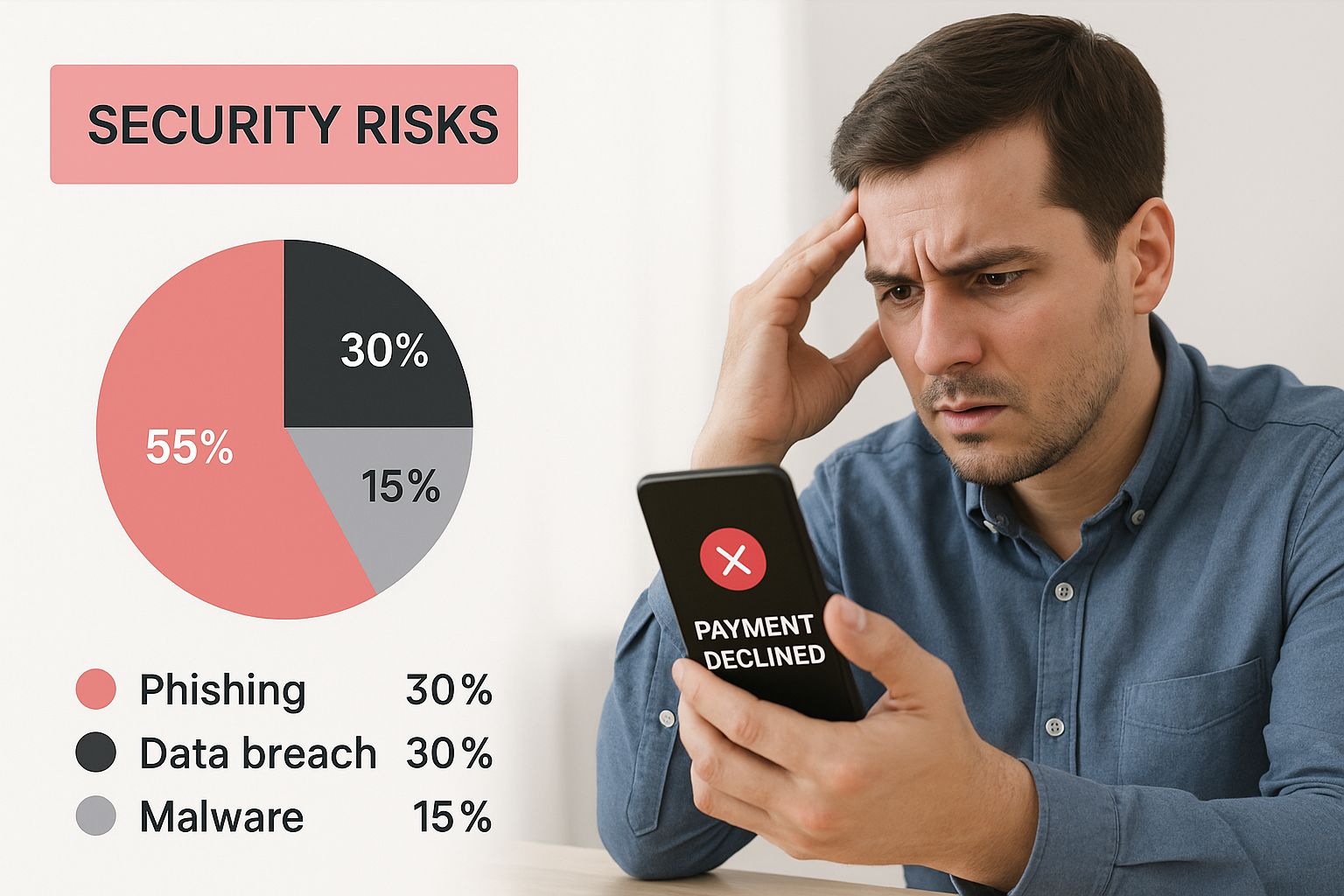
When a transaction fails, it’s frustrating and can shake a customer’s confidence. This is exactly why building secure and reliable payment systems is so critical for earning and keeping trust.
Together, these three types of mobile commerce create a powerful loop. A customer might discover a product through mobile shopping, check their balance with mobile banking, and then seal the deal with a quick mobile payment—all without ever putting their phone down.
How Leading Brands Win With Mobile Commerce
Knowing the theory behind mobile commerce is one thing, but seeing it in action is where the real lessons are learned. The best brands don’t just create a mobile version of their website; they build an entire world around their customers’ devices, turning simple convenience into fierce loyalty.
Studying these real-world examples gives us a playbook for what actually works. Let’s break down how a few of the biggest names in the game transformed a simple app into a core part of their customers’ daily lives.
Amazon: The King of Personalization
Amazon’s mobile app is a masterclass in making shopping ridiculously easy and personal. It does so much more than just show you a list of products. The app uses a mountain of data to guess what you might need next, making product discovery feel like the app is reading your mind.
This personalized engine is built on a few key pillars:
- Tailored Recommendations: Your homepage looks completely different from anyone else’s. It’s constantly shifting based on what you’ve bought, what you’ve looked at, and even what you’ve left in your cart.
- One-Click Ordering: Amazon literally patented its “1-Click” ordering system. It zaps the single biggest roadblock in any online sale—the checkout process. On a phone, that speed is everything.
- Integrated Services: The app is way more than just a store. It fluidly connects you to Prime Video, Amazon Music, and Whole Foods, creating a sticky, interconnected ecosystem that’s hard to leave.
By making everything so simple and relevant, Amazon makes sure its app is the first place millions of people go to shop.
Starbucks: Blending Loyalty and Payments
Starbucks completely changed the morning coffee run by merging its loyalty program and payment system into one slick mobile app. They figured out early on that mobile commerce wasn’t just about selling coffee; it was about building habits and rewarding people for coming back.
The real genius of the Starbucks app is how it turns a boring transaction into a rewarding little game. Every coffee you buy earns “Stars,” which you can cash in for free drinks. It creates a powerful incentive to always use the app.
This strategy is a knockout combination of a few smart features:
- Mobile Order & Pay: This is a lifesaver for anyone in a hurry. You can order ahead and stroll right past the line, which is a massive win for busy customers.
- Integrated Digital Wallet: Loading money onto your Starbucks card in the app makes checkout instant. It also gives Starbucks a ton of useful data on what people are buying and when.
- Gamified Rewards: The app keeps things interesting with special challenges and bonus “Star” offers, turning your daily coffee into a fun, engaging habit.
The Rise of Social Commerce
The next frontier is happening outside of dedicated brand apps. Smart brands are now building the store right into your social media feed. They’re increasingly leveraging TikTok shoppable videos to convert casual viewers into customers on the spot.
This approach is brilliant because it catches people at the exact moment of discovery, completely blurring the line between entertainment and shopping. These examples prove that winning at mobile commerce is all about deeply understanding your customer and using technology to create an experience that’s seamless, valuable, and genuinely fun to use.
The Future of Mobile Commerce and What to Expect
The digital storefront in your pocket is gearing up for its next big leap. Mobile commerce is moving way beyond simple taps and swipes, entering a new phase where the lines between the digital and physical worlds start to seriously blur. We’re seeing innovations that will make shopping more immersive, intelligent, and woven right into our daily lives.
This next wave isn’t just about small tweaks; it’s about fundamentally changing how we find, interact with, and buy products. Technologies that felt like science fiction just a few years ago are now becoming real, practical tools for retailers, promising a future that’s more personal and convenient than ever.
Immersive Shopping With Augmented Reality
One of the most exciting shifts is the rise of Augmented Reality (AR). AR tech layers digital information over the real world, letting you “try before you buy” right from your phone. This cracks one of the oldest problems with online shopping: not being able to see how a product actually fits into your life.
Imagine pointing your phone at your living room to see how that new sofa looks, or using your front-facing camera to try on a pair of sunglasses. Brands like IKEA and Sephora are already all over this, using AR to:
- Slash return rates by giving customers the confidence to make the right choice.
- Boost engagement with an interactive and genuinely memorable shopping experience.
- Bridge the gap between browsing online and seeing how it works in the real world.
As AR gets more powerful and easier to use, it will go from being a cool gimmick to a standard feature that mobile shoppers expect.
The Rise of AI and Hyper-Personalization
Artificial Intelligence (AI) is the engine that’s going to drive the next generation of personal mobile shopping. Basic personalization—like product recommendations—is already old news. AI is set to take this to a whole new level by figuring out what you need before you even know you need it.
AI algorithms can crunch huge amounts of data—your browsing habits, purchase history, your location, even the time of day—to serve up hyper-relevant content and offers. This creates a true one-to-one shopping experience, making you feel like the brand just gets you.
Conversational and Social Commerce Converge
The way we even begin to shop is changing, too. Voice assistants like Alexa and Google Assistant are making “conversational commerce” a real thing. Pretty soon, you’ll be able to reorder your favorite coffee or find the perfect gift just by talking to your device.
At the same time, social commerce is demolishing the wall between seeing something you like and buying it. Platforms like Instagram, TikTok, and Pinterest aren’t just for scrolling anymore; they’re turning into powerful storefronts. With shoppable posts and built-in checkouts, you can buy a product the second you fall in love with it, all without ever leaving the app. These are just a couple of the top e-commerce trends reshaping the digital marketplace.
The numbers back this up in a big way. By 2025, mobile is set to completely dominate online, with mobile traffic hitting an estimated 66.88% of all internet traffic worldwide. This trend is even stronger in retail, where mobile commerce recently accounted for a massive 72.9% of all e-commerce sales. You can dig into more stats about mobile marketing’s incredible growth.
Common Questions About Mobile Commerce
You’ve grasped the fundamentals of mobile commerce, but a few practical questions tend to pop up. Below, you’ll find straightforward answers to clear up any lingering doubts and help you feel confident in this critical retail channel.
Is M-Commerce Different From E-Commerce
They’re closely related, yet distinct. Think of e-commerce as the entire universe of online shopping—desktop, laptop, tablet. M-commerce is that same world, but zoomed in on smartphones and other handheld devices.
Put simply, all m-commerce sits under the e-commerce umbrella, but e-commerce isn’t all mobile. The real difference comes down to the design and user experience built for tiny screens and on-the-go browsing.
Do I Need a Mobile App for My Business
Not always. It really depends on your goals and how your customers prefer to shop.
- Mobile Website: This is non-negotiable. A responsive site boosts your visibility in search engines and welcomes anyone with a browser.
- Mobile App: Ideal for nurturing repeat buyers. An app gives you direct access to push notifications and lets you craft a tailored, branded environment.
Many brands find the sweet spot is both—a mobile-friendly site to attract new visitors, and an app to keep loyal customers coming back.
What Is the Biggest Challenge in Mobile Commerce
The toughest nut to crack? Optimizing the user experience on a small screen. Every tap, swipe and button placement needs to feel effortless. Even a tiny hiccup—a hidden checkout button or a long form—can send shoppers running.
Security tops the list, too. Mobile payments are generally safe, but you have to build trust from the very first screen. One misplaced certificate or unclear badge can make customers hesitate. Nailing both usability and trust is what separates the winners in m-commerce.
Ready to conquer cart abandonment and boost your sales? CartBoss turns lost visitors into loyal customers with powerful SMS campaigns on autopilot. Start recovering revenue today