


At its core, text to pay is a brilliantly simple way for businesses to get paid. You just send your customer a secure payment link through a standard SMS text message. This single step cuts through all the usual checkout clutter, making it incredibly easy for people to pay you right from their phones, wherever they happen to be.
The Shift to Instant Mobile Payments
Let’s be honest, we all live in a world that runs on convenience. Speed and simplicity aren’t just nice extras anymore—they’re what customers expect. The way people shop and interact with businesses has completely changed, and payments are at the very center of this transformation.
Gone are the days of patiently keying in credit card numbers on a clunky website or waiting for an invoice to land in your email inbox. Today’s customer is glued to their smartphone. It’s their command center for everything, and they absolutely expect to handle payments the same way.
This isn’t some passing fad. It’s a fundamental shift toward instant, on-the-go transactions. Just think about the last time you booked a ride, ordered dinner, or bought a movie. The payment was probably so smooth you barely noticed it—a quick tap and you were done.
Why Traditional Payments Are Losing Ground
Old-school payment methods, whether it’s typing in card details online or using a machine in a store, are full of friction. Every extra step—digging out a wallet, mistyping one of the 16 digits, or standing in a queue—is another chance for a customer to get fed up and walk away. With the rise of digital wallets and one-click checkouts, people have been trained to expect something better.
The concept is really straightforward: the easier you make it for someone to pay you, the more likely they are to actually do it. Text to pay nails this by bringing the payment process directly to the one device everyone has in their pocket.
This is exactly why text to pay is becoming so crucial for any modern e-commerce business. It slides perfectly into your customers’ existing mobile habits, delivering a payment experience that feels both instant and secure. It’s a natural extension of a smart communication strategy, and you can learn more about how it fits in by reading our guide on what is SMS marketing.
A Quick Look: Text to Pay vs. Traditional Methods
To see just how much of a leap forward this is, let’s compare text to pay with the methods we’re all used to. The table below breaks down the key differences in speed, convenience, and overall customer experience.
| Feature | Text to Pay | Manual Online Card Entry | In-Store POS |
|---|---|---|---|
| Speed | Instant (seconds) | Slow (minutes) | Varies (can be slow) |
| Convenience | Pay from anywhere | Requires desktop/laptop | Must be physically present |
| Friction | Very low (1-2 taps) | High (many fields to fill) | Medium (waiting, PINs) |
| Device | Smartphone | PC, tablet, or phone | Physical terminal |
| Abandonment Risk | Low | Very high | Medium |
As you can see, text to pay strips away the frustrating steps that cause customers to abandon their purchases, offering a far more streamlined and immediate path to payment.
The Booming Mobile Payment Market
This clear preference for mobile payments is fueling some absolutely massive market growth. The entire mobile payment sector, which includes tech like text to pay, is seeing explosive expansion.
Current projections show the market soaring from an estimated $4.97 trillion in 2025 to a mind-boggling $26.53 trillion by 2032. This incredible growth is driven by everyone having a smartphone and the constant innovation in payment technology.
By bringing this technology into your business, you’re not just tacking on another payment button. You’re aligning your entire operation with the powerful and undeniable trend of mobile-first commerce, securing your revenue for the future while giving your customers the effortless experience they now demand.
How Text to Pay Actually Works
From the outside, text-to-pay seems almost like magic. A customer gets a text, taps a link, and poof—the payment is complete. But what’s really happening behind the scenes? It’s a beautifully simple sequence of events that involves your business, a messaging service, and a payment processor, all working together in seconds.
Think of it this way: the SMS message isn’t the payment itself. Instead, it’s a secure key to a private digital doorway. Your business sends this key, and only your customer can use it to access a secure, pre-filled checkout page. This completely sidesteps the need for them to manually punch in their info, which is where so many traditional online sales fall apart.
The Core Transaction Flow
At its heart, the process can be broken down into a few key stages. It all starts the moment you decide to request a payment and ends when the funds are confirmed in your account. The journey is seamless, with data moving between different specialized platforms that each handle one part of the job perfectly.
There are two main ways this whole thing kicks off:
- Business-Initiated Request: Your system, whether it’s your e-commerce platform or CRM, triggers a payment request. Maybe it’s for an abandoned cart, an unpaid invoice, or a brand-new order. An SMS is then automatically fired off to the customer with their unique payment link.
- Customer-Initiated Keyword: A customer can text a specific keyword (like “PAYNOW”) to a designated number. Your system catches this keyword and automatically replies with their personalized payment link. This is fantastic for recurring services or quick follow-up purchases.
This simple infographic shows the basic flow when a customer starts the payment process.
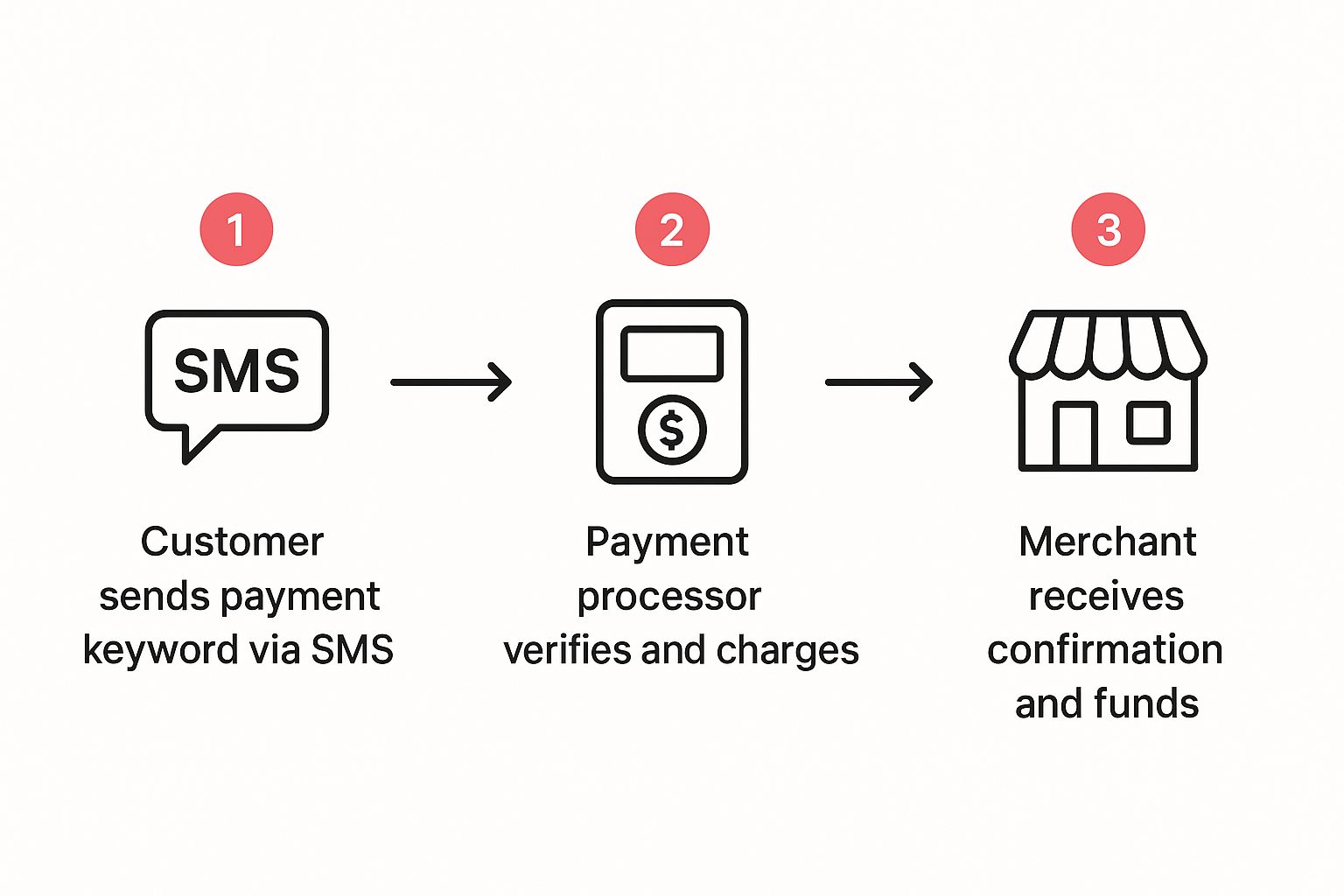
As you can see, the core loop is incredibly straightforward: the customer sends a signal, the systems process the request, and you get paid. This efficiency is exactly what makes text to pay so powerful for closing the gap between interest and purchase.
The Key Players and Their Roles
To make this dance happen, three main partners work in concert. Each one is a specialist, making sure the process is both reliable and rock-solid secure. Think of them as a relay team passing a baton—and that baton is your customer’s payment instruction.
- Your E-commerce Platform (e.g., Shopify, WooCommerce): This is your home base. It holds all the important customer and order data, like what was purchased and how much is owed. It’s the system that gets the ball rolling on a payment request.
- The SMS Gateway (e.g., Twilio): This is the communication layer. It takes the payment request from your platform and translates it into an actual SMS message delivered straight to your customer’s phone. This service ensures reliable delivery across different mobile carriers.
- The Payment Processor (e.g., Stripe, PayPal): This is the financial engine. When the customer clicks the link in the text, they are whisked away to a secure page hosted by the processor. This is where the actual money transfer is handled safely.
The Security Linchpin: Tokenization
Here’s a critical concept to grasp: tokenization. At no point are credit card details ever sent via text message. That would be a huge security risk. Instead, the payment processor converts the customer’s sensitive card information into a secure, non-sensitive “token.” This token acts as a stand-in, allowing future payments without ever exposing the actual card number again.
This approach is what makes the whole system both convenient and secure, giving customers the confidence to pay with a single tap.
The Business Case for Text-to-Pay
Sure, understanding the mechanics of text-to-pay is important. But what really gets business owners excited is seeing how it directly beefs up the bottom line. This isn’t just about adding another gadget to your tech stack; it’s a strategic move that delivers real, measurable wins across your entire business.
These benefits break down into three main buckets: financial, operational, and the all-important customer experience.
By meeting customers on the device they’re glued to all day, you’re creating a straight shot to faster payments, smoother operations, and much happier, more loyal shoppers. Let’s dig into what that actually looks like for your e-commerce store.
Get Paid Faster, Boost Your Cash Flow
The most immediate—and frankly, most powerful—benefit of text-to-pay is how quickly it gets money into your account. It’s a simple truth: when you make it easy for people to pay, they pay faster. This has a massive impact on your financial health.
Businesses that switch to text-based payments see a huge drop in the time it takes to close an invoice or complete a purchase. You’re no longer waiting days for a customer to maybe check their email or log into some clunky payment portal. Instead, you can get paid within minutes of sending a text.
This speed is a lifesaver, especially when you’re chasing down past-due accounts. A quick SMS reminder with a direct payment link can clear an outstanding balance on the spot. It’s a world away from the soul-crushing process of making collection calls or sending formal letters. Just look at the federal student loan situation, where nearly 10 million borrowers fell behind after a payment pause. It goes to show how even tiny hurdles can cause massive payment delays.
The core idea is simple: the shorter the path to payment, the healthier your cash flow. Text-to-pay creates the shortest path possible, turning a multi-step chore into a quick two-tap solution.
This direct line not only gets you paid faster but also helps lock in revenue that might have otherwise slipped through the cracks.
Make Your Operations Run Smoother
Beyond the cash injection, a text-to-pay system brings incredible efficiency to your day-to-day grind. It puts time-sucking tasks on autopilot, freeing up your team to focus on things that actually grow the business.
Think about all the manual work that goes into chasing late payments or just sending out invoice reminders. A text-to-pay platform automates that entire headache. You can set it up to send friendly pings when an invoice is due—or a bit more firm ones when it’s overdue—all with a handy link to pay right then and there.
Here’s how it makes things more efficient:
- Automated Collections: Set up a sequence of SMS reminders for unpaid orders. This massively cuts down on the need for manual follow-ups.
- Less Admin Work: Payments are processed and logged automatically, so your team isn’t stuck doing tedious data entry.
- Lighter Support Load: The process is so simple that you’ll get far fewer “how do I pay?” questions, which frees up your support staff.
This level of automation doesn’t just simplify collections; it makes your entire operation run smoother and cheaper.
Seriously Upgrade the Customer Experience
At the end of the day, the biggest long-term win comes from giving your customers a better experience. In a crowded market, convenience is a secret weapon that builds trust and keeps people coming back.
When you send a payment link via text, you’re sending a clear message: “We value your time.” You’re removing a point of friction from their day, and people notice and appreciate that. It’s a modern, smooth experience that shows you get it and are easy to do business with.
This is also a killer tool for fighting e-commerce’s biggest enemy: cart abandonment. So many shoppers bail at checkout because it’s too long or complicated. Sending a recovery text with a pre-filled checkout link just demolishes those barriers. It’s a go-to strategy for rescuing sales that would otherwise be lost forever. For a deeper dive, check out our insights on how to supercharge your abandoned cart SMS strategy.
Offering this kind of convenience makes customers more likely to finish their purchase now and return for another one later, turning a one-off sale into a long-term relationship.
Integrating Text to Pay Into Your E-commerce Stack
Adding a new way for customers to pay might sound like a huge technical headache, but getting text to pay up and running in your store is often surprisingly simple. Modern solutions are built for busy e-commerce merchants, which means they’re designed to be fast and straightforward. This is your practical guide to getting started, breaking down the process so you can launch with total confidence.
Think of it like adding a new express checkout lane at a grocery store. The idea is to give your customers a quicker, more convenient option without tearing up the rest of the store’s layout. You can pull this off with a simple plugin that snaps right into your current system or, for more complex setups, through a custom API connection.
Choosing the Right Text to Pay Provider
Picking the right partner is hands-down the most important decision you’ll make here. Not all services are the same, and the best fit for you will depend on your specific business, your sales volume, and the e-commerce platform you use, like Shopify or WooCommerce. A great provider is like a silent partner, working seamlessly in the background to make you money.
To make a smart choice, use this checklist to size up potential providers:
- Platform Compatibility: Does the service have a ready-made plugin or app for your e-commerce platform? A native integration for Shopify or WooCommerce will save you a ton of time and development costs.
- Pricing Structure: Don’t just look at the headline rate. Dig into all the costs—monthly fees, per-transaction percentages, and any per-message charges for the SMS texts. You want a model that makes sense for your sales volume.
- Security and Compliance: This one is non-negotiable. The provider must be PCI-DSS compliant to guarantee all payment data is handled securely. This protects you and your customers.
- Feature Set: Does the platform do what you need it to do? This could be anything from automated reminders for unpaid invoices and support for subscriptions to detailed analytics on how your payments are performing.
Choosing a provider is about more than just tech; it’s about finding a partner that helps you grow. Look for great customer support and clear instructions to help you get the most out of their system.
Taking the time to choose carefully ensures you don’t just get a tool, but a solution that actively helps you boost sales and simplify how you operate.
Understanding Your Integration Options
Once you have a shortlist of providers, the next thing to figure out is how their tech will actually connect to your store. You’ll generally run into two main options: plugins and APIs.
1. Plugins and Apps (The No-Code Route)
For most stores on platforms like Shopify, BigCommerce, or WooCommerce, this is the path of least resistance. A plugin is a small piece of software you install in your store’s admin panel with just a few clicks. It’s built to work right out of the box, automatically connecting the text to pay service to your store’s existing orders and customer information.
2. API Integration (The Custom-Fit Route)
If you have a custom-built website or need more advanced features, an API (Application Programming Interface) integration might be the way to go. An API is basically a set of rules that lets different software systems communicate with each other. This approach gives you the most flexibility but usually requires a developer to get it all hooked up.
The explosive growth of mobile payment methods is tied directly to the boom in e-commerce, which is on track to hit $4.8 trillion globally in 2025. With online shopping expected to make up around 23% of all retail sales by 2027, the demand for fast, secure payment options has gone through the roof. You can dig deeper into these digital payment trends on Statista.
Launching Your System
With your provider picked and your integration path clear, the final step is setting everything up. This means creating your message templates, deciding when to send automated reminders, and tweaking the payment page to match your brand’s look and feel. A perfect use for this is following up on unfinished orders. You can learn more about how to recover abandoned carts with our detailed guide. Once you’re all configured, do a full test run to make sure everything is working perfectly before you go live.
Best Practices for a Secure and Effective Strategy

Just setting up a text-to-pay system is only half the battle. The real magic happens when you use it smartly, building a strategy that customers actually appreciate and trust. This means getting your communication crystal clear, staying compliant, and making security an obvious priority.
A great strategy isn’t just about blasting out payment links. It’s about crafting a smooth, professional, and secure experience from the first text to the final thank you. Get this right, and you won’t just get paid faster—you’ll build a rock-solid brand reputation that turns one-time buyers into loyal fans.
Crafting Clear and Compliant Messages
The payment request message is your moment of truth. It has to be instantly recognizable, trustworthy, and dead simple to understand. Any confusion is a conversion killer, so clarity is everything.
To write messages that actually work, stick to these core principles:
- Identify Yourself Clearly: Always lead with your brand name. Your customer shouldn’t have to guess for a split second who’s texting them.
- State the Purpose Upfront: Be direct. Use simple language like, “Your payment for order #12345 is due,” or “Click here to complete your purchase from [Your Brand].”
- Include Key Details: Drop in the specific order number or invoice amount. This personal touch adds a layer of legitimacy that a generic message just can’t match.
- Set Expectations: A quick heads-up goes a long way. Something as simple as “Tap to pay securely” tells them exactly what to do next.
A text message is a personal space. Your goal is to be a helpful assistant, not an annoying spammer. Every single message should feel professional, expected, and genuinely valuable to the person receiving it.
Nailing these points makes your payment requests both effective and professional. For a deeper dive into what makes SMS communication click, check out our detailed guide on SMS marketing best practices.
Navigating Security and Building Customer Trust
With any kind of payment system, security is the bedrock of customer confidence. While the tech behind text-to-pay is secure, you also need to make your customers feel safe. A big part of that is teaching them how to spot your real payment texts versus a potential phishing scam.
A legitimate text-to-pay message from your business will always have a few key ingredients. Make sure your customers know what to look for:
- Consistent Sender ID: Your texts should always come from the same number or branded sender ID they recognize.
- Personalized Information: Your messages will always reference a specific, recent interaction, like an order number they’ll know is theirs.
- Secure Link Only: You will never ask for credit card numbers, passwords, or other sensitive details directly in the SMS itself. The link is the only place for that.
By proactively showing customers what a real payment request looks like, you empower them to ignore fraudulent texts. That kind of transparency builds a powerful layer of trust and shows you care about their security just as much as their business.
The Rise of Instant Payment Expectations
This focus on speed and security is all part of a much bigger picture. Real-time payments are no longer a novelty; they’re becoming the standard.
In 2022, instant payments already accounted for 13% of all global non-cash transactions, with a staggering volume of 195 billion. And it’s not slowing down. Projections show that number will skyrocket past 500 billion transactions by 2027 as faster payment systems take over worldwide.
By integrating text-to-pay, you’re not just adding a feature. You’re aligning your business with a powerful customer expectation for immediate, seamless, and secure transactions.
Answering Your Top Questions About Text to Pay
Even after seeing how powerful text to pay can be, it’s natural to have a few questions before jumping in. Adopting any new tech for your store is a big decision, and it’s smart to get the full picture first.
This section tackles the most common questions and concerns we hear from business owners. We’ll give you straightforward answers on everything from security and costs to setup and more advanced features, so you can feel confident moving forward.
Is Text to Pay Secure for My Customers?
Absolutely. This is usually the first question people ask, and for good reason. The short answer is yes, it’s incredibly secure. There’s a common myth that sensitive card details are flying around in the text message itself, but with any professional text to pay solution, that’s just not how it works.
Instead, the entire process relies on a highly secure method called tokenization. Here’s a simple breakdown of how it keeps everyone’s information safe:
- Your customer gets an SMS with a unique, single-use, secure link.
- Tapping that link takes them to a PCI-compliant payment page hosted directly by a major payment processor like Stripe or PayPal.
- This is the exact same level of bank-grade encryption used by the biggest online retailers. The payment details are entered into the processor’s secure environment, not on your website or within the SMS app.
Think of the text message as a secure key, not the vault. It simply unlocks the door to a fortified, encrypted space where the actual transaction happens. Your customer’s sensitive card details are never exposed on their device or stored in your systems.
When you’re looking at different providers, make sure they are open about their PCI-DSS compliance. This certification is the gold standard for payment security and is completely non-negotiable.
What Are the Typical Costs?
The cost of adding text to pay can vary, but most providers use a few common pricing structures. Once you understand them, it’s much easier to compare your options and figure out what makes the most sense for your business.
Generally, you’ll see a mix of these pricing models:
- Monthly Subscription Fee: A flat rate you pay each month for access to the platform and its features.
- Per-Transaction Fee: This is almost always a small percentage of the sale plus a fixed amount (for example, 2.9% + $0.30), which is similar to what you already pay for standard credit card processing.
- Per-Message Fee: Some services charge a tiny fee for each SMS sent. This can add up if you’re sending a high volume of reminders and notifications, so it’s something to keep an eye on.
Some companies bundle everything into one simple package, while others list each cost separately. The key is to calculate the total cost of ownership based on your expected sales volume. Factor in any setup fees, the monthly subscription, and your estimated transaction and message counts to get a true picture of the investment.
Do I Need Technical Skills to Set It Up?
For the vast majority of businesses, the answer is a firm no. Modern text to pay platforms are built for regular people, not developers. Most e-commerce merchants are experts in their products, not in coding, and today’s tools reflect that.
If you’re using a major platform like Shopify or WooCommerce, you’ll usually find dedicated apps or plugins. These are designed to be “plug-and-play,” integrating with just a few clicks from your dashboard.
For stores with custom-built websites or more complex needs, an API integration might be required, which does call for a developer. But even if you don’t have tech resources, there’s another option. Many providers offer a virtual terminal—a simple web-based dashboard where you can manually type in a customer’s phone number and sale amount to send a payment link. This makes text to pay accessible to practically any business, no matter how it’s built.
Can I Use It for Subscriptions or Recurring Billing?
Yes, and this is where text to pay really starts to shine. Many advanced platforms are perfectly built to handle subscriptions and recurring payments, transforming a simple payment tool into a powerful customer retention machine.
The process is incredibly smooth. When a customer pays their first invoice through a secure text link, the payment processor tokenizes their info. This secure token is then stored and can be used to automatically charge future subscription payments on schedule. You can also set up automated text reminders before a payment is due or notifications after a successful charge. This proactive communication is fantastic for reducing churn and keeping your subscribers happy.
This is especially helpful for preventing involuntary churn—when a customer unintentionally leaves because of an expired card or a failed payment. This is a huge contributor to lost revenue, closely related to cart abandonment. To dive deeper into this topic, check out our guide on how to reduce cart abandonment and keep more of your hard-earned customers.
Ready to stop losing sales to abandoned carts? CartBoss turns those missed opportunities into revenue with automated, intelligent SMS campaigns. See how easy it is to recover sales and boost your profits by visiting https://www.cartboss.io today.