


Think about the last time you bought something. Did you order it directly from the brand’s website? Maybe you saw it on Instagram and bought it right there. Or perhaps you walked into a physical store. If a brand lets you do all three, you’ve experienced multichannel retailing firsthand.
It’s a bit like a musician selling a new album. They’ll have it on their own website, stream it on Spotify, and sell physical vinyl copies in record stores. Each one is a different way to get the music, and each one operates on its own terms. That’s the core idea of multichannel retailing: using multiple, independent channels to sell your products and connect with customers.
What’s at the Heart of Multichannel Retailing?
At its simplest, multichannel retailing is about being present wherever your customers are. The crucial part is that each channel—your e-commerce site, a brick-and-mortar store, an Amazon page, or a social media shop—pretty much runs its own race. They’re like separate storefronts flying the same company flag, each designed for the customers who prefer to shop that way.
This isn’t just a clever business tactic; it’s a direct response to how people actually shop now. By 2025, it’s estimated that 73% of consumers will be using a mix of platforms to make purchases. Compare that to the tiny 7% who shop only online or the 20% who stick strictly to physical stores, and the picture becomes crystal clear. People want choices.
The main goal here is to cast a wide net. Instead of trying to funnel everyone through one door, you open up several. This approach has a few distinct advantages:
- It’s all about customer choice. People can interact with your brand on their terms, whether that’s on their laptop, scrolling through social media, or browsing in a store.
- You reach more people. Every new channel you add opens up a fresh segment of the market, letting you connect with audiences you’d otherwise miss.
- The channels work independently. This is a key feature. The inventory for your website might be managed separately from what’s in your physical store. A purchase made online won’t necessarily show up in the in-store system.
Let’s quickly create a table to summarize the core components of this strategy.
Core Components of a Multichannel Strategy
This table breaks down the essential channels and clarifies the role each one plays in reaching customers.
| Channel Type | Primary Function | Customer Touchpoint |
|---|---|---|
| E-commerce Website | Direct sales, brand storytelling, full product catalog | Online shoppers, brand loyalists |
| Brick-and-Mortar Store | In-person experience, immediate purchase, customer service | Local shoppers, those wanting to see products first |
| Third-Party Marketplaces | Broad audience reach, leveraging existing traffic (e.g., Amazon) | Price-conscious buyers, convenience shoppers |
| Social Media Shops | Impulse buys, community engagement, targeted marketing | Younger demographics, highly engaged followers |
| Mobile App | Loyalty programs, personalized offers, convenient reordering | Repeat customers, mobile-first users |
Each of these channels acts as a unique entry point, giving your brand more opportunities to make a sale.
While this strategy is great for maximizing your presence, it’s easy to confuse it with its more connected cousin, omnichannel. It’s helpful to understand the nuances between different approaches, and you can dive deeper into a related concept in our guide on multi-channel marketing. The main thing to remember is that multichannel is all about availability—making sure your products are easy to find, no matter where someone looks.
Exploring Your Multichannel Sales Channels
Think of your multichannel setup not as one giant store, but as a collection of different storefronts. Each one is designed to pull in a different kind of customer, working as its own separate funnel to bring people to your brand. They don’t all have to be perfectly connected to work well; their real power is in their variety.
Your brick-and-mortar store is the classic, hands-on experience. It’s perfect for customers who want to see, touch, and try on products before they commit to buying. This channel is unbeatable for building a local presence and giving shoppers that instant gratification—no waiting for a delivery van.
The Digital Storefronts
When you move online, your e-commerce website is your central hub. It’s the home base for your brand, where you can show off your entire product line, provide tons of detail, and completely control the customer’s journey. This is where your most dedicated fans and the serious researchers will end up.
Then you have a mobile app, which is tailored for your most loyal, on-the-go customers. As mobile commerce keeps exploding, a dedicated app makes the shopping process incredibly smooth for people who already love your brand. You can learn more about this in our detailed guide on https://www.cartboss.io/blog/what-is-mobile-commerce/.
The key to multichannel is understanding that each channel serves a specific shopping habit. You’re not just giving people different places to buy—you’re offering them different ways to connect with your brand.
Finally, there are the channels that plug you into massive existing audiences:
- Social Media Commerce: Platforms like Instagram and TikTok are perfect for grabbing discovery-driven shoppers. These are the people who make impulse buys based on great visuals and engaging content.
- Online Marketplaces: Giants like Amazon or Etsy put your products in front of a huge, ready-to-buy crowd. They’re incredibly powerful for reaching new customers who are actively searching for what you sell.
- Events and Pop-Ups: When thinking about direct customer engagement, understanding the differences between virtual events and trade shows can help you pick the right platform to meet your customers face-to-face (or screen-to-screen).
Each channel acts as a unique doorway into your brand, helping you maximize your reach and boost your sales potential.
Multichannel vs Omnichannel Retailing
When it comes to retail strategy, many brands get stuck trying to figure out the difference between multichannel and its close relative, omnichannel. The distinction seems small, but it’s actually huge.
Think of it this way: multichannel is like a group of talented solo artists performing on different stages. Each performance is great on its own, but they aren’t playing together. Omnichannel, on the other hand, is an orchestra. Every instrument works in harmony to create one seamless, beautiful symphony for the audience. The core difference boils down to a single word: integration.
The Fundamental Difference Is Integration
Multichannel retailing simply means giving your customers multiple, separate places to buy from. Someone might browse your website, but if they later open your mobile app, their shopping cart will probably be empty. Each channel operates in its own little bubble, completely unaware of the others.
Omnichannel weaves all these channels together into a single, unified customer experience. For example, a shopper can add an item to their cart on a mobile app during their lunch break and then finish the purchase later on their desktop at home. The systems talk to each other, making the journey feel effortless. This approach is all about creating a consistent and fluid journey. You can dig deeper into this by exploring the core principles of an omnichannel customer experience.
At its heart, multichannel is channel-focused, giving customers options. Omnichannel is customer-focused, creating a singular experience across all those options.
The data below shows just how differently these channels can perform, comparing a hypothetical split between online and in-store sales.
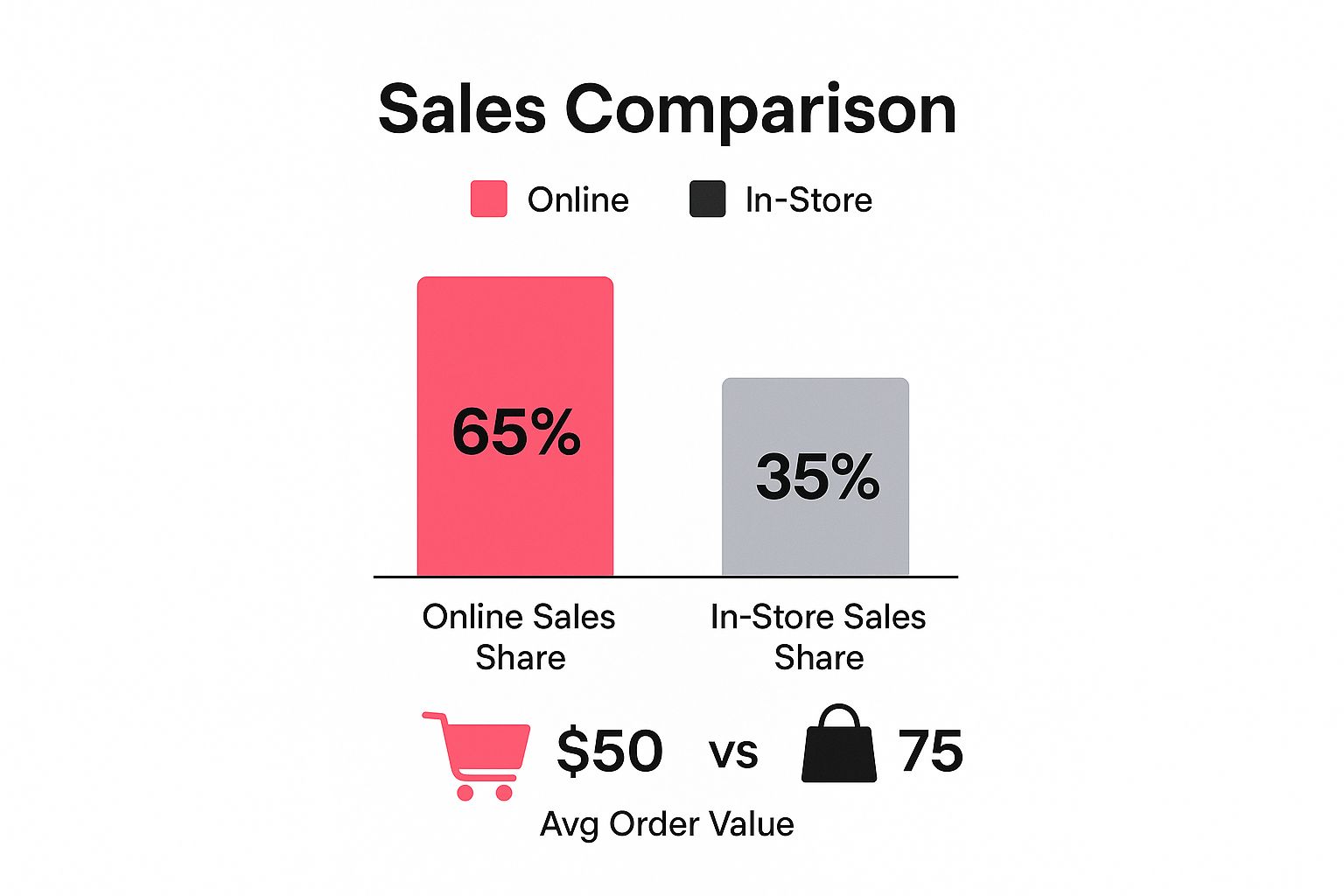
As you can see, each channel contributes in its own way. Online sales might drive more volume, while in-store purchases could bring in a higher average order value.
Multichannel vs Omnichannel at a Glance
To make the distinction even clearer, let’s break it down side-by-side. This table highlights the core differences you’ll see in strategy, customer experience, and the technology behind it all.
| Feature | Multichannel Retailing | Omnichannel Retailing |
|---|---|---|
| Core Strategy | Be present on multiple, independent channels | Create one unified experience across all channels |
| Customer Experience | Inconsistent; actions on one channel don’t affect others | Consistent and seamless; a single journey across devices |
| Channel Focus | Each channel operates as a separate business (siloed) | All channels are interconnected and work together |
| Technology | Disconnected systems and separate data for each channel | Centralized data and integrated technology platforms |
| Primary Goal | Maximize the performance of each individual channel | Maximize the customer’s lifetime value and overall journey |
Understanding this distinction is the first step. Choosing the right path depends on your business’s resources, tech capabilities, and what kind of long-term relationship you want to build with your customers.
The Real Benefits of a Multichannel Approach
Jumping into a multichannel strategy isn’t just about being everywhere at once; it’s about unlocking some serious advantages that hit your bottom line. The most obvious win? You dramatically expand your market reach.
By setting up shop on different platforms, you start connecting with customer groups who might stick to just one channel. Think about it: some shoppers love the hands-on feel of a physical store, while others live for the convenience of clicking “buy” on a social media ad. A multichannel approach means you don’t have to choose—you get to serve them all.
Driving Revenue and Customer Loyalty
Another huge benefit is the sheer amount of customer data you can gather. Every channel gives you a different window into your customers’ buying habits and preferences. This treasure trove of insights is exactly what you need to fine-tune your products and sharpen your marketing, and it’s a cornerstone of many powerful e-commerce growth strategies.
Ultimately, this all leads to more robust, diversified revenue streams. Putting all your eggs in one sales basket is a risky game. A multichannel setup gives you more chances to turn browsers into buyers, protecting your business if one platform hits a rough patch.
The impact on customer loyalty is especially powerful. Businesses with a strong multichannel game retain around 89% of their customers, a massive jump from the 33% retained by companies with weaker strategies.
This isn’t just about keeping customers happy; it’s about their lifetime value. Multichannel shoppers tend to spend 30% more with a brand over their lifetime compared to single-channel buyers.
Even better, campaigns running across three or more channels see an incredible 494% higher order rate than those stuck on a single channel. It’s clear proof that meeting customers on their preferred turf pays off, big time.
Navigating Common Multichannel Challenges
Jumping into multichannel retail is a powerful move, but it’s not without its growing pains. Honestly, a smooth rollout is all about knowing what hurdles you’re likely to face. Every new channel you add—whether it’s an Amazon storefront, a TikTok Shop, or a weekend pop-up—can accidentally create its own little island of data, making it tough to see the big picture of your business.
The most common headache by far is inventory management. Picture this: you sell the last of a popular sweater on your website. Minutes later, someone in your physical store buys the exact same one because the systems didn’t talk to each other. Now you’ve got an oversold product, an unhappy customer, and a logistical mess. The only real fix is a centralized system that keeps everything in sync. You can explore some best practices for inventory management to get a handle on this.
Maintaining a Cohesive Brand
Another huge challenge is keeping your brand consistency in check. Your brand’s voice, visuals, and deals need to feel the same whether a customer sees a Facebook ad or lands on your homepage. A disjointed experience just confuses people and weakens your brand identity. A solid, comprehensive brand guide isn’t just nice to have; it’s a non-negotiable first step to make sure every channel is telling the same story.
Finally, dealing with siloed customer data is a classic problem that stops you from truly understanding your audience. When a customer’s purchase history on one channel is completely invisible to another, you’re missing out on golden opportunities for personalization and smarter marketing.
This is where technology often comes to the rescue. The global market for multichannel retail software is projected to hit USD 11.91 billion by 2033, which tells you just how critical these unifying tools have become for retailers. You can find more data on this trend over at MarketResearch.com.
To get ahead of these issues, a great starting point is to dive into inventory management best practices and look into some introductory CRM tools. Even basic steps toward unifying your data can make a massive difference.
Setting Up Your First Multichannel Strategy
Jumping into your first multichannel strategy can feel like a huge undertaking, but it doesn’t have to be a headache. The secret? Start small and be smart about it. Forget trying to be everywhere at once. Just focus on adding one new channel that genuinely makes sense for your brand and, more importantly, your customers.
The first step is always figuring out where your target customers are already spending their time. Don’t just guess—let your data do the talking. Dive into your website’s traffic demographics, send out a few customer surveys, and even peek at which platforms your competitors are having success with. A little research now will point you straight to the channels with the biggest payoff.
Prioritizing Your Expansion
Once you know where your audience is, you can decide on your next move. Should you open an Etsy shop, or is it time to build out your Instagram Shopping? The right answer comes down to your products, your resources, and what you’re trying to achieve.
Here’s a quick way to think about it:
- For unique, handmade goods: A marketplace like Etsy is a no-brainer. You’re tapping into a crowd that’s actively looking for artisanal products.
- For visually driven brands: Social commerce on platforms like Instagram or TikTok is perfect. You can capture those discovery-driven sales and impulse buys.
- For reaching a massive audience: Selling on a giant like Amazon gives you instant access to an enormous, ready-to-buy customer base.
The goal isn’t to be on every channel; it’s to be on the right channels. A focused attack on one or two new platforms will always beat spreading your resources too thin across five or six.
As you get set up, nail the basics first. You’ll want to create separate inventory pools for each new channel to avoid the nightmare of overselling. And make sure to tailor your marketing messages for the platform you’re on—what works on your website won’t necessarily land on TikTok. By building a smart, scalable foundation, you’re setting yourself up for growth that actually lasts.
Frequently Asked Questions
Jumping into multichannel retail can feel a little overwhelming, so let’s clear up a few of the most common questions brands ask when they’re getting started.
What’s the First Step for a Small Business to Become Multichannel?
Don’t try to boil the ocean. The best way to start is by adding just one new channel that makes perfect sense for your customers.
If you’re running a physical store, setting up a simple e-commerce website is a natural next move. Already have a website? Then think about expanding to a major marketplace like Amazon or dipping your toes into social commerce on a platform like Instagram to find new buyers.
How Do You Choose the Right Channels for Your Business?
It all comes down to your customer. You need to figure out where they’re already hanging out and spending money.
Start by digging into the data. Send out customer surveys, look at the demographics of your website traffic, and don’t be afraid to see what your competitors are doing right. The goal isn’t to be everywhere at once. Pick two or three channels where you know you can get the best return for your specific products.
Remember, mobile is king in modern shopping. Forrester data shows that 38% of customers will check inventory on their phone before even stepping into a store, and a whopping 71% say their mobile device is a crucial part of the in-store experience. You can see more multichannel retail stats over at LLC Buddy.
How Can You Measure the Success of Each Channel?
You have to track each channel’s performance individually. What works for one won’t necessarily work for another.
For your own website, keep a close eye on conversion rates and average order value. On marketplaces, you’ll want to track your sales volume and how your products are ranking. And for social media, it’s all about click-through rates and sales generated from shoppable posts. By measuring each channel on its own terms, you’ll quickly see what’s working and where you should put more of your budget.
Ready to turn those abandoned carts from every channel into revenue? CartBoss uses powerful SMS automation to recover lost sales and boost your profits on autopilot. Start recovering sales today with CartBoss.