


When you start looking into SMS marketing costs, you’ll quickly find there’s no one-size-fits-all answer. A typical monthly investment can run anywhere from $25 to over $500, all depending on how many messages you send and the features you need. It’s a lot like picking a mobile phone plan—your final bill really comes down to your usage and the package you select.
Decoding SMS Marketing Prices
Getting a handle on SMS marketing costs is much easier when you break it down into the core pieces that make up the price. The cost isn’t just an arbitrary number; it’s a direct reflection of the tools and capabilities a platform offers. For most businesses, the amount they spend is tied directly to their goals and how many people they want to reach.
The sheer amount of money being poured into SMS advertising globally speaks volumes about its effectiveness. Market projections show that total ad spending in this space is expected to hit around $809 million in 2025. This figure, which you can explore in more detail with SMS advertising market projections on Statista, highlights just how many businesses are leaning on this channel to drive real growth.
Core Pricing Models Explained
At its core, SMS pricing usually falls into one of two main structures. Each one is designed for different types of businesses, from startups just dipping their toes in the water to large companies running massive campaigns.
To help you see the difference at a glance, here’s a quick breakdown:
Quick Overview of SMS Pricing Models
| Pricing Model | Best For | Average Cost Structure |
|---|---|---|
| Pay-As-You-Go | Businesses with seasonal campaigns, unpredictable volume, or just starting. | Buy credits upfront. No monthly fee. Credits expire over time. |
| Monthly Subscription | Businesses with consistent, ongoing communication and predictable needs. | Fixed monthly fee for a set number of messages or contacts. |
Let’s dive a little deeper into what each of these means for you.
- Pay-As-You-Go: This is flexibility at its finest. You buy a block of message credits upfront and use them whenever you need to, with no recurring monthly commitment. It’s the perfect setup for businesses that run big promotions during the holidays or for anyone just getting started with SMS.
- Monthly Subscriptions: With this model, you pay a flat fee each month for a certain number of messages or contacts. This approach usually works out to a lower cost-per-message, making it a great fit for businesses that send texts regularly and have a good idea of their monthly volume.
By getting a firm grasp on these two fundamental approaches, you can start matching your budget to your marketing strategy. The right choice really just depends on how often you plan to send campaigns, the size of your contact list, and your growth goals.
Figuring out which of these models fits best is the first real step toward building a strategy that doesn’t break the bank. To see how these pricing structures look in the real world, take a look at our guide comparing some of the top affordable SMS marketing services on the market today.
Choosing Your SMS Pricing Model

Picking the right SMS pricing model is a bit like choosing the right tool for a job—the best one depends entirely on what you’re trying to build. Are you running frequent campaigns? Is your contact list massive? Does your business have a busy season? The answers will point you to the most cost-effective structure.
Getting this choice right is the first step to keeping your SMS marketing costs under control. For most businesses, the decision comes down to two main paths: the flexibility of pay-as-you-go or the predictability of a monthly subscription.
Pay-As-You-Go Plans
Think of this model like buying tokens at an arcade. With a pay-as-you-go plan, you simply buy a block of message credits upfront and then use them whenever you need them. No monthly fees, no commitments.
This approach is a perfect fit for businesses with irregular communication needs. A flower shop, for example, might send a massive blast of texts for Valentine’s Day and Mother’s Day but stay relatively quiet the rest of the year. It’s also a smart way for anyone just dipping their toes into SMS marketing to test the waters without getting locked into a contract.
- Best For: Seasonal businesses, one-off campaigns, or anyone just starting out.
- Key Benefit: You only pay for what you actually send.
With pay-as-you-go, you have total control over your spending. You’ll never waste money on messages you didn’t need.
Monthly Subscription Plans
A monthly subscription, on the other hand, is more like a gym membership. You pay a flat fee every month for a certain number of messages or the ability to text a set number of contacts. This model is all about consistency, and it rewards regular use with a much lower cost per message.
This is the default choice for any business with a steady, year-round marketing calendar. An e-commerce store sending out weekly deals or a salon sending daily appointment reminders will almost always save money this way. When you’re sending a high volume of texts, those small per-message savings add up fast.
Key Takeaway: If SMS marketing is a core, ongoing part of your strategy, a monthly subscription will almost always give you a better bang for your buck and a more predictable budget.
If you want to see how this plays out in the real world, checking out a comparison of top SMS marketing platforms for ecommerce can give you a better feel for how different providers structure their plans.
Premium Number Options
Beyond the basic plans, you might also consider investing in a premium phone number. These definitely cost more, but they can offer huge advantages in branding, message deliverability, and building customer trust.
- Toll-Free Numbers: We all recognize these 1-800 style numbers. They’re great for sending high volumes of messages and lend an immediate sense of credibility to your business.
- Dedicated Short Codes: These are those super memorable 5 or 6-digit numbers you see in big campaigns (like texting “PIZZA” to 55555). They offer the best possible message speed and branding power, but they come with a hefty price tag—often thousands of dollars just to set up and lease per year.
Opting for a premium number is a serious strategic move. While the upfront SMS marketing costs are higher, the boost in brand recognition and delivery rates can easily lead to a stronger ROI, especially for established businesses looking to level up.
What Actually Determines Your Final Bill?
Picking a pricing model is just the first step in figuring out your budget. The reality is, your total SMS marketing costs can swing quite a bit from one month to the next based on a handful of key variables. Think of it like your electricity bill—you have a base rate, but how much you actually use the lights determines the final number.
Getting a handle on these factors is essential for forecasting your spending and making sure you don’t get hit with any surprises. Each one, from how many texts you send to the fancy features you use, plays a part in what you’ll ultimately invest.
The different pricing models out there are the foundation of your costs, as you can see below.
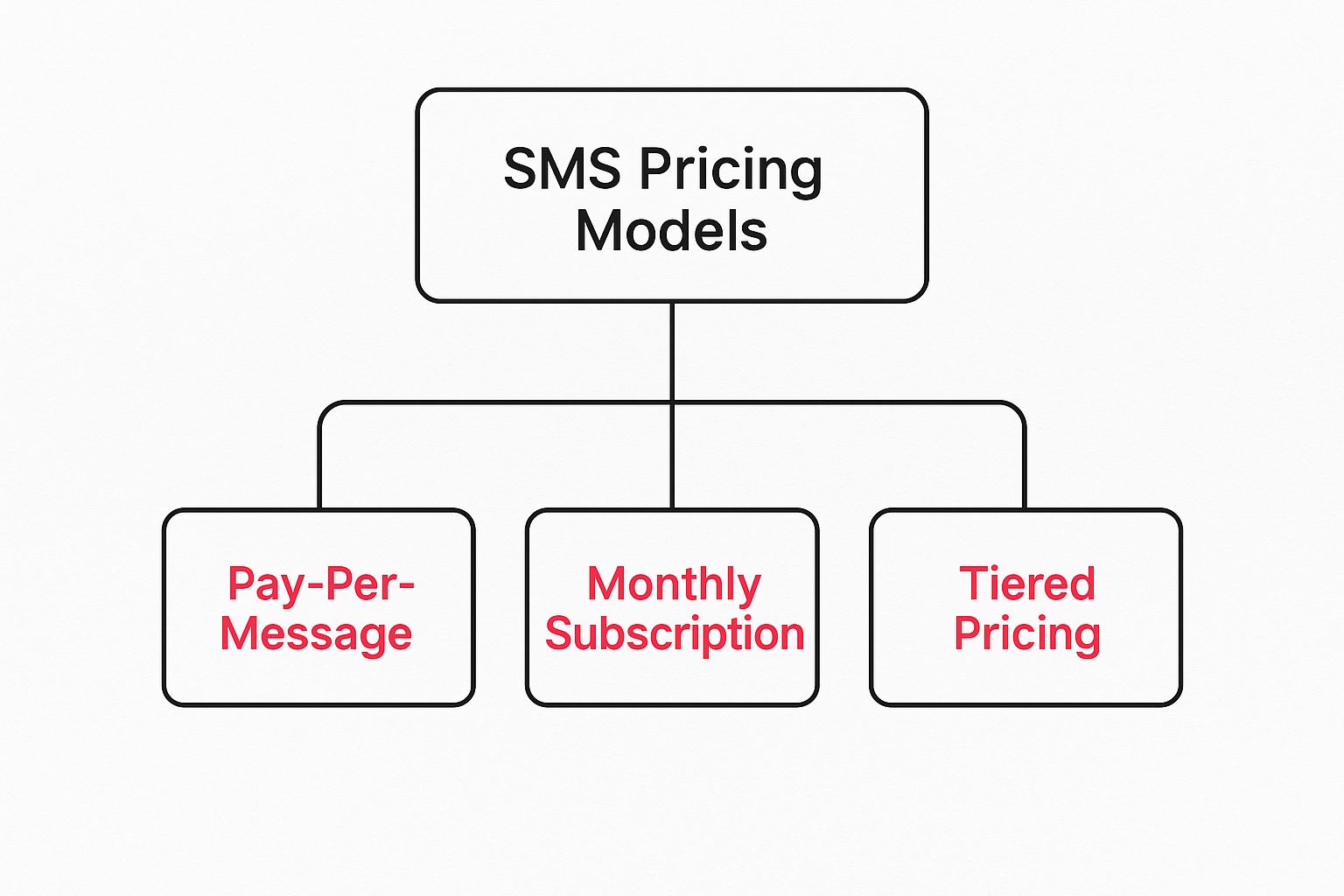
This image lays out the common paths—Pay-Per-Message, Monthly Subscriptions, and Tiered Pricing—but your final bill will have other costs layered on top.
Message Volume and Tiers
Without a doubt, the biggest driver of your cost is the sheer number of messages you send. Nearly every SMS platform uses a tiered system where your cost-per-message goes down as your sending volume goes up. It’s a simple economy of scale.
For example, sending 1,000 messages might run you $0.015 a pop, but if you bump that up to 50,000 messages, the price could drop to just $0.01 each. This setup encourages businesses to send more and makes SMS a lot more accessible for larger campaigns. It’s a good habit to check your sending volume regularly to make sure you’re in the most economical tier for your needs.
Message Type: SMS vs. MMS
Not all messages are built the same, and their price tags reflect that. You’ll primarily be working with two types.
- SMS (Short Message Service): These are the plain-text workhorses of the industry, limited to 160 characters. They’re perfect—and cheap—for quick alerts, appointment reminders, and straightforward promotions.
- MMS (Multimedia Messaging Service): Want to send images, GIFs, or short videos? That’s where MMS comes in. Because they carry more data, MMS messages are usually 2-3 times more expensive than a standard SMS.
While MMS definitely costs more upfront, the ability to send eye-catching visuals often translates to much higher engagement and conversion rates, which can easily justify the extra spend.
Pro Tip: Stick with SMS for routine, high-frequency messages like shipping updates. Save the pricier MMS for your big-impact campaigns, like a new product reveal or a major holiday sale where visuals really matter.
Carrier Fees and Compliance
Here’s a cost that often catches people by surprise: carrier fees. These are tiny surcharges passed on from mobile carriers like AT&T and Verizon just for using their networks. A common one you’ll see is the A2P 10DLC fee, which is a requirement for businesses texting from a standard 10-digit phone number.
Your SMS provider isn’t making a profit on these; they’re just passing the cost directly to you. While we’re talking about fractions of a cent per message, they can add up to a noticeable amount if you’re sending in high volumes. For a closer look at these fees and the results they help deliver, check out this great breakdown on the full costs of sending text messages.
Platform Features and Support
Finally, the tools and features packed into your plan have a direct line to your monthly bill. A basic plan might just let you send and receive texts, but the higher-end tiers usually come loaded with powerful features that can seriously boost your campaign performance.
These premium goodies often include:
- Sophisticated automation and audience segmentation tools
- In-depth analytics and reporting dashboards
- Integrations with your CRM, email platform, and other marketing software
- Dedicated customer support or even a personal account manager
Opting for a pricier plan raises your fixed monthly cost, but the advanced functionality can pay for itself many times over by making your campaigns smarter, more targeted, and way more effective.
To help you get a clearer picture of what to expect, here’s a quick checklist of the variables that will shape your SMS marketing bill.
Cost-Influencing Factor Checklist
| Factor | How It Impacts Cost | Typical Cost Range/Effect |
|---|---|---|
| Message Volume | Higher volume typically leads to a lower cost-per-message. | Prices can drop from $0.02 to $0.0075 per SMS at scale. |
| Message Type | MMS (with images/GIFs) costs significantly more than plain-text SMS. | MMS is often 2-3x the price of an SMS. |
| Carrier Fees | Small, mandatory fees charged by mobile carriers (e.g., A2P 10DLC). | Adds a fraction of a cent (e.g., $0.002 – $0.005) per message segment. |
| Keywords | Some platforms charge for dedicated keywords (e.g., “Text JOIN to 55555”). | Can be a one-time fee or $5 – $25 per month per keyword. |
| Phone Number Type | Toll-free numbers, 10DLC, and short codes have different monthly costs. | Short codes are the most expensive, often costing $500 – $1,500 per month. |
| Platform Tier | Higher-priced plans include more advanced features like automation and analytics. | Plans can range from $25/month for basics to $500+/month for enterprise features. |
| Customer Support | Access to dedicated support or an account manager often comes with premium plans. | Included in higher tiers; basic plans may only offer email or chat support. |
Thinking through these factors beforehand will give you a much more realistic budget and help you choose a platform and plan that truly aligns with your business goals.
Uncovering the Hidden Costs of SMS Marketing

The price you see advertised on an SMS platform’s website is rarely the whole story. To build a realistic budget, you need to dig deeper than the per-message rate and account for the less obvious expenses that can sneak up on you.
Think of it like selling on Amazon. You can’t just look at the referral fee; a savvy seller needs to understand the to know their true profit margin. The same principle applies here—getting a clear view of all potential charges from the start prevents nasty surprises down the road.
One of the first and most critical costs you’ll encounter is compliance. Following the rules isn’t optional, and it comes with a price tag.
The Price of Staying Compliant
Text message marketing is a regulated industry for a reason—to protect people from unwanted spam. In the United States, the big one is the Telephone Consumer Protection Act (TCPA), and ignoring it can be a costly mistake. Fines for violations can run anywhere from $500 to $1,500 per message.
Staying on the right side of the law means budgeting for a few key things:
- Legal Counsel: You might want a lawyer to double-check your opt-in language and campaign messaging to make sure you’re airtight.
- Platform Features: Some SMS platforms offer built-in compliance tools, like automatic opt-out handling, but they might charge extra for them.
- Team Training: Your team needs to know the rules of the road. This means ongoing training and maybe even periodic audits to ensure everyone is up to speed.
Navigating these regulations can feel like a headache, but it’s a non-negotiable part of building a trustworthy and sustainable SMS program. If you want to get into the nitty-gritty, our guide on TCPA compliance and text messages is a great place to start.
Integration and Internal Resource Costs
Beyond the legal stuff, two other costs often fly completely under the radar. The first is integration fees. Getting your SMS platform to talk to your e-commerce store, CRM, or analytics tools isn’t always plug-and-play. Sometimes it requires help from a developer or a paid third-party app, which can be a one-time setup fee or an ongoing subscription cost.
The second, and probably the most overlooked cost, is the time and effort from your own team. Time is money, right? A successful SMS strategy needs real people to write great copy, segment lists, run the campaigns, and analyze the results. This is a real cost that absolutely has to be factored into your overall budget and ROI calculations.
Figuring Out Your Real Return on Investment
Smart marketing isn’t about spending as little as possible; it’s about getting the most value out of every dollar you do spend. When we stop looking at SMS marketing costs as just an expense and start seeing them as an investment in profitability, the real power of this channel clicks into place. The goal isn’t just to send texts—it’s to turn those texts into real, measurable revenue.
Calculating your return on investment (ROI) is how you find out if your campaigns are just a cost or a genuine growth engine. Luckily, the formula is pretty simple, and it gives you a crystal-clear picture of how your investment is paying off. It all boils down to tracking what you put in versus what you get out.
The Basic ROI Formula
At its heart, the calculation is straightforward. You just take the total revenue your campaign brought in, subtract what you spent on it, and then divide that number by your total cost.
(Total Return – Total Investment) / Total Investment = ROI
To turn that into a percentage, just multiply the result by 100. A positive ROI means you’re in the black. A negative one is a sign that it’s time to tweak your strategy.
The real secret sauce, though, is making sure you’ve accurately tallied up all your costs and tracked every bit of your return.
Calculating Your Total Investment
Your total investment is more than just the price tag on each text message. To get the full picture, you need to add up every related expense.
- Platform Fees: This is your monthly subscription fee or what you paid for your block of credits.
- Message Costs: Tally up the specific cost for every single SMS and MMS message you sent for that campaign.
- Staff Time: Don’t forget this one! Estimate the cost of the hours your team spent writing copy, cleaning up lists, and digging through the campaign results.
Add all those up, and you’ve got the “Total Investment” part of your formula. This makes sure you’re accounting for every dollar and hour that went into the campaign.
Measuring Your Total Return
This is the fun part—seeing the direct impact of your hard work. The best way to do this is to build tracking right into your messages from the start.
- Unique Discount Codes: Create a specific promo code for each SMS campaign, like “TEXT20”. When a customer uses that code, you know for a fact that the sale came from that text.
- Trackable Links: Use shortened links (like from Bitly) that have tracking parameters built-in. Your analytics can then show you exactly how many clicks, and more importantly, how many sales came directly from a specific message.
This kind of direct attribution is what makes SMS marketing so effective. The results speak for themselves—research shows that for every $1 spent on SMS, businesses can bring in as much as $71 in revenue. You can see a breakdown of these numbers by exploring the cost-effectiveness of SMS marketing on Textla.com.
For an even deeper dive, check out our guide on calculating the ROI of SMS marketing for your ecommerce store. By carefully tracking these figures, you can prove that your SMS program isn’t just another expense—it’s a clear, data-backed driver of profit for your business.
What’s Next? How Future Trends Will Shape SMS Costs

The world of SMS marketing never sits still. New technologies are always just around the corner, and they’re guaranteed to have a direct impact on future SMS marketing costs. If you want to keep your budget on track and your strategy effective, you need to know what’s coming.
What once seemed like sci-fi is quickly becoming standard practice. These shifts add powerful new features to SMS platforms, but they also introduce new wrinkles to pricing. Getting a handle on these trends is the key to staying competitive and making sure your marketing dollars are well spent.
AI and Automation Are Becoming Standard
Artificial intelligence isn’t just a buzzword anymore—it’s a real, practical tool that’s making SMS campaigns smarter and more efficient. AI-powered platforms can now automatically send messages at the perfect time, personalize offers based on a customer’s past behavior, and even figure out which leads are most likely to buy.
Of course, this extra brainpower usually means higher platform fees. But the payoff is a serious boost in performance. It’s no surprise that over half of businesses (50.4%) are already using AI for personalization, with a staggering 81% reporting better campaign results because of it. You can dig into more of these stats and other interactive SMS marketing trends on SimpleTexting.com.
Ultimately, these tools save you countless hours of manual work and help you send messages that actually resonate. The higher conversion rates you’ll see can easily justify the added cost.
The Big Shift to Rich Communication Services (RCS)
The other huge change on the horizon is the move toward Rich Communication Services (RCS). Just think of RCS as “texting 2.0.” It’s designed to replace the old, plain SMS with a rich, interactive experience that feels more like using a modern app—all without leaving the phone’s native messaging client.
With RCS, you can do things that are simply impossible with a standard text message. We’re talking about features like:
- Interactive Carousels: Let customers swipe through different products right in the message.
- High-Resolution Media: Send beautiful, crisp images and videos instead of pixelated previews.
- Quick-Reply Buttons: Give customers suggested replies like “Yes” or “Track My Order” for one-tap responses.
- Read Receipts: Finally know for sure when a customer has actually seen your message.
As carriers and platforms continue to roll out RCS, you can bet that new pricing models will follow. Sending a dynamic RCS message will almost certainly cost more than a plain SMS, but its ability to create truly engaging moments promises a much higher return. Planning for these richer formats now is a smart move for anyone looking to create knockout customer experiences down the road.
Got Questions About SMS Marketing Costs? We’ve Got Answers.
Alright, so we’ve walked through the different pricing models and what pushes costs up or down. But I know from experience that when it comes time to actually pull out the credit card, there are always a few lingering questions. Let’s tackle the most common ones I hear from business owners.
What’s a Realistic Starting Budget for a Small Business?
If you’re just dipping your toes into SMS marketing, a great starting point is somewhere in the $50 to $150 per month range.
That kind of budget typically gets you a solid plan with anywhere from 1,000 to 5,000 messages and your own dedicated phone number. It’s the perfect amount to start building your subscriber list from scratch and run a few initial campaigns to see what your audience responds to.
Do I Have to Pay for Incoming Messages?
This is a big one, and the answer is: it depends on your provider.
Many of the best platforms offer free incoming messages. Why? Because they know that real conversations drive sales, and they don’t want to penalize you for engaging with your customers. However, some pay-as-you-go plans might charge a small fee for every reply you get. Always double-check the fine print on the pricing page before you commit.
A good rule of thumb: If a platform wants to charge you for customer replies, they might not be focused on building the kind of two-way relationships that truly grow a business.
How Much More Will I Pay for an MMS Message?
Sending a picture or a GIF (an MMS message) is definitely more expensive than a plain text (SMS). You can generally expect an MMS to cost 2 to 3 times more than a standard SMS.
So, if your SMS credit costs you $0.01, that same MMS might run you $0.03. It’s a higher upfront cost, for sure, but the boost in engagement you get from eye-catching visuals can often deliver a far better return on your investment.
Ready to turn abandoned carts into profit without unpredictable fees? CartBoss operates on a performance-based model, so you only pay for the results you get. Start recovering lost sales on autopilot and boost your revenue today. Find out more at https://www.cartboss.io.