



Let’s break down what mobile marketing really is. At its core, it’s any marketing you do that reaches people on their phones, tablets, or other mobile gadgets. It’s less like shouting from a billboard and more like having a direct, personal chat with your customers, right in the palm of their hand.
Understanding Mobile Marketing Basics
Mobile marketing isn’t some new fad—it’s a core part of how modern businesses talk to people. We all spend hours on our phones every single day, so this is about meeting your audience where they already are. This gives you a direct line to them for everything from a quick text alert to a rich, interactive experience inside an app.
The real magic here is in the immediacy and personalization. Unlike a TV ad that everyone sees, mobile marketing can react to a person’s location, what they’ve looked at before, and what they’re doing right now. This makes the whole experience feel more relevant and useful, which is what gets people to act.
Why It Matters Now More Than Ever
The world has gone mobile. There’s no debating it. The latest numbers show that a staggering 4.88 billion people around the globe own a smartphone, and that number is climbing fast.
This shift has completely changed how people shop, with many now doing it straight from their phones. It’s a huge part of e-commerce today, which you can read more about in our guide on what is mobile commerce.
What this means for you is simple: your audience is on mobile. If you aren’t there with them, you’re practically invisible to a massive chunk of potential customers.
By engaging customers on the device they use most, you open the door to building real connection and loyalty. It’s a level of engagement that desktop-only strategies just can’t replicate. You’re showing up in the moments that matter.
The Core Channels of Modern Mobile Marketing
So, what does mobile marketing actually look like in practice? It all comes down to the specific channels you use to get your message in front of people. Think of these as different roads that all lead to your customer’s smartphone, each with its own strengths.
The Most Direct Lines of Communication
One of the oldest and still most powerful channels is SMS marketing. This is simply sending text messages with offers, shipping alerts, or quick updates. It’s hard to ignore a text—which is why SMS boasts a staggering open rate of over 98%. Your message lands right in their pocket, and it almost always gets read.
Then you have in-app marketing, which covers everything that happens inside your application—push notifications, special in-app messages, and ads. This is your secret weapon for engaging people who’ve already shown interest by downloading your app. You can guide them, re-engage them, and prompt them to take action.
Choosing between SMS and a push notification can be a tough call. They both seem similar, but they serve different purposes. Our guide on the differences between SMS vs. push notifications breaks it down so you can pick the right tool for the job.
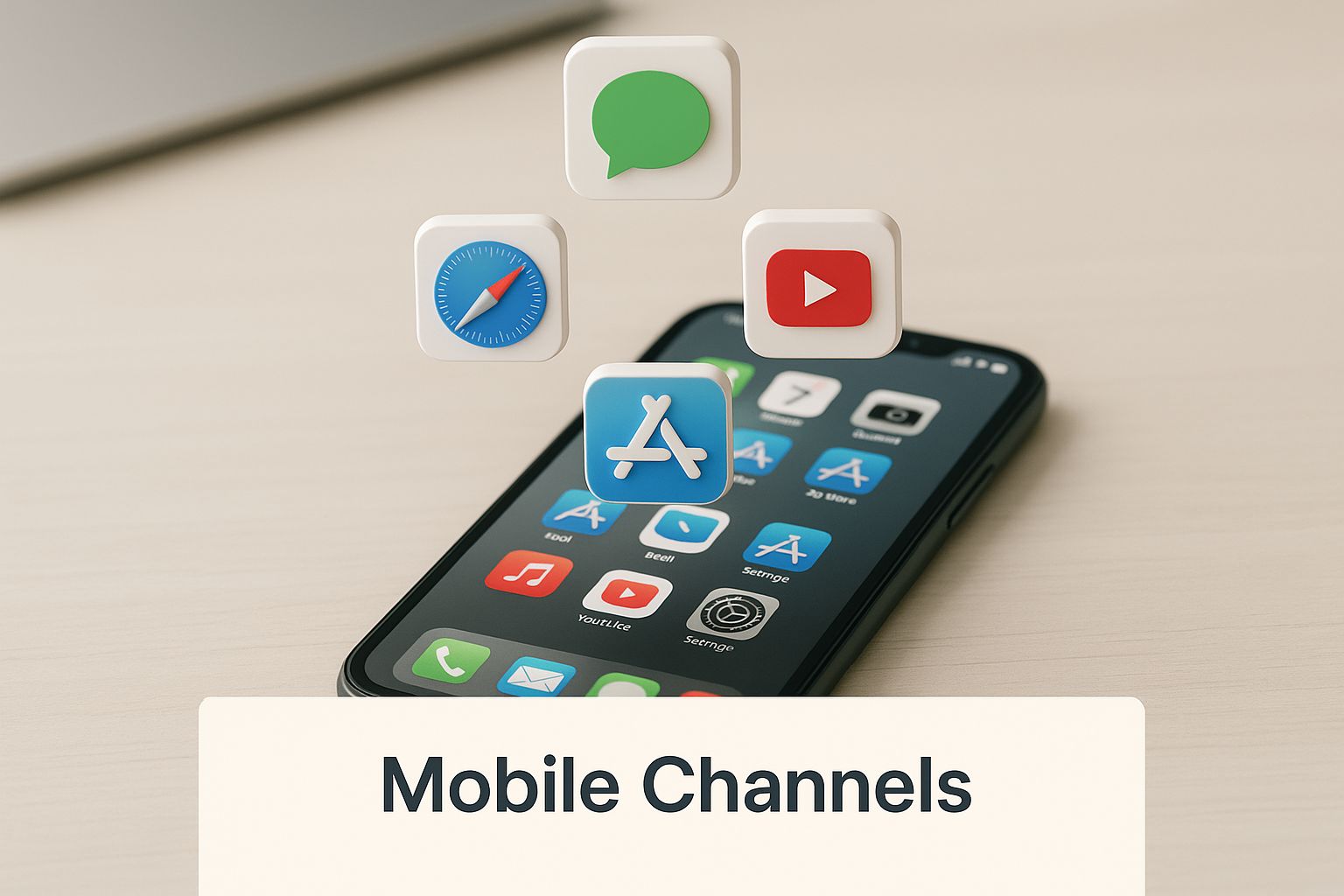
This image really drives home how the smartphone has become the central hub for everything. All these different touchpoints and channels ultimately point back to that one device in your customer’s hand.
Expanding Your Mobile Reach
Beyond direct messaging, a handful of other channels are essential for a well-rounded strategy.
- Mobile-First Social Media: Platforms like TikTok, Instagram, and even Facebook are built for the phone. Success here means creating content, especially video, that feels natural and grabs attention instantly on a vertical screen.
- Mobile Search Ads: Think about the last time you Googled “pizza near me” on your phone. Those top results are mobile search ads, designed to capture your immediate, location-based need.
- QR Codes: These little black-and-white squares are comeback kings. They act as a perfect bridge between the physical world and your digital one, letting someone scan a poster or a product and instantly land on your website or a special offer.
The real magic happens when you don’t just rely on one channel. The best strategies weave them together. Imagine a user sees your ad on Instagram, which prompts them to download your app. From there, you can send personalized in-app messages and timely SMS alerts to create a truly connected experience.
Why Your Business Cannot Afford to Ignore Mobile
It’s one thing to know what mobile marketing channels are, but it’s the why that really matters. Let’s be blunt: ignoring mobile marketing today is like setting up a shop on a busy street but keeping the doors locked. Your potential customers are walking right by, phones in hand, but they can’t connect with you.
The simple truth is that our phones are always on and always with us. This creates a direct, uninterrupted line to your audience. You can reach them during those critical moments—when they’re searching for dinner on the way home or even standing inside a competitor’s store researching a better deal. It’s not just about broad reach; it’s about being there at the exact moment they need you.
A Major Engine for Growth
Mobile isn’t just another channel; it’s a massive force in the global economy. The ecosystem around mobile services adds up to $6.5 trillion in economic value, which is a staggering 5.8% of the global GDP. When you invest in mobile, you’re tapping into one of the most powerful drivers of modern commerce. For a deeper dive, check out the full mobile economy report from GSMA.
This economic impact is fueled by how incredibly effective mobile channels are. They almost always deliver higher engagement than their desktop counterparts.
Think about it. A timely SMS or a personalized push notification feels immediate and personal. It’s much harder to ignore than an email that might get buried in a crowded inbox. That urgency is what turns a casual browse into a sale.
In fact, the data on SMS marketing shows just how much people welcome texts from businesses, especially for important updates and offers. You can see the full breakdown in our guide to SMS marketing statistics.
The Power of Being Personal
What truly makes mobile a game-changer is the ability to get incredibly personal. By using data points like location, past purchases, and app usage, your marketing can feel less like an ad and more like a helpful tip from a friend.
Here’s what that looks like in action:
- Location-Based Offers: Sending a coupon to a customer the moment they walk past your store.
- Behavioral Targeting: Nudging a user with a reminder about the items they left in their shopping cart.
- Personalized Content: Curating product recommendations based on what a user has looked at before.
This kind of relevance doesn’t just make your marketing more successful—it builds genuine, lasting relationships with your customers.
Building Your First Mobile Marketing Campaign

Jumping from theory to practice can feel like a huge leap, but launching your first mobile marketing campaign is more about process than perfection. Think of it like a recipe: get the ingredients right, follow the steps, and you’ll create something effective. It all starts with one fundamental question.
What are you actually trying to accomplish? That’s your foundation. Without a solid goal, your campaign will drift aimlessly, and you’ll have no way to tell if it even worked.
Define Your Campaign Objectives
Before you write a single line of copy or spend a dollar on ads, you need a specific, measurable goal. “Getting more customers” is way too vague. You need something concrete to aim for.
Are you trying to increase sales on your website? Get more people to download your app? Or maybe drive foot traffic to your brick-and-mortar store?
Here are a few examples of what a strong, clear objective looks like:
- Increase online sales by 15% this quarter using a targeted mobile coupon.
- Get 500 new app downloads in the first month.
- Bring 200 people into our store for a weekend flash sale via location-based alerts.
- Recover 10% of abandoned carts this month with an automated SMS reminder.
Having a goal like this is like plugging a destination into your GPS. It keeps every other decision you make pointed in the right direction.
Understand Your Mobile Audience
Okay, you know your destination. Now, who’s in the car with you? A message that works for a Gen Z TikTok user will completely miss the mark with a business professional scrolling LinkedIn on their tablet. You have to know who you’re talking to.
Start by asking a few simple questions:
- Where do they hang out on their phones? Are they addicted to Instagram Reels, watching YouTube reviews, or constantly on WhatsApp?
- When are they most glued to their screens? Think about their daily routine—is it the morning commute, their lunch break, or late-night scrolling?
- What kind of content actually stops their thumb? Do they engage with short, punchy videos, quick articles, or interactive quizzes?
Figuring this out helps you show up in a way that feels natural and helpful, not like an annoying interruption. You’re meeting them where they already are, which is half the battle.
Choose the Right Channels and Craft Your Message
Once you have your goal and your audience dialed in, picking the right channels becomes pretty obvious.
If your objective is to rescue abandoned carts with a time-sensitive offer, nothing beats SMS and its incredible 98% open rates. For a deeper dive, this ultimate guide to SMS marketing campaigns has some fantastic strategies.
On the other hand, if you’re telling a visual story to a younger crowd, a mobile-first platform like Instagram or TikTok is your best bet.
The final piece is the message itself. On mobile, you have seconds to make an impression. Your content needs to be short, scannable, and easy on the eyes. Use tight sentences, bold text for emphasis, and a crystal-clear call-to-action that tells people exactly what you want them to do next.
Getting Mobile Marketing Right: Best Practices
Just having a mobile marketing strategy isn’t enough. The line between a welcome interaction and an annoying interruption is incredibly thin, and it all boils down to respecting the user’s experience. If you want your messages to land, you need to follow a few core principles.
Build for the Small Screen First
Your starting point should always be a mobile-first design. This is a big shift from the old “mobile-friendly” mindset, where a desktop site was just shrunk down. Instead, you design the experience for the phone from the ground up.
Think big, easy-to-tap buttons, readable text that doesn’t require squinting, and simple navigation. The goal is a smooth, intuitive journey that feels completely natural on a mobile device—no frustrating pinching and zooming required.
Earn Their Trust with Permission
Next up is permission-based marketing. This is non-negotiable, especially for highly personal channels like SMS. You must get explicit, opt-in consent before you send a single message.
When someone gives you their number, they’re inviting you into their personal space. Respecting that trust is crucial. It ensures your audience actually wants to hear from you, making them far more receptive to your messages.
Make Every Message Count
Once you have that permission, make every interaction feel personal and relevant. Use the data you have—ethically, of course—to tailor your content. A message that references a past purchase or a recently viewed item shows you’re paying attention. It feels helpful, not creepy.
A great mobile experience is one that feels like a concierge service, not a megaphone. It anticipates needs and provides timely, useful information that makes the customer’s life easier, building loyalty with every interaction.
Finally, every single message needs a point. A clear call-to-action (CTA) tells the user exactly what to do next. Whether it’s “Shop Now,” “Track Your Order,” or “Get Your Coupon,” the path forward should be obvious and compelling. This clarity is what turns a passive reader into an active customer.
To really drive home the difference between a strategy that works and one that falls flat, let’s look at some side-by-side examples.
Mobile Marketing Best Practices Good vs Bad
| Practice | Good Example (What to Do) | Bad Example (What to Avoid) |
|---|---|---|
| Mobile-First Design | A restaurant menu that’s a single, scrollable page with large, tappable categories. | Uploading a PDF of your print menu that forces users to pinch and zoom to read anything. |
| Permission-Based Marketing | A clear checkbox at checkout: “[ ] Yes, text me with shipping updates and exclusive offers.” | Automatically adding every customer’s phone number to an SMS list without their consent. |
| Personalization | Sending a push notification: “Your favorite pizza is 50% off tonight only! 🍕 Order now.” | Blasting every user with the same generic “Weekend Sale!” message, regardless of their interests. |
| Clear Call-to-Action (CTA) | An SMS with a direct link: “Your package has shipped! Track its journey here: [link]” | A vague email that says “Big news about your order” with no clear link or next step. |
Ultimately, these practices aren’t just a checklist. They’re a mindset focused on creating value and building a relationship with your audience, one helpful, well-timed message at a time.
What’s Next for Mobile Marketing?
As we look to the horizon, mobile marketing isn’t just evolving; it’s getting smarter and a whole lot more personal. The driving force behind this shift is hyper-personalization, which is really just a fancy way of saying brands are using artificial intelligence to understand what you want before you even know you want it. AI crunches data on the fly, serving up predictive recommendations and offers that feel genuinely useful, not just like another automated ad.
This push for deeper personalization is also what’s making conversational marketing so popular. We’re moving beyond one-way blasts and into real-time chats with AI-powered bots or even voice assistants like Alexa and Google Assistant. These aren’t just simple Q&A tools anymore; they can walk a customer through a complicated purchase, offer instant support, and turn a monologue into a meaningful dialogue.
Immersive Experiences are Taking Over
At the same time, the content itself is changing. It’s becoming more hands-on, more visual, and frankly, more fun. Two trends are really spearheading this movement:
- Augmented Reality (AR): AR has officially moved from a “cool trick” to a serious business tool. It lets you use your phone’s camera to see how a new sofa would look in your living room or “try on” a pair of sneakers virtually. This simple act of visualizing a product in your own space builds an incredible amount of confidence and helps erase that nagging “what if it’s not right?” feeling.
- Short-Form Video: Platforms like TikTok and Instagram Reels have completely rewired how we consume content. These snappy, bite-sized videos are perfect for telling a quick story, showing off a product, and grabbing someone’s attention in seconds. For many brands, this is now the go-to way to connect with people in a way that feels authentic and entertaining.
And in case you’re wondering, the money is following these trends. Mobile advertising is now the undisputed king of digital spending, with projections suggesting it will hit a staggering $402 billion in 2025. Much of that growth is coming from the insane engagement on video platforms. If you want to dive deeper, there’s some great data on mobile advertising statistics.
The takeaway here is simple: to stay ahead, your strategy needs to embrace these shifts. The future of mobile isn’t about just shouting at customers on their phones. It’s about creating intelligent, interactive, and immersive moments that build real, lasting connections.
Common Questions About Mobile Marketing
As you start to map out your mobile marketing strategy, a few questions always seem to pop up. Let’s get them answered so you can move forward with confidence.
How Much Should I Budget for Mobile Marketing?
Honestly, there’s no magic number. Your budget will really depend on your industry, what you’re trying to achieve, and which channels you decide to focus on.
A smart way to start is by carving out a small piece of your current digital marketing budget for a few mobile-specific tests. Dip your toes in the water with something cost-effective, like a targeted SMS campaign or a small social media ad buy. This lets you see what works without breaking the bank. Once you see a solid return, you can start scaling up.
What Is the Most Important Mobile Metric to Track?
While it’s tempting to obsess over open rates and click-throughs, the metric that truly matters is your conversion rate. This is the number that tells you how many people are actually doing what you want them to do—whether that’s buying a product, signing up for a newsletter, or downloading your app.
Conversions are what tie your marketing spend directly to revenue. It’s the bottom-line metric that proves your campaigns are actually working.
Can Small Businesses Benefit from Mobile Marketing?
Absolutely. In fact, mobile marketing can be a game-changer for small businesses. It levels the playing field.
Things like local SEO get you found in those “near me” searches, while social media ads can be targeted down to a specific zip code. Plus, SMS marketing gives you a direct line to your local customers. Just make sure you’re up to speed on the regulations by understanding SMS marketing compliance to maintain that customer trust. Many of the most powerful mobile strategies are surprisingly affordable and easy to scale.
Ready to turn abandoned carts into profit? CartBoss uses automated SMS to bring customers back and boost your sales on autopilot. Start recovering lost sales today!
