


Campaign text messages are a pretty straightforward concept: you send a single, targeted text to a massive group of subscribers all at once. Think of it like having a direct line to thousands of your customers simultaneously, all with the goal of getting them to take immediate action—whether that’s making a purchase, checking out a new product, or using a discount code.
The Power of a Direct Connection
Let’s be honest, we all have crowded email inboxes and social media feeds that never end. Campaign text messages completely sidestep that chaos. They land directly on a customer’s phone, a personal space they check constantly, which makes your message feel both urgent and important.
This direct line is what really makes SMS marketing a different beast. For a more formal breakdown, you can check out this definition of SMS Marketing. Unlike an email that might sit unread for days (or get lost in the promo tab), a text creates an instant connection. That immediacy is a total game-changer for time-sensitive promotions, flash sales, or big announcements.
Why Texts Just Work Better
The incredible effectiveness of campaign texts boils down to simple human behavior. We’re all wired to open text messages almost instantly. This reflex translates into marketing metrics that other channels can only dream of.
When you put SMS side-by-side with a traditional powerhouse like email, the difference is night and day.
SMS Marketing vs Email Marketing At a Glance
Just look at how the numbers stack up. This quick comparison shows why so many businesses are turning to text messages to get their message heard.
| Metric | Campaign Text Messages (SMS) | Email Marketing |
|---|---|---|
| Average Open Rate | A massive 98% of all text messages get opened. | Hovers around 21%, depending on the industry. |
| Click-Through Rate (CTR) | Can soar as high as 36% with a good offer. | Averages a much lower 2.6%. |
| Delivery Speed | Delivered and read within seconds or minutes. | Can get delayed or filtered into spam/promo folders. |
| Personal Feel | Feels like a direct, one-on-one conversation. | Often comes across as more formal and less personal. |
As you can see, the engagement level with SMS isn’t just a little better—it’s in a completely different league.
How SMS Became a Marketing Giant
It’s pretty wild to think that text messaging went from a simple personal tool to a marketing heavyweight. The first-ever SMS was sent way back on December 3, 1992, and from there, it exploded into a core part of business strategy around the globe.
Today, the SMS marketing industry is projected to be worth around $12.6 billion globally by 2025, and it’s all thanks to its direct reach and sky-high engagement. People get texts in seconds, and with response rates hitting 45% (compared to email’s 6%), it’s clear why it’s so effective.
This chart really drives the point home, visualizing the powerhouse metrics that make campaign texts a go-to for any modern business.
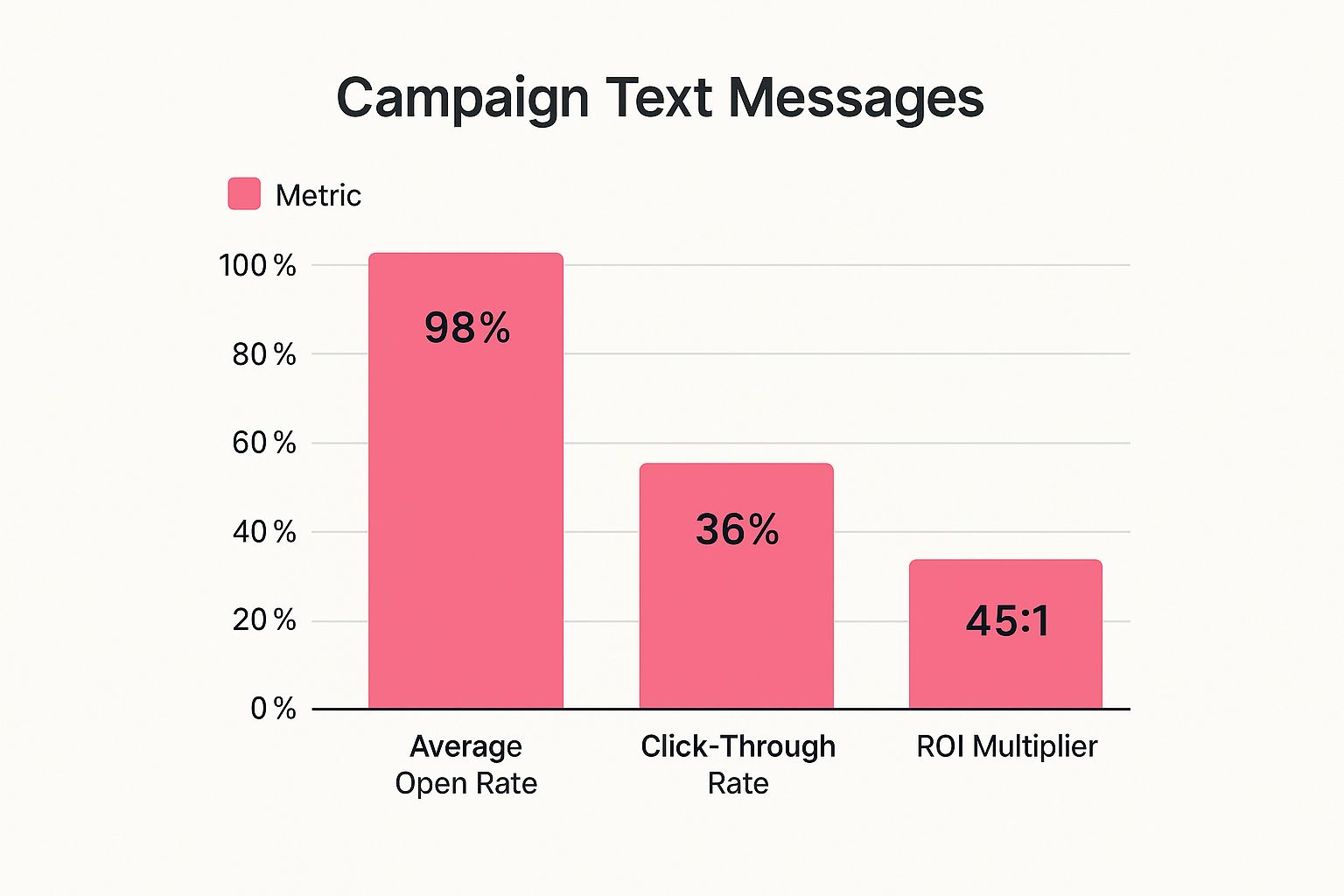
The data doesn’t lie. Businesses are flocking to SMS because it grabs attention and delivers a killer return on investment. With engagement rates this high, it’s worth exploring all the different ways you can use it. To learn more, check out our ultimate guide to SMS message types and strategies.
Why SMS Campaigns Actually Grow Your Business
High open rates are nice, but they don’t pay the bills. The real magic of campaign text messages is how they turn that immediate attention into cold, hard business results. Sending a simple text can kickstart customer engagement, drive sales right now, and build the kind of loyalty that keeps people coming back.
Think of your customer’s phone as the most valuable piece of marketing real estate you can access. When you send a text, you’re not just throwing another ad into the void; you’re creating a direct, personal moment. It’s your chance to cut through all the digital noise and deliver a message that feels urgent and relevant, leading to a direct impact on your bottom line.
This is what makes SMS so different. Whether you’re recovering an abandoned cart or announcing a flash sale, the return on your investment (ROI) is often crystal clear and happens almost instantly.
Sparking Immediate Action and Sales
Unlike emails that can sit unread for days, a text message creates a sense of urgency that gets customers to act now. This is a game-changer for any kind of time-sensitive offer.
Picture a local coffee shop sending a text that says, “2-for-1 coffee special, today only!” That message lands right in a customer’s pocket while they’re already out and about, making an impulse visit almost a sure thing. Just like that, a simple text becomes a direct sale.
It’s the same for e-commerce. A brand can use text messages to clear out last season’s inventory with a quick flash sale. A message like, “Final hours! 50% off all sale items. Shop now before they’re gone!” taps into a powerful sense of FOMO (fear of missing out), turning subscribers into buyers within hours.
Building Lasting Customer Loyalty
Real growth isn’t about one-off sales. It’s about building relationships that keep customers choosing you over and over again. Campaign text messages are brilliant for this because they make customers feel like they’re part of an exclusive club.
Imagine sending a personalized birthday discount or giving your SMS subscribers early access to a new product. These small gestures turn a simple transaction into a genuine connection. You’re telling your customers they’re insiders, which builds trust and makes them far more likely to stick with your brand.
This goes beyond just promotions, too. You can send helpful tips, order updates, or back-in-stock alerts that provide real value, keeping your brand top-of-mind for all the right reasons.
The Undeniable Shift in How People Shop
This isn’t just a theory; it’s backed by a huge shift in how people prefer to communicate. Customers are flocking to text messages as their channel of choice. Recent data shows that a massive 84% of consumers in the United States have opted in to receive marketing texts, which is a 35% jump since 2021.
Texting has become the number one mobile activity for 83% of consumers, and 80% of companies are now automating their SMS strategies to keep up. You can dig into more of these numbers in these 2025 texting and marketing statistics from SimpleTexting.
This trend sends a clear signal: customers don’t just tolerate texts from brands, they actively welcome them.
By meeting customers on their favorite channel, you’re doing more than just sending a marketing message. You’re respecting their time and how they like to communicate, and that’s the foundation of any strong relationship.
This willingness to engage opens up a massive opportunity. Businesses that weave SMS into their strategy are simply better positioned to grab attention, drive action, and hit their growth targets—whether that’s reducing appointment no-shows, boosting event attendance, or recovering lost revenue from abandoned carts. It’s a flexible tool that delivers measurable results across the board.
Best Practices for Effective Text Campaigns
Launching a successful text campaign is more art than science, but a few core principles can make all the difference. Think of it like a conversation. You wouldn’t just shout offers at a friend; you’d be respectful, pick your moment, and get straight to the point.
Applying that same mindset to your SMS strategy is how you turn a simple text into a powerful revenue driver. It’s all about building trust and delivering real value in a space as personal as a customer’s phone.
Nail the Essentials First
Before you even dream up the perfect offer, you have to get the fundamentals right. These are the non-negotiables that form the foundation of every successful—and ethical—text campaign. Skipping these is like building a house without a foundation. It’s bound to collapse.
Here are the absolute must-dos:
- Get Explicit Consent: This is the golden rule. You must have clear, documented permission from every single person before you send them a marketing text. No exceptions.
- Always Identify Yourself: Start every message by clearly stating your brand’s name. A text from a random number just feels like spam and gets deleted instantly.
- Provide a Clear Opt-Out: Every message has to include a simple way to unsubscribe, like replying “STOP.” This isn’t just a courtesy; it’s a legal requirement that also builds trust with your audience.
These rules aren’t just about staying compliant. They make sure your audience actually wants to hear from you, which makes your campaigns ridiculously more effective.
Craft Messages That Convert
Once the basics are locked down, you can shift your focus to the message itself. The best campaign text messages feel personal, urgent, and incredibly easy to act on. In fact, a recent analysis of over 25 billion messages showed that specific phrasing can boost conversion rates by up to 19%.
That means tiny tweaks to your copy can have a massive impact on your results.
Key Takeaway: The goal isn’t just to be seen; it’s to inspire immediate action. Every single character in your message should push toward that one goal, guiding the customer effortlessly to the checkout.
To make your messages hit harder, focus on a few proven elements. Using words that speak directly to the subscriber (like “you” and “your”) can lift conversions by 9% simply because it makes a mass text feel like a one-to-one chat. For a deeper dive, our guide on SMS marketing best practices has more tips to help you launch successfully.
Perfect Your Timing and CTA
The final pieces of the puzzle are when you send your message and what you ask the customer to do. Sending a text at the wrong time is a surefire way to get ignored.
Data shows that the sweet spot for sending marketing texts is between 11 a.m. and 4 p.m. This window usually catches people during their lunch break or as their workday is winding down—times when they’re more likely to be on their phones anyway.
Your call-to-action (CTA) has to be just as strategic. It needs to be crystal clear and compelling. Ditch the vague phrases and use direct, action-oriented language instead.
Here’s a quick comparison:
| Do This (Clear & Actionable) | Not That (Vague & Weak) |
|---|---|
| “Shop the sale now!” | “Click here to see more.” |
| “Get your 25% off today.” | “Check out our deals.” |
| “Claim your free gift.” | “Find out more.” |
A strong CTA removes all the guesswork and tells the customer exactly what to do next. When you combine that with perfect timing, you’ve created a campaign that respects the customer’s time and drives real results for your business.
Navigating SMS Compliance and Legal Rules
Jumping into the world of campaign text messages is exciting, but it comes with a serious responsibility: you have to respect your customer’s privacy.
Think of it this way—you wouldn’t just walk into someone’s house without knocking. In the same way, you absolutely need clear permission before you start sending marketing messages to a person’s phone.
Ignoring the rules isn’t just bad manners. It can land you with staggering fines and do permanent damage to your brand’s reputation. Getting to know regulations like the Telephone Consumer Protection Act (TCPA) in the US or the GDPR in Europe is a non-negotiable part of running a sustainable, ethical, and profitable SMS program.
The Golden Rule of Consent
The entire foundation of SMS compliance rests on one simple concept: explicit consent. This means a customer must knowingly and clearly agree to get marketing texts from you. You can’t just assume they’re okay with it or bury the opt-in in the fine print.
This is where the “double opt-in” process becomes your best friend. First, a customer gives you their number. Then, you send a confirmation text asking them to reply with something like “YES” to confirm. This two-step process creates a rock-solid record of their consent, protecting both your business and the customer.
Core Compliance Requirements You Must Follow
Beyond getting permission, a few other key practices build a foundation of trust with your audience. Following these rules shows you respect their inbox and value their time, which is crucial for keeping them engaged long-term.
- Always Identify Your Brand: Every single text message needs to clearly state who it’s from. A message from a random number feels sketchy and is almost guaranteed to be ignored or reported as spam.
- Provide a Simple Opt-Out: You must include clear, easy-to-follow instructions for unsubscribing, like “Reply STOP to end.” This is a legal requirement that gives users control and shows you’re transparent.
- Respect Quiet Hours: Sending a promo text at 3 AM is the fastest way to get an angry customer and an immediate unsubscribe. Always follow regulations that prohibit sending messages during late-night or early-morning hours.
Following these guidelines does more than just keep you out of legal hot water. It builds a respectful, trustworthy relationship with your customers. That makes them far more likely to listen to your offers and stay loyal to your brand.
Why Compliance Is Your Competitive Advantage
Some marketers see compliance as a pain, but it’s actually a powerful tool for building a high-quality list of subscribers. When people have explicitly opted in, you know they’re actually interested in what you have to say. This leads directly to higher conversion rates and a much better return on your marketing spend.
By making ethical practices a priority, you naturally filter out people who aren’t interested. You get to focus your energy on a core audience that genuinely wants to hear from you. It’s a win-win: customers get valuable content, and you get better campaign results.
For a deeper dive into the specific regulations, you can learn more about SMS marketing compliance in our comprehensive guide. Getting this right from day one ensures your text campaigns are not only effective but built to last.
How to Measure Your Campaign Success
Launching a text campaign without tracking its performance is like driving with your eyes closed. Sure, you’re moving forward, but you have no idea if you’re headed in the right direction. To really know if your campaign text messages are hitting the mark, you have to get into the data and measure what actually matters.
This isn’t about getting lost in a sea of spreadsheets. It’s about focusing on a few key numbers that tell a clear story about what’s working, what isn’t, and where you can make small tweaks for much better results.
Key Metrics That Tell the Full Story
Think of each metric as a clue in a puzzle. One piece might not tell you much, but when you put them all together, a complete picture of your campaign’s health starts to emerge. Focusing on the right numbers helps you ditch the guesswork and make smart, data-driven decisions.
Here are the essential metrics you need to keep an eye on:
- Delivery Rate: This is simply the percentage of messages that successfully landed on your subscribers’ phones. A low delivery rate can be a red flag for issues with your contact list, like invalid or old numbers.
- Click-Through Rate (CTR): This tracks how many people clicked the link in your message. It’s a direct signal of how compelling your offer and call-to-action really are.
- Conversion Rate: This is the big one—the ultimate measure of success. It’s the percentage of people who actually completed the desired action, like making a purchase.
- Opt-Out Rate: This shows the percentage of subscribers who unsubscribed after getting your message. A few opt-outs are perfectly normal, but a spike can mean your messages are too frequent or not relevant enough.
By watching these numbers, you can diagnose problems fast. For example, a high delivery rate but a low CTR tells you the message was seen, but the offer wasn’t strong enough to make someone tap the link.
This kind of quick analysis is exactly what you need to fine-tune your approach. The best part? You don’t have to guess what “good” looks like. You can compare your results to established benchmarks to see how you stack up.
Industry Benchmarks for SMS Campaign Metrics
Context is everything. You need a baseline to know if your numbers are great, average, or need some work. Knowing the industry averages helps you set realistic goals and spot where you’re crushing it or falling behind.
Here’s a look at some typical performance stats for SMS marketing to help you gauge your own success.
| Metric | Industry Average | What It Tells You |
|---|---|---|
| Delivery Rate | 95-99% | The quality and health of your subscriber list. |
| Click-Through Rate (CTR) | 10-36% | How engaging and relevant your message content is. |
| Conversion Rate | 3-10% | The overall effectiveness of your campaign, from message to checkout. |
| Opt-Out Rate | < 1% | Subscriber satisfaction and the relevance of your campaigns. |
These numbers are your reference point. If your CTR is hovering below 10%, it’s a clear signal to start testing different copy, offers, or calls-to-action to see what truly connects with your audience.
For a deeper dive, check out our guide on how to measure marketing campaign success and apply those same principles to your SMS strategy. By regularly checking your performance against these benchmarks, you can continuously improve your campaigns and turn those valuable insights into real revenue.
All this theory is great, but turning knowledge into action is where you’ll see real growth. Now that you’ve got the strategy down for effective campaign text messages, let’s walk through how to launch your very first one using a tool like CartBoss. We’ll turn what sounds like a complex task into a few clear, manageable steps.
CartBoss really takes the guesswork out of the equation by handling a lot of the heavy lifting. It automatically detects a customer’s language and can even pre-fill checkout forms, so your first campaign isn’t just easy to set up—it’s built to be effective right from the get-go.
Setting Up for Success in Minutes
Getting started with CartBoss is quick and painless. The first step is integrating the tool with your e-commerce platform, whether that’s Shopify, WooCommerce, or something else, and then importing your list of consented contacts. This is a crucial foundation for making sure your messages reach the right people, both legally and effectively.
Once you’re connected, it’s time to decide on your goal. Are you trying to recover abandoned carts, announce a new product drop, or run a flash sale? Your objective shapes every word you write. Abandoned cart recovery is where CartBoss truly shines, making it a perfect starting point. You can also set up a powerful SMS auto-respond sequence to engage customers without lifting a finger.
Crafting and Scheduling Your Message
With your account ready, you can start building the message itself. This is where you combine the best practices we’ve discussed with CartBoss’s built-in features to create a text that actually converts.
- Start with a Pre-Written Template: Don’t stare at a blank screen. CartBoss has a library of proven, pre-written messages already translated into multiple languages. This saves you a ton of time and ensures your copy is optimized from day one.
- Personalize Your Offer: Add a dynamic discount code. CartBoss generates these automatically and applies them at checkout, creating a seamless, personalized experience for your shopper.
- Set Your Timing: Schedule your message to land at the perfect moment. For abandoned carts, that first text is most effective within an hour. For a promo campaign, you’ll want to aim for that sweet spot between 11 a.m. and 4 p.m.
The dashboard gives you a clean overview of your campaign, making it simple to double-check everything before you hit launch.
This visual shows just how easy it is to monitor key metrics, helping you understand campaign performance at a glance.
Messaging tech is also getting smarter. For instance, Rich Communication Services (RCS) are already boosting engagement by 22% over standard SMS with branded, interactive features. When you combine that with AI-driven personalization, which can lift click-through rates by around 14%, the future of campaign texts looks incredibly bright. This lines up perfectly with what customers want, as 70% of people now prefer getting notifications via text. You can discover more insights about texting statistics on SlickText.com to see the full picture.
By following these steps, you’re not just sending a text; you’re launching a targeted, automated, and measurable sales-generating machine. CartBoss empowers you to start small, learn from the data, and scale your efforts confidently.
A Few Lingering Questions
Even with the best strategy in hand, you probably still have a couple of questions rattling around. It’s only natural. We hear the same ones all the time, so let’s get them answered right now. Think of this as your final pre-flight check before you launch.
Can I Just Text My Entire Email List?
Absolutely not, and this is probably the most critical point to get right. You cannot, under any circumstances, start sending marketing texts to your email subscribers unless they have separately and explicitly consented to receive SMS messages from you.
Think of it this way: someone giving you their email address for a newsletter is not the same as them handing you their personal phone number for marketing texts. They are two completely different permissions. Trying to text your email list is a fast track to violating compliance laws like the TCPA, which can bring some seriously painful penalties. Build your SMS list the right way by asking for that specific opt-in.
What’s the Perfect Length for a Campaign Text?
Short and sweet wins the race every single time. While you technically have 160 characters to play with, the real sweet spot is much shorter. Your goal is to deliver a clear, punchy offer that someone can grasp in a few seconds flat.
Put your offer and call-to-action front and center. Don’t waste time with fluff or long, meandering sentences—people will just ignore them. Get straight to the value.
Key Takeaway: Every character is precious real estate. You’re trying to spark instant action, not write a novel. A tight, value-packed message will always outperform a wordy one.
How Often Should I Be Sending These Messages?
This is all about finding the right balance. You want to stay on your customer’s radar, but you don’t want to annoy them into hitting “STOP.” For most e-commerce brands, a good starting point is one to two promotional texts per week.
But that’s just a baseline, not a hard-and-fast rule. The real answer is in your data:
- Keep an eye on your opt-out rate: If you see a jump in unsubscribes right after a send, you’re probably texting too often. Dial it back.
- Look at your engagement: Are click-through and conversion rates holding strong? If so, your audience is clearly happy with the cadence.
Your data is your best friend here. It’ll tell you exactly what your audience wants, allowing you to fine-tune your schedule for maximum impact without burning out your list.
Ready to see what text messages can really do for your store? With CartBoss, you can turn those abandoned carts into a consistent revenue stream. We make it simple to launch automated, high-converting SMS campaigns that recover lost sales while you sleep. Start recovering sales today with CartBoss.