


Figuring out what a “good” ecommerce conversion rate is can feel a bit like asking, “How long is a piece of string?” The truth is, there’s no single magic number.
While the general consensus points to a healthy range between 2.5% and 3%, that’s really just a starting point. Your target rate is a moving target, heavily influenced by what you sell, how much it costs, and where your customers are coming from.
Defining a Good Ecommerce Conversion Rate
Let’s cut right to it. Knowing the global average is useful, but treating it like a universal gold standard is a recipe for frustration. Think of it like a batting average in baseball—what’s considered ‘good’ depends entirely on the league you’re playing in.
For a high-end luxury furniture store, a 1% conversion rate could be phenomenal, bringing in massive revenue with each sale. On the flip side, a fast-moving cosmetics brand hitting a 3% rate might just be doing okay, given their lower prices and higher purchase frequency.
Why Context Is Everything
Your conversion rate is a direct reflection of your store’s unique situation. A few key factors will always shape what a successful number looks like for you:
- Industry: A store selling everyday groceries will naturally see higher conversion rates than one selling custom-built gaming PCs.
- Product Price: High-ticket items almost always involve a longer, more thoughtful decision-making process. This leads to lower conversion rates compared to cheap impulse buys.
- Customer Intent: A visitor who clicked on a highly targeted ad is worlds away from someone who stumbled upon your site while casually scrolling through social media. Their intent to buy is completely different.
At its core, a conversion rate simply tells you how many of your website visitors take the action you want them to—which is usually making a purchase. If you want a deeper dive, you can explore the core principles of what is conversion rate in our detailed guide.
A good conversion rate isn’t about hitting some arbitrary number from a report. It’s about figuring out what’s realistically achievable for your specific store and then working to consistently improve on that baseline. It’s a measure of efficiency, not just popularity.
To give you a clearer picture of what different numbers mean, here’s a quick breakdown.
Ecommerce Conversion Rate Performance Tiers
| Performance Tier | Conversion Rate | What It Means |
|---|---|---|
| Needs Work | Below 1.5% | Something in your funnel is likely broken or causing friction. Time to investigate. |
| Average | 1.5% – 2.5% | You’re on par with many stores, but there’s significant room for growth and optimization. |
| Good | 2.5% – 3.5% | You’re doing well! Your store is effective at turning visitors into customers. |
| Excellent | 3.5% – 5% | You’re in the top tier. Your user experience and marketing are clearly dialed in. |
| Elite | Above 5% | You’re among the best of the best. Stores at this level are often market leaders. |
This table helps you see where you stand, but remember, these are just general guidelines.
Hitting Elite Performance
The global average ecommerce conversion rate in 2025 sits somewhere between 2.5% and 3%, which most experts agree is a solid benchmark to aim for.
For store owners on platforms like Shopify and WooCommerce, breaking into the top 20% means hitting a rate of 3.2% or higher. Reaching that isn’t just “good”—it’s a sign that you’ve built a highly optimized customer journey from start to finish.
Understanding where your store fits into this picture is the first critical step. Now that you have the context, we can start digging into the specific numbers and strategies that will truly move the needle for your business.
Ecommerce Conversion Rate Benchmarks by Industry
Trying to nail down a single, “good” conversion rate for every e-commerce store is a fool’s errand. It’s like comparing the sales process for a candy bar to a custom-built motorcycle—they’re just not in the same league.
What counts as a strong conversion rate is completely different from one industry to the next. The customer behavior, the price point, and the type of product all create a unique sales environment. You just can’t measure a grocery store with the same yardstick you use for a luxury watch retailer.
Why Some Industries Convert Better Than Others
The real driver behind these differences is purchase psychology. Industries built on low-cost, frequently bought, or immediate-need products will almost always see higher conversion rates. Think about it: buying your favorite snack or a tube of toothpaste is a low-stakes, easy decision. The barrier to clicking “buy” is tiny.
On the other hand, stores selling expensive, long-lasting, or highly specialized goods have a much steeper hill to climb. Customers looking at these items spend a ton of time comparing features, digging through reviews, and just waiting for the right moment. This longer journey naturally creates more chances for them to drop off before they ever complete the purchase.
A key thing to remember is that a low conversion rate isn’t always a red flag. For a store selling furniture worth thousands of dollars, a rate under 1% can still be wildly profitable.
To see this in action, just look at the 2025 industry benchmarks. Food & beverages are at the top with a 6.8% conversion rate, with personal care right behind at 4.9%. These are classic repeat-purchase sectors. Then you have something like home decor, which converts at just 1.4% because of the higher costs and longer decision-making time. You can dig into even more detailed data to see how these ecommerce benchmarks vary across the board.
Finding Your Place in the Market
To get a real sense of how you’re doing, you have to benchmark your store against direct competitors in your specific niche. This means looking past just the conversion rate and pulling in other key performance indicators to get the full story.
Without that context, you’re just flying blind. If you want to build a complete dashboard for your store’s health, it’s a good idea to get familiar with all the most important ecommerce metrics you should be tracking. This helps you spot real opportunities for improvement instead of just chasing a number that doesn’t even apply to you.
How Traffic Source and Device Impact Conversions
Just as different industries have their own benchmarks, not all website visitors are created equal. Where your traffic is coming from and what device they’re using to shop are two of the biggest factors that will swing your conversion rates one way or the other. Getting a handle on this is the key to spending your marketing budget wisely and nailing your user experience.
Think about it like this. Imagine two shoppers. The first one clicks a link from a trusted friend’s recommendation. The second one is just killing time, scrolling through social media, and taps on an ad out of curiosity. That first visitor lands on your site with high intent and trust already baked in, making them far more likely to buy. The second one? They’re just a casual browser with almost zero intent to purchase, which naturally leads to a lower conversion rate.
This isn’t just about intent, though. The type of product plays a huge role, especially when you factor in purchase frequency and price.
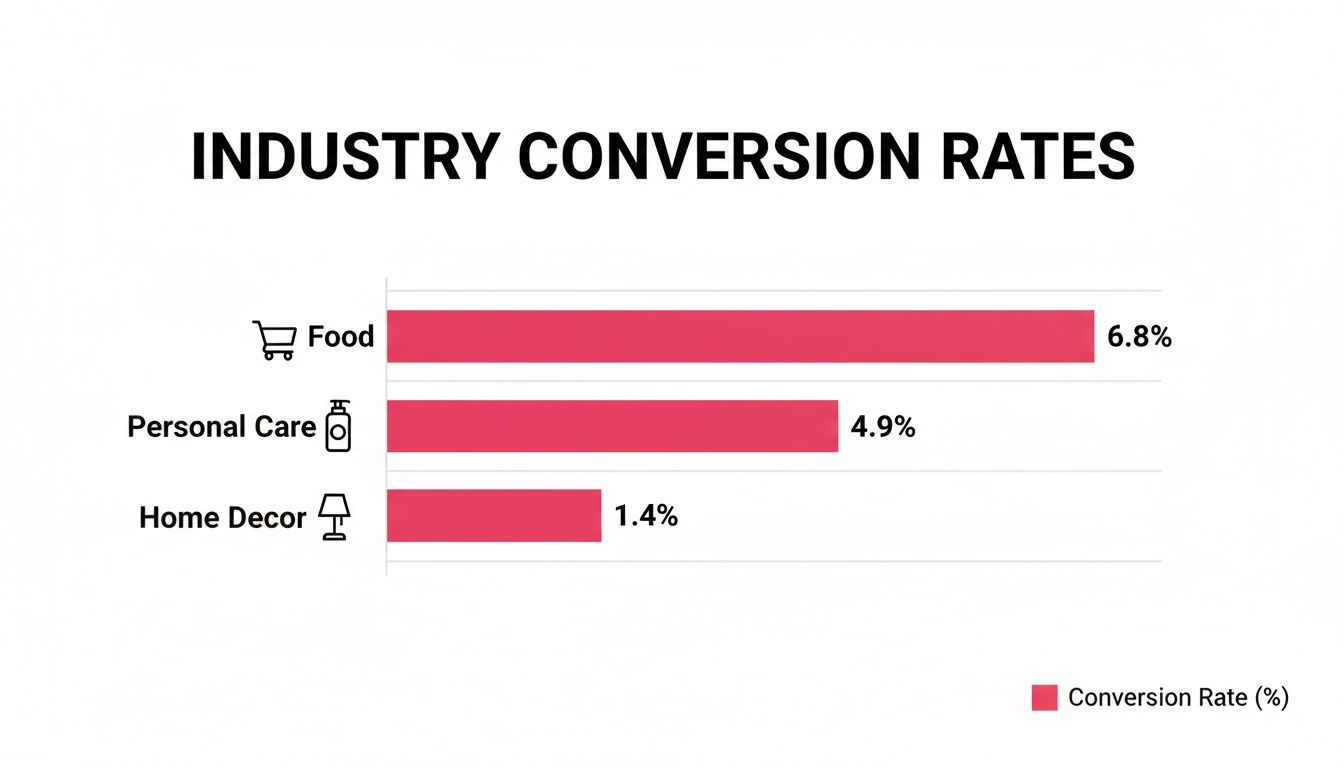
As you can see, industries like Food, which are all about frequent, low-cost buys, tend to have much higher conversion rates than something like Home Decor, where a single purchase requires a lot more thought and consideration.
The Desktop vs. Mobile Divide
One of the most stubborn gaps you’ll see in e-commerce is the difference between desktop and mobile conversions. Mobile phones now drive the majority of online traffic and sales, but they almost always convert at a lower rate than desktops. It’s a common pattern: shoppers use their phones to browse and do research, but then they switch over to a laptop or desktop to actually pull the trigger and buy.
This gap is usually all about user experience friction. Small screens, clunky checkout forms, and security worries can make shopping on a phone feel awkward and less trustworthy. For store owners, closing this gap is a massive opportunity for growth.
The big takeaway here is the need for a completely seamless experience on smaller screens. A great place to start is by implementing some proven strategies for mobile checkout optimization to smooth out the bumps and capture more sales from your on-the-go shoppers.
Traffic Source Performance
Data consistently shows that not all marketing channels are pulling their weight. The quality of traffic they send has a direct impact on what you can consider a good e-commerce conversion rate for your store.
The following table breaks down some of the most recent data, showing just how much performance can vary by where your visitors come from and what device they use.
Average Conversion Rates by Traffic Source & Device
| Source / Device | Average Conversion Rate | Key Insight |
|---|---|---|
| Referral | 5.4% | Visitors from trusted sources arrive with high intent, making this your top-performing channel. |
| Paid Search | 3.2% | Captures users actively looking for products, resulting in strong conversion rates. |
| Desktop | 5.06% | The larger screen and perceived security still make it the preferred device for completing purchases. |
| Mobile | 2.49% | Dominates traffic but lags in conversions. Optimizing the mobile UX is a huge opportunity. |
| Social Media | 0.7% | Primarily a discovery channel. Traffic has very low purchase intent, leading to poor conversions. |
The numbers don’t lie. A visitor from a high-intent channel like a direct referral or a targeted search ad is already halfway to the checkout before they even land on your site. Focusing your efforts on the channels that actually drive results is a must.
Key Factors That Influence Your Conversion Rate

Knowing the conversion benchmarks for your industry and traffic channels gives you a map, but the on-site experience is the actual journey your customers take. A smooth, trustworthy experience is what turns a casual click into a completed sale.
Think of your website as a system where everything works together. A weakness in one spot can easily undermine the strength of another. The goal is to get rid of friction and build confidence at every single turn.
User Experience and Site Performance
Your website’s usability is the bedrock of a good conversion rate. If visitors struggle to get around your store or find what they’re looking for, they’ll just leave. Slow page speed is a massive culprit; a delay of even one second can send your bounce rates through the roof.
Here are the key areas to nail down:
- Lightning-Fast Page Speed: Every second really does count. A slow site feels unprofessional and frustrating, pushing potential customers straight to your speedier competitors.
- Intuitive Navigation: Your menu and search bar should be simple and predictable. If someone can’t find a product, they can’t buy it. Simple as that.
- Mobile-First Design: The majority of your traffic is likely coming from phones. A clunky mobile experience isn’t an option anymore—it needs to be flawless.
A great user experience isn’t just about looking pretty; it’s about making the path to purchase as simple and effortless as possible. Each obstacle you remove is a direct boost to your conversion potential. For a deeper dive, check out these essential ecommerce UX best practices that can make a huge difference.
Building Trust and Confidence
Beyond just being easy to use, your store has to scream “trustworthy.” Shoppers are about to hand over sensitive payment details, and the slightest doubt can kill a sale on the spot. This is where your visual cues and clear communication become critical.
High-quality product photos and detailed, persuasive descriptions are your digital salespeople. They need to answer questions before they’re even asked and build a real desire for the product. A huge part of this is reducing uncertainty, which you can tackle with features like utilizing virtual try-on technologies for clothing or augmented reality for furniture.
On top of that, these trust signals are non-negotiable:
- Customer Reviews: Social proof is incredibly powerful. Real, authentic reviews build credibility and help shoppers feel much more confident in their decision.
- Security Badges: Displaying recognizable logos (like SSL certificates and payment provider seals) is a simple way to reassure customers that their data is safe.
- Transparent Policies: Hidden shipping costs are one of the biggest reasons for cart abandonment. Be completely upfront about all costs, shipping times, and your return policy to build lasting trust.
Turn Abandoned Carts Into Revenue with SMS
One of the biggest leaks in any e-commerce store’s bucket is cart abandonment. It’s a huge deal. Studies show that nearly 70% of all online shopping carts are just left behind, which means a massive amount of potential revenue is just vanishing into thin air.
This isn’t just a small drip in your sales funnel; it’s a gaping hole. While you should absolutely be optimizing your site for conversions, going after these high-intent shoppers is one of the fastest ways to see a real impact on your bottom line. They’ve already done the hard part—they found you, browsed your products, and decided they wanted something.
The Power of a Perfectly Timed Text
So, how do you get them back over the line? Email has been the go-to for years, but let’s be honest, inboxes are crowded and open rates are dropping. This is where SMS cart recovery completely changes the game.
Text messages have an insane 99% open rate, and most are read within just a few minutes of landing on a phone. That kind of immediacy cuts right through the noise, re-engaging customers at the very moment they might be having second thoughts or simply got distracted by the cat. It’s direct, it’s personal, and it’s incredibly effective at winning back those lost sales.
This is where a tool like CartBoss becomes a secret weapon for store owners on Shopify and WooCommerce. It automates the entire recovery process, sending perfectly timed, localized messages that feel more like a helpful nudge than an aggressive sales pitch. The whole point is to turn cart abandonment from a major headache into your single biggest revenue opportunity.
Think of it like this: a shopper adds a product to their cart, their boss calls, and they completely forget about it. An hour later, a friendly text pops up with a direct link that takes them right back to their pre-filled checkout. You’ve just wiped out all the friction and made it ridiculously easy for them to finish what they started.
Making Recovery Effortless and Effective
A solid SMS recovery strategy is about more than just sending a reminder. It’s about making the entire return journey as smooth and seamless as possible.
Great platforms automate a few key things to really crank up the conversions:
- Pre-Filled Checkouts: Sending a shopper back to an empty cart is a conversion killer. An effective SMS should always link directly to a checkout page where their cart items and info are already waiting for them.
- Dynamic Offers: Sometimes, all it takes is a little push. You can automatically toss in a unique discount code or a free shipping offer to provide that final incentive they need to click “buy.”
- Intelligent Timing: Sending a message too soon feels pushy, but waiting too long means you’ve lost the moment. Automated systems test and find the perfect send times to catch shoppers when they’re most likely to act.
This kind of automated, intelligent approach ensures you’re connecting with lost customers in the most impactful way. You can learn more about how to recover abandoned carts with text messages in our complete guide to see how these strategies play out in more detail. By putting a robust SMS recovery system in place, you’re actively improving your store’s conversion rate and turning lost interest into real profit.
Your Action Plan for Better Conversion Rates
Knowing your conversion rate is one thing. Actually doing something about it is where the real money is made. It’s time to stop just looking at the numbers and start turning them into a game plan.
First things first, you need a starting line. Before you can measure improvement, you have to know where you stand today. Hop into Google Analytics and figure out your average conversion rate over the last 30 to 90 days. This isn’t just a random number—it’s your baseline, your single source of truth.
A Simple Three-Step Framework to Get Started
With your baseline in hand, you can start making sense of it. This simple framework will keep you from getting bogged down in tiny, insignificant tweaks and instead focus you on what actually moves the needle.
- Benchmark Your Performance: How does your baseline stack up? Compare it against the industry and channel benchmarks we covered earlier. This is your reality check. It’ll immediately flag where you’re crushing it and where you’re falling behind. Is mobile traffic a weak spot? Is your paid search campaign not pulling its weight?
- Find the Leaks in Your Funnel: Now, dig into your analytics and find where customers are bailing. The biggest culprits are usually product pages with high exit rates or a clunky mobile checkout process. These are the friction points costing you sales. Polishing your site’s design can work wonders here; you can find some great small business website design tips to boost conversions to get you started.
- Prioritize the Biggest Wins: Let’s be real—you can’t fix everything at once. So, what’s the one change that will give you the most bang for your buck? For almost every e-commerce store, the answer is the same: tackling cart abandonment.
For a quick, high-impact win, setting up an automated SMS cart recovery solution like CartBoss is a no-brainer. It goes straight after high-intent shoppers who were this close to buying. It’s a powerful and incredibly efficient first move to see a real jump in your overall conversion rate.
This isn’t about guesswork. It’s a clear, manageable roadmap to making strategic improvements that show up directly on your bottom line.
Got Questions About Conversion Rates? We’ve Got Answers.
Let’s tackle some of the most common questions store owners have about their conversion rates with quick, straightforward answers.
How Often Should I Be Checking My Conversion Rate?
It’s tempting to refresh your analytics every hour, but try to resist. Checking your conversion rate daily is a recipe for anxiety. The numbers can swing wildly in short periods, which might trick you into making reactive, unhelpful changes.
A much better rhythm is to review it on a weekly or monthly basis. This gives you a big enough data set to see real trends without getting bogged down in the daily noise. For the big-picture strategy stuff, look at your quarterly or even year-over-year data to understand how your business is really evolving.
Can a Low Conversion Rate Still Be Profitable?
Absolutely. Profitability is about way more than just your conversion rate. It’s a dance between your rate, your average order value (AOV), and your profit margins.
Think about it: a high-end furniture store might have a conversion rate under 1% but still be incredibly profitable because every single sale brings in thousands of dollars. On the flip side, a store selling cheap, low-margin trinkets could have a 5% conversion rate and still be struggling to stay afloat. The key is to look at the whole picture.
The question isn’t just, “What’s a good ecommerce conversion rate?” It’s, “Is my current conversion rate building a profitable business?” A lower rate with high-value orders can easily beat a higher rate with tiny, low-margin sales.
What’s the Fastest Way to Improve My Conversion Rate?
If you want the single fastest lever you can pull, it’s implementing an automated SMS cart recovery system. It’s simple math: nearly 70% of all shoppers abandon their carts. These aren’t just random visitors; they are your hottest leads who were just one click away from giving you money.
Sending a perfectly timed text message that links them right back to their pre-filled checkout is the easiest win you’ll ever get. It cuts through the friction and brings back revenue that was about to disappear forever.
Ready to turn those abandoned carts into your biggest revenue stream? CartBoss uses automated SMS to recover lost sales and boost your conversion rate on autopilot. You can start recovering sales in less than 60 seconds at cartboss.io.