


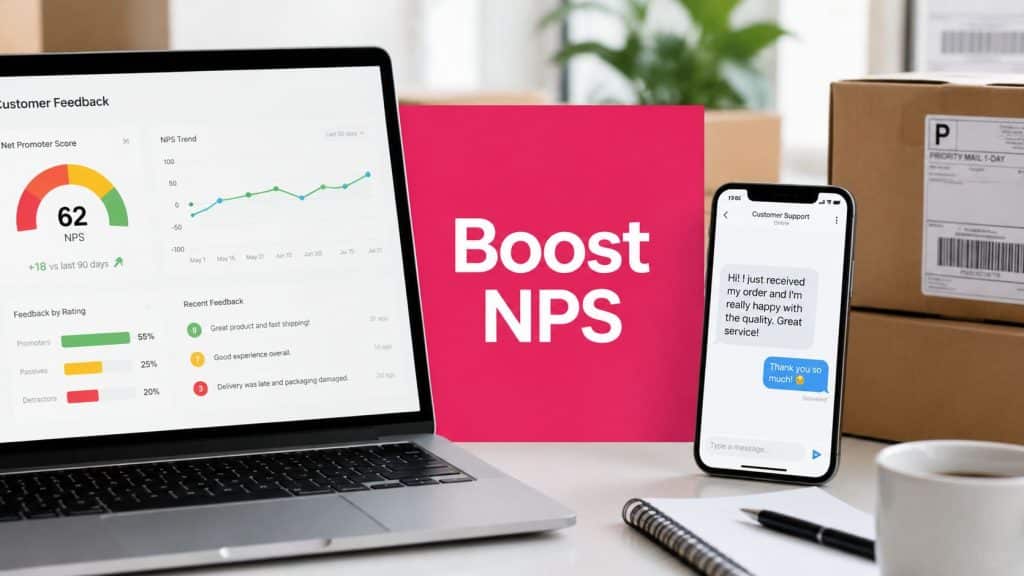
You just got the NPS results, and the number is lower than you hoped. The team wants answers, support is blaming shipping, marketing is blaming product pages, and the score itself still doesn’t tell you what to fix first. That’s the trap.
NPS score improvement starts when you stop treating the score like a verdict and start using it like a map. The score points to friction in the customer journey, but its full value comes from what customers say, where they say it, and how quickly your team acts on it. In e-commerce, that usually means building a feedback loop that runs through the same channels your buyers already use, especially SMS for fast post-purchase and post-support follow-up.
Why Your NPS Score Is More Than Just a Number
A low score can trigger panic, but panic doesn’t improve retention. What helps is treating NPS as a signal that something in the customer experience needs attention, then tracing that signal back to the actual purchase, delivery, or support moment that caused it. NPS is most useful when it points to the next operational fix, not when it sits in a dashboard as a weekly mood report.
The biggest mistake is collecting scores without a plan for follow-up. A score alone won’t tell you whether the issue is shipping speed, product quality, support tone, or a mismatch between what your store promised and what the buyer received. If your team can’t connect the score to a specific friction point, you’re measuring sentiment without learning from it.
Think like a merchant, not a report owner
E-commerce brands don’t need more metric theater. They need a way to see which customer moments create loyalty and which moments create regret. That’s why NPS works best when it sits inside a closed-loop system, where feedback leads to action, action leads to follow-up, and follow-up leads to another measurement cycle.
Practical rule: if a score changes but no customer experience changes with it, the program isn’t improving anything.
Use NPS as a compass, not a grade. That mindset keeps the team focused on what customers experienced, which is where the revenue impact lives.
For a broader view of the numbers that matter alongside NPS, see CartBoss’s guide to customer engagement metrics.
Set Up NPS Surveys That Deliver Actionable Insights
The quality of your NPS improvement depends on the quality of the question and the moment you ask it. In e-commerce, the highest-value feedback usually comes right after a purchase, after delivery, or after a support interaction, because those are the moments buyers remember most clearly. A relational survey can tell you how customers feel about the overall brand, while a transactional survey can capture a specific touchpoint before memory gets fuzzy.
The practical choice is simple. Use relational surveys for periodic relationship checks, then use triggered surveys for moments that matter, such as post-purchase confirmation, delivery completion, or support resolution. That combination gives you both the big picture and the operational detail you need to improve.

Ask less, but ask better
Keep the survey short. The core NPS question should stay simple, then follow it with one open-text question that asks why the customer gave that score. A second prompt asking what would improve the experience can help, but only if your team can act on the answer.
A clean survey flow might look like this:
- Score first: Ask the standard recommendation question.
- Reason second: Ask why they gave that score.
- Follow-up third: Ask what would improve their experience if the answer is negative or neutral.
- Permission last: Ask whether you can contact them about their feedback.
Segment responses from the start
Segmenting is where most store owners find hidden patterns. First-time buyers often describe uncertainty around product fit, repeat buyers may focus on reliability, and high-value customers can be more sensitive to service delays. If you don’t segment, those differences get buried inside one blended score.
Keep your operational setup focused on the data you already know. You usually don’t need a long demographic form if your CRM already tracks order history, product line, or customer status. What matters is that each response can be linked to a meaningful segment so you can compare patterns later.
For survey wording and placement ideas, CartBoss’s text-in-survey guide is a useful companion.
Analyze Feedback to Find and Prioritize Fixes
Once responses start coming in, the work shifts from collection to interpretation. The score itself matters less than the language customers use to explain it, because that’s where repeated issues show up. If detractors and passives keep mentioning the same problem, you’re looking at a root cause, not random noise.

The most effective workflow starts with triggered, segmented measurement. Use relational or transactional surveys, track results by segment, compare pre and post changes after each fix, and catalog the open-text comments so repeated complaints rise to the top. Then prioritize the highest-frequency or highest-value issues before you re-survey on a regular cadence such as quarterly or after key interactions, as outlined in ZoomInfo’s NPS workflow guidance.
Tag comments into clear buckets
Don’t overcomplicate the analysis. A simple tagging system is enough if your team uses it consistently. Common buckets might include shipping, product quality, support, pricing clarity, or checkout friction.
The point isn’t to build a perfect taxonomy. The point is to make repeated patterns visible fast enough that someone can act on them.
Use one pass to tag each response, then a second pass to group the tags by theme. If shipping complaints show up in multiple forms, for example, those should be treated as one operational issue until proven otherwise. If support comments mention both speed and tone, separate those issues so the fix is specific.
Prioritize by impact, not volume alone
Not every complaint deserves equal attention. A recurring issue that affects high-value customers or blocks repeat buying should move ahead of a cosmetic annoyance. That’s especially true in commerce, where one broken workflow can damage trust across multiple future orders.
A useful internal review session includes support, operations, product, and marketing. Each team hears the same customer language, then agrees on which issue can be fixed fastest and which issue has the biggest effect on loyalty. CartBoss’s customer feedback management resource fits well here if you want a cleaner process for organizing responses.
Use Automated SMS to Close the Loop with Detractors
Speed matters most when a buyer is unhappy. Email follow-up often arrives too late, especially in e-commerce, where the customer may already be frustrated, canceled, or bought elsewhere. SMS gives you a direct, immediate channel that fits the way shoppers already behave on mobile.
The channel choice matters because the buyer is usually still in the moment when the low score comes in. If you wait, the issue hardens into a story about your brand. If you answer quickly, you still have a chance to resolve the problem while trust is salvageable.

A useful gap in current NPS advice is channel-specific recovery for mobile-first commerce. For CartBoss’s audience, the unanswered question is how fast, personalized post-purchase or post-abandonment messaging affects not just response rates but actual loyalty and repeat buying across different languages and regions, which is why this NPS perspective on e-commerce messaging is especially relevant.
Build the recovery flow first
Trigger the text message the moment a low score is submitted. Route that response to the right owner, whether that’s support, operations, or a customer success lead. Then make the message personal enough that it sounds like a real reply, not a blast.
Here are three message patterns that work well in practice:
- Apology and help: “Thanks for the honest feedback. I’m sorry the experience wasn’t right. Reply here with the issue, and I’ll connect you with the right person.”
- Service recovery: “I saw your feedback and want to help fix this. If you’re open to it, reply with your order number and we’ll take a look right away.”
- Future re-engagement: “Thanks for sharing this with us. We’d like to make it right and earn another chance to serve you better.”
Keep the tone human
Don’t send a corporate script. A short, direct message feels more credible because it shows the team is paying attention. If the buyer replies, the conversation should move to one owner who can solve the problem, not bounce between departments.
Many teams make the same mistake here. They route feedback into a ticket queue and call that recovery. Real loop closure means a quick human response, a clear next step, and a follow-up that confirms the issue was solved. For implementation ideas on SMS automation, CartBoss’s automated text messaging guide is a practical reference.
Turn Promoter Feedback into Powerful Marketing Assets
Promoters are the easiest group to overlook because they don’t create urgency. That’s a mistake, because their feedback can become reviews, testimonials, and user-generated content that supports acquisition as well as retention. If someone is already enthusiastic, a respectful ask can turn private satisfaction into public proof.
The key is timing. Ask when the experience is fresh, usually after a successful delivery, a smooth support resolution, or a repeat purchase. At that moment, the customer has a clear reason to recommend you, and the request feels natural.
Ask for the right thing at the right time
Don’t ask every happy customer for the same asset. A recent buyer may be open to a review, while a loyal repeat customer might be better suited for a testimonial or a photo-based social post. Match the ask to the relationship.
A simple workflow looks like this:
- Identify promoters from NPS responses.
- Choose one ask based on how strong the relationship is.
- Send a short message that explains why their feedback helps.
- Make it easy by linking directly to the review or upload flow.
Keep the message respectful
The request should feel appreciative, not transactional. You’re not trying to pressure anyone into marketing for you. You’re giving satisfied buyers a quick way to help other customers make a confident decision.
Sample message:
“Thanks for the great feedback, it means a lot. If you’d be open to it, could you share a quick review of your experience? It helps other shoppers choose with confidence.”
For stores trying to turn local trust into broader credibility, this Google rating playbook is a useful companion.
Use promoter language in your own copy
Promoter comments often reveal the words customers naturally use to describe your brand. That language is gold for landing pages, ad copy, and post-purchase emails. If customers keep describing the same strength in their own words, mirror that phrasing in your marketing so the message sounds familiar and credible.
Don’t over-edit the voice. The best testimonials are specific, concrete, and easy for a future buyer to believe.
Build a System for Continuous NPS Improvement
NPS improvement only works when it becomes part of the operating rhythm. If the team reviews scores once in a while and then moves on, the same issues keep resurfacing. A durable system ties the feedback loop to product, support, and marketing decisions so every team sees its role in the customer experience.

The most effective lifts come from a closed-loop operating model, not survey collection alone. Assign ownership for detractor follow-up, respond quickly to hot negative feedback, and convert recurring themes into root-cause actions, with small achievable SLAs, cross-functional accountability, and attention on the top three to four complaint categories, as described in Strategex’s NPS improvement guidance.
Make feedback review a standing habit
Set a regular meeting with the teams that can fix what customers complain about. Product should hear recurring usability complaints, support should hear service breakdowns, and marketing should hear where expectations don’t match delivery. That shared review keeps everyone grounded in the same customer reality.
Then track the score alongside other indicators of customer health. NPS works best when it sits next to repeat purchase behavior, churn signals, and resolution speed, because those measures help confirm whether a score change reflects real experience change.
Practical rule: if the same complaint appears twice, it’s a pattern. If it appears across segments, it’s a priority.
Keep the loop moving
One fix rarely solves everything. What matters is whether the team keeps measuring, reviewing, acting, and checking again. That rhythm turns customer feedback into a management habit instead of a one-off project.
Over time, the strongest programs stop arguing about the number and start using the number to improve the business. This is the core value of NPS score improvement in e-commerce, it pushes the team toward faster recovery, clearer messaging, and better repeat buying.
If you want to turn customer feedback into a working revenue system, start by setting up triggered SMS surveys and a clear detractor follow-up flow. Explore CartBoss to see how automated messaging can help you recover abandoned carts, respond faster to unhappy buyers, and build a tighter loop between customer experience and repeat sales.