


Branded organic traffic converts at 5–12%, while non-branded transactional traffic converts at 3–6%, according to a 2026 organic search benchmark. The key decision isn’t whether branded or non-branded marketing is better, but how much budget each funnel stage deserves.
A Shopify store needs both motions. Branded demand is harvested, while non-branded demand is created. If you fund only branded campaigns, you capture existing intent without expanding your customer base. If you fund only non-branded acquisition, you pay to create demand and leave the eventual conversion touchpoints under-defended.
The right operating model separates campaigns, landing pages, conversion reporting, and margin expectations by intent. It also treats branded SMS cart recovery as a bottom-of-funnel conversion system, not as a generic retention channel.
Table of Contents
- What Branded vs Non Branded Really Means for E-Commerce
- The Two Types of Search Intent Every Store Owner Misses
- Side-by-Side Performance Comparison
- How to Split Your Budget by Growth Stage
- Why Branded SMS Is Your Highest-Impact Recovery Channel
- Measuring Both With One Simple Framework
- Two Real Scenarios From E-Commerce Stores
- Your 30-Day Branded vs Non Branded Action Plan
What Branded vs Non Branded Really Means for E-Commerce
Branded search includes any query containing your company, store, service, product, or SKU name. The definition covers organic results and paid search, as explained in this guide to branded search. A shopper searching for “Allure soy candles,” “Allure candles,” or a specific Allure SKU already recognizes the business.
Non-branded search excludes your brand name. These queries describe a category, problem, use case, or alternative, such as “fall scented candles” or “soy candles for gifts.” The shopper may be ready to buy, but your store still has to earn the choice.
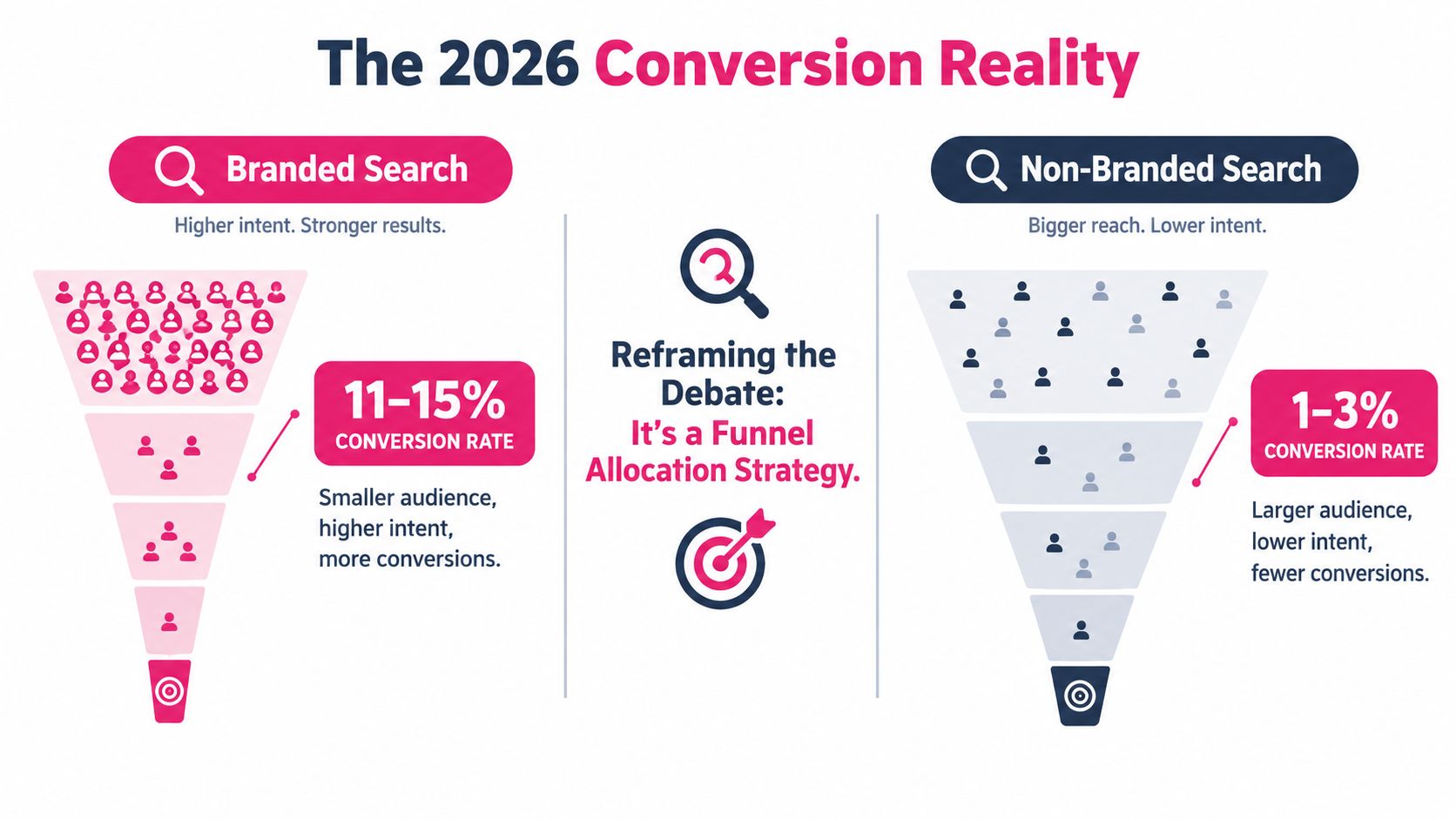
The funnel distinction matters
Branded traffic usually reflects recall, previous exposure, or an existing relationship. Non-branded traffic reaches shoppers earlier, while they compare products, read reviews, or define what they need. Non-branded keywords therefore support awareness and consideration, while branded terms capture demand that other channels have already helped generate.
Allocate budget by funnel stage, not by a branded-versus-non-branded preference:
- Branded campaigns harvest demand: Protect visibility, remove checkout friction, and send shoppers to the exact product, collection, or cart they expect.
- Non-branded campaigns create demand: Fund education, comparison content, reviews, merchandising, and landing pages that earn preference.
- Branded reporting protects truth: Separating existing demand from acquisition prevents search performance from making customer acquisition look cheaper than it is.
- Non-branded reporting protects growth: Immediate return may be weaker while the campaign introduces buyers who later search for your brand.
Practical rule: Judge demand-creation campaigns by their role in acquiring future customers, not by the same payback expectation used for demand capture.
Brand spend is not automatically wasteful because some shoppers might have converted organically. Test that assumption with controlled experiments and channel-level reporting. Defend branded terms when competitors, marketplaces, or resellers can intercept the click. Keep non-branded acquisition separate so it receives credit for creating demand.
A broader multi-channel marketing approach clarifies how demand moves between channels. Meta, creators, email, SEO, Google Shopping, and SMS can create branded searches, while search ads receive the final click. Cart recovery SMS then gives the store another branded touchpoint, reaching shoppers who already showed purchase intent and sending them back to complete the order.
The Two Types of Search Intent Every Store Owner Misses
Industry benchmarks consistently show branded organic traffic converts at roughly double the rate of non-branded transactional queries. That gap matters, but it does not justify treating all branded clicks as one audience. Search intent should determine the destination, bid, and follow-up experience.
A branded query can point to a specific need. Someone who finds your store through TikTok may search for the featured product. A returning customer may look for a replenishment item after an earlier order. A shopper searching by SKU expects the product page, availability, shipping information, and checkout access.
Separate campaigns and landing-page rules for store-name searches, product-name searches, SKU searches, support searches, and navigation terms such as “login” or “order status.” Sending each visitor to the homepage adds friction and wastes existing intent.
Non-branded intent has two different jobs
Non-branded traffic divides into two practical modes:
- Informational research: Queries such as “best merino wool socks” show category exploration. Use buying guides, comparison pages, product education, and content that helps shoppers choose.
- Transactional category intent: Queries such as “black running shoes size 10” express a clearer buying need. Use collection pages, product feeds, availability details, shipping information, and direct merchandising.
Prioritize faster testing for the second group because the shopper has already narrowed the problem. It still will not perform like branded traffic, but a focused landing page can match the request and shorten the path to purchase.
One product can require three campaign structures
A candle brand selling soy candles may need three campaign structures:
- Branded: “Allure soy candles.” Reinforce recognition and send shoppers to the relevant product or collection.
- Category transactional: “soy candles for gifts.” Explain scent profiles, gift packaging, delivery, and reviews.
- Seasonal discovery: “fall scented candles for autumn.” Lead with seasonal scents, merchandising, and a clear purchase path.
The product stays the same. The shopper’s knowledge changes. Behavioral targeting helps you build audiences around those differences instead of forcing every visitor into one retargeting pool.
In 2026, intent should determine the bid and landing page, not the branded or non-branded label alone. A high-intent non-branded query may deserve more aggressive bidding than a weak branded query, while a product-specific branded search needs a more direct experience than a store-name query.
Side-by-Side Performance Comparison
Allocate search and retention spend by funnel job. Compare four operating metrics: click cost, conversion rate, order value, and future customer value. Branded traffic usually captures existing demand, while non-branded traffic creates or expands it.
The available 2026 benchmark data, drawn from industry benchmarks, provides conversion ranges for branded organic traffic, non-branded transactional queries, and informational traffic. It does not provide verified e-commerce benchmarks for CPC, AOV, or LTV. Measure those metrics from your own store rather than importing assumed averages.
| Metric | Branded | Non-Branded |
|---|---|---|
| Typical intent | Navigational or recall-driven | Category, problem, competitor, or product research |
| Conversion benchmark | 5–12% for branded organic traffic | 3–6% for non-branded transactional queries |
| Informational traffic benchmark | Not applicable as a primary branded category | 0.5–2% for blog and informational traffic |
| CPC | Measure from your own paid-search account | Measure by category, match type, and competition |
| AOV | Measure by returning and branded cohorts | Measure by first-order acquisition cohorts |
| LTV | Compare repeat purchase and replenishment behavior | Compare first-order cohorts after acquisition |
| Primary role | Capture, defend, convert, retain | Discover, educate, acquire, expand |
Source: 2026 organic search benchmark. Figures are representative ranges. Measure store-specific CPA, AOV, and LTV directly.
Read the economics by job
Branded traffic often converts with less friction because shoppers already recognize the store. That can produce lower CPA and stronger immediate ROAS, but branded demand is capped by awareness. Higher bids cannot create branded searches that do not exist.
Non-branded acquisition offers more room to grow and more variation in quality. Separate transactional terms from informational terms. Transactional queries can drive first orders, while informational queries often require stronger proof, better education, and more follow-up before purchase. Non-branded keywords can reach shoppers during both awareness and consideration, so judge them by the funnel stage they serve rather than by one blended conversion rate.
AOV and LTV require cohort analysis. A returning shopper may place a smaller replenishment order and still generate more value through repeat purchases. A new non-branded customer may place a larger first order and never return. Compare contribution margin, repeat rate, subscription attachment, and refund behavior before shifting budget toward apparently efficient traffic.
Track these fields in a weekly export:
- CPC and CPA: Separate branded, non-branded transactional, and non-branded informational campaigns.
- Conversion rate: Compare equivalent landing-page and device segments.
- AOV: Separate first purchases from repeat purchases.
- LTV: Review cohorts by original acquisition query or campaign.
- Contribution margin: Include discounts, shipping, returns, and messaging costs.
Keep SMS recovery revenue separate from acquisition reporting. Review SMS marketing versus email marketing to choose the right recovery role and prevent retention revenue from inflating search performance.
Branded search protects profit. Non-branded search creates growth. Fund both, then judge each by its funnel-stage job.
How to Split Your Budget by Growth Stage
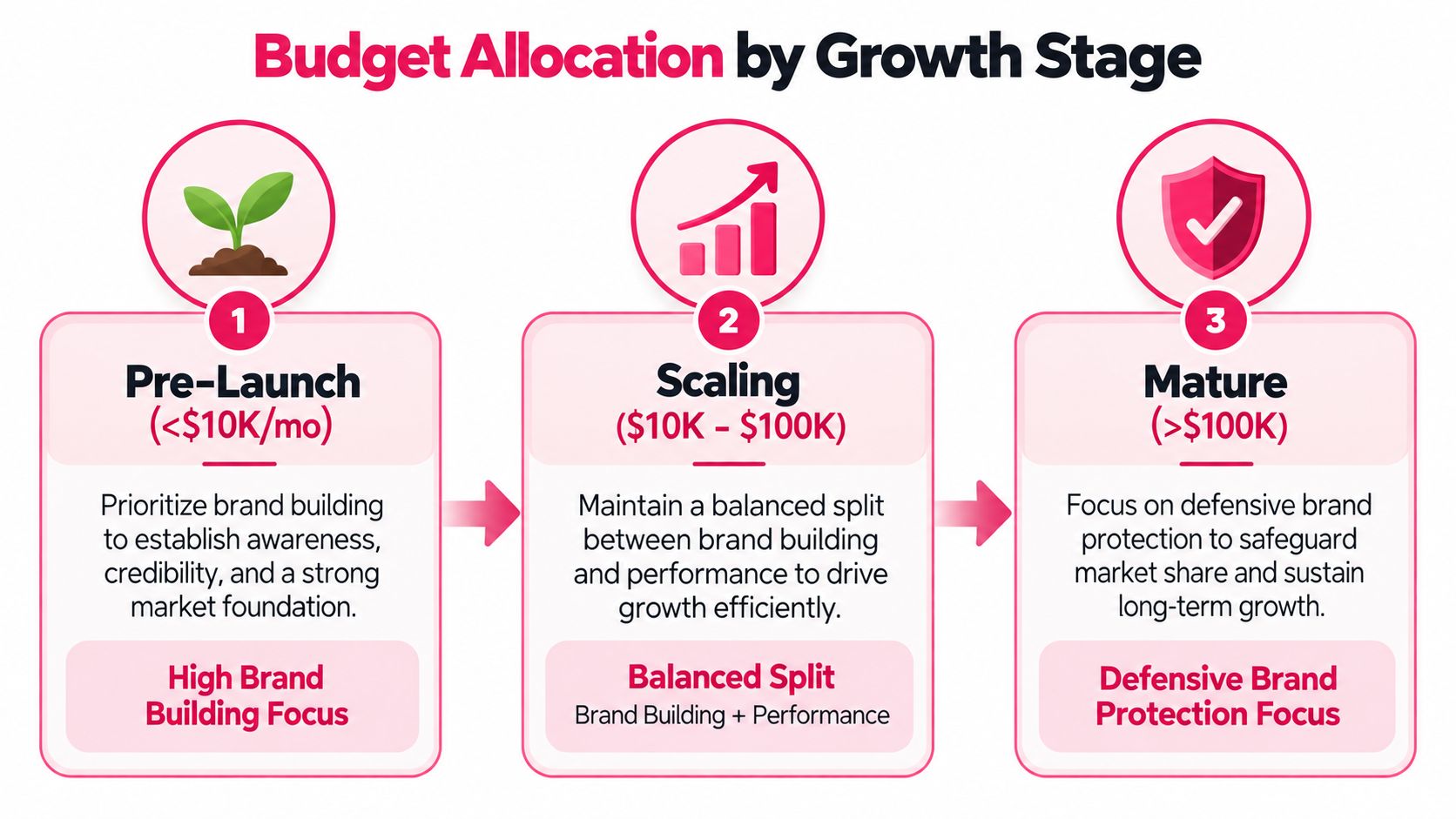
Don’t use a fixed 50/50 split. A store’s budget should reflect awareness depth, available demand, conversion evidence, and tolerance for acquisition payback.
Match the split to maturity
Pre-launch, under $10K monthly revenue: Put the emphasis on non-branded discovery, creator partnerships, category content, and conversion infrastructure. You have little branded demand to defend, so the priority is building reasons for shoppers to remember the store.
Scaling, from $10K to $100K monthly revenue: Keep non-branded acquisition as the larger allocation, then increase branded protection as search volume and competitor activity grow. Separate Google brand campaigns from category campaigns and make every budget change against revenue, not blended ROAS.
Mature, above $100K monthly revenue: Protect branded visibility, returning-customer paths, product searches, and retention flows. Continue funding non-branded acquisition, but don’t assume a mature brand can reduce growth spending only because branded campaigns look efficient.
A practical starting point for a scaling store is 70% non-branded acquisition, 20% branded search, and 10% branded SMS recovery. That’s a directional model, not a universal rule.
Worked example for a $40K Shopify store
For a store generating $40K per month:
- Allocate 70% to Meta prospecting, Google non-branded search, Shopping, and category content.
- Allocate 20% to exact-match brand defense, product-name searches, and branded Shopping protection.
- Allocate 10% to branded SMS recovery through CartBoss, with the store measuring recovered revenue against eligible abandoned-cart sessions.
The plan should change after a 30-day review. If non-branded campaigns attract profitable first orders and branded demand rises, increase acquisition carefully. If competitors intercept branded searches or product-page traffic becomes expensive to recover, strengthen brand defense and landing-page relevance.
A mature brand shouldn’t let branded spend disappear. It should keep a protected allocation while testing whether organic listings and direct traffic capture the same demand without paid support.
Pure non-branded acquisition can also make margin management harder as privacy restrictions reduce the precision of some audience signals. Use first-party customer data, clean consent records, and query-level reporting to compensate.
The funnel logic stays simple: non-branded supports top-of-funnel reach, branded search supports consideration and conversion, and branded retention channels support post-purchase value.
Use a written digital marketing budget allocation guide to document the assumptions behind each shift. A documented split prevents a strong branded month from hiding weak acquisition performance.
Why Branded SMS Is Your Highest-Impact Recovery Channel
A shopper who adds an item to the cart has already cleared several conversion barriers. They know the store, have assessed the offer, and showed enough intent to choose a product. The remaining obstacle is often shipping cost, payment friction, distraction, or a delayed decision.
Cart recovery therefore belongs in the branded retention layer of the funnel. A well-timed message names the store, references the abandoned cart, sends the shopper back to a prepared checkout, and addresses the most immediate source of hesitation. For Shopify stores, this makes SMS a direct recovery touchpoint rather than another broad acquisition campaign.
The brief includes CartBoss recovery benchmarks of 15–25% on the first SMS and 4–8% on a second timed follow-up, plus comparison figures for branded email and retargeting. Those claims are not supported by the verified data supplied for this article. Use them as unverified brief figures, not universal targets. Measure your own flow by customer segment, product margin, consent source, and time to purchase.
| Channel | Avg Recovery Rate | Open Rate | Avg Time to Conversion | Blended ROAS |
|---|---|---|---|---|
| Branded SMS | Measure first-touch and follow-up recovery separately | Measure delivered and clicked messages | Measure from send to completed order | Measure recovered contribution against messaging cost |
| Branded email | Measure by flow and customer segment | Measure delivered and clicked messages | Measure by send and conversion window | Include platform, creative, and discount costs |
| Branded retargeting | Measure post-click purchases | Measure impressions and clicks | Measure by attribution window | Exclude view-through revenue unless tested |
Build the flow around consent and compliance
SMS does not permit repeated promotions to every shopper. Consent language, opt-out handling, quiet hours, country rules, and sender registration influence deliverability and customer trust.
Some markets require branded sender IDs to be registered before use. An unregistered sender can be rejected or rewritten. Australia can take 7–10 days for branded sender ID registration, according to sender ID compliance guidance. Register each market before launching a high-volume campaign.
Registered sender IDs may improve deliverability by up to 25% versus unregistered numbers, according to SMS sender ID guidance. The same guidance says short codes may deliver messages up to 10 times faster than branded sender IDs, toll-free numbers, or long codes. Use a different sending route for urgent transactional alerts when the market and use case support it.
Set up a two-touch recovery sequence only after valid consent:
- First message: Identify the store, provide the cart link, and address the clearest checkout friction.
- Second message: Send a useful reminder or relevant incentive, then stop after an opt-out or purchase.
- Suppression: Remove purchasers and unsubscribers immediately.
- Testing: Compare recovery rate, post-discount margin, opt-outs, and complaint signals.
SMS produces strong recovery economics only when consent is valid, the cart link works, delivery is prompt, and discounts do not teach shoppers to postpone purchases. Compare the flow with email and retargeting using this guide to Shopify SMS marketing as a revenue channel. CartBoss can be included in that comparison as the attribution and automation layer, while your own margin data determines whether the channel earns more budget.
Measuring Both With One Simple Framework
A weekly dashboard should show how each funnel stage contributes to growth. Use one taxonomy for branded search, non-branded acquisition, retention, and SMS recovery. Review allocation before platform ROAS, because cheap branded conversions can hide weak demand creation.
The four-number weekly view
Track these metrics in one report:
- Branded and non-branded conversion rate: Compare like-for-like traffic. Branded organic visits usually convert more strongly than non-branded informational traffic, while product-focused non-branded queries sit between those extremes. Separate landing pages and intent before judging channel quality.
- CPA by channel: Report Meta prospecting, non-branded search, branded search, Shopping, email, and SMS separately. Include contribution margin when discounts or shipping costs vary.
- Branded search share of voice: Compare your visibility with the top three competitors across core brand and product terms. Rising share can indicate stronger demand, but it does not prove incremental revenue.
- SMS-attributed revenue per 1,000 sessions: Normalize recovered revenue by eligible traffic so seasonal demand does not create a false improvement.
Sources: 2026 organic search benchmarks and branded-versus-non-branded keyword guidance from Semrush. Store-specific figures should be measured directly.
A geo holdout can isolate branded lift. Pause branded search in one comparable region for 14 days, then compare branded organic movement and direct traffic with a control region. Keep competitor activity, promotions, and inventory changes documented. Do not make a budget decision from a single day.
Use attribution to challenge easy wins
Branded search often receives credit for shoppers who were already close to purchase. Keep the channel running when it protects demand efficiently, but do not use blended ROAS as the allocation rule.
A U-shaped model can assign 20% weight to the first-touch non-branded interaction and 40% weight to branded conversion touchpoints. Put the remaining credit into a middle-touch pool, then compare the result with last click. Use the model to decide where the next dollar belongs, not to declare one channel the winner.
Review on Monday morning. Reweight channels on Friday. Do not change budgets after a single order.
Two Real Scenarios From E-Commerce Stores
These store scenarios show how the same framework can produce different budget decisions. Treat them as planning examples, not independently verified case studies. The right allocation depends on funnel stage, brand demand, repeat behavior, and the quality of each channel’s conversion evidence.
Scenario A, mature skincare
A 14-month-old direct-to-consumer skincare brand generates $180K per month, with 6% brand search volume share and a 22% repeat buyer rate. Brand demand remains modest relative to revenue, so the growth team gives non-branded acquisition more budget through Meta prospecting and Google Performance Max.
The team assigns 70% of paid media to non-branded acquisition, 20% to branded search defense, and 10% to branded SMS recovery. Each channel receives its own contribution-margin target. The team then checks whether broader discovery creates more branded searches and repeat purchases, rather than judging performance through blended ROAS alone.
The scenario includes a notable SMS recovery lift. Because that figure is illustrative rather than verified, the team should validate it with CartBoss-attributed revenue, a holdout, or a pre/post comparison that accounts for traffic and offer changes. Its team sets a tracked SMS recovery target and validates it against actual CartBoss-attributed revenue. When branded share crosses its chosen threshold, the team can increase defensive search without reducing prospecting too sharply.
Scenario B, early coffee equipment
A six-month-old coffee equipment store generates $40K per month and has 1.8% branded traffic share. Its immediate priority is to capture category demand while protecting the limited recognition it has built. Competitor pressure matters, but broad prospecting should wait until product-query conversion and contribution margin are clearer.
The team shifts 70% of paid search spend into branded defense and Google non-branded exact-match campaigns, then keeps broader discovery tightly controlled. It sets separate ROAS targets for brand defense, exact-match category acquisition, and prospecting. One blended target would hide whether each funnel stage is earning its budget.
| Dimension | Early-Stage Coffee Brand ($40K/mo) | Mature Skincare Brand ($180K/mo) |
|---|---|---|
| Brand signal | 1.8% branded traffic share | 6% brand search volume share |
| Repeat behavior | Still being established | 22% repeat buyer rate |
| Primary move | Protect emerging demand and test exact-match category terms | Expand non-branded acquisition while defending growing brand demand |
| Directional allocation | 70% branded defense and exact-match non-brand search | 70% non-branded acquisition, 20% branded search, 10% SMS recovery |
| Reallocation trigger | Raise prospecting after category terms prove profitable | Raise brand defense when branded share and competitor pressure increase |
| Recovery measurement | Establish a baseline | Validate the illustrative SMS lift with CartBoss-attributed revenue before scaling |
The coffee store concentrates spend because its branded base is thin and category demand is the immediate growth lever. The skincare store commits more budget to non-branded discovery because repeat purchasing and brand demand provide a stronger base to monetize. In both cases, allocation follows funnel stage, not a permanent preference for branded or non-branded traffic.
Your 30-Day Branded vs Non Branded Action Plan
Start Monday with an account split, not a campaign launch. If your reporting combines branded and non-branded sessions, every later decision will be contaminated.
Week 1, audit and map
- Days 1–2: Export GA4 acquisition data and Search Console queries. Label brand names, product names, SKUs, category terms, competitor terms, and informational queries.
- Days 3–4: Map each query group to its current landing page. Flag branded traffic landing on the homepage when a product or collection page would be more relevant.
- Days 5–7: Pull Google Ads Search Term Reports. Check whether brand terms leak into non-branded campaigns and whether competitors appear in your auction insights.
Create a baseline with sessions, revenue, conversion rate, CPA, and contribution margin for each group.
Week 2, set the allocation
Set a directional ratio based on maturity and awareness. Launch exact-match branded defense with a low CPC ceiling, then create a negative keyword list that excludes brand terms from non-branded campaigns.
Audit your Shopping feed for product titles, brand attributes, variants, availability, and query matching. A weak feed can make branded and non-branded Shopping performance look like a bidding problem when the underlying issue is product relevance.
Week 3, deploy recovery
Configure a consent-based SMS cart recovery flow for branded visitors who abandon. Use three timed sends only if your legal basis, local requirements, and customer expectations support the sequence. Test the cart link, pre-filled checkout, unsubscribe handling, sender identity, and suppression after purchase.
Don’t judge the flow by clicks alone. Record delivered messages, opt-outs, recovered orders, discount cost, gross margin, and revenue per eligible session.
Week 4, measure and reallocate
Build one dashboard covering branded versus non-branded conversion rate, CPA, revenue share, and recovery revenue. Review it Monday, then make one controlled reallocation on Friday.
Use the situational rule as a starting point:
- Below 5% branded share: Defend emerging recognition first, but keep a focused non-branded acquisition test running.
- Above 20% branded share: Push harder on non-branded growth while protecting the branded demand already created.
- Between those levels: Let contribution margin, repeat purchase, competitor activity, and landing-page performance decide.
The URL above appears malformed relative to the required pre-uploaded asset URL, so use the exact supplied asset URL from the brief in production: `
CartBoss provides automated SMS cart-recovery campaigns, branded sender ID support, pre-filled checkout links, consent and suppression controls, and analytics for measuring recovered revenue. Visit CartBoss to connect branded bottom-of-funnel recovery with the wider branded versus non-branded allocation strategy.