


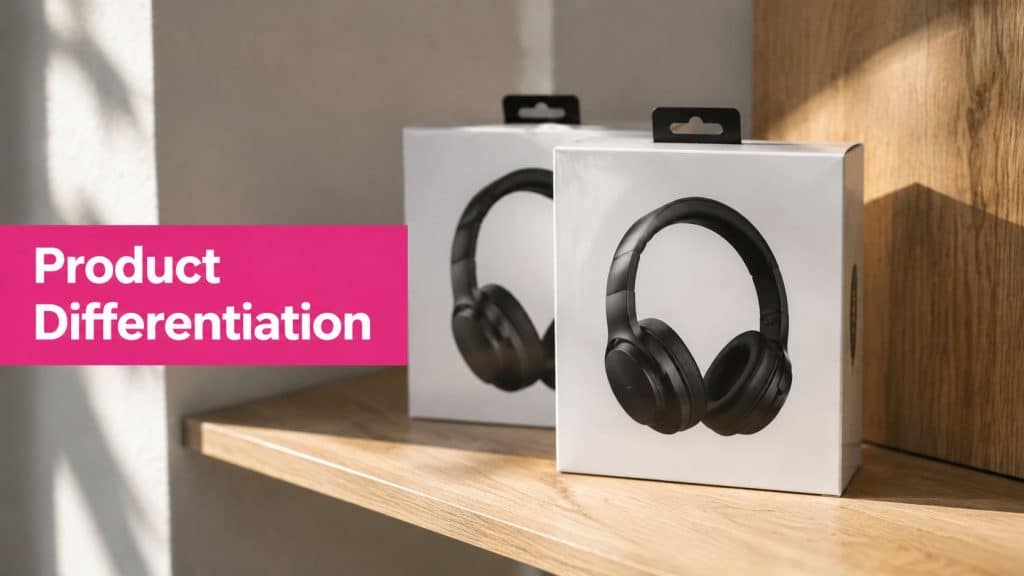
You’ve probably seen the pattern: a shopper lands on your product page, opens a competitor’s tab, compares nearly identical photos and prices, then leaves without buying. Your store may offer a good product, but the customer can’t see a compelling reason to choose it. In that situation, the problem isn’t always traffic or product quality. Often, it’s a weak definition of product differentiation in practice.
Product differentiation means creating meaningful distinctions that make your offer a less interchangeable choice. Those distinctions can involve the product, price, design, customer experience, brand, or post-purchase service. The important question isn’t, “How are we different?” It’s, “Which difference matters enough for this customer to notice, trust, and act on?”
The Problem With Indistinguishable Products
Consider a small apparel store selling everyday jackets. The materials are similar to competing products, the product photos use the same neutral backgrounds, and the store’s promise is “high quality at a great price.” A shopper can’t immediately tell what makes this store safer, easier, or more valuable than the alternatives. The merchant then responds with discounts, which may create a sale but also trains customers to wait for a lower price.
This is the practical cost of sameness. Customers compare price because the store hasn’t given them a stronger comparison point. They also hesitate when they can’t judge fit, durability, delivery expectations, or support with confidence. For products where fit creates uncertainty, resources such as Robosize’s guide on how to judge fit for online shopping can help merchants think more clearly about the information shoppers need before purchasing.
Edward Chamberlin introduced product differentiation formally in 1933 through The Theory of Monopolistic Competition. His argument challenged the assumption that products within an industry are perfect substitutes. Buyers may prefer one variety because of features, branding, service, or other real or perceived attributes, giving the seller some market power beyond pure price competition. Product differentiation in economic theory remains useful because it explains why customers can value similar products differently.
Practical rule: If customers can replace your product with a competitor’s offer without giving up anything they care about, you’re competing mainly on price.
The same issue appears after a shopper leaves. A generic reminder may bring attention back to the cart, but it doesn’t repair the uncertainty that caused abandonment. Understanding what drives customers away helps you identify whether your differentiation should address fit, trust, convenience, value, or another obstacle.
This guide focuses on differentiation that buyers value, not novelty for its own sake. You’ll learn how to define the concept, distinguish horizontal and vertical approaches, evaluate four practical differentiation channels, and apply the idea to cart recovery and retention.
What Is Product Differentiation
The clearest definition of product differentiation is the process of distinguishing a product or service from competing alternatives so it becomes more relevant and recognizable to a target audience. That definition is practical, but economics adds an important layer: differentiated products are imperfect substitutes. Customers may choose a competitor, but switching means losing an attribute they value.

Break the concept into four working questions:
- What changes? Identify the attribute that separates your offer. It could be a material, fit tool, delivery model, subscription structure, support process, or brand position.
- Who notices? A difference only matters when a defined customer segment recognizes it. A technical feature may matter to experienced buyers but mean nothing to first-time shoppers.
- What value does it create? Translate the feature into a customer outcome. “Pre-filled checkout” describes a function. “Less retyping when returning to finish an order” describes the value.
- Why is it credible? Product pages, reviews, demonstrations, policies, and post-purchase communication must support the promise.
A strong differentiator creates a value gap between your store and the alternatives. It might reduce uncertainty, save effort, improve confidence, or make the experience feel more personal. It doesn’t need to appeal to everyone. In fact, trying to satisfy every buyer often produces vague messaging that nobody remembers.
For a useful messaging exercise, compare your draft promise with these unique value proposition templates. Then replace broad claims with a specific customer, problem, outcome, and reason to believe.
Personalization can also turn a common product into a more relevant offer. A recommendation based on browsing behavior, a customized bundle, or language-specific messaging can make the experience less interchangeable. The practical connection between relevance and conversion is explored in personalization in digital marketing.
Horizontal Versus Vertical Differentiation
Not every difference works in the same way. Horizontal differentiation reflects preference diversity. Customers disagree about which option is best because they value different styles, flavors, colors, layouts, or use cases. Vertical differentiation reflects a shared quality ranking. Customers generally agree that greater durability, speed, capacity, or reliability represents a higher level of quality, even if they disagree about whether the extra cost is worthwhile.
| Differentiation Types Compared | Customer Agreement | Strategy Implication | Example |
|---|---|---|---|
| Horizontal | Buyers disagree about which option is best | Offer meaningful choices and target distinct preferences | Clothing color, packaging style, or coffee flavor |
| Vertical | Buyers share a quality ranking | Prove the higher quality and connect it to a defensible price | A more durable product or a faster service level |
The distinction affects merchandising. A horizontally differentiated store should help shoppers find the option that fits their taste or situation. Filters, quizzes, style collections, and clear use-case categories can make preference-based choice easier. The store isn’t trying to prove that one design is objectively superior. It’s helping the right customer recognize a personal fit.
Vertical differentiation requires evidence. Claims about construction, performance, materials, or support need demonstrations, specifications, comparisons, warranties, and credible customer feedback. A premium price makes sense only when customers can understand what additional value they receive.
Economic analysis describes the operational difference clearly. In a vertically differentiated market, equal pricing can push demand toward the highest-quality option because customers share the same ranking. In a horizontally differentiated market, multiple sellers can coexist because buyers prefer different attributes or combinations, as explained in this technical overview of product differentiation.
Buyers don’t need your product to be universally better. They need it to be clearly better for the job they’re trying to complete.
Use behavioral segmentation in marketing to identify whether customers choose based on preference, performance, convenience, or a blend. That answer should shape your product filters, landing pages, offers, and follow-up messages.
Four Primary Types of Differentiation
E-commerce brands usually differentiate through four connected channels: features, price, user experience, and branding. Each can work, but each carries a different cost and risk. The strongest stores combine them without making the customer decode a confusing promise.

Product features
Features can create a visible distinction when they solve a specific problem. An apparel store might offer a measurement tool, fit preview, or custom configuration. A skincare brand might make ingredient sourcing easier to understand. A home goods retailer might provide modular replacement parts rather than requiring a full replacement.
The failure mode is feature accumulation. Every added capability brings development, support, education, and maintenance costs. If customers don’t notice or use it, the feature adds complexity without strengthening the purchase decision.
Price
Price differentiation can position a store as accessible, premium, bundled, or unusually transparent. It can attract attention quickly, but it’s difficult to defend when competitors can match the reduction. Economic analysis also identifies a broader trade-off: differentiation can reduce direct price comparability, but creating and defending uniqueness may increase average production costs through design, marketing, or service investment, as discussed in this FTC policy analysis of product differentiation and imperfect information.
User experience
UX includes navigation, search, product comparison, checkout, support, delivery updates, and post-purchase engagement. A store can sell a familiar product but make buying it substantially clearer and less stressful. That advantage should appear in the interface, not just in a slogan.
Watch this practical example of a digital customization experience, then ask where your own store creates avoidable friction.
Branding
Branding gives customers a reason to identify with the offer. Consistent visual language, tone, values, packaging, founder perspective, and service behavior can make similar products feel meaningfully different. Online businesses can also differentiate through post-purchase engagement and customer experience, not only through the product itself, as outlined in this e-commerce differentiation guide.
Audit each channel with a simple checklist:
- Product: What does the item do that customers notice?
- Price: Why does the price feel justified or distinct?
- Experience: Where does the buying process remove effort?
- Brand: What does choosing this store say about the customer?
Then connect those answers to revenue priorities. If you want to increase basket value, review the merchandising ideas in how to increase average order value. A differentiated bundle, guided add-on, or premium option should reinforce the same customer value rather than introduce an unrelated promotion.
Why Being Different Isn’t Enough
A store can be distinctive and still lose sales. A new color, unusual tagline, or extra feature may look impressive in an internal presentation but fail to change what shoppers do. Difference becomes differentiation only when customers notice it, care about it, and use it to choose.
That’s why “unique” is a weak success criterion. A product can be unique because it includes an option nobody requested, uses language customers don’t understand, or adds steps to a process they already find difficult. In each case, the business invested in separation from competitors without creating a meaningful reason to buy.
Start with customer value
Ask customers what they were trying to accomplish when they searched for your product. Look for recurring friction in reviews, support tickets, search queries, returns, and checkout behavior. Then connect each proposed difference to a problem:
- Does it reduce uncertainty?
- Does it remove effort?
- Does it improve the outcome?
- Does it support a customer identity or preference?
- Would the customer pay more, choose faster, return, or recommend because of it?
The answer may be “no.” That’s useful. It keeps the team from funding additions that sound exciting but don’t influence the decision.
Validate before investing
Create a short value-alignment test for every proposed differentiator:
- Write the customer problem in the customer’s language.
- Describe the difference without internal product terminology.
- Show how the alternative handles the same problem.
- Ask existing or target customers to rank the options.
- Check whether the difference affects product selection, message engagement, or repeat behavior.
The Simon-Kucher perspective on product differentiation makes the central point well: differentiation should align with attributes customers value, whether those involve product, pricing, design, or experience.
The strongest differentiator is often the one customers can explain to someone else without reading your product page.
Also account for the cost of maintaining uniqueness. Design work, paid promotion, customer education, service capacity, packaging, and operational changes can all consume margin. A feature that wins attention but creates expensive support may be weaker than a simpler improvement customers immediately understand.
Measure outcomes that match the promise. If the difference promises confidence, monitor returns, product questions, and checkout completion. If it promises convenience, monitor time to purchase, support contacts, and repeat orders. If it changes only your copy but not customer behavior, you’ve created a positioning statement, not a durable differentiator.
Applying Differentiation to Cart Recovery
Differentiation doesn’t stop when a shopper adds an item to the cart. The recovery experience can either repeat the same generic reminder used by every store or reinforce the value that made your product worth considering.
Start by identifying the likely abandonment friction. A shopper may need reassurance about fit, a clearer delivery expectation, a simpler checkout, or a reminder of why the product suits their needs. Your message should answer that specific concern instead of sending, “You forgot something.”
SMS is useful for time-sensitive recovery because independent benchmarks report open rates around 93% to 98%, with messages often viewed within minutes, according to SMS marketing benchmark data. That speed creates an opportunity to deliver a concise, branded message while the shopping context remains fresh.
A practical recovery flow can look like this:
- Remind: Show the product name or cart detail so the customer recognizes the message.
- Reinforce: Repeat one value-aligned difference, such as a fit tool, material benefit, or simplified checkout.
- Reduce friction: Send the customer to a checkout path with relevant details preserved.
- Use incentives carefully: Apply a discount only when price is the actual obstacle, not as the default response.
- Respect consent: Include clear opt-out handling, follow applicable privacy rules, and honor do-not-disturb preferences.
Tools such as CartBoss provide automated SMS workflows, pre-written messages, pre-filled checkout forms, dynamic discount application, branded sender identification, language detection, and compliance features for abandoned cart recovery. Those capabilities can support differentiation when the recovery message reflects the store’s actual promise rather than functioning as a disconnected coupon blast.
The checkout experience matters as much as the message. Review this guide on using abandoned cart recovery text messages to optimize checkout and map every click between the SMS and completed order. For broader campaign inspiration, compare your messaging with an e-commerce advertising strategy from DesignGuru, then adapt the principles to your audience and offer.
Track recovery by message engagement, completed checkout, discount use, unsubscribes, repeat purchases, and customer feedback. The objective isn’t merely to retrieve one order. It’s to show the same useful difference before, during, and after purchase, so recovery supports retention instead of weakening your brand with constant discounts.
CartBoss automates abandoned-cart SMS recovery with features such as pre-written campaigns, dynamic discounts, pre-filled checkout, multilingual messaging, and compliance controls. Visit CartBoss to connect your differentiation strategy with a more relevant recovery experience and start turning qualified abandoned carts into completed orders.