


Most abandoned carts aren’t forgotten carts. They’re often stalled by shipping costs, checkout friction, uncertainty, or a shopper who was only comparing options. Sending a bigger discount faster may recover some orders, but it can also train customers to wait for coupons, reduce margin, and increase opt-outs.
Effective SMS remarketing starts with a better question: what stopped this shopper from buying, and what can the next message remove? The answer determines the timing, copy, offer, checkout link, consent basis, and measurement plan.
This guide treats SMS as an operating system for recovery, not a stream of urgent coupon blasts. You’ll learn how to diagnose abandonment, build a timed sequence, match messages to specific obstacles, collect auditable consent by market, measure incremental profit, and automate the operational details that cause most recovery programs to fail.
Table of Contents
- Why SMS Remarketing Beats Email for Cart Recovery
- Timing Your SMS Remarketing Sequence
- Matching Messages to Why Shoppers Abandon
- Building Compliant SMS Consent Flows by Market
- Measuring Real ROI Beyond Recovered Orders
- Automating and Scaling With SMS Remarketing Tools
Why SMS Remarketing Beats Email for Cart Recovery
The assumption that every abandoned cart represents forgetfulness leads to poor automation. A shopper may have been “just browsing,” discovered unexpected delivery charges, struggled with a mobile form, or decided that the product wasn’t urgent. A discount cannot fix every one of those problems.
SMS still has a structural advantage when the shopper has high recent intent. A text appears in a mobile-native environment, can be read quickly, and can take the recipient directly to a saved checkout. Email remains useful for longer explanations, product education, and broader lifecycle communication, but a text is often better suited to a short path from reminder to action.
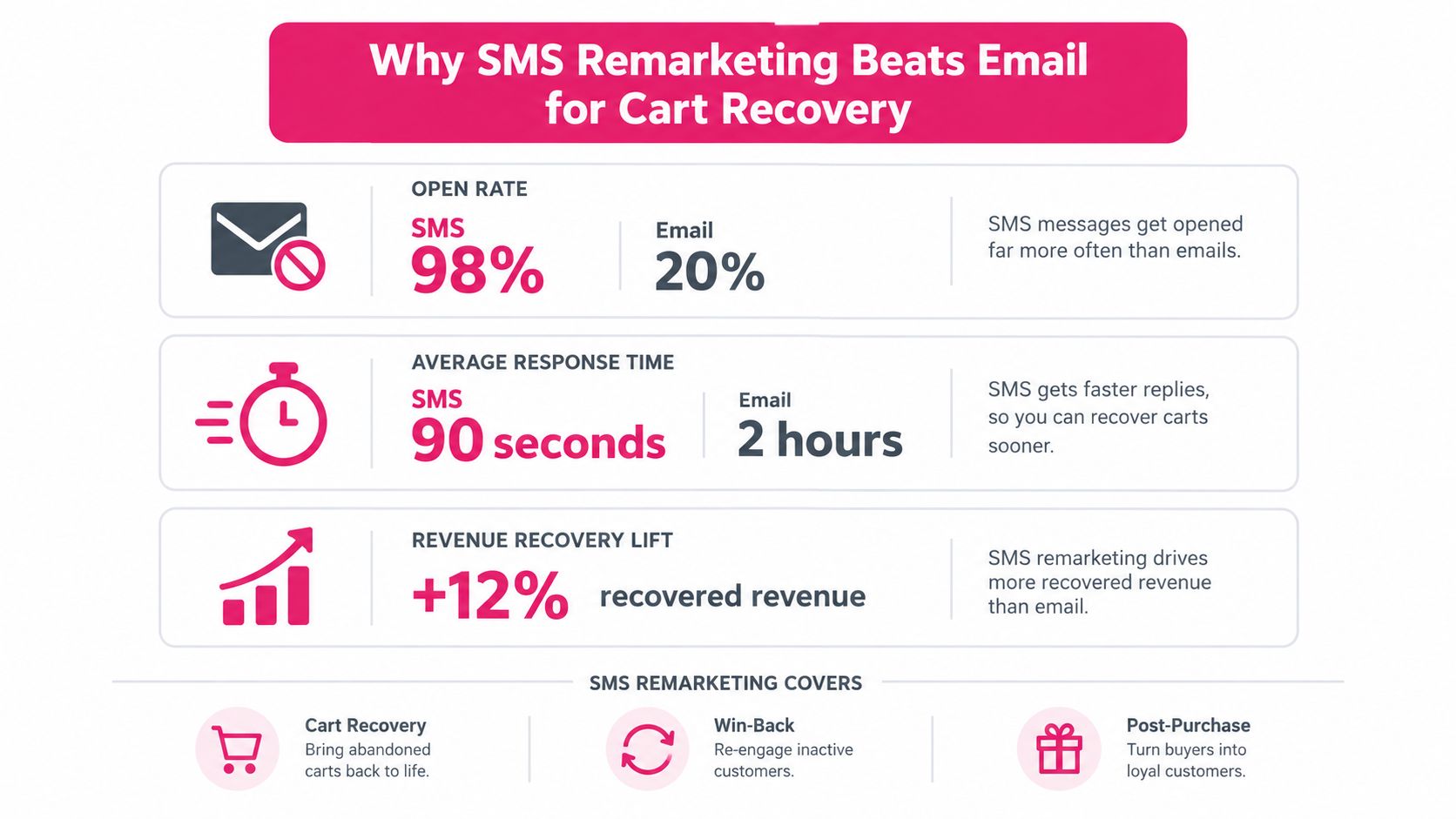
Multiple benchmark compilations place SMS open rates at approximately 98%, compared with roughly 20% for email. Other reports estimate that about 90% of recipients read a text within three minutes. The same benchmark data places average SMS response rates near 45%, versus approximately 6% for email. These figures are reported benchmarks, not guarantees, and SMS doesn’t offer email-style open tracking, so they shouldn’t become a universal “99% open rate” promise. See the SMS benchmark context behind these comparisons before using them in a forecast.
What SMS remarketing actually includes
Cart recovery is the most obvious use case, but it isn’t the whole channel. A permission-based program can also include:
- Win-back messages: Reconnect with customers who previously purchased but have gone inactive.
- Post-purchase communication: Provide useful updates, replenishment prompts, or relevant follow-up offers.
- Checkout recovery: Return shoppers to the exact cart or checkout state instead of sending them to a generic homepage.
- Reply-based support: Give customers a direct way to ask about shipping, sizing, availability, or payment.
That direct path is valuable, but pressure must stay proportionate to intent. A low-pressure reminder can protect trust more effectively than a dramatic offer, much as customer-retention teams protect revenue by addressing the reason people leave. For broader retention thinking, this guide on how to reduce customer churn with Querio is useful context.
Email and SMS work best as complementary channels, not as a winner-takes-all decision. This comparison of text messages vs. emails can help define which channel belongs at each stage.
The practical playbook is straightforward: segment by behavior, send while intent is fresh, write one clear action, suppress buyers immediately, preserve consent records, and judge the program on incremental profit rather than attributed orders. The rest of the system exists to make those decisions consistently.
Timing Your SMS Remarketing Sequence
Fast sending is not a recovery strategy by itself. Cart intent can fade quickly, yet a rushed message cannot fix unclear shipping, a difficult checkout, or simple hesitation. Build the sequence around the likely cause of abandonment, then stop it immediately when the shopper buys or opts out.
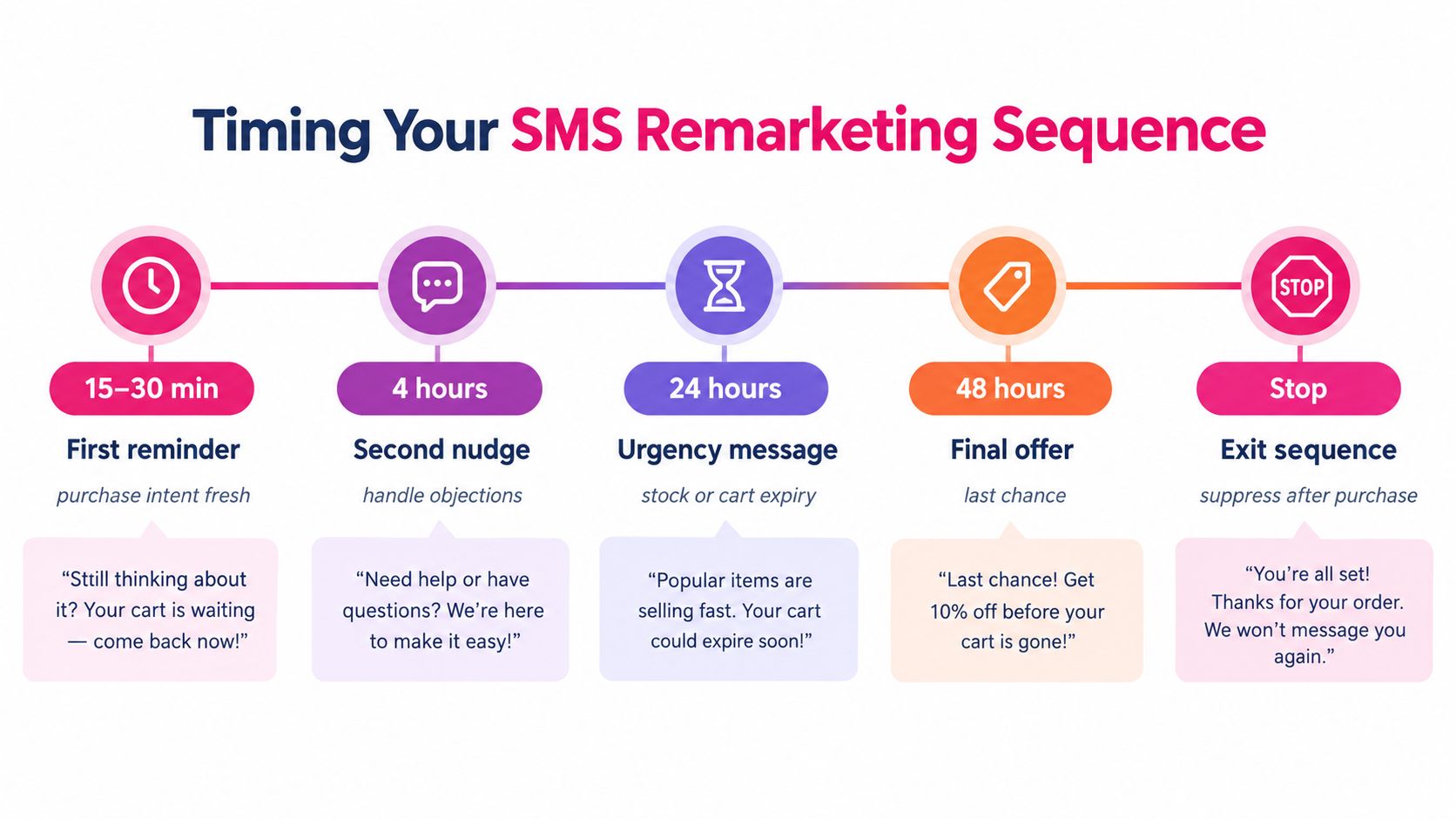
A practical starting schedule is:
- Send the first reminder after 15–30 minutes. Name the product or cart and provide one mobile-optimized checkout link. Send shoppers back to their saved cart, not the homepage, so they do not have to rebuild it.
- Send a second message 8–24 hours later. Restrict it to shoppers who have not converted. Use the message to clarify delivery, answer a likely objection, or test a modest incentive.
- Use a final message selectively. It can create measured urgency, request feedback, or recommend a relevant product. Do not send it automatically to every shopper.
Reported recovery rates for first messages sent in the 15–30-minute window are approximately 12–18%, compared with 6–9% when the first message is delayed beyond 60 minutes. Later follow-ups typically recover about 4–7% of remaining shoppers. Treat these as directional benchmarks from abandoned-cart SMS timing guidance, not revenue promises. For detailed send-time windows and quiet-hour rules, use this guide to when to send abandoned cart text messages.
A sequence that earns the next message
The first text should remove one small obstacle and make returning easy:
First reminder: Your cart is saved. Resume checkout for [product] here: [link]
If the shopper does not buy, change the treatment rather than repeating the same line with stronger pressure. A second message can clarify shipping, show the free-shipping threshold, or address another known concern:
Second message: Still considering [product]? Your cart is ready. See delivery details and complete checkout: [link]
Use an incentive only when the segment and unit economics support it:
Selective offer: Your saved cart is waiting. Use [code] at checkout if you decide to complete your order: [link]
A discount belongs in a test plan, not in every flow. Compare reminder-only and incentive variants, then add a holdout group. That comparison shows whether the offer generated incremental purchases or reduced margin on orders that would have occurred anyway.
Suppression is the operating rule that protects trust. Connect purchase events to the flow, cancel pending reminders after payment, cap frequency across campaigns, and process opt-outs immediately. Localize currency, checkout links, and send times. A message sent after purchase or during an inappropriate local hour can create more harm than a weak reminder can recover.
The infographic presents a five-step timeline, but a live campaign may need fewer steps. A two-message flow can suit a high-consideration product, while a final contact may fit a short inventory window. Test each schedule against a control group instead of copying the sequence blindly.
Matching Messages to Why Shoppers Abandon
A recovery message should behave like a service intervention. If the shopper abandoned because shipping looked expensive, the text should clarify shipping. If the checkout was difficult on mobile, the message should restore a simple checkout state. If the customer was only browsing, a hard discount can create unnecessary margin leakage.
Baymard’s quantitative research found that 42% of U.S. online shoppers had abandoned a cart in the previous three months because they were “just browsing” or not ready to buy, while 17% abandoned because checkout was too long or complicated. Those findings support a sequence that begins with reassurance and convenience, not an automatic coupon. The Baymard checkout usability research provides the relevant context.
| Likely Abandonment Cause | Best SMS Treatment | Example Offer |
|---|---|---|
| Just browsing or not ready | Low-pressure reminder with product context | No offer initially |
| Unexpected shipping cost | Transparent delivery information or free-shipping threshold | Free shipping when the threshold is met |
| Price sensitivity | Explain value first, then test a controlled incentive | Limited discount or fixed offer |
| Long or complicated checkout | Deep link to a simplified, mobile-ready checkout | No discount required |
| Mobile friction | Pre-filled checkout and localized payment path | Convenience instead of a coupon |
| Uncertainty about delivery or returns | Show delivery timing and return reassurance | Product reassurance |
Treat the obstacle, not the symptom
For shipping-related abandonment, clarity often beats a generic discount. A shopper who sees a lower product price but encounters an unexpected delivery charge can still leave. Test copy such as:
- Shipping transparency: Your cart is saved. Shipping starts at [amount], and returns are free. Complete checkout: [link]
- Free-shipping threshold: You’re [amount] away from free shipping. Add an eligible item or complete your order here: [link]
- Delivery reassurance: Your [product] is available for delivery to [location]. Review the delivery details and finish checkout: [link]
The example uses placeholders because the message should pull real store data. Don’t promise free delivery unless the cart and destination qualify.
Checkout friction requires a different treatment. Send shoppers back to the saved cart or a pre-filled checkout rather than a category page. A useful test compares a basic resume link with a version that restores customer information and reduces form completion. Measure completed checkouts and profit, not just link clicks.
Let hesitation breathe
A “just browsing” shopper hasn’t necessarily rejected the product. The first message should remind them what they considered and make returning easy:
You were looking at [product]. Your cart is still saved if you’d like to take another look: [link]
A second message can provide useful reassurance:
Still deciding on [product]? See shipping, returns, and product details here: [link]
Only after that should an incentive enter the test, and even then it should be limited to shoppers for whom price appears to be the obstacle. The goal isn’t to maximize coupon use. It’s to recover profitable demand while learning which objection blocked the purchase.
Building Compliant SMS Consent Flows by Market
A phone number is contact data, not automatic marketing permission. Checkout may collect it for delivery updates, while a later cart reminder promotes a purchase. Treating those uses as interchangeable creates compliance and list-quality problems.
For US recipients, promotional SMS is governed principally by the TCPA and related FCC rules. Express written consent specifically for marketing texts is required under the CTIA consent framework. Email or voice-call permission does not automatically extend to SMS. Unsolicited promotional texts can also expose a business to statutory damages, depending on the circumstances. Review the CTIA Messaging Principles and Best Practices when configuring consent and opt-out handling.
Build the opt-in around the message type
Use a separate, unchecked SMS field for promotional messages. Identify the business, explain that recurring marketing texts may be sent, state that consent is not required to purchase, and provide clear STOP instructions.
Record the details that let an operator prove what happened:
- Separate SMS checkbox: Keep email, phone, and SMS permissions distinct.
- Clear sender identity: Name the store or legal business sending the texts.
- Message description: State whether messages include cart reminders, promotions, or both.
- Opt-out instruction: Explain how recipients can stop messages, including STOP where applicable.
- Consent evidence: Store the displayed wording, source, timestamp, jurisdiction, and policy version.
Use different rules for transactional and promotional content. An order confirmation or delivery update supports an operational purpose. A cart reminder with a discount, urgency, or product recommendation may be advertising, so a number collected for service communication should not automatically qualify it for marketing.
A useful audit should check both the front-end wording and the records behind it. Use this SMS compliance checklist by market to review consent wording, evidence storage, and opt-out handling.
Apply a market-specific decision rule
For European traffic, align consent and data use with GDPR and applicable electronic-marketing rules. The UK’s ICO explains that consent for email or phone calls does not automatically cover text-message marketing, so permission must identify the electronic marketing channel. Consult the ICO direct-marketing planning guidance for that distinction.
California audiences may trigger CCPA obligations, and other jurisdictions can impose additional requirements. Determine eligibility by market rather than relying on one global checkbox.
When a recipient opts out, acknowledge the request under the applicable messaging rules, then suppress the number across connected stores and campaigns. Retain opt-out events for audit, enforce required quiet hours, identify the sender in every message, and do not re-add a number just because a later checkout captures it again.
Measuring Real ROI Beyond Recovered Orders
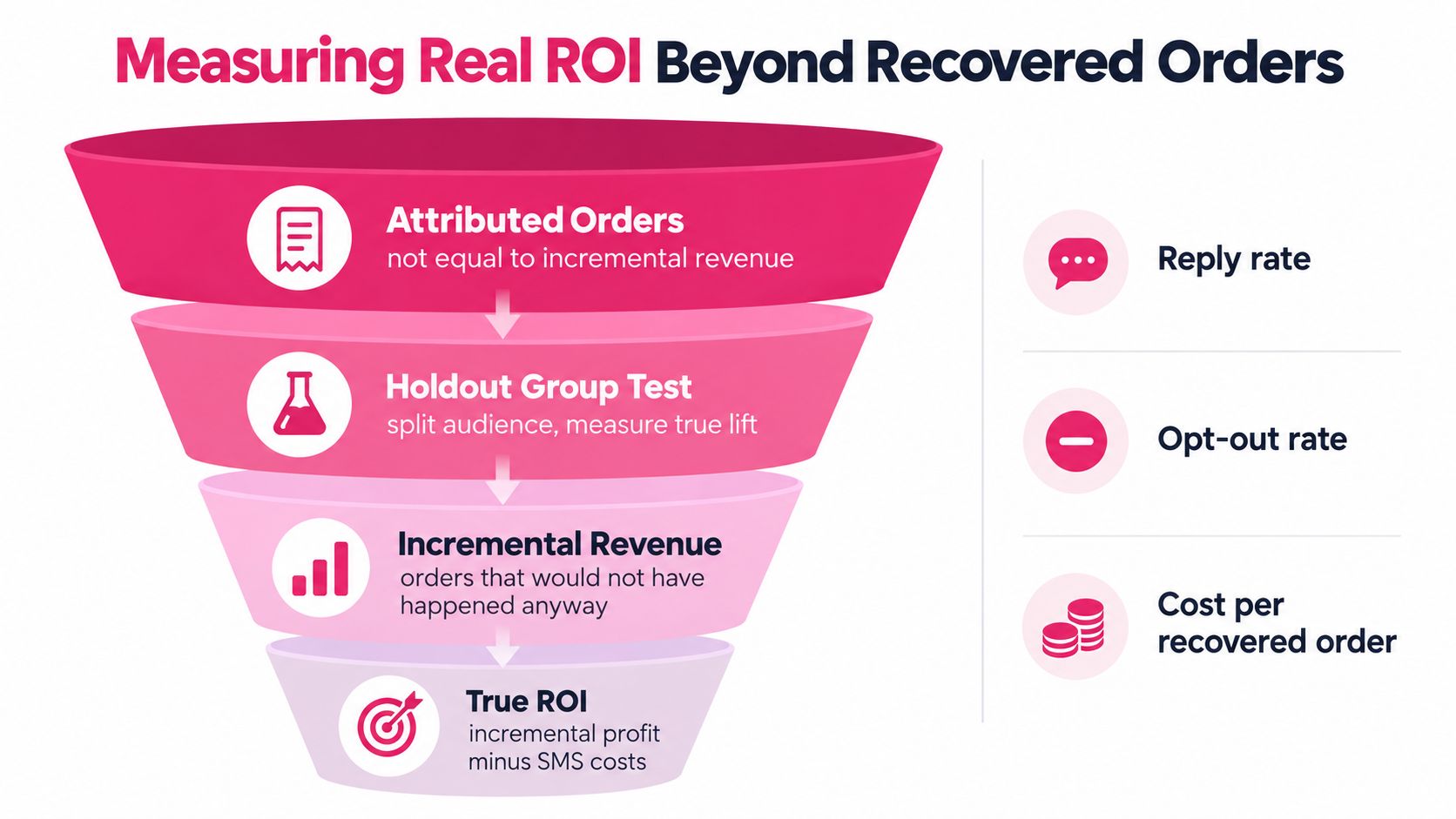
An attributed order isn’t automatically an incremental order. Some shoppers would have returned without the text, especially when the cart contained a high-intent product and the reminder arrived during an active buying session.
Create a randomized holdout group that meets the same eligibility rules but doesn’t receive the SMS treatment. Compare completed purchases, revenue, margin, and opt-outs between the exposed and holdout groups. The difference gives you a more credible estimate of incremental lift than a dashboard that assigns every later purchase to the last clicked message.
Track the complete funnel
A useful report starts before the click:
- Delivered messages: Confirms that eligible, consented numbers were reachable.
- Click-through rate: Shows whether the message and checkout path earned action.
- Conversion rate: Measures completed purchases from the defined audience.
- Gross margin after discounts: Reveals whether an incentive created profitable revenue.
- Revenue per recipient: Makes variants comparable when audience sizes differ.
- Unsubscribe rate: Shows whether frequency or relevance is damaging the list.
Available benchmark data places abandoned-cart SMS click-through rates around 9.53–17.28%, conversion rates around 3.97–7.84%, and unsubscribe rates around 0.56–1.83% across the 25th to 75th percentile ranges. Use the abandoned-cart SMS benchmarks from Postscript as orientation, not as a universal target.
A discount variant may produce more clicks and orders while lowering contribution margin. Compare it with a reminder-only variant on incremental profit after the discount, messaging cost, refunds, and other directly attributable costs. A message that recovers fewer orders can still be the better treatment if it preserves more profit per recipient.
Prevent attribution errors
Use one consistent attribution window and a unique checkout or campaign identifier. Avoid counting the same purchase across SMS, email, and paid media. If the shopper clicked an email, saw an ad, and then tapped the SMS link, your reporting needs a defined attribution rule rather than three channels claiming the full order.
For a practical framework, use this guide to calculate the ROI of SMS marketing for your ecommerce store. The important operating habit is simple: report attributed revenue, but make decisions using controlled incremental profit.
Automating and Scaling With SMS Remarketing Tools
Automation should remove operational mistakes, not remove judgment. A useful SMS remarketing tool connects the cart event to consent status, segmentation, checkout, purchase suppression, localization, and reporting.
For Shopify or WooCommerce, evaluate the system against the actual work your team needs to automate:
- Store integration: Cart and purchase events should pass reliably into the messaging flow.
- Language handling: Automatic language detection and pre-translated messages can support multilingual stores, but review translations for product and legal accuracy.
- Checkout recovery: Pre-filled links should restore the cart without forcing the shopper through unnecessary steps.
- Offer logic: Dynamic discounts should apply only to eligible segments and preserve margin rules.
- Identity and timing: Branded sender identification, localized send times, and do-not-disturb modes should be configurable.
- Compliance controls: GDPR and CCPA handling, STOP processing, consent records, and suppression should be built into the workflow.
- Reporting: The platform should expose delivery, clicks, purchases, opt-outs, and variant performance.
CartBoss is one example of this operating model. It integrates with Shopify and WooCommerce, supports automated cart reminders, multilingual messages, pre-filled checkout forms, dynamic discount application, branded sender identification, do-not-disturb mode, and compliance-oriented controls. Review other options in this comparison of SMS marketing platforms for ecommerce before choosing a tool.
Launch with a controlled first flow
Klaviyo’s benchmark guidance gives one example sequence: an email reminder after 2–4 hours, a follow-up text with a discount after 24 hours, and a final message after 48 hours offering product recommendations or requesting feedback. Treat that as a testing framework, not a fixed recipe. Your SMS flow may need an earlier first contact, a non-discount objection handler, or no final message for certain products. See the Klaviyo abandoned-cart benchmark guidance for the example sequence.
Before switching on automation, verify:
- Consent capture: Promotional SMS permission is separate, specific, recorded, and auditable.
- Event logic: The first reminder fires after the intended abandonment window.
- Suppression: Purchases, opt-outs, invalid numbers, and excluded markets stop future messages.
- Message treatment: Each contact has one primary action and a checkout link that works on mobile.
- Segmentation: Shipping, price, hesitation, and checkout-friction treatments aren’t mixed blindly.
- Measurement: Holdouts, margin, revenue per recipient, and opt-outs are visible from launch.
- Review process: Copy, translations, offers, and legal disclosures are checked before scaling.
CartBoss gives ecommerce teams automated SMS cart reminders that return shoppers to saved carts, support translated messages, apply eligible discounts, and use pre-filled checkout paths across Shopify and WooCommerce. Visit CartBoss to set up a consent-led recovery flow, test friction-matched messages, and measure whether recovered revenue is profitable.