


Every Shopify store owner feels the sting of a lost sale, but the true impact of cart abandonment for Shopify goes way beyond one missed order. Think of it as a silent profit killer. It slowly eats away at your ad spend, shrinks customer lifetime value, and points to real friction in your buying process.
Understanding and tackling it isn’t just a good idea—it’s essential if you want to build a sustainable business.
The True Cost of Shopify Cart Abandonment
Cart abandonment is more than just a metric; it’s a direct reflection of your customer’s experience. When someone adds an item to their cart, they’re showing clear intent to buy. If you lose them at that final stage, it means something in the process broke down.
The costs pile up fast, and it’s not just about the lost revenue from that single sale.
Think about what you’ve already invested to get that customer to the checkout. There are the marketing dollars spent on ads, the time you poured into crafting compelling product pages, and all the effort to build brand awareness. Each abandoned cart is like a leak in your sales funnel, and all that investment drains away with zero return. This is exactly why you need a proactive strategy.
Top Reasons Shoppers Abandon Carts on Shopify
Customers don’t just leave for no reason. The causes are often predictable and, more importantly, totally fixable. They aren’t just “window shopping”—specific hurdles are pushing them away right at the finish line.
Here’s a breakdown of the most common culprits we see time and time again.
| Reason for Abandonment | Potential Shopify Solution | Impact Level |
|---|---|---|
| Unexpected Costs | Display all-in pricing upfront or use Shopify’s shipping calculator early in the process. | High |
| Forced Account Creation | Enable guest checkout on your Shopify store. It’s a simple toggle in your settings. | High |
| Complex Checkout | Use Shopify’s accelerated checkouts like Shop Pay, Apple Pay, and Google Pay. | Medium |
| Lack of Trust | Prominently display security badges (SSL, payment providers), customer reviews, and return policies. | Medium |
Pinpointing which of these issues might be affecting your store is the first step toward plugging the leaks and recovering those almost-sales.
The financial impact is staggering. It’s estimated that billions are lost annually, with a huge portion being entirely recoverable. For a deeper dive into how to stop these leaks, you should check out our guide on how to reduce cart abandonment.
The Power of Recoverable Revenue
This brings us to a crucial idea: recoverable revenue. Not every abandoned cart is a lost cause. In fact, a huge percentage of these sales can be clawed back with the right approach.
The financial potential here is massive. Research suggests that $260 billion in lost orders could be recovered in the US and EU alone just by improving checkout design and flow. You can dig into these findings directly from Shopify’s own research.
Imagine you could lower your store’s abandonment rate by just 5%. For a store doing even modest sales, that small tweak could mean thousands of dollars in extra revenue each month—without spending another dime on advertising.
That’s the hidden opportunity inside every abandoned cart. It’s a chance to re-engage, solve a customer’s problem, and lock in a sale that was just about to slip away.
Diagnosing Your Store’s Checkout Leaks
Before you can fix the leaks in your sales funnel, you have to find them. Guessing why customers are leaving your store without buying is like fumbling around in the dark; data is what flips the switch. The very first, most critical step in tackling cart abandonment for Shopify is to dive deep into your analytics.
This isn’t about glancing at one big number. You need to become a detective, piecing together clues from customer behavior. By figuring out where people are dropping off and why, you can stop using generic fixes and start implementing targeted solutions that actually recover lost sales.
The average cart abandonment rate is shockingly high. In fact, some studies show that nearly 70% of all shopping carts are abandoned. You’re definitely not alone in this fight, but it also shows the massive opportunity waiting for anyone who can diagnose the problem correctly.
Your Shopify Conversion Funnel
The heart of your investigation is right inside your Shopify analytics. Think of your conversion funnel as a roadmap of the customer journey, showing you exactly how many people make it from one stage to the next.
Your funnel usually breaks down into these key stages:
- Added to Cart: The shopper showed real interest by adding a product.
- Reached Checkout: They took the next big step and started the payment process.
- Sessions Converted: The customer successfully paid and completed their order.
By looking at the drop-off between each of these stages, you can find your biggest leaks. Is there a huge drop between “Added to Cart” and “Reached Checkout”? That could point to a problem with your cart page—maybe it’s confusing or the checkout button is hard to find. If the big drop-off happens after they reach checkout, you’re likely looking at issues with shipping costs, payment options, or forcing them to create an account.
Segmenting Data to Find Hidden Patterns
Looking at all your data at once tells you what’s happening, but segmenting it tells you why. You have to dig deeper and filter your reports to uncover the patterns that are otherwise invisible.
Your overall abandonment rate is just the tip of the iceberg. The real story is often hidden within specific customer segments. Averages can be misleading; focus on the outliers to find your biggest opportunities for improvement.
For instance, start comparing the behavior of different groups. You might find that your cart abandonment for Shopify is way higher for certain types of customers.
Common Segments to Analyze:
- Device Type: Is your abandonment rate through the roof on mobile? This is a classic sign of a checkout experience that isn’t optimized for smaller screens.
- Traffic Source: Are visitors from your Instagram ads bailing more often than people from your email list? This could mean your ad promises don’t match the checkout reality.
- Customer Location: Are international customers leaving at a higher rate? This almost always points to surprise shipping fees or a lack of clear information on duties and taxes.
Pinpointing these weak spots is the foundation of a good recovery strategy. If you see mobile users dropping off at the payment stage, you know to prioritize adding accelerated checkouts like Shop Pay or Google Pay. If a certain traffic source is underperforming, you can tweak your ad creative. To fix these issues at a higher level, you should also look into broader conversion rate optimization best practices that improve the entire user experience.
This data-first approach turns your strategy from guesswork into a surgical operation. Armed with this knowledge, you can move on to implementing specific fixes, including powerful abandoned cart recovery techniques that target the exact problems you’ve uncovered.
Fortify Your Checkout to Prevent Abandonment
While recovering sales with SMS is powerful, the best strategy is always prevention. You want to stop customers from leaving in the first place. Preventing cart abandonment for Shopify really boils down to creating a checkout experience that’s airtight and completely frictionless.
Think of your checkout as the final, most important conversation you’ll have with a customer. It needs to be easy, reassuring, and totally free of any nasty surprises that could make them hesitate.
Once a customer hits that “checkout” button, they’re on a mission. Any little obstacle can break their momentum and send them packing. Let’s dig into the proactive steps you can take to reinforce your checkout and turn those potential drop-off points into solid conversions.
Streamline the Path to Purchase
A complicated checkout is a guaranteed conversion killer. I’ve seen it time and time again. Research from the Baymard Institute backs this up, showing that 22% of shoppers ditch their carts simply because the process is too long or confusing. Every extra field is another reason to bounce.
The fix? Get ruthless about removing every unnecessary step.
A huge one is forced account creation. Making someone create an account before they can buy is a massive point of friction—it’s responsible for 26% of abandoned carts. Yes, you want their info for future marketing, but securing that initial sale is far more important.
- Offer Guest Checkout: This is non-negotiable. Always give people the option to buy without signing up. You can easily prompt them to create an account on the order confirmation page after their purchase is complete.
- Use Accelerated Checkouts: Integrate one-click options like Shop Pay, Google Pay, and Apple Pay. These autofill a customer’s details, shrinking the checkout process down to just a few seconds. It’s a game-changer.
- Simplify Your Forms: Take a hard look at your checkout fields. Do you really need a phone number if you aren’t using SMS marketing? Is the “Company” field essential for B2C sales? Cut the fluff.
The goal is to get your customer from their cart to your confirmation page with as little effort as possible. A clean, simple process respects their time and drastically cuts the odds of them getting distracted or frustrated.
Build Unshakeable Trust and Transparency
Your customers are about to hand over sensitive payment details. They need to feel 100% secure. Any flicker of doubt can send them running for the hills.
But an even bigger issue? Unexpected costs. It’s the #1 reason for cart abandonment. A staggering 48% of shoppers leave because of surprise shipping fees, taxes, or other charges that pop up at the last second.
Transparency isn’t just a buzzword; it’s essential. You must show all costs upfront and constantly reinforce your store’s credibility to prevent that last-minute hesitation.
How to build that checkout confidence:
- Show Off Trust Badges: Make sure your security seals (like SSL certificates) and logos from trusted payment providers (Visa, Mastercard, PayPal) are prominently displayed.
- Be Upfront About Shipping: Don’t ambush customers with shipping costs on the final page. Use a shipping calculator in the cart or offer a clear flat rate that’s visible early on.
- Display a Clear Returns Policy: A simple link to your return policy right in the checkout can work wonders. Knowing they can easily send a product back removes a major barrier to purchase.
Optimizing the entire checkout flow is a key strategy for cutting down abandonment. For a deeper dive, check out these expert tips on how to modify your Shopify checkout page to streamline the journey.
Optimize for the Modern Shopper
Let’s face it, your customers are on their phones. A slow, clunky checkout on a mobile device is a surefire way to kill a sale and inflate your cart abandonment for Shopify.
Your checkout must be designed with a mobile-first approach. That means big, easy-to-tap buttons, text you can read without pinching to zoom, and a layout that flows smoothly on a vertical screen.
Speed is just as critical. Did you know that even a one-second delay in page load time can slash conversions by 7%?
- Mobile-First Design: Seriously, test your checkout on your own phone. And on a friend’s phone. Make sure it’s intuitive and seamless on multiple devices.
- Page Speed Optimization: Compress your images, be mindful of heavy apps on the checkout page, and make sure your Shopify theme is built for speed.
By focusing on these proactive measures, you’ll create a checkout experience that doesn’t just prevent abandonment but actively builds customer trust and loyalty. To get even more granular, our guide on how to improve the checkout process offers more detailed strategies. Fortifying your checkout is an investment that pays for itself many times over in recovered revenue.
Even with a perfectly optimized checkout process, some shoppers are bound to get distracted and leave. Life just gets in the way—a phone call, a crying baby, or a spotty Wi-Fi connection can derail a sale in seconds. When that happens, your response needs to be quick, personal, and effective. This is where automated SMS marketing stops being a “nice-to-have” and becomes a serious revenue recovery tool.
For years, email was the go-to for abandoned cart recovery. But let’s be honest, its effectiveness is waning. SMS, on the other hand, delivers results that email can only dream of. Its power is in its immediacy. While a recovery email might sit unread for hours or even days, a text message gets seen almost instantly. We’re talking open rates as high as 98%. That’s a direct line to your customer’s pocket you just can’t ignore.
Why SMS Is Your Best Bet for Cart Recovery
Look at how people shop today—it’s all happening on mobile. So, it only makes sense to re-engage them on the same device. Cart abandonment rates are notoriously high on mobile, sometimes reaching a staggering 85.65%. Smaller screens and on-the-go distractions are the main culprits.
These numbers can swing wildly depending on your niche. A pet care store might see abandonment rates hover around 55-60%, while a big multi-brand e-commerce site could face rates pushing 86%, especially from mobile shoppers. This is exactly why you need to meet customers where they are: on their phones.
That’s where a tool like CartBoss comes in. It hooks directly into your Shopify store and automatically sends a text to a shopper just moments after they leave. It’s not just about firing off a random message; it’s about sending the right message at the right time.
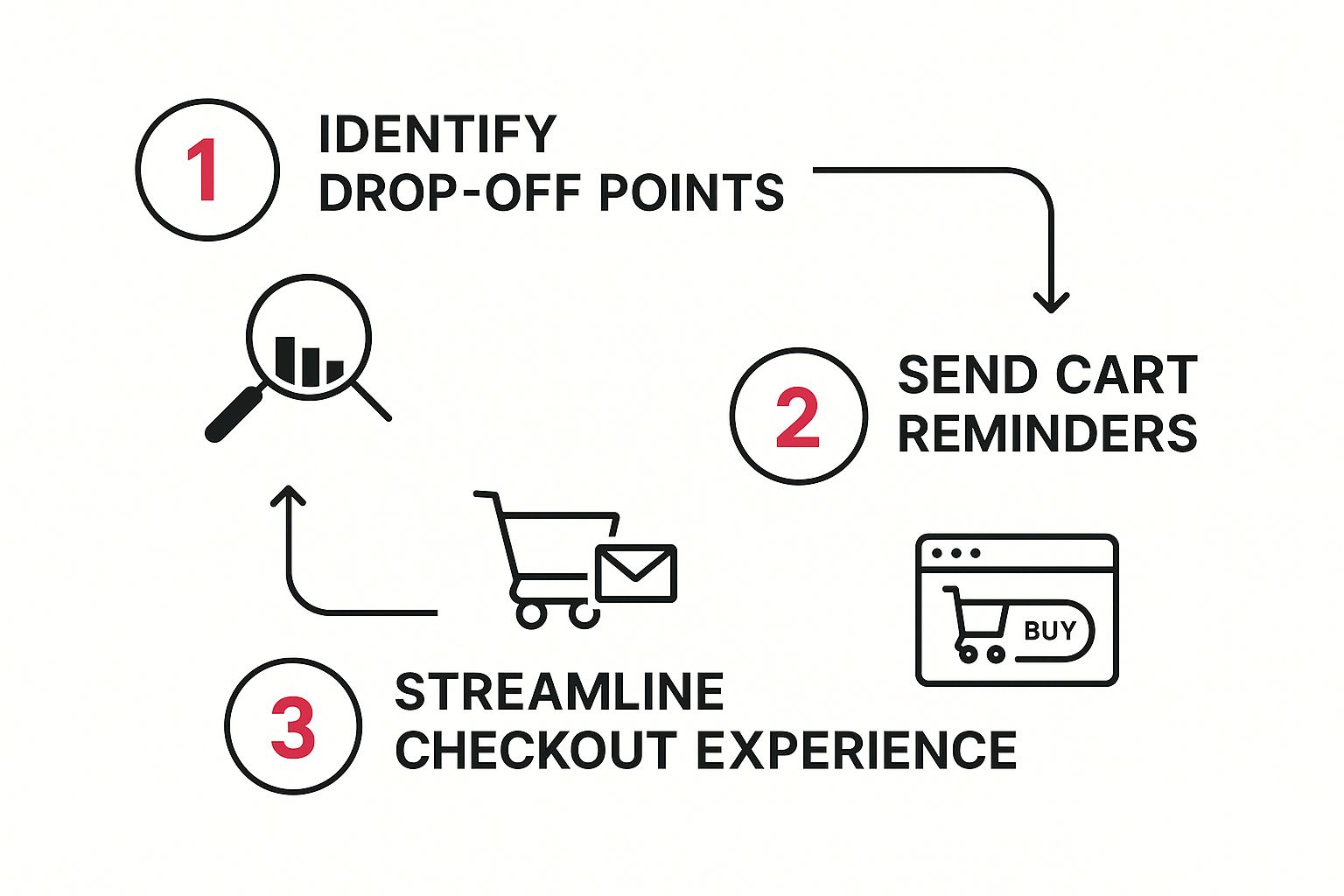
The flow is simple: identify the drop-off, re-engage the customer, and make it ridiculously easy for them to come back and finish their purchase. This infographic breaks down the core strategy, turning a complex problem into a simple, actionable process.
Crafting SMS Copy That Actually Converts
The secret to a great recovery SMS is to make it feel helpful, not pushy. You’re not a faceless corporation blasting out ads; you’re sending a friendly reminder. Good messages are always short, conversational, and add value right away.
Here are a few tips I’ve picked up for writing compelling SMS copy:
- Lead with helpfulness. Start with a gentle nudge. Something like, “Hey [Name], did you forget something?” feels more like a customer service touchpoint than a sales pitch.
- Create a little urgency (but don’t overdo it). A phrase like “Your cart is reserved for the next hour!” can add a light sense of scarcity without sounding aggressive.
- Make it easy to come back. This is non-negotiable. Always include a direct link that drops the shopper right back into their pre-filled cart. The fewer clicks, the higher the conversion rate.
Remember, the goal of the first SMS isn’t always to close the sale right then and there. It’s to re-open the conversation. A simple, helpful reminder is often all it takes to bring a distracted shopper back.
For a much deeper dive into the art of writing these messages, check out our guide on abandoned cart SMS strategies. It’s packed with more advanced templates and tips.
Setting Up Your Automated SMS Flow
This is where the real magic happens. By automating your recovery process with a tool like CartBoss, you build a system that works for you 24/7, clawing back sales while you focus on other things. It’s a true “set it and forget it” solution.
A solid automated sequence usually looks something like this:
- First Message (30-60 minutes after abandonment): A simple, no-discount reminder. “Hi [Name], it looks like you left a few things behind. We saved your cart for you here: [Link]”
- Second Message (24 hours later): If the first text didn’t work, sweeten the deal. “Still thinking it over? Complete your order today and get 10% off with code SAVE10. Your cart: [Link]”
- Third Message (3-5 days later): This is your final shot, so bring out your best offer. “Last chance, [Name]! Your cart items are about to expire. Use code FREESHIP for free shipping on your order. [Link]”
This tiered approach lets you recover sales without giving away discounts to everyone, which is crucial for protecting your profit margins.
Just be sure your SMS practices are compliant with regulations like TCPA and GDPR. That means only messaging customers who have clearly opted in and always providing an easy way to unsubscribe. By turning cart abandonment for Shopify into an automated SMS engine, you can recapture a serious amount of revenue with minimal effort.
Advanced Recovery Tactics for Maximum Revenue
Alright, you’ve plugged the biggest leaks by setting up your initial automated SMS reminders. That’s a huge first step. But if you want to move from “good” to “great,” it’s time to get a bit more sophisticated. The top-tier Shopify stores don’t just send one-off reminders; they build smart, layered campaigns that tackle the real reasons customers hesitate.
Let’s be honest: cart abandonment for Shopify isn’t a one-size-fits-all problem. Someone bailing on a $20 t-shirt has a completely different mindset than a shopper who just left a $500 cart on the table. A truly effective strategy recognizes this and adapts.
Architecting a Multi-Channel Recovery Sequence
Relying on a single channel, even one as powerful as SMS, is like trying to build a house with only a hammer. You’ll get somewhere, but you’re leaving a lot of potential on the table. The most successful recovery strategies I’ve seen blend the instant punch of SMS with the rich detail of email.
This multi-channel approach isn’t about spamming people. It’s about reaching them on the right platform, with the right message, at the right time.
Think of it like this: SMS is your quick, high-impact nudge. Email is where you can elaborate, show off product photos, and add social proof like reviews.
Here’s a multi-channel flow that just works:
- After 30 Minutes (SMS): Send a simple, friendly reminder. No discount needed yet. Something like, “Hi Sarah, did you forget something? We saved your cart for you: [Link]” works wonders.
- After 4 Hours (Email): If they haven’t bitten, follow up with an email. This is your chance to showcase images of the items in their cart and reinforce why your brand is the right choice.
- After 24 Hours (SMS): Now it’s time to sweeten the deal. “Still thinking it over? Complete your order and get free shipping on us. Your cart is waiting: [Link]”
- After 48 Hours (Email): This is your final shot. Use this email to create a little urgency or build trust with customer testimonials.
This sequence gives you multiple chances to win the sale without ever feeling pushy. It respects the customer’s attention by using different channels for different types of messages.
When deciding between email and SMS, it helps to see the performance differences side-by-side. SMS is built for speed and engagement, while email offers more space for content.
Email vs. SMS Recovery Performance
A comparative look at the key performance indicators for email and SMS cart recovery campaigns, helping merchants decide where to invest their efforts.
| Metric | Email Recovery | SMS Recovery |
|---|---|---|
| Open Rate | ~20% | ~98% |
| Click-Through Rate | ~3-5% | ~30-40% |
| Conversion Rate | ~3-5% | ~25-30% |
| Time to Open | 2-6 hours | Under 3 minutes |
As the data shows, SMS has a clear advantage in getting your message seen and acted upon quickly. While email still has its place for longer-form content, you can’t beat the immediacy of a text message.
Segmenting Offers by Cart Value
One of the fastest ways to kill your profit margins is by throwing a 20% discount at every single abandoned cart. It’s lazy and expensive. A much smarter play is to segment your offers based on the cart’s value. This protects your profits on smaller sales while giving you room to be more aggressive on the big ones.
I like to think of it as a tiered system:
- Low-Value Carts (under $50): Often, a simple reminder is all it takes. A discount probably isn’t necessary here. If you feel you must offer something, make it small, like 5% off or free shipping on a slightly higher order value.
- Mid-Value Carts ($50 – $150): This is the sweet spot for a standard offer. A 10% discount or a free shipping code is usually the perfect nudge to get these shoppers over the line without giving away the farm.
- High-Value Carts (over $150): This is where a lost sale really stings. Don’t be afraid to bring out the big guns. A 15% discount or a valuable free gift is a worthwhile investment to recover a large order.
Segmenting your offers is a strategic move that boosts your overall recovery rate while protecting your all-important bottom line.
The Smart Use of Exit-Intent Popups
You’ve seen them before. Just as your mouse cursor drifts towards the “back” button, a popup appears. That’s an exit-intent popup, and it’s your last-ditch effort to keep a visitor on your site. According to data from OptiMonk, these popups can convert at an impressive average rate of 17.12%. But here’s the catch: the offer has to be good.
A generic “Don’t Go!” popup is a waste of pixels. A great exit-intent popup makes a specific, valuable offer that solves a potential problem, like sticker shock or unexpected shipping costs.
Instead of a vague plea, try something targeted:
- Tackle Price Sensitivity: “Wait! Before you go, take 10% off your first order.” It’s direct, classic, and it works.
- Capture the Lead: If you can’t make the sale now, get their email. “Join our list for exclusive deals and get 15% off your next purchase.”
- Eliminate Shipping Costs: “Leaving so soon? We’ll ship your first order for FREE. Claim your offer now.”
For a deeper dive into the different tools you can use—from popups to advanced SMS automation—check out this breakdown of the top cart abandonment solutions available today. By layering these advanced tactics, you’re not just recovering sales; you’re building a smarter system that turns every instance of cart abandonment for Shopify into a chance to learn and grow.
Common Questions About Shopify Cart Recovery
Even with a solid plan, you’re bound to run into some specific questions about cart abandonment for Shopify. It happens to every merchant. Getting these details right is what separates a decent recovery strategy from a great one, so let’s clear up a few of the most common things we hear.
When Is the Best Time to Send a Recovery Message?
Timing is everything. Send a message too quickly, and you might seem pushy. Wait too long, and the customer has already moved on and forgotten what they were about to buy.
When it comes to SMS, that perfect window is surprisingly tight. We consistently see the best results when the first text goes out 30 to 60 minutes after a cart is abandoned. This hits the sweet spot—your store is still fresh in their mind, but it doesn’t feel like you were spying on their shopping session.
Email gives you a bit more breathing room. The first follow-up is usually most effective when sent anywhere from one to three hours later.
Should I Offer a Discount or Free Shipping?
This is the classic debate. The right answer really comes down to why your customers are leaving in the first place. You need to put on your detective hat and look at your analytics. Is there a massive drop-off right after the shipping costs are calculated? If so, you’ve found your culprit.
In that case, offering free shipping is the perfect fix because it directly solves the customer’s problem. Honestly, it’s often more powerful than a simple percentage-off discount.
But if customers are bailing earlier in the process or if your shipping costs are already low and transparent, the issue might just be general price sensitivity. That’s where a small discount, like 10% off, can be the little nudge they need to pull the trigger.
Stop guessing and start testing. The best way to know for sure is to run a simple A/B test. Send a free shipping offer to one group of shoppers and a percentage discount to another. Your own data will tell you exactly what your audience wants.
What’s a “Good” Cart Recovery Rate?
Everyone wants to know how their numbers stack up. It’s important to set realistic goals here, because what’s “good” can swing wildly depending on your industry and the recovery method you’re using. It’s the most important metric for tracking how well your cart abandonment for Shopify efforts are working.
Here are some solid benchmarks to aim for:
- Email Recovery: For a well-tuned email campaign, a recovery rate of 5-10% is a strong performance.
- SMS Recovery: SMS is a different beast entirely. Thanks to its immediacy and high engagement, a recovery rate of 15-25% is a very achievable goal. We’ve even seen top-tier campaigns blow past the 30% mark.
Ultimately, the most important thing is to establish your own baseline and just focus on improving from there. It’s not about hitting some magic industry number—it’s about beating your own record, month after month. By getting clear on these common questions, you can fine-tune your recovery strategy and start turning more of those lost carts back into sales.
Ready to stop losing sales and start recovering revenue on autopilot? With CartBoss, you can turn abandoned carts into profit with powerful, automated SMS campaigns. See how CartBoss can transform your Shopify store today!