



An opt-in message is basically the digital handshake between your business and a customer. It’s the moment they give you clear, confirmed permission to send them SMS marketing messages. This turns a curious visitor into a subscriber who actually wants to hear from you, and it’s the absolute foundation of any successful—and legal—SMS strategy.
What’s an Opt-in Message, Really?
Think of an opt-in not as a single, sterile text, but as the start of a crucial conversation. It’s your first real chance to set the stage for a valuable relationship.
Imagine you’re inviting someone to an exclusive club. They willingly give you their phone number because they’re genuinely interested in the benefits you’re offering. This simple act of agreement immediately separates your brand from unsolicited spam and starts building trust. Get this first step wrong, and you can sour a customer relationship before it even has a chance to begin.
A great opt-in message does three things well:
- It Secures Consent: This is the big one. It gives you clear, documented permission to text them. No gray areas.
- It Sets Expectations: It tells subscribers exactly what kind of messages they’ll get, how often, and why it’s worth their time.
- It Reinforces Your Brand: A professional, straightforward opt-in process shows you respect customer privacy and are a brand worth trusting.
Why This First Step Is So Important
The real power of SMS marketing comes from its incredible engagement. When customers willingly sign up, they’re far more open to what you have to say. The numbers don’t lie: with response rates floating around 45% and open rates hitting a massive 98%, text messages leave email in the dust.
In fact, the opt-in rate for consumers receiving business texts is expected to hit about 84% by 2025. This shows that customers are more than comfortable with this channel, as long as it’s built on permission. These stats make it crystal clear why nailing that initial opt-in is so critical to unlocking all that potential. You can dig into more SMS marketing statistics to see the full picture.
A well-crafted opt-in message is much more than just a legal box to check. It’s the first real step toward building a loyal, engaged, and profitable customer channel. It’s the difference between being a welcome guest in someone’s inbox and an unwanted intruder.
Now, let’s break down exactly what needs to be in that message to keep things clear, compliant, and effective.
Here’s a quick summary of the essential elements every compliant and effective opt-in message must include to ensure clarity, legality, and user trust.
Core Components of an Effective Opt-in Message
| Component | Purpose | Example Snippet |
|---|---|---|
| Business Name | Clearly identifies who is sending the message, preventing confusion. | “Hey from [Your Brand]!” |
| Confirmation of Subscription | Explicitly confirms the user has been subscribed to your SMS list. | “You’re now signed up for…” |
| Message Frequency | Sets expectations on how often the user will receive texts. | “Msg frequency varies.” |
| “Msg & Data Rates May Apply” | A standard legal disclosure required by wireless carriers. | “Msg&Data rates may apply.” |
| Help and Opt-Out Keywords | Provides clear instructions for getting help or unsubscribing. | “Reply HELP for help, STOP to cancel.” |
Putting these pieces together ensures your opt-in message not only meets legal standards but also starts the customer relationship on the right foot—with transparency and respect.
Navigating the Legal Rules of SMS Opt-Ins
Sending a text message feels casual, right? But when you’re a business, it’s a different ball game entirely. Texting is governed by some pretty strict legal frameworks, especially in the United States. The big one you need to know is the Telephone Consumer Protection Act (TCPA).
This act lays down the law for how businesses can contact people via text. Get it wrong, and you could be looking at fines from $500 to $1,500 per message. That adds up fast, making compliance a non-negotiable part of your SMS strategy.
The heart of the TCPA is a concept called express written consent. Now, this doesn’t mean your customer needs to physically sign a piece of paper. Instead, it’s all about getting a clear, documented “yes” from them to receive your marketing texts. This could be as simple as them checking a box on a form, texting a keyword like “JOIN,” or typing their number into a compliant sign-up form. The key is that the customer has to take a clear, deliberate action.
The Importance of Clear Disclosure
To get that valid consent, you have to be completely upfront. Regulators call this “clear and conspicuous disclosure.” It just means that before a customer ever agrees to anything, you must tell them:
- Who you are: Your business name has to be clearly identified.
- What they’ll get: Be specific that they are signing up for marketing messages.
- Key disclaimers: Always include standard phrases like “Msg & Data rates may apply.”
- How to stop: Give them clear instructions on how to opt-out, like “Reply STOP to unsubscribe.”
This image shows exactly how a simple, compliant sign-up should look from the user’s side.
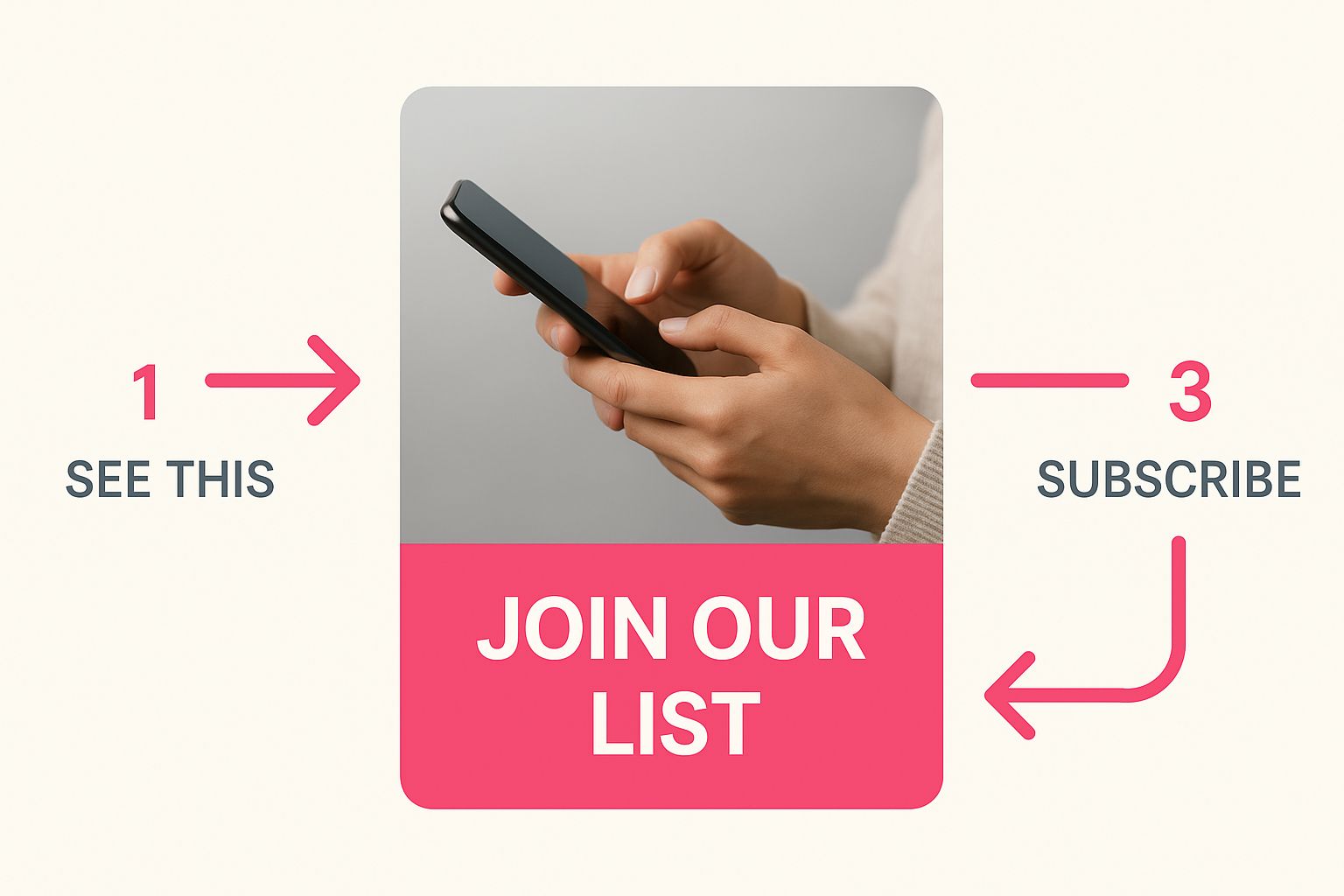
As you can see, the user takes a very straightforward action, which is the foundation of any legally sound SMS program. Getting these details right is so important that we put together an actionable guide to express written consent to help businesses stay on the right side of the law.
Think of it like a contract. You wouldn’t sign one without reading the terms, right? Your customers shouldn’t be asked to subscribe without knowing exactly what they’re agreeing to. This kind of transparency isn’t just about avoiding fines; it’s about building the long-term trust you need for a truly successful SMS program.
How to Write a High-Converting Opt-In Message
Alright, let’s move from the legal stuff to what really grows your SMS list: writing an opt-in message that people actually want to respond to. Getting this right comes down to nailing four key elements.
Think of it as your 5-second pitch to a potential customer. You need to grab their attention and make them want to sign up, right now. Even small tweaks to your wording can make a huge difference in how fast your list grows.
The Four Pillars of a Perfect Opt-In
A powerful opt-in request is built on a solid foundation. If you focus on getting these four things right, your message will be clear, compelling, and compliant every time.
- Clarity (What do they get?): Be completely upfront. Tell them exactly what kind of texts you’ll be sending. Is it weekly deals? Exclusive access to new products? Helpful tips? Don’t be vague. “Get weekly 20% off codes” is way more powerful than a generic “Join our club for updates.”
- Incentive (Why should they sign up now?): What’s in it for them, right this second? The easiest and most effective hook is an immediate discount, like 10% off your first order. You could also offer a free gift, exclusive access, or entry into a giveaway. The goal is to give them a shot of instant value that makes saying “yes” a total no-brainer.
- Simplicity (How do they sign up?): Make it ridiculously easy. A simple keyword like “JOIN” or “SAVE” is perfect because it removes all the guesswork. Always remember the “Don’t Make Me Think” rule—if someone has to puzzle over what to do, you’ve probably already lost them.
- Compliance (The boring but necessary legal bit): This might feel like fine print, but it’s non-negotiable. Including disclosures like “Msg&Data rates may apply” and “Reply STOP to cancel” is required by law. More importantly, it shows you’re a professional brand that respects your customers’ privacy and choices, which builds a ton of trust.
When you combine a great incentive with a crystal-clear call-to-action, you create real urgency and value. This is the magic formula that turns a casual website visitor into an engaged subscriber who’s ready to buy.
Getting these pillars right is fundamental to any successful SMS program. If you want to go even deeper and fine-tune your entire strategy, check out our SMS marketing best practices playbook for tips that will boost both your ROI and customer engagement.
Proven Opt In Message Examples for Your Industry

Theory is one thing, but seeing a perfect opt-in message in action makes everything click. The best approach really depends on your industry and what your specific customers find valuable. What grabs a retail shopper’s attention won’t necessarily work for a restaurant patron or someone booking a service.
The secret is tailoring your offer to scratch a particular itch for your audience. Below are some real-world examples you can adapt for your own business to turn casual visitors into a loyal list of subscribers.
Retail and Ecommerce Brands
For online stores, the name of the game is driving immediate sales and building a list you can market to later. Hands down, the most powerful incentive is usually a discount.
- Example:
Hey fashionista! Text JOIN to 22334 for 15% off your next order at Style Maven Boutique. Msg&Data rates may apply. Reply STOP to cancel. - Why It Works: This is a classic for a reason. It dangles a clear, instant carrot (15% off) and uses a simple keyword (JOIN) and short code that are easy for someone to type out on the spot.
Restaurants and Cafes
Diners are all about exclusive deals, sneak peeks at new menu items, and feeling like part of a club. Your opt-in message should feel like a special invitation.
Example:
Get weekly specials and a FREE appetizer on your next visit! Reply YES to join the VIP list for The Corner Bistro. Msg&Data rates may apply. Reply STOP to end.
This approach is so effective because it blends an immediate reward (that free appetizer) with long-term perks (the weekly specials). It gets them to sign up now and gives them a reason to stay subscribed. It feels valuable and exclusive.
The sheer speed of SMS is what gives these offers their punch. Over half (51%) of consumers fire back a response to a business text in just two minutes, making it the perfect channel for time-sensitive deals. For even more creative inspiration, check out our in-depth guide to the opt-in text message.
SMS Opt-Ins Versus Push Notification Opt-Ins

Many businesses use both SMS and push notifications to get in front of customers, but it’s vital to understand they play by completely different rules. The way you get permission for each channel is fundamentally different, which has a huge impact on how you build your audience and what they expect from you.
Think of an opt-in message for SMS as an exclusive handshake. The law demands that you get a customer’s clear, written permission before sending them marketing texts. This is a non-negotiable standard, meaning every single subscriber has actively and plainly said, “Yes, I want to hear from you.” This process naturally builds a highly engaged, high-intent audience from day one.
Push notifications, on the other hand, are a different ballgame. Their opt-in process is all over the place, depending entirely on the user’s phone.
A Tale of Two Permission Models
You can really see this difference when you compare Android and iOS. On Android devices, push notifications are often switched on by default the moment a user installs your app. They have to dig into their settings to opt out. But on iOS, it’s the opposite. Users have to explicitly opt in after installation by tapping “Allow” on a system pop-up.
This creates a massive gap in the data. Android opt-in rates can soar to 49% or higher, while iOS rates lag far behind because the user has to take that extra step.
For SMS, every subscriber is an enthusiastic “yes.” For push notifications, especially on Android, many “subscribers” are just people who haven’t bothered to say “no” yet. That’s a critical distinction every marketer needs to grasp.
While both channels have their uses, the strict consent required for an SMS opt-in message means you’re always talking to a warmer, more receptive crowd. It’s a key reason why SMS engagement consistently outperforms other channels. You can dig deeper into this by exploring the differences between SMS marketing vs. email marketing and seeing how permission levels change the game.
Common Questions About Opt-In Messages
As you get started with SMS marketing, you’ll notice the same questions pop up again and again. It’s easy to feel a bit lost in the rules and best practices for opt-in messages, but once you get clear, straightforward answers, you’ll feel much more confident.
Let’s tackle some of the most common points of confusion. Getting this right is critical—when you handle permissions properly, you build a healthier, more engaged subscriber list and sidestep any legal headaches.
Is a Double Opt-In Required By Law?
This is easily one of the most frequent questions we hear. The short answer is no, a double opt-in is not legally required by the TCPA. A single opt-in, where a user gives you their number through a form or by texting a keyword, is enough to establish express written consent.
But just because it’s not required by law doesn’t mean you should dismiss it. Think of double opt-in as an insurance policy for your SMS list. It works by having a user first sign up, and then they have to confirm their subscription by replying “YES” to an automated follow-up text.
While not a legal mandate, a double opt-in is a powerful best practice. It proves a subscriber is genuinely interested and helps ensure the phone number is correct and active, leading to higher-quality leads and better engagement rates.
This extra step is fantastic for filtering out mistyped numbers and lukewarm leads. The result? Better campaign metrics and more protection from compliance complaints down the road.
What Must Be In the Confirmation Message?
Whether you choose a single or double opt-in, that first confirmation message is your official handshake with a new subscriber. It needs to contain a few key things to be compliant and set clear expectations right from the start.
Your confirmation opt-in message should always include:
- Your Business Name: Immediately let them know who’s texting them.
- Confirmation of Subscription: A clear statement like, “You’re now subscribed to [Your Brand] SMS alerts.”
- Opt-Out Instructions: Simple, clear instructions like “Reply STOP to cancel.”
- Help Keyword: A way for them to get assistance, such as “Reply HELP for help.”
- “Msg & Data Rates May Apply” Disclosure: This is a non-negotiable disclaimer required by carriers.
These elements aren’t just polite suggestions; they are the foundation of a transparent and legally sound SMS program.
How Do You Handle Opt-Outs Correctly?
Handling unsubscribe requests is just as important as getting the initial opt-in. Legally, you are required to process opt-out requests immediately and automatically. When a user texts a keyword like “STOP,” “CANCEL,” or “UNSUBSCRIBE,” your system must remove them from all marketing lists without any delay.
Failing to honor these requests is a serious TCPA violation. Plus, a graceful exit is just good for your brand’s reputation. Always send one final, simple confirmation text like, “You have been unsubscribed and will not receive any more messages.” This confirms their request was successful and closes the loop professionally.
Proper list hygiene is crucial for long-term success. It keeps your efforts focused on an engaged audience, which in turn can help you learn how to reduce cart abandonment and achieve other key e-commerce goals.
Ready to turn your abandoned carts into sales with a powerful, compliant SMS tool? CartBoss recovers lost revenue on autopilot, engaging customers with perfectly timed messages that drive action. Start recovering sales today with CartBoss!
