


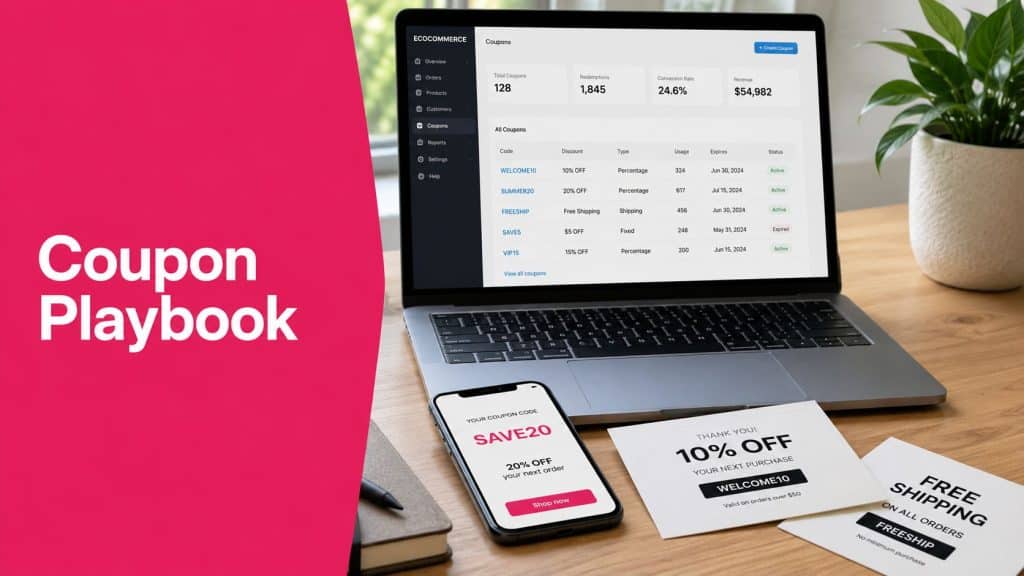
Coupon distribution has always been a scale game, but scale alone has never guaranteed sales. In the United States, brands distributed 235.49 billion coupons in 2019 and 200.40 billion in 2020, yet shoppers redeemed only 1.32 billion and 1.04 billion, respectively, according to coupon distribution and redemption data. That works out to roughly 0.56% redemption in 2019 and 0.52% in 2020.
The lesson is uncomfortable but useful: distributing more codes doesn’t automatically create more revenue. Your advantage comes from sending the right offer through the right channel, at the right moment, with a redemption mechanic that protects margin.
This playbook treats coupons as a sequencing system. You’ll learn how to match email, SMS, on-site placements, social, affiliates, and print to shopper intent, how to measure incremental value, and how to spot the point where additional distribution starts training customers to wait.
Table of Contents
- What Coupon Distribution Looks Like in 2026
- The Main Distribution Channels and When to Use Each
- Segmentation and Timing Strategies That Lift Redemption
- Redemption Mechanics and the Cost of Free Code
- Tracking Analytics and Optimization Tactics That Compound
- When More Distribution Starts Hurting Your Margins
- Legal and Compliance Guardrails for Coupon Campaigns
- Your Coupon Distribution Playbook and Action Checklist
What Coupon Distribution Looks Like in 2026
Coupon distribution has moved from a calendar-based promotion into an operating system for demand. The old model was simple: choose a discount, create a code, send it to a broad audience, and judge success by orders. The modern model assigns every offer a job, such as recovering an abandoned cart, converting a high-intent browser, increasing basket size, or reactivating a lapsed buyer.
The historical scale explains why this shift matters. Coupons became mainstream in the United States by the mid-20th century. The first Coca-Cola coupon appeared in 1887, the first grocery coupon followed for Grape-Nuts in 1895, Nielsen Coupon Clearing House was created in 1957, and about half of American shoppers used coupons by 1965, according to this history of couponing. Distribution later expanded into the tens and then hundreds of billions, creating a market where indiscriminate reach became easy and useful attention became scarce.

Treat every coupon as inventory
A coupon consumes margin, attention, and sometimes customer willingness to pay full price. Give each code a defined purpose before you distribute it:
- Cart recovery: Bring back a shopper who has already demonstrated purchase intent.
- New-customer acquisition: Create a clear reason for a qualified prospect to try the store.
- Basket expansion: Set a threshold that encourages a larger order without discounting the entire purchase.
- Retention: Reward a repeat buyer without making every future order dependent on a promotion.
- Inventory movement: Help a specific product or collection move when the commercial case supports it.
Track the result using redemption rate, recovered cart value, incremental average order value, revenue per send, and margin erosion. A campaign that produces orders but mostly subsidizes buyers who would’ve purchased anyway is not a growth win.
For broader context on the forces reshaping online retail, review these ecommerce marketplace trends. The important operating principle is straightforward: distribution is only valuable when it changes behavior profitably.
The Main Distribution Channels and When to Use Each
No channel is universally superior. Each one has a different relationship with shopper intent, speed, reach, and attribution.
Email remains the workhorse for owned-list broadcasts, lifecycle sequences, post-purchase upsells, and replenishment campaigns. It gives you room to explain eligibility, product benefits, exclusions, and expiry terms. Use it when the shopper needs context or when the offer supports consideration rather than immediate action.
SMS is the urgency channel. Industry benchmarks commonly place SMS open rates between 90% and 98%, according to SMS marketing benchmark data. Another retail and ecommerce benchmark source reports 97% to 99% open rates and 19% to 26% click-through rates for SMS campaigns, as shown in this SMS performance report. Use SMS for cart recovery, limited-time offers, price-drop alerts, and back-in-stock messages, but only for subscribers who have provided the required consent.
On-site placements convert existing intent. Test exit-intent modals, cart-page offers, personalized banners, and checkout reminders before spending more on acquisition. These placements can preserve the visitor’s momentum without adding another outbound message.
Social and influencer codes extend reach while keeping attribution relatively visible. Give each creator a unique code or tracked link, then monitor new-customer quality rather than counting redemptions alone.
Affiliate and partner codes help you reach audiences you don’t own. They also require controls for unauthorized listings, stacking, brand bidding, and code leakage. Set clear commission rules before partners start distributing offers.
Print and inserts still have a role for subscription boxes, packaging, retail partnerships, and high-consideration purchases. They’re slower to optimize, but a physical insert can reach an existing customer at a relevant point in the product experience.
| Channel | Best Use Case | Typical Redemption Rate | Deployment Cost |
|---|---|---|---|
| Lifecycle campaigns and owned-list broadcasts | Varies by audience and offer | Low to moderate | |
| SMS | Cart recovery and urgent offers | Varies by timing, consent, and relevance | Moderate |
| On-site | High-intent visitors and cart users | Varies by placement and intent | Low after setup |
| Social | Reach and creator-led acquisition | Varies by audience and attribution setup | Moderate to high |
| Affiliate | Partner-led acquisition | Varies by partner quality and controls | Commission-based |
| Inserts, packaging, and subscription commerce | Varies by context and offer | Moderate |
Use the channel that matches the commercial goal, not the channel with the largest audience. For location-aware promotion ideas, marketers can browse nearby promotions on AIR.POG. A store that needs immediate cart recovery shouldn’t lead with a broad email blast, while a post-purchase cross-sell shouldn’t consume an urgent SMS slot.
The broader principle is covered in this guide to multi-channel marketing: sequence channels so each message adds information or urgency instead of repeating the same discount.
Segmentation and Timing Strategies That Lift Redemption
Segmentation determines whether coupon distribution feels useful or noisy. Start with shopper intent, because a browser, a cart abandoner, and a repeat buyer shouldn’t receive the same offer.
Build segments around five practical dimensions:
- Intent: Separate product viewers, cart abandoners, checkout abandoners, and recent purchasers.
- Cart value: Use thresholds or product-specific incentives where a larger basket justifies the subsidy.
- Predicted lifetime value: Protect margin for buyers who already purchase frequently, and reserve stronger incentives for customers who need a reason to return.
- Locale: Adapt language, currency presentation, delivery expectations, and eligibility by geography.
- Lifecycle stage: New subscribers, first-time buyers, active customers, lapsed customers, and reactivation audiences need different treatment.
Timing adds the second layer of precision. A price-drop alert should arrive close to the price change. A back-in-stock coupon belongs near the inventory event. A cart recovery message should follow the shopper’s abandonment window rather than wait for the next scheduled newsletter.
A two-year mobile coupon field trial involving about 8,500 people found that redemption depended on when recipients received the offer and how much time remained before expiry, according to the mobile coupon timing research. The same source describes later findings showing that reminders worked better when shoppers had more time remaining, while negatively framed reminders near expiry increased redemption.

Build a controlled sequence
For a late-night cart, the sequence might look like this:
- Initial recovery: Send a relevant SMS shortly after abandonment if the shopper has consented.
- Contextual follow-up: Use email later to show the cart, clarify the offer, and answer objections.
- Return experience: Display the offer on-site when the shopper comes back.
- Stop condition: Suppress further promotion after purchase, expiry, or a defined frequency limit.
Don’t blast the same code across every channel. A coupon engine should track delivery, hold time, expiry, redemption, and suppression status so reminders respond to shopper behavior rather than a fixed calendar. For more implementation ideas, see these customer segmentation techniques.
Redemption Mechanics and the Cost of Free Code
The checkout mechanic can determine whether a shopper completes the purchase or abandons the process again. You have four common options:
- Auto-apply links: The discount is attached to a tracked URL and applied when the shopper returns.
- Pre-filled cart URLs: The link restores products and may carry the promotion into checkout.
- Unique single-use codes: Each recipient receives a code that limits sharing and improves attribution.
- Field-entry codes: The shopper copies a code into checkout, which is easy to understand but adds friction.
Automatic redemption has a measurable tradeoff. A large-scale field study found that automatic coupon redemption increased redemption rates, but also reduced customer expenditures during the campaign period, as described in the automatic redemption study. That means convenience can improve completion while still lowering the amount customers spend. Track both outcomes.
| Channel | Recommended Mechanic | Typical Conversion Lift | Leakage Risk |
|---|---|---|---|
| Cart recovery | Single-use auto-apply link | Varies by intent and friction | Low to moderate |
| Email lifecycle | Pre-filled cart or controlled code | Varies by message and audience | Moderate |
| Influencer | Unique single-use code | Varies by creator and audience fit | Moderate |
| Affiliate | Unique code with partner attribution | Varies by partner quality | Moderate to high |
| Broad social | Explicit field code | Varies by reach and offer clarity | High |
| On-site | Auto-applied or visible cart offer | Varies by visitor intent | Low |
Use unique codes where attribution and abuse control matter. Use automatic application for cart recovery, where the shopper has already shown intent and copy-paste friction is particularly wasteful. Reserve broadly shareable field codes for campaigns where distribution is the objective.
For implementation guidance, use this resource on generating coupon codes. The technical choice should follow the channel’s risk profile, not convenience for the marketing team.
Tracking Analytics and Optimization Tactics That Compound
Coupon reporting fails when teams count redemptions without asking whether the coupon caused the order. A healthy dashboard separates demand creation from demand subsidy.
Track these metrics by channel, segment, campaign, and cohort:
- Redemption rate: The share of issued or delivered offers that are used. Define the denominator consistently.
- Incremental revenue per code: Revenue associated with buyers who changed behavior because of the offer.
- Margin per redemption: Profit after discount, product cost, shipping support, commissions, and messaging costs.
- Coupon dependency: The share of orders using any coupon, not just the performance of one campaign.
- Fatigue score: A directional measure of how conversion changes when customers receive repeated promotions.
- Recovered cart value: Revenue from abandoned sessions that return and purchase.
SMS reporting needs clean definitions. Open rate is generally calculated from delivered messages, not sent messages, and SMS benchmark guidance recommends monitoring click-through rate and placed-order rate alongside opt-outs, deliverability, replies, complaints, and carrier filtering.
Stop flattering your attribution model
A shopper might receive an email, click an SMS, see a creator’s code, and then purchase through a retargeting ad. Last-click attribution will usually over-credit the final interaction. Use consistent campaign tags, unique codes, customer IDs, and channel-level holdouts where your platform permits them.
Optimization should happen in layers:
- Test discount depth: Compare a smaller incentive with a stronger one against a control group.
- Test eligibility: Try product-specific, cart-threshold, and customer-specific rules rather than discounting everything.
- Test the mechanic: Compare auto-apply links with manual entry while measuring margin, not just conversion.
- Test the sequence: Change the order and spacing of SMS, email, and on-site reminders.
- Review cohorts: Check whether coupon-acquired customers return and whether full-price customers begin waiting.
Cart recovery tools can connect coupon distribution with behavioral triggers. CartBoss can send SMS cart recovery messages with custom or automatically generated codes, and the recipient’s discount can be applied through the link. Treat that automation as part of the measurement system, not as a separate promotional island.
Set a weekly operating review for live campaigns and a monthly strategic review for cohort margin, fatigue, and incrementality. Kill campaigns that generate activity without profitable incremental behavior.
When More Distribution Starts Hurting Your Margins
More distribution can make a weak coupon program look healthy. More sends create more clicks, more code copies, and more redemptions, but those surface metrics don’t prove that the program is creating profitable demand.
Recent industry coverage shows the market moving toward precision. Total coupon distribution reportedly fell to 34 billion in 2025 from 53.1 billion the prior year, while digital formats such as load-to-card continued growing, according to Inmar’s 2026 promotion analysis. The direction is clear: smaller, more targeted distribution can outperform indiscriminate reach.
Oversupply creates a second problem. A 2026 coupon-code report found that code supply had quintupled since 2022, healthy codes in circulation had reached 914,000, and average active merchant code counts rose from roughly 2 to nearly 10 by late 2025, while discounts themselves didn’t meaningfully increase, according to SimplyCodes’ coupon-code analysis. The same report recorded more than 107,000 unique visitors referred by AI chatbots to coupon listings in November and December 2025, and an average of 356,000 daily code copies during Black Friday weekend.

Watch for three warning signals:
- The dependency ratio rises: More orders require a coupon, but total contribution doesn’t keep pace.
- Full-price behavior weakens: Customers who previously bought without discounts begin delaying purchases.
- Marginal revenue flattens: Another send produces clicks and redemptions but no meaningful incremental profit.
Operator rule: Measure the marginal profit from each additional touchpoint. When the next message adds activity without incremental margin, stop expanding distribution.
Move the budget into product improvements, bundles, loyalty benefits, or retention experiences. A coupon should solve a commercial problem, not become the product.
Legal and Compliance Guardrails for Coupon Campaigns
Compliance belongs in the coupon engine. Marketing teams shouldn’t have to remember legal conditions manually every time they create a code.
Use this launch checklist:
- Consent: Send SMS promotions only to recipients who have provided the required consent under applicable rules, including TCPA and GDPR requirements.
- Unsubscribe handling: Honor email CAN-SPAM unsubscribe requests within 10 business days, as stated in the applicable compliance framework.
- Clear terms: Show the discount, expiry, eligibility, exclusions, and stacking rules on the same surface as the offer.
- Regional language: Adapt disclosures to local requirements. Quebec’s Consumer Protection Act, for example, requires French-language disclosure of terms.
- Pricing fairness: Review regional pricing and minimum-purchase rules so eligibility doesn’t discriminate by nationality or protected characteristics.
- Checkout reliability: Make sure valid codes apply correctly and explain failures clearly. Silent rejection creates both customer-service issues and deceptive-promotion risk.
- Tax treatment: Confirm how promotional discounts affect tax calculations in every jurisdiction where you ship.
- Abuse controls: Enforce expiry dates, single-use limits, product restrictions, and customer-level limits automatically.
Don’t hide critical conditions behind a secondary page. If a shopper sees “20% off,” the qualifying terms should be close enough to prevent a reasonable misunderstanding.
Build suppression into the workflow too. A customer who opted out, reached a frequency cap, or used a single-use code should automatically exit the relevant campaign.
Read this SMS marketing compliance guide before expanding text-message coupon distribution. Your legal review should cover consent records, message content, opt-out behavior, data retention, and regional requirements.
Your Coupon Distribution Playbook and Action Checklist
Treat coupon distribution as one orchestrated system. The strongest programs don’t run eight disconnected tactics. They use one customer state, one offer policy, and a sequence that escalates only when the shopper’s behavior justifies it.
Build the operating sequence
Start with a cart recovery path:
- Hour 1: Send an SMS cart reminder through a compliant recovery workflow, with a relevant offer only when the economics justify it.
- Hour 24: Send an email follow-up that adds product context or a stronger incentive for qualified shoppers.
- Day 3: Use retargeting display for non-converters, while suppressing purchasers and shoppers who have exhausted the offer.
- Week 2: Add affiliate or partner nurture only when the customer remains eligible and the channel provides incremental reach.
This is a starting architecture, not a reason to message every shopper identically. Test the order, spacing, incentive, and stop conditions by intent segment.
Keep attribution clean
Tie each campaign to a unique identifier:
- Product tag: Connect the offer to a SKU, collection, or inventory objective.
- Customer tag: Record lifecycle stage, acquisition source, and eligibility.
- UTM structure: Separate channel, campaign, audience, and creative.
- Code policy: Use single-use codes when leakage would damage margin.
- Suppression rule: Remove buyers, opt-outs, and exhausted-code recipients immediately.
Run the monthly audit
Review redemption rate by channel, incremental margin by cohort, the share of orders using coupons, fatigue signals, code leakage, opt-outs, and compliance flags. Reallocate spend away from the channel with the weakest incremental revenue per send and toward the sequence that recovers high-intent demand.
Keep the playbook in a shared workspace such as Notion. Assign owners across marketing, customer experience, analytics, and legal. Include frequency caps, approval requirements, expiry rules, and kill switches. That turns coupon distribution from a series of last-minute promotions into a controlled revenue system.
CartBoss helps ecommerce stores connect SMS cart recovery with coupon distribution by sending automated reminders, supporting custom or unique discount codes, and applying the offer through the shopper’s checkout link. Visit CartBoss to evaluate whether its cart recovery workflow fits your store’s sequencing, consent, and margin requirements.