



Trying to set up marketing automation without a plan is like trying to build a house without a blueprint. Sure, you have all the tools, but you’ll end up with a mess. Real success with automation doesn’t start with the software—it starts with a clear strategy.
Build Your Automation Blueprint First
Before you touch a single piece of software, you need a solid plan. This means figuring out your goals, getting inside your customers’ heads, and mapping out how they interact with your brand from start to finish. This prep work is what makes every automated message feel personal and drive actual results.
The first step is simply defining what you’re trying to achieve. Are you looking to warm up new leads until they’re ready to buy? Or maybe you want to turn one-time buyers into loyal fans who keep coming back. Each of these goals needs a totally different game plan.
Define Clear and Measurable Goals
Vague goals like “boost engagement” are useless. You need specific, measurable targets tied directly to your business’s bottom line.
Think more along the lines of: “increase our lead-to-customer conversion rate by 15% this quarter” or “get 25% of first-time buyers to make a second purchase within 60 days.”
When your goals are this sharp, your automation has a clear purpose. It tells you which workflows to build first and exactly what metrics to watch. For example, if your goal is to slash cart abandonment, building out an SMS or email recovery sequence is the obvious first move.
Understand Your Audience Deeply
Once you know your “what,” it’s time to focus on the “who.” Go beyond the basic demographic data. You need to dig into the triggers and motivations that actually make your audience tick.
Ask yourself:
- What problem are they trying to solve? Your messages should be the answer.
- What info do they need before they’ll buy? Your lead nurturing flows should deliver it.
- What are their biggest hang-ups or fears? Use automation to address those worries head-on.
This kind of insight helps you segment your audience based on their actions and intent, which is way more powerful than just grouping them by age or location.
A critical part of setting up marketing automation is mapping the customer journey from their first touchpoint to becoming a loyal advocate. Identify the key moments where a timely, automated message can provide value, answer a question, or nudge them toward the next step.
This isn’t just a nice-to-have; it’s essential. A staggering 91% of business decision-makers are seeing more demand for automation that delivers personalized experiences. It’s no surprise the marketing automation industry is set to hit $15.6 billion by 2030. Businesses are seeing a clear return, pulling in an average of $5.44 for every $1 spent. Taking the time to build a blueprint is how you get a piece of that action.
To help you connect your strategy to real-world metrics, here’s a quick-reference table.
Core Automation Goals and Relevant KPIs
| Automation Goal | Example Workflow | Primary KPI |
|---|---|---|
| Reduce Cart Abandonment | SMS/Email recovery sequence with an offer | Cart Recovery Rate (%) |
| Nurture New Leads | Welcome email series with educational content | Lead-to-Customer Conversion Rate (%) |
| Increase Customer Lifetime Value | Post-purchase follow-up with cross-sell offers | Repeat Purchase Rate (%) |
| Re-engage Inactive Customers | “We miss you” campaign with a special discount | Win-Back Rate (%) |
| Gather Customer Feedback | Automated post-purchase survey request | Net Promoter Score (NPS) |
Using a table like this keeps your team focused on what truly matters: driving measurable outcomes, not just sending more messages.
By creating this blueprint first, you’re not just buying a tool; you’re building a strategic engine for growth. If you’re looking for some inspiration on what’s possible once your plan is in place, check out these awesome marketing automation workflow examples.
Choose the Right Automation Platform for Your Business

Alright, you’ve got your strategy mapped out. Now for the fun part: picking the tool that will actually do the work. The market is packed with options, but don’t get bogged down by endless feature lists. The “best” platform is simply the one that fits your specific needs without adding a bunch of complexity you’ll never use.
At its core, a great marketing automation tool should make your life easier, not give you a headache. The first thing I always look for is a clean, visual workflow builder. You want to be able to drag, drop, and connect triggers and actions without having to call in a developer.
Seriously, this is a deal-breaker. If setting up a simple welcome email feels like a chore, you’ll never get around to building the campaigns that really move the needle, like a multi-step SMS cart recovery flow.
Core Features That Truly Matter
Beyond a slick interface, the platform has to play nice with the tools you already use. Look for native integrations with your e-commerce platform (like Shopify or WooCommerce) and your CRM. This is crucial for a smooth flow of data. It’s what allows customer actions—like abandoning a cart—to instantly kick off the right automated message.
Also, think beyond just email. Today’s customers are everywhere. A platform that combines email and SMS marketing under one roof gives you so much more power. For example, a cart recovery workflow can start with an email and, if that doesn’t work, follow up with a quick SMS for a significantly higher engagement rate.
Don’t just pick a tool for the business you have today; choose one that can scale with you tomorrow. A flexible pricing model that grows with your contact list or usage is far better than a cheap plan you’ll outgrow in six months.
Comparing Your Options
Different businesses need different things. A B2B company might be laser-focused on lead scoring and deep CRM integration. But a direct-to-consumer brand, especially one using a tool like CartBoss, needs powerful e-commerce triggers for things like cart recovery and post-purchase follow-ups.
To cut through the noise, here’s a simple checklist I use when evaluating a new platform:
- Ease of Use: Can you build a basic workflow without having to binge-watch tutorials for hours?
- Key Integrations: Does it connect seamlessly with your store, CRM, and other essential tools?
- Channel Support: Does it offer both email and SMS so you can reach customers where they are?
- Segmentation Power: How easily can you group customers based on what they’ve bought or how they’ve behaved?
- Pricing Scalability: Does the cost make sense for your business today and a year from now?
The move toward automation is happening fast. Research shows that about 79% of marketers are now automating parts of their customer journey. But here’s the kicker: a whopping 66% of marketers also say their current tools aren’t quite cutting it, usually because of bad integrations or a steep learning curve. You can see the full research on current marketing automation adoption rates on Emailvendorselection.com.
By focusing on these core points, you can avoid that common trap and find a tool that actually works for you.
Alright, you’ve got your strategy mapped out and the right platform picked. Now comes the fun part: actually building the automation workflows that bring in the results. Theory is one thing, but this is where the rubber meets the road.
We’re going to focus on three heavy-hitting campaigns that every single eCommerce store needs to have running: the welcome series, a lead nurture sequence, and a cart recovery flow.
Think of these workflows less like a script and more like an automated conversation. Each one is designed with a specific goal in mind, whether that’s making a great first impression or pulling a lost sale back from the brink.
Make a Killer First Impression with a Welcome Series
When someone new signs up for your list, they’re basically raising their hand and saying, “I’m interested.” That’s a critical moment. Don’t let that initial spark of interest fizzle out. A solid welcome series is your chance to roll out the red carpet, share what your brand is all about, and nudge them toward that all-important first purchase.
A simple but incredibly effective welcome flow could look something like this:
- Email 1 (Sent Immediately): The second they subscribe, hit their inbox with a warm welcome. Confirm their subscription and, most importantly, deliver whatever you promised them—usually a discount code. Keep it short, sweet, and focused on that immediate value.
- Email 2 (Wait 2 Days): Now that you’ve delivered the goods, it’s time to build a connection. Share your brand’s origin story, what makes you different, or what you stand for. This helps them see you as more than just a store.
- Email 3 (Wait 4 Days): Time for some social proof. Showcase your best-selling products or highlight a few glowing customer reviews. This helps new subscribers see what others love and discover products they might like.
With just three simple emails, you’ve taken a brand-new subscriber and turned them into a warm lead, setting the foundation for a real customer relationship.
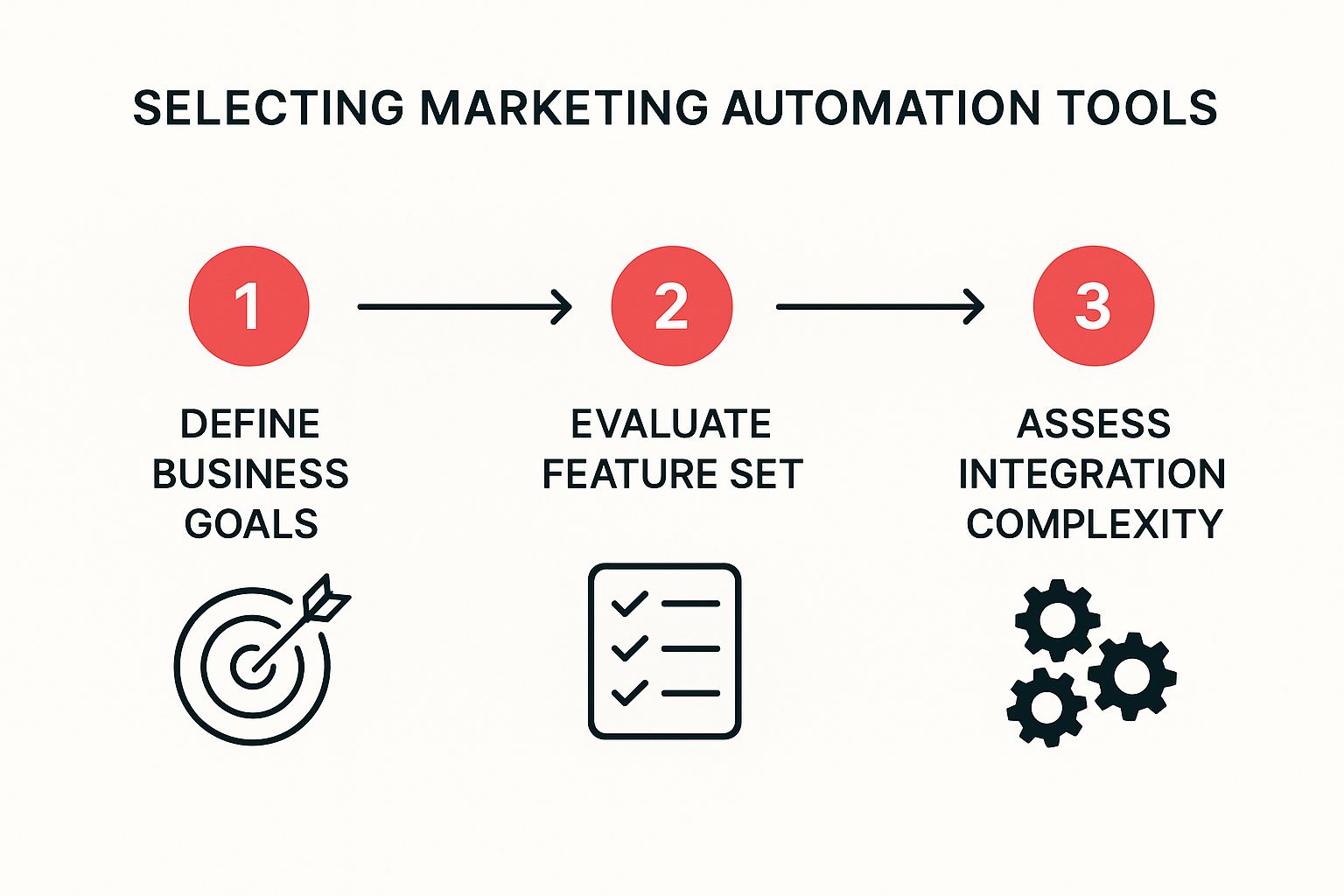
This process just goes to show that the workflows you build—whether it’s a welcome series or a cart recovery machine—are only as good as the platform supporting them.
Nurture Potential Customers with Real Value
Let’s be real: not every visitor is going to buy something on their first visit. That’s where a lead nurturing workflow comes in. It’s designed to educate and guide prospects who are still kicking the tires. The secret here is to provide genuine value based on what they’ve shown interest in, gently moving them closer to a purchase without being aggressive.
For example, if someone downloads a guide on “how to choose the right running shoes,” your workflow can automatically send them a series of emails with related running tips, product deep-dives, and success stories from other runners. This frames you as a trusted expert, not just another retailer.
The goal is to be a resource, not a sales machine. When you provide genuinely helpful content that solves their problems, you build trust. You stay top-of-mind. So when they are ready to buy, your store is the first one they think of.
Win Back Lost Sales with Email and SMS
Cart abandonment is the bane of every online store’s existence. It’s a huge problem. That’s why having a powerful abandoned cart workflow isn’t just a nice-to-have; it’s non-negotiable. The most effective way to tackle this is by combining the power of email with the immediacy of SMS.
Why SMS? Because it has an insane average open rate of 99%. It’s the perfect tool for cutting through the noise with a time-sensitive reminder.
Here’s a sequence that we’ve seen work wonders:
- Email (45 Minutes After Abandonment): Send a friendly, low-pressure reminder. “Hey, did you forget something?” Include big, clear images of the products they left behind and a direct link straight back to their cart.
- SMS (2 Hours After Abandonment): Now it’s time for a quick, direct text. Something casual like, “Hey [Name], still thinking it over? Your cart is waiting for you at [Link].”
- Email (24 Hours After Abandonment): If they still haven’t converted, it’s time to create a little urgency. Offer a small, compelling discount—like 10% off—to give them that final push to complete the purchase.
Of course, when you’re sending text messages, you have to play by the rules. For a complete rundown on how to craft effective and compliant messages, you’ll want to check out these essential SMS marketing best practices.
Set Up a Compliant SMS Cart Recovery Campaign
SMS marketing is an absolute beast for winning back lost sales. We’re talking about a channel with an incredible 99% average open rate. But with that kind of power comes a whole lot of responsibility. You can’t just start blasting texts. Launching an SMS abandoned cart workflow requires a careful, compliant approach to turn that high intent into real revenue without ticking off customers or, worse, breaking the law.
The first thing to sort out is the technical connection. Your e-commerce store and your automation tool need to be perfectly in sync. This is what lets your system know instantly when a shopper bails on their cart, triggering the recovery message. A platform like CartBoss, for instance, connects directly with Shopify and WooCommerce, so this data sync happens automatically. It grabs the customer’s phone number, what was in their cart, and the unique checkout link, all in real-time.
This image is a perfect visual for a problem every single online store deals with. A smart SMS recovery campaign is your best bet for getting those potential customers back to your site to finish what they started.
Nailing Compliance and Getting Consent
Before a single text goes out, you absolutely must get explicit consent from your customers to send them marketing messages. This isn’t just a good idea; it’s a legal requirement under regulations like the Telephone Consumer Protection Act (TCPA).
Your checkout page needs a clear, separate checkbox for SMS marketing opt-in. The wording has to be crystal clear, something like: “I agree to receive promotional and marketing text messages from [Your Brand Name] at the phone number provided.” And that box cannot be pre-checked. The customer has to take the action themselves.
On top of that, every single SMS campaign needs to give people a simple, obvious way to opt out. Including “Reply STOP to unsubscribe” in your messages is the standard and it’s mandatory for compliance. Getting this wrong can lead to massive fines and seriously hurt your brand’s reputation.
The golden rule of SMS marketing is to treat the customer’s inbox like you’re a guest in their home. You were invited in, so be respectful, provide real value, and make it easy for them to say goodbye. This is how you build trust and long-term loyalty.
If you’re new to the SMS game, getting the fundamentals right is everything. You can get a great overview of the basics and legal stuff in this detailed guide explaining what SMS marketing is and how to start off on the right foot.
Crafting the Perfect SMS Sequence
With the compliance side locked down, you can shift your focus to building a workflow that actually feels helpful, not pushy. Timing and tone are your best friends here. The goal is a gentle reminder with a little incentive, not a hard sell.
Here’s a two-step sequence I’ve seen work wonders, balancing persistence with respect for the customer’s time:
- Message 1 (Send 45 minutes after abandonment): This is just a light nudge. Keep it friendly and get straight to the point.
- Template: “Hey [Name]! Looks like you left something behind at [Your Store Name]. Your cart is saved and waiting for you: [Cart Link]”
- Message 2 (Send 24 hours after abandonment): If they didn’t bite on the first message, it’s time to sweeten the deal. A small, time-sensitive discount can be the perfect motivator.
- Template: “Still thinking it over? Complete your order at [Your Store Name] in the next 12 hours and get 10% off with code SAVE10. Your cart: [Cart Link]”
Honestly, this two-step flow is often all it takes. It gives the customer space but also provides a clear, easy path back to their cart, turning what could have been a lost sale into a completed order.
Measure and Optimize Your Automation Performance
Getting your automation workflows live is a huge step, but it’s really just the beginning. The real magic happens when you treat your marketing automation like a living system—something you’re always measuring, tweaking, and improving. This is how you go from a decent campaign to a predictable growth engine.
Your platform’s analytics dashboard is where you’ll spend a lot of your time. Don’t get overwhelmed by all the numbers, though. The key is to focus on the metrics that actually tell you the story of what’s working and what isn’t.
Pinpoint the Key Metrics That Matter
For any workflow you build, you need to define what success looks like in plain numbers. Forget just tracking opens and clicks; you need to connect your automation efforts to bottom-line results that actually impact your business.
Here are the metrics I always keep a close eye on:
- Conversion Rate: This is the big one. What percentage of people actually completed the action you wanted, like making a purchase?
- Revenue Per Recipient: On average, how much money is each automated message bringing in? This cuts through the vanity metrics.
- Workflow ROI: A simple calculation: total revenue from the campaign divided by what it cost you to run it. Is it paying for itself?
- Unsubscribe Rate: If this number starts creeping up, it’s a major red flag that your content or sending frequency is off the mark.
Tracking these helps you understand what’s truly driving sales. For instance, our guide on how to recover an abandoned cart is packed with different strategies. By tracking the ROI of each SMS, you can quickly see which tactics are delivering the best bang for your buck.
Use A/B Testing to Continuously Improve
Guesswork has no place in optimization. A/B testing, also known as split testing, is a straightforward but incredibly powerful way to make data-driven decisions. The whole idea is to test just one small change at a time to see what your audience responds to.
Don’t just “set it and forget it.” The most successful brands are constantly testing. A tiny 0.5% improvement in conversion rate, compounded over thousands of interactions, can add up to significant revenue over time.
Start by testing the elements that will have the biggest impact. For an abandoned cart SMS, you could test an offer of 10% discount against an offer for free shipping. For a welcome email series, try a subject line with an emoji versus one without. These little experiments give you clear, actionable insights into what your audience actually wants, letting you refine your approach over time.
A/B Testing Ideas for Automation Workflows
Not sure where to start? This table should give you some solid ideas for your next A/B test. Remember to only test one element at a time to get clean results.
| Element to Test | Variable A | Variable B |
|---|---|---|
| SMS Offer | 10% Discount | Free Shipping |
| Email Subject Line | “Your cart is waiting!” | “Forgot something? Here’s 15% off” |
| Send Time (First SMS) | 10 minutes after abandonment | 30 minutes after abandonment |
| Image in Email | Product image | Lifestyle image with product |
| Call-to-Action (CTA) | “Complete Your Order” | “Take Me Back to My Cart” |
| Tone of Voice | Friendly and casual | Urgent and direct |
Treat this as your starting point. Every audience is different, so what works for one store might not work for another. The key is to keep testing and let the data guide your decisions.
This is also where artificial intelligence (AI) is becoming a massive advantage. AI is popping up everywhere in marketing automation, analyzing huge amounts of data to predict which offers or send times will work best for specific customer groups. The global AI marketing market was valued at $20 billion in 2022 and is expected to rocket to $40 billion by 2025, which just shows how quickly brands are jumping on board.
Companies using AI are gaining a serious edge by understanding customer behavior on a deeper level and optimizing campaigns almost in real-time. You can dig into more of these game-changing AI marketing statistics on cubeo.ai. By constantly measuring and optimizing, you ensure every automated message you send is working as hard as it possibly can.
Common Questions About Marketing Automation Setup
Even with the best game plan, you’re bound to have some questions as you dive into setting up your first marketing automation. Let’s walk through a few of the most common ones I hear. Getting these cleared up early will help you sidestep those initial bumps in the road.
How Long Does It Take to Set Up?
This is the classic “it depends” question, but I can give you a real-world answer. If you’re looking to set up something simple, like a basic welcome email, you can have that live and running in just a couple of hours with a good tool.
But for a more advanced, multi-channel sequence—say, a lead nurturing flow that talks to your CRM—you’ll want to set aside a few days. You need time to properly map it out, build the steps, and test everything from top to bottom. My advice is always to start small. Get one high-impact workflow running perfectly, learn the ropes, and then build from there.
What Are the Most Common Mistakes to Avoid?
The single biggest mistake I see is people jumping into automation without a clear strategy. Just blasting generic, untargeted messages to your entire list is the fastest way to annoy your audience and destroy your engagement rates.
A few other common pitfalls to watch out for:
- Using messy data. If your contact information is incomplete or inaccurate, your personalization will fail spectacularly.
- Forgetting to track conversions. If you don’t set up tracking, you’ll have no idea if your efforts are actually making money.
- Ignoring consent. This is a big one, especially with SMS. You absolutely must have explicit permission to text people, or you’re asking for serious trouble.
Your automation should always feel helpful and personal to the person receiving it. If it comes across like spam, you’ve missed the point entirely. The goal is to build relationships at scale, not just send more messages.
Can I Set Up Automation on a Small Budget?
Absolutely. You don’t need a huge budget to get started. Many of the top automation platforms offer free or very affordable starter plans specifically for small businesses.
These plans usually give you all the core features you need to get going, like a visual workflow builder and basic email sends. This lets you prove the concept and see the revenue your automations are generating. Once you can show a clear return on your investment, it becomes a much easier decision to upgrade to a more powerful plan as your business scales.
For more on this, check out our guide on how to calculate marketing return on investment.
How Do I Make My Automation Feel Personal?
This is the secret sauce. Personalization is what separates automation that works from automation that gets ignored. The key is using the data you already have to make every interaction feel like it was written just for them.
Simple things make a big difference. Use merge tags to include the customer’s name. Use their behavior to trigger messages—for instance, if they viewed a specific product category, send them a follow-up about related items.
Segmenting your audience into smaller, highly relevant groups is also a game-changer. This ensures the right message finds the right person at the perfect moment.
Ready to turn abandoned carts into your biggest revenue source? With CartBoss, you can set up powerful SMS recovery campaigns in minutes and watch your sales soar. Start recovering lost sales today!