


If you feel like you’re spending more and more to bring in each new customer, you’re not imagining things. It’s a real trend, and it’s hitting businesses in just about every industry out there. This isn’t just about ad prices creeping up; we’re seeing a fundamental shift in the entire marketing environment.
Getting a handle on why this is happening is the first real step toward building a smarter, more cost-effective growth strategy. The forces at play aren’t isolated problems—they’re all interconnected, and they amplify each other’s impact.
Why Your Customer Acquisition Costs Are Climbing
Let’s break down the big reasons you’re seeing those numbers go up:
- Intense Market Competition: It’s gotten crowded. More businesses are jumping into the ring, all fighting for the same ad space on platforms like Google and Meta. That drives auction prices through the roof.
- Data Privacy Shifts: This is a huge one. Major changes like Apple’s iOS 14.5 update and the slow death of third-party cookies have seriously handicapped our ability to track user behavior and serve up personalized ads.
- Ad Platform Saturation: Your potential customers are getting tired. They’re becoming desensitized to the same old ads, which means engagement rates are dropping. You have to spend more just to get the same results you used to.
- Regulatory Compliance: New rules like GDPR and CCPA have added extra layers of complexity and cost to how we handle data and run our marketing campaigns.
What Exactly Is Customer Acquisition Cost?
Before we go any further, let’s get on the same page. At its core, Customer Acquisition Cost (CAC) is the total amount you spend on sales and marketing to convince someone to buy from you.
This isn’t just your ad spend. It includes salaries for your marketing team, the cost of your software tools, content creation expenses, and any other related overhead.
The formula is pretty simple: divide your total sales and marketing costs over a set period by the number of new customers you brought in during that same time. For a deeper look, check out our detailed guide on how to calculate customer acquisition cost.
Tracking your CAC isn’t optional—it’s essential. It tells you whether your business model can actually survive in the long run. A high CAC isn’t just a marketing headache; it’s a direct threat to your profitability, signaling that the cost to get a customer might be more than they’re ever worth to you.
The Impact of a Changing Digital World
The new privacy-first world that tech giants are pushing has thrown a real wrench in the works, directly contributing to climbing costs.
Recent data shows a staggering 60% increase in customer acquisition costs over the last five years alone. This spike has been largely fueled by these privacy updates and stricter regulations. The old tactics just don’t pack the same punch anymore, forcing businesses like yours to get more creative and find more efficient ways to reach an audience.
Understanding these market dynamics is critical. This isn’t just a budget problem—it’s a strategic challenge you have to adapt to. The goal has shifted. It’s no longer just about getting customers; it’s about getting them profitably and sustainably in a much tougher game.
Making Every Ad Dollar Count

Simply pouring more money into your ad budget is rarely the answer for sustainable growth. If you really want to reduce customer acquisition costs, you need to make every dollar work smarter, not just harder. It’s a mindset shift—from volume to precision.
Your ad spend should feel like a strategic investment, not a slot machine. It all starts with a deep dive into who you’re targeting and why.
Laser-Focus Your Audience Targeting
Generic demographic targeting is a relic of the past. Spraying your ads across a wide net and hoping for the best is a quick way to burn through your budget with little to show for it.
Your real goal is to pinpoint high-intent audiences who are actively looking for a solution just like yours. Think beyond age and location. Dig into behaviors, interests, and recent purchase history. Platforms like Meta and Google offer incredibly detailed targeting options that let you reach people who recently visited specific product pages or even engaged with your competitors.
Key Takeaway: The single most effective way to lower your CAC in paid advertising is to stop paying to show ads to people who will never buy. Hyper-targeting ensures your message hits the most qualified prospects, which can dramatically improve your conversion rates and overall efficiency.
Test and Iterate Your Creative and Copy
What resonates with one audience segment might fall completely flat with another. This is why relentless A/B testing isn’t just a best practice—it’s a necessity for optimizing ad spend. I’ve seen tiny tweaks lead to massive improvements in performance.
Start by testing one variable at a time:
- Headlines: Pit a benefit-driven headline against one that creates urgency.
- Images/Videos: Does a lifestyle photo outperform a clean product shot? Does a short, punchy video get more clicks than a static image?
- Calls-to-Action (CTAs): Compare “Shop Now” with “Learn More” or “Get 20% Off.” See what actually drives action.
Testing constantly tells you what motivates your customers, allowing you to refine your campaigns with real data, not just assumptions.
Leverage Retargeting and Lookalike Audiences
Some of your most valuable audiences are people who’ve already shown interest in your brand. Retargeting campaigns are designed to bring these warm leads back into the fold.
By showing tailored ads to users who have visited your site, added an item to their cart, or engaged with your social media, you recapture their attention and nudge them toward a purchase. These campaigns almost always deliver a higher return because you’re marketing to a pre-qualified audience.
Once you’ve identified your best customers, you can use lookalike audiences to find more people just like them. These platforms analyze the traits of your existing customer base and build a new audience that shares similar characteristics. For specialized fields, a deep dive into efficient strategies, such as optimizing PPC campaigns for law firms, is essential for making every dollar count. This approach lets you expand your reach without sacrificing relevance.
In fact, some AI-driven tools can reduce CAC by up to 50%, enabling better targeting and personalization that really boost marketing efficiency. To see how your ad performance truly impacts your bottom line, check out our guide on how to calculate your return on ad spend.
Turning More Visitors Into Customers
Getting traffic to your site is only half the battle, and let’s be honest, it’s usually the most expensive part. If you really want to make a dent in your customer acquisition costs, the real magic happens when you get more value from the visitors you already have. This is the whole idea behind Conversion Rate Optimization (CRO).
Instead of just pouring more money into ads to get more clicks, CRO is all about making your website work smarter. It’s a systematic process of finding and fixing all the little things that cause people to leave before buying.
Identifying and Fixing Funnel Friction
Think of every visitor’s journey on your site as a path. Along that path, there are potential roadblocks. It could be a confusing checkout form, a landing page that takes forever to load, or a “Buy Now” button that’s nearly impossible to find. These little issues add up, creating friction that absolutely kills your conversion rate and drives up your CAC.
The first step is to stop guessing what’s wrong and start looking at the data. Tools that give you heatmaps and session recordings are goldmines for this. They let you see exactly where users are clicking, how far they’re scrolling, and where they’re getting stuck and rage-quitting. Seriously, watching a few recordings of real users struggling with your site is one of the most eye-opening things you can do.
Key Insight: Your website isn’t just a digital brochure; it’s your most important salesperson. Optimizing it for conversions is like training that salesperson to be more persuasive and helpful, directly improving its performance without increasing your ad spend.
Prioritizing High-Impact CRO Tests
Once you’ve got a list of potential problems, you need to figure out where to start. Not all fixes will give you the same bang for your buck. A simple framework can help you decide what to test first.
For every potential change, think about these three things:
- Potential Impact: How much could this realistically improve your conversion rate? Fixing a broken checkout button is huge. Changing the color of a footer link? Not so much.
- Confidence: How sure are you that this change will actually work? Is it backed by solid user data, or is it just a hunch?
- Ease of Implementation: How much time and effort will this take? A simple headline swap is easy. A complete homepage redesign is a major project.
You want to find the sweet spot: tests with high potential impact, high confidence, and low implementation effort. These are your quick wins that will move the needle the fastest. Remember, lowering CAC isn’t about blindly slashing budgets. It’s about getting more efficient—improving your sales funnel, creating a better user experience, and A/B testing things like headlines and calls to action.
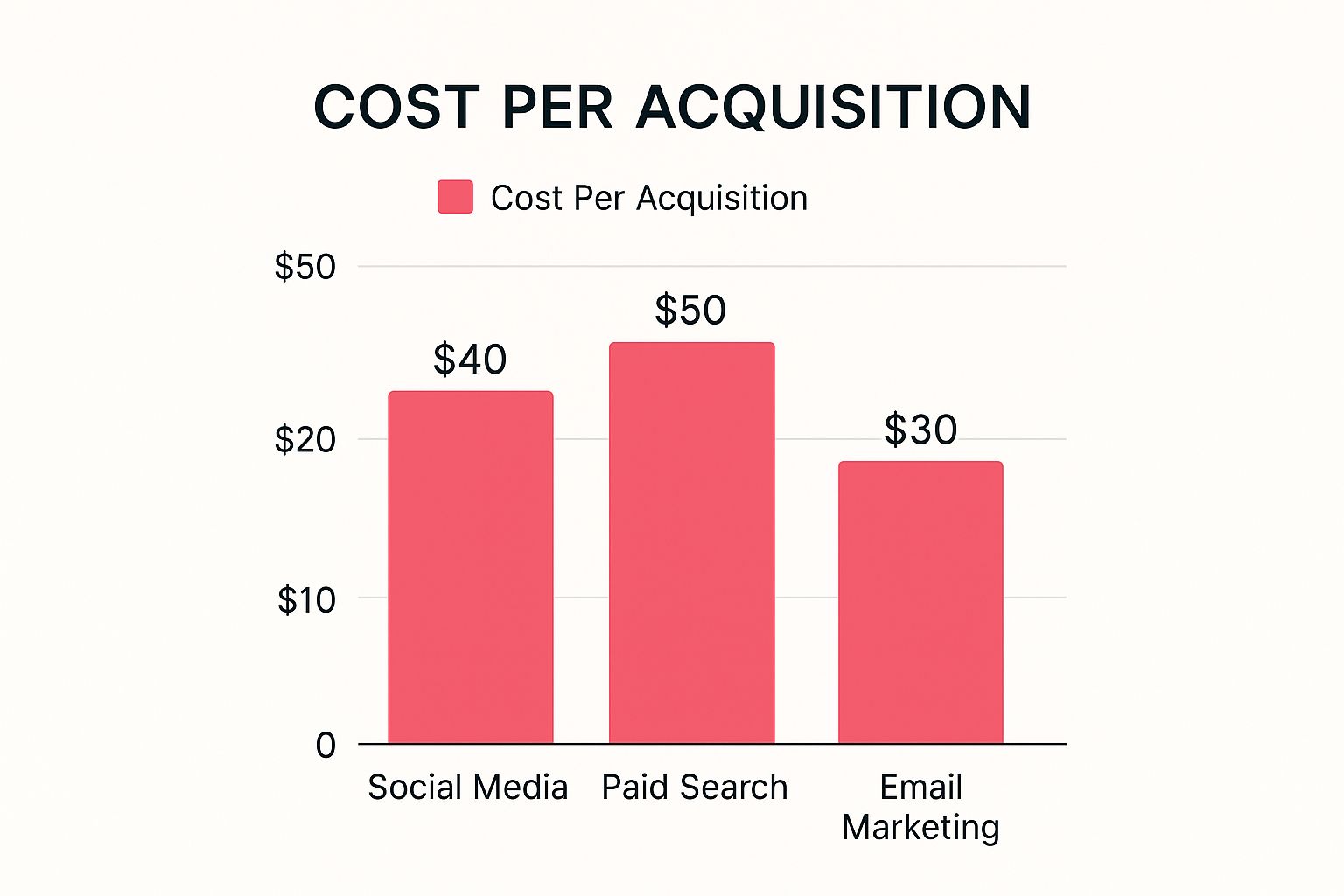
The chart above shows a pretty clear picture: some channels are just naturally more cost-effective than others. A balanced marketing strategy is key, but optimizing the performance of every channel is where you’ll see the biggest gains.
To help you prioritize, here’s a quick breakdown of common CRO tactics and the kind of impact they can have on your customer acquisition cost.
High-Impact CRO Tactics and Their Potential CAC Reduction
| CRO Tactic | Common Problem Solved | Estimated CAC Impact |
|---|---|---|
| A/B Testing Headlines & CTAs | Low engagement, unclear value proposition | 5-15% reduction |
| Mobile-First Optimization | Poor user experience on mobile devices, high bounce | 10-25% reduction |
| Page Speed Improvements | High bounce rates, user frustration | 10-20% reduction |
| Streamlining Checkout | High cart abandonment rates | 15-30% reduction |
| Improving Site Navigation | Users can’t find products, low pages per session | 5-10% reduction |
Focusing on these areas first will almost always yield the best results for the effort you put in.
One of the biggest friction points for any e-commerce store is the checkout process. A clunky, confusing, or long checkout is the number one killer of sales. If you’re seeing a massive drop-off at this final stage, it’s a huge red flag that needs your immediate attention. For some specific strategies on this, you might want to check out our guide on how to reduce abandoned carts.
By making smart, data-driven improvements to your site, you convert more of the traffic you’ve already paid for. That directly lowers your acquisition costs across the board.
Building Loyalty to Lower Acquisition Pressure

The constant chase for new customers is exhausting. It’s also incredibly expensive.
While bringing new people through the door is obviously key for growth, your most profitable source of revenue is the customer who has already trusted you with their business. When you shift your focus from pure acquisition to robust retention, you fundamentally change your financial model for the better.
This approach helps you reduce customer acquisition costs by creating a much more resilient business. Instead of being entirely dependent on pricey top-of-funnel marketing, you build a loyal base that generates predictable, repeat income. The economics are overwhelmingly clear: keeping a customer is far, far cheaper than finding a new one.
Nurturing Relationships with Post-Purchase Automation
The moment a customer completes a purchase isn’t the end of their journey—it’s the beginning of a massive opportunity. This is your chance to solidify the relationship and turn a one-time buyer into a lifelong fan. Automated post-purchase campaigns using email and SMS are perfect for this.
Imagine a customer buys a new skincare product. Instead of silence, they get an automated SMS a week later with a helpful tip on how to use it for the best results. A few weeks after that, an email lands in their inbox offering a discount on a complementary product. This isn’t just selling; it’s providing real value and staying top-of-mind.
These automated touchpoints are simple to set up but incredibly powerful. They show you care beyond the initial transaction, which is exactly what builds the trust needed for repeat business.
Implementing Simple Loyalty and Referral Programs
Rewarding your best customers is one of the smartest investments you can possibly make. A simple loyalty program doesn’t need to be complicated at all. It can be as straightforward as offering points for every dollar spent that can be redeemed for future discounts.
This small gesture encourages repeat purchases and makes customers feel genuinely appreciated. When they know their loyalty is valued, they are far less likely to be swayed by a competitor’s ad.
Pro Tip: Your most enthusiastic customers can also become your most effective sales team. A referral program that gives both the existing customer and the new customer a discount is a powerful, low-cost acquisition channel. You’re essentially paying for a highly qualified lead only after they’ve already converted.
Boosting Customer Lifetime Value (LTV)
Ultimately, all of these retention efforts are about one thing: increasing Customer Lifetime Value (LTV). That’s the total revenue you can expect from a single customer over time. When you successfully increase LTV, you can actually afford to spend more to acquire a new customer, making your marketing efforts much more competitive.
Here’s how retention directly pumps up your bottom line:
- Higher Purchase Frequency: Loyal customers simply buy from you more often.
- Increased Average Order Value: Happy customers are far more likely to try new products or add more to their cart.
- Reduced Marketing Spend: You spend less acquiring new leads because your existing customer base is driving a ton of revenue.
By building a strong foundation of repeat business, you create a powerful buffer against rising ad costs and unpredictable markets. A well-executed retention plan isn’t just a defensive move; it’s one of the most proactive and profitable strategies for long-term growth.
For more ideas, explore our comprehensive guide on building a winning customer retention strategy.
Driving Organic Growth with Content and SEO

Paid ads are great for a quick traffic jolt, but it’s a tap that runs dry the second you stop paying. For a truly sustainable way to reduce customer acquisition costs, you need to build an asset that grows in value over time: your organic presence.
This is where content marketing and SEO enter the picture. Instead of paying for every single click, you create genuinely useful content that pulls in your ideal customers for free, day in and day out. It’s definitely a long-term play, but the reward is a powerful, self-fueling customer acquisition machine.
And it all starts with figuring out what your audience is actually looking for.
Tapping into Customer Intent with Keyword Research
Good SEO isn’t about jamming keywords onto a page. It’s about getting inside your customers’ heads and pinpointing the exact problems, questions, and pain points they’re typing into Google.
When you build content that answers those queries directly, you attract highly qualified traffic—people who are much closer to making a decision.
Think about it from their side. Are they searching for “best software to manage inventory” or “how to fix a leaky sales funnel”? These are high-intent phrases that signal an immediate need. By targeting them, you position your brand as the perfect solution at the exact moment they’re looking for one.
This strategy builds a content engine that works for you 24/7. Your blog posts and guides essentially become your digital sales team, establishing authority and nurturing leads while you sleep.
Creating valuable content isn’t a cost; it’s an investment in a durable marketing asset. A single well-ranked blog post can generate leads for years, continuously lowering your blended CAC as it attracts more organic traffic.
Building a Content Engine That Converts
The real goal is to create a library of resources that helps your audience at every stage of their journey. This opens up countless entry points to your website and builds deep trust with potential buyers long before they ever see a “buy now” button. For a more complete picture, check out our deep dive on how to lower customer acquisition cost using a variety of proven methods.
Your content mix could include things like:
- Practical Blog Posts: Actionable tips and quick wins for common problems your audience deals with.
- In-Depth Guides: Definitive, go-to resources on complex topics that establish you as an industry leader.
- Case Studies: Show, don’t just tell. Nothing builds trust like proving how real customers found success with your solution.
As this content ecosystem grows, so does your organic footprint. Every new article is another shot at ranking for valuable keywords and drawing in your ideal customer. This steady flow of organic traffic diversifies your acquisition channels, making you far less dependent on pricey ads and consistently bringing down your overall costs.
Got Questions About CAC? We’ve Got Answers.
As you start digging into your customer acquisition cost, a bunch of questions are bound to pop up. It’s totally normal. When you’re trying to fine-tune your marketing spend and get smarter with your strategy, you want to know what to expect and what “good” even looks like.
Let’s clear up some of the most common questions we hear from brands trying to get a handle on their CAC.
What Is a Good Customer Acquisition Cost?
Honestly? This is the million-dollar question, and the real answer is: it depends entirely on your industry and business model.
A “good” CAC for a B2B SaaS company selling a $10,000 annual subscription looks completely different from a good CAC for an e-commerce brand selling $50 t-shirts. There’s no magic number.
Instead of chasing an arbitrary figure, the real focus should be on the relationship between your CAC and your Customer Lifetime Value (LTV). A healthy, sustainable business model usually has an LTV that’s at least three times its CAC.
Think of it this way: if your average customer spends $300 over their lifetime with you, a CAC of $100 or less is a solid goal. The key isn’t a specific dollar amount—it’s profitability.
How Long Does It Take to See a Reduction in CAC?
The timeline for seeing results really hinges on the strategies you’re putting into play. Some moves get you quick wins, while others are a long game.
- Paid Ad & CRO Tweaks: Optimizing your ad campaigns or running A/B tests on your landing pages can show results pretty fast. You can often see a difference within a few weeks to a month.
- Content & SEO Efforts: Building organic traffic is an investment in your brand’s future. It can easily take six months or more to see significant traffic from SEO that starts to bring down your blended CAC.
- Retention & Loyalty Programs: Improving customer retention builds momentum over time. You might see an impact on your repeat purchase rate within a couple of months, but the full effect on LTV and reducing the pressure to acquire new customers takes longer.
The fastest wins almost always come from plugging leaks in your existing funnel—think a confusing checkout process or poorly targeted ads. But the most durable, impactful reductions in CAC come from long-term investments in organic growth and customer loyalty.
Which Channels Typically Have the Lowest CAC?
Generally, the channels that don’t make you pay for every single click tend to have a lower CAC in the long run.
Once they get going, organic channels like SEO, content marketing, and good old-fashioned word-of-mouth referrals often deliver the best ROI. They take time to build, but they pay off massively.
Email and SMS marketing to your existing list are also incredibly cost-effective. You’re talking to an audience that already knows and trusts you, so the conversion cost is minimal.
While paid channels like social media and search ads can have a higher upfront cost, they can become extremely efficient when you dial in your targeting and nail your creative. The real goal is to build a balanced mix of channels that work together.
Ready to slash your cart abandonment rate and turn lost visitors into loyal customers? CartBoss uses the power of automated SMS to recover sales on autopilot, boosting your revenue by up to 50%. See how it works at https://www.cartboss.io.