



Imagine recovering lost sales, nurturing leads, and delighting customers, all while you focus on growing your business. That’s the power of marketing automation. Yet, moving from theory to practice can be challenging. Many e-commerce owners understand the need to automate but get stuck on the how.
The key is seeing what works for successful brands. This article cuts through the noise to provide practical, replicable workflows. We will dissect each marketing automation example to reveal the exact triggers, actions, and strategic thinking behind them. You’ll learn not just what to do, but why it works, with actionable steps to implement these powerful sequences in your own store today.
We are diving deep into the strategies used by top platforms like CartBoss, HubSpot, and Mailchimp. Each breakdown includes screenshots and direct links to help you visualize and replicate these automations. Our goal is to equip you with clear, powerful examples that solve common e-commerce problems, from cart abandonment to customer retention. You will leave with a playbook of proven tactics to boost efficiency and drive revenue immediately.
1. CartBoss
CartBoss presents a powerful and highly focused marketing automation example centered on solving one of e-commerce’s most persistent problems: cart abandonment. While many platforms offer broad automation suites, CartBoss distinguishes itself with its singular dedication to SMS-based cart recovery, a channel boasting an impressive 99% open rate. This specialization allows it to deliver exceptional performance in a critical, high-impact area of the customer journey.
The platform is engineered for immediate results, enabling Shopify and WooCommerce store owners to launch automated, expertly-timed SMS campaigns within minutes of installation. This plug-and-play approach removes the technical barriers often associated with implementing new marketing tools, making it an ideal solution for businesses of all sizes, from solo entrepreneurs to multi-brand agencies.
Strategic Breakdown: Why CartBoss Excels
CartBoss’s strategy is built on simplicity, speed, and precision. By focusing exclusively on SMS, it leverages the most direct and immediate communication channel available to re-engage shoppers who have shown clear purchase intent.
- Pre-Configured Workflows: Unlike general automation tools that require extensive setup, CartBoss comes with pre-written, optimized message templates. These templates are designed based on data from millions of recovered carts, ensuring the timing and content of each SMS are primed for conversion.
- Global Reach with Localization: A key differentiator is its automatic language detection. The system identifies the customer’s browser language and sends messages in one of over 30 supported languages, creating a personalized experience that significantly boosts engagement for international stores.
- Compliance and Trust: The platform operates with a strong focus on privacy. It is fully GDPR and CCPA compliant, featuring automatic do-not-disturb modes and simple opt-out links. This respect for customer preferences helps build trust and maintain a positive brand reputation.
Key Takeaway: The power of CartBoss lies in its focused execution. By mastering a single, high-leverage automation (SMS cart recovery), it delivers a remarkable average ROAS of 4500%, turning a common e-commerce challenge into a significant revenue stream.
Actionable Insights for Your Store
Implementing CartBoss is straightforward. Its pricing model is particularly compelling: it’s entirely performance-based with zero subscription fees. You only pay for the revenue it successfully recovers. This risk-free structure, combined with a free trial that doesn’t require a credit card, makes it an easy decision for any store owner looking to combat cart abandonment. The platform’s dynamic discount feature, which automatically applies coupon codes when a customer clicks the recovery link, further streamlines the path to purchase and enhances the user experience.
For more information or to start a free trial, visit the official website at https://www.cartboss.io.
2. HubSpot
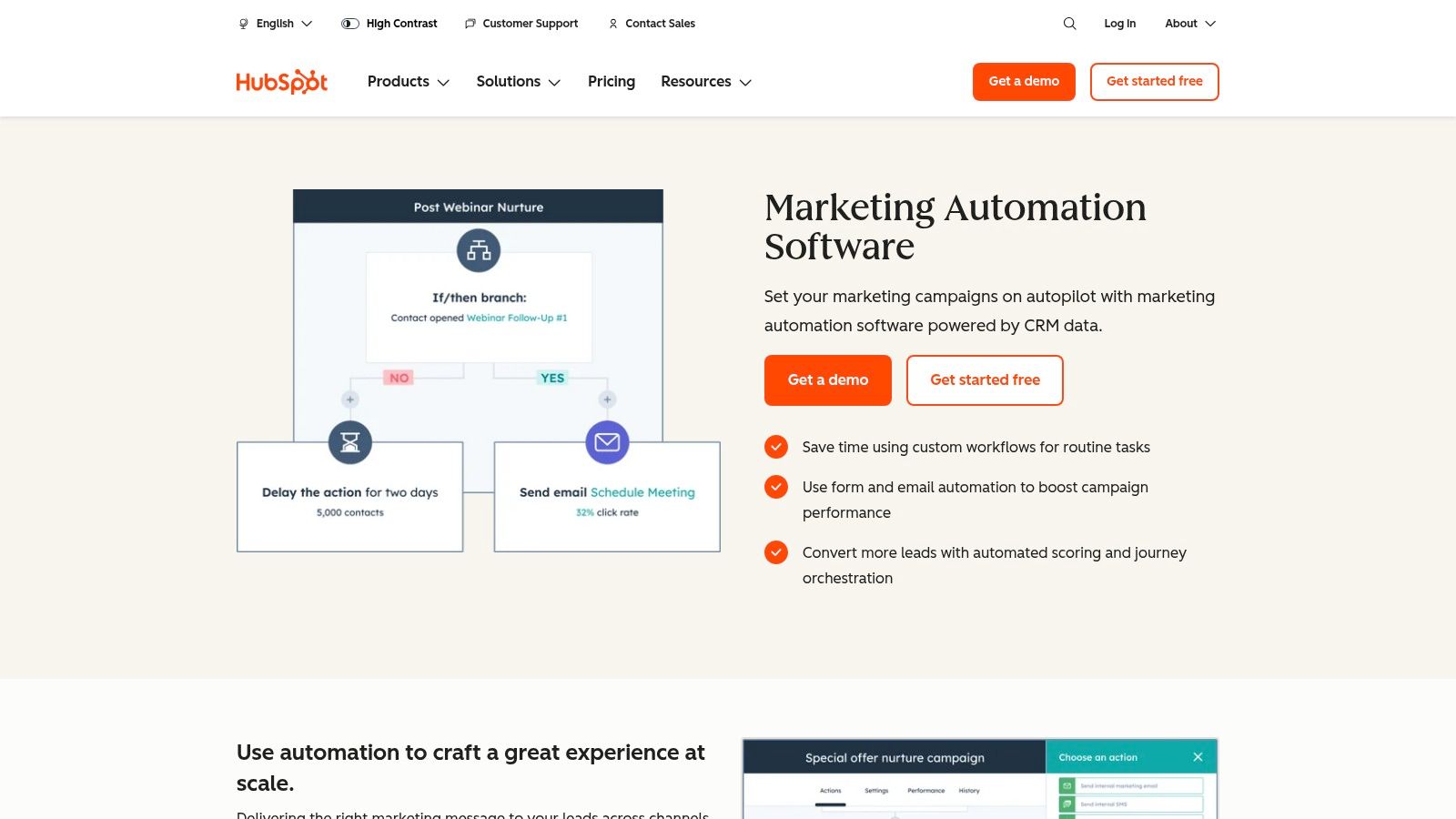
HubSpot stands out as an all-in-one marketing, sales, and service platform with a powerful, yet user-friendly, automation engine at its core. It’s designed for businesses that want a single source of truth for their customer data, enabling deeply integrated and personalized communication across the entire customer lifecycle. The platform’s visual workflow builder is a key differentiator, allowing users to map out complex sequences with if/then branches, delays, and goal-based triggers without writing a single line of code.
Strategic Analysis: The Power of Unified Data
HubSpot’s primary advantage lies in its deep integration with its own CRM. Every action a contact takes, from opening an email to visiting a pricing page or talking to a sales rep, can be used as a trigger or a branching condition within an automation workflow. This provides a holistic view of the customer journey that many point solutions struggle to replicate.
Key Insight: True personalization becomes possible when marketing automation has access to sales and service data. HubSpot allows you to create workflows that change based on a lead’s sales stage, a customer’s support ticket status, or their lifetime value, making it a powerful marketing automation example for relationship-driven e-commerce.
Actionable Takeaways & Unique Features
HubSpot is more than just an email tool; its automation extends to internal notifications, deal creation, task management, and data hygiene. For e-commerce stores, this means you can automatically alert a sales rep when a high-value lead browses a specific product category or create a support ticket if a customer mentions “problem” in a form submission.
- Goal-Based Workflows: Set a specific goal for your automation (e.g., booked a demo). HubSpot will automatically unenroll contacts once they meet that goal, preventing them from receiving irrelevant messages.
- Extensive Template Library: New users can get started quickly with pre-built templates for common use cases like lead nurturing, event reminders, and customer re-engagement.
- Comprehensive Training: HubSpot Academy offers free, high-quality courses and certifications on everything from inbound marketing to using their software, significantly lowering the learning curve.
Pricing for HubSpot’s Marketing Hub starts with a free tier and scales up through Starter, Professional, and Enterprise plans, with costs tied to the number of marketing contacts and feature access. For businesses just starting out, some find it a great tool; exploring marketing automation for a small business can provide more context on scaling. While the higher tiers can be a significant investment, the platform’s unified nature often justifies the cost for teams seeking to eliminate data silos.
3. Mailchimp
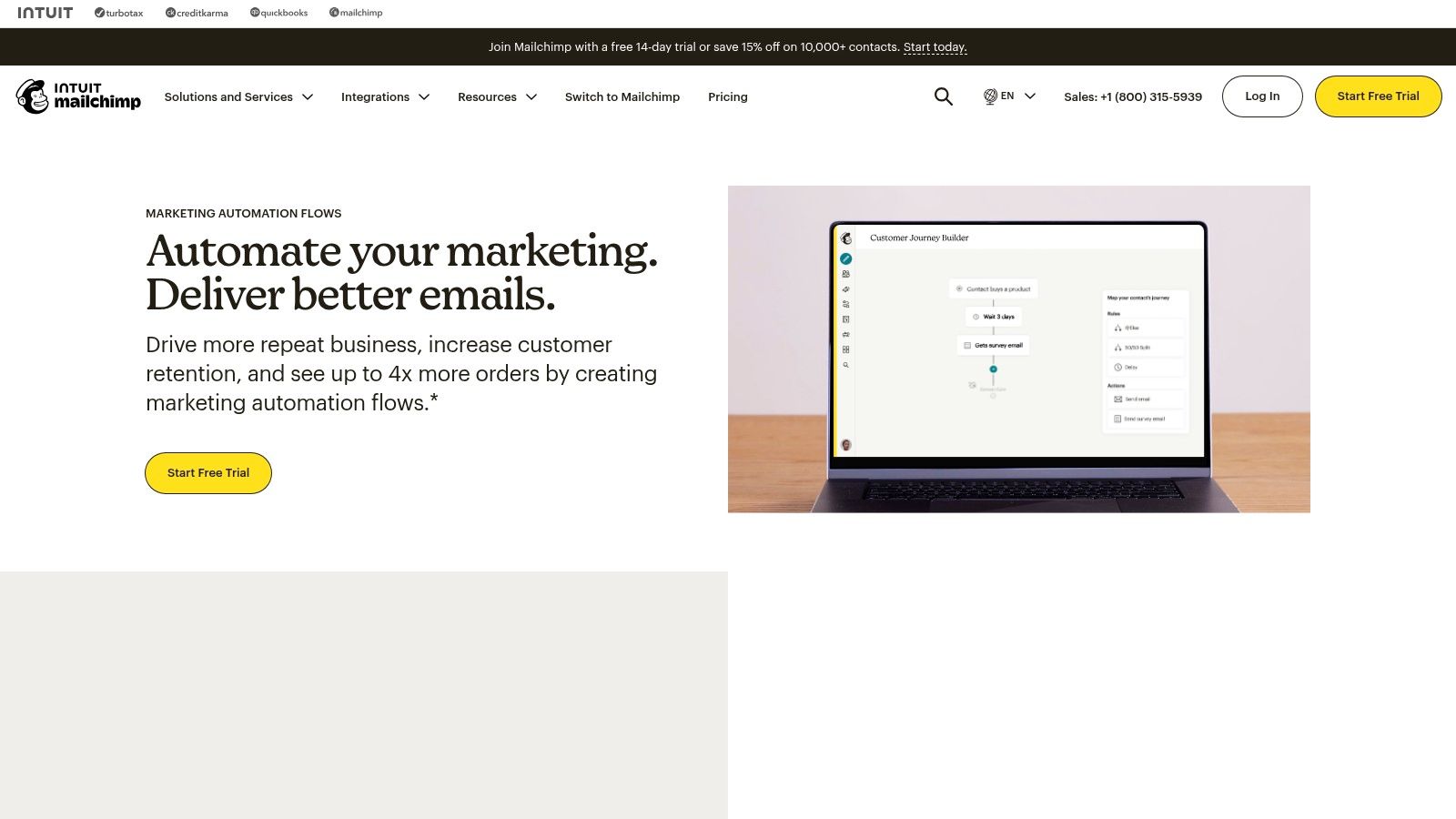
Mailchimp is widely recognized for making email marketing accessible, and its evolution into a multichannel automation platform makes it a strong contender for small to medium-sized businesses. Its Customer Journey Builder provides a simple, visual interface for creating automated workflows, focusing on ease of use and quick implementation. The platform excels at guiding users with pre-built templates for common e-commerce scenarios like welcome series and abandoned cart reminders, lowering the barrier to entry for teams just starting with automation.
Strategic Analysis: The Power of Accessibility and Multichannel Flow
Mailchimp’s strength lies in its approachable design and its integration of multiple channels within a single workflow. Unlike platforms that require complex setups or separate tools for different channels, Mailchimp allows users to drag-and-drop email, SMS, and delays into one cohesive journey. This unified approach simplifies the process of creating a layered communication strategy, where a customer might receive an email first, followed by an SMS message if they don’t engage.
Key Insight: Combining email and SMS in one automated flow increases touchpoints and boosts conversion rates without overcomplicating the marketing stack. Mailchimp provides an excellent marketing automation example for e-commerce stores wanting to test multichannel strategies with minimal technical overhead.
Actionable Takeaways & Unique Features
Mailchimp is designed for action, providing tools that help users launch effective campaigns quickly. Its AI-powered features, like Intuit Assist for generating branded email templates, reduce creative workload, while its extensive library of pre-built journeys provides a clear starting point for essential e-commerce automations.
- Prebuilt Journey Templates: Activate proven workflows for abandoned carts, customer re-engagement, and welcome series in minutes, with clear guidance for each step.
- Integrated SMS and Email: Add SMS messages directly into your email automation sequences using if/else splits to target customers based on their engagement or purchase behavior. If you want to explore more on this topic, understanding the nuances of SMS marketing automation can further enhance your strategy.
- AI-Assisted Content Creation: Use Intuit Assist to generate on-brand email designs and copy, speeding up the time it takes to build and launch new automations.
Mailchimp offers a free plan with limited automation features, with more advanced journey capabilities available in its paid plans (Essentials, Standard, and Premium). While the most powerful features are gated behind paid tiers, its user-friendly interface makes it an ideal platform for businesses looking to implement fundamental automations effectively.
4. ActiveCampaign
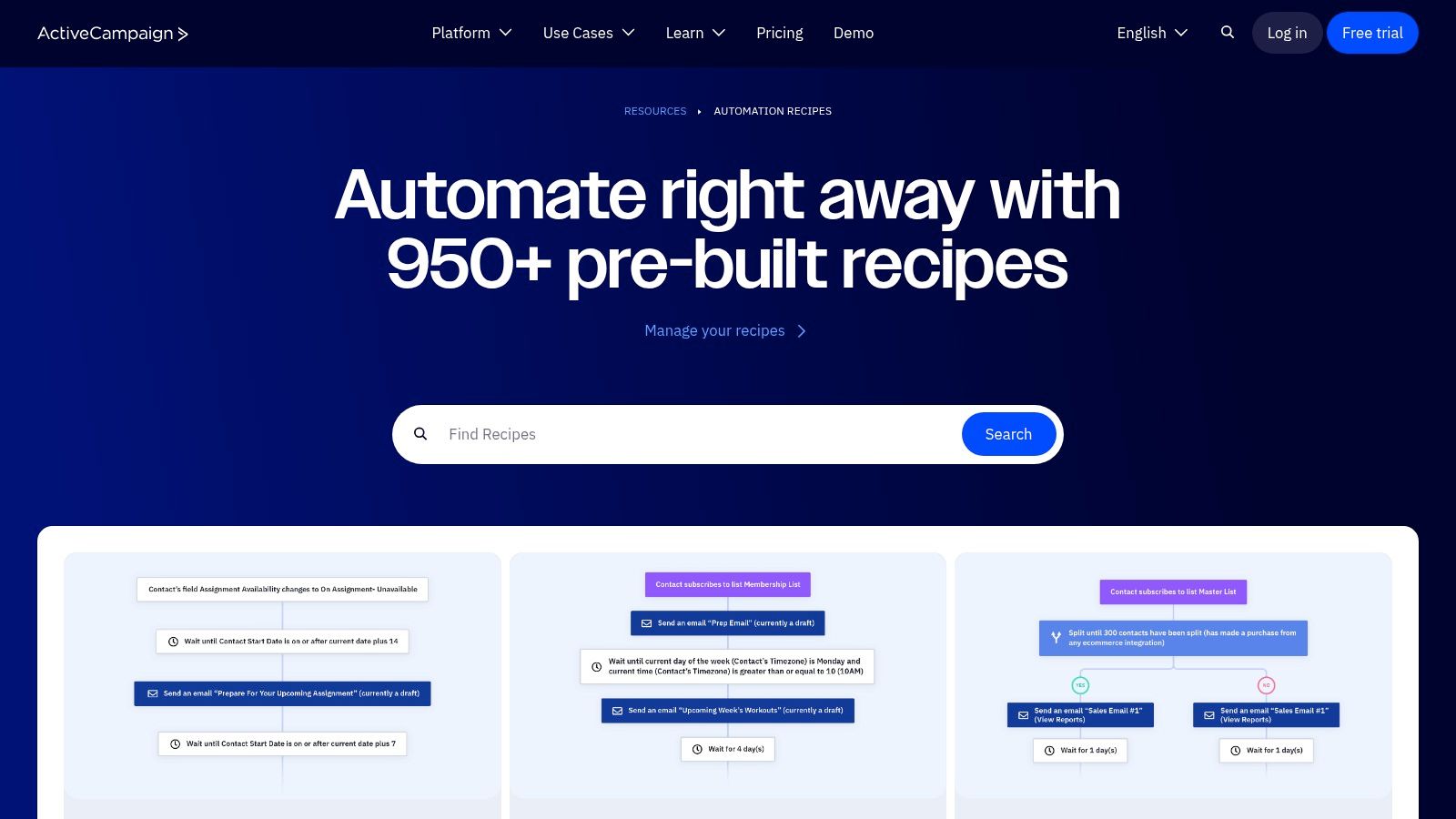
ActiveCampaign positions itself as a customer experience automation platform, excelling with its massive library of pre-built “automation recipes.” It’s designed for businesses that want to implement sophisticated automation sequences quickly without building them from scratch. The platform’s Automation Marketplace allows users to import entire workflows, complete with emails and logic, which can then be customized to fit their specific lists and custom fields.
Strategic Analysis: The Power of Templated Speed
ActiveCampaign’s core advantage is speed to implementation. By offering over 200 pre-built recipes for everything from abandoned cart recovery to lead scoring and post-purchase follow-ups, it dramatically lowers the barrier to entry for complex automation. This is particularly valuable for e-commerce stores on platforms like Shopify or WooCommerce, as many recipes are built specifically for those integrations.
Key Insight: Democratizing access to advanced automation strategies allows smaller teams to compete with larger operations. ActiveCampaign serves as a powerful marketing automation example by proving you don’t need a dedicated developer or a huge budget to implement effective, multi-step customer journeys.
Actionable Takeaways & Unique Features
Beyond its marketplace, ActiveCampaign combines email marketing with a robust CRM and sales automation, enabling a unified approach to customer communication. Its deep integration capabilities mean you can trigger automations based on e-commerce activities, such as a customer’s purchase history or their interactions with a specific product. This is a key component when designing a robust strategy; learning more about marketing automation for e-commerce can provide deeper insights.
- One-Click Automation Import: Users can browse the marketplace and import a complete automation flow directly into their account, making setup incredibly fast.
- Split-Testing Automations: Go beyond A/B testing emails and test entire automation paths against each other to see which sequence of actions drives the best results.
- Site and Event Tracking: Trigger automations based on website visits, video views, button clicks, or custom events you define, allowing for highly contextual messaging.
ActiveCampaign’s pricing is tiered based on features and contact count, starting with the Lite plan. Access to more advanced features like the CRM, lead scoring, and e-commerce integrations requires higher-tier plans like Plus or Professional. While some marketplace recipes from third parties come at an additional cost, the vast library of free templates provides immense value for businesses at any stage.
5. Adobe Marketo Engage
Adobe Marketo Engage is an enterprise-grade automation powerhouse designed for large organizations with complex B2B and B2C marketing needs. It excels in sophisticated lead nurturing, account-based marketing (ABM), and multi-touch revenue attribution. The platform is built for scalability, offering deep customization and robust integrations, making it a go-to for marketers who need granular control over every aspect of their automated campaigns and customer journeys.
Strategic Analysis: The Power of Enterprise-Grade Segmentation
Marketo’s core strength is its ability to manage and segment vast amounts of data for highly targeted communication. Unlike many platforms that focus primarily on individual contacts, Marketo’s architecture natively supports account-based marketing, allowing teams to orchestrate campaigns that target entire buying committees within a specific company. This is crucial for high-value B2B sales cycles where multiple decision-makers are involved.
Key Insight: Advanced automation requires equally advanced segmentation and attribution. Marketo allows you to move beyond simple triggers to build complex lead scoring models and revenue cycle models that tie marketing efforts directly to sales outcomes, offering a clear marketing automation example for businesses focused on proving ROI.
Actionable Takeaways & Unique Features
Marketo provides a comprehensive toolkit for building, deploying, and analyzing sophisticated marketing programs. Its extensive library of guided landing page templates and campaign “bootstrap” assets helps teams launch faster, even with complex requirements. For e-commerce, this means creating dynamic, personalized experiences is not just possible, but scalable. You can discover more proven e-commerce personalization examples to inspire your campaigns.
- Advanced Lead Scoring: Create detailed scoring models based on demographic data, firmographic data, and behavioral engagement to identify sales-ready leads with precision.
- Native CRM Integrations: Features deep, bi-directional syncs with major CRMs like Salesforce and Microsoft Dynamics, ensuring sales and marketing teams are always aligned.
- Multi-Touch Attribution: Go beyond “last-click” and understand how every marketing touchpoint contributes to revenue with customizable attribution models.
Pricing for Adobe Marketo Engage is sales-led and tailored to enterprise needs, so it is not transparently listed. While the platform requires a higher implementation effort and investment compared to SMB-focused tools, its rich feature set and scalability make it a formidable choice for large organizations aiming to execute complex, revenue-driven marketing strategies.
6. Salesforce Marketing Cloud Engagement
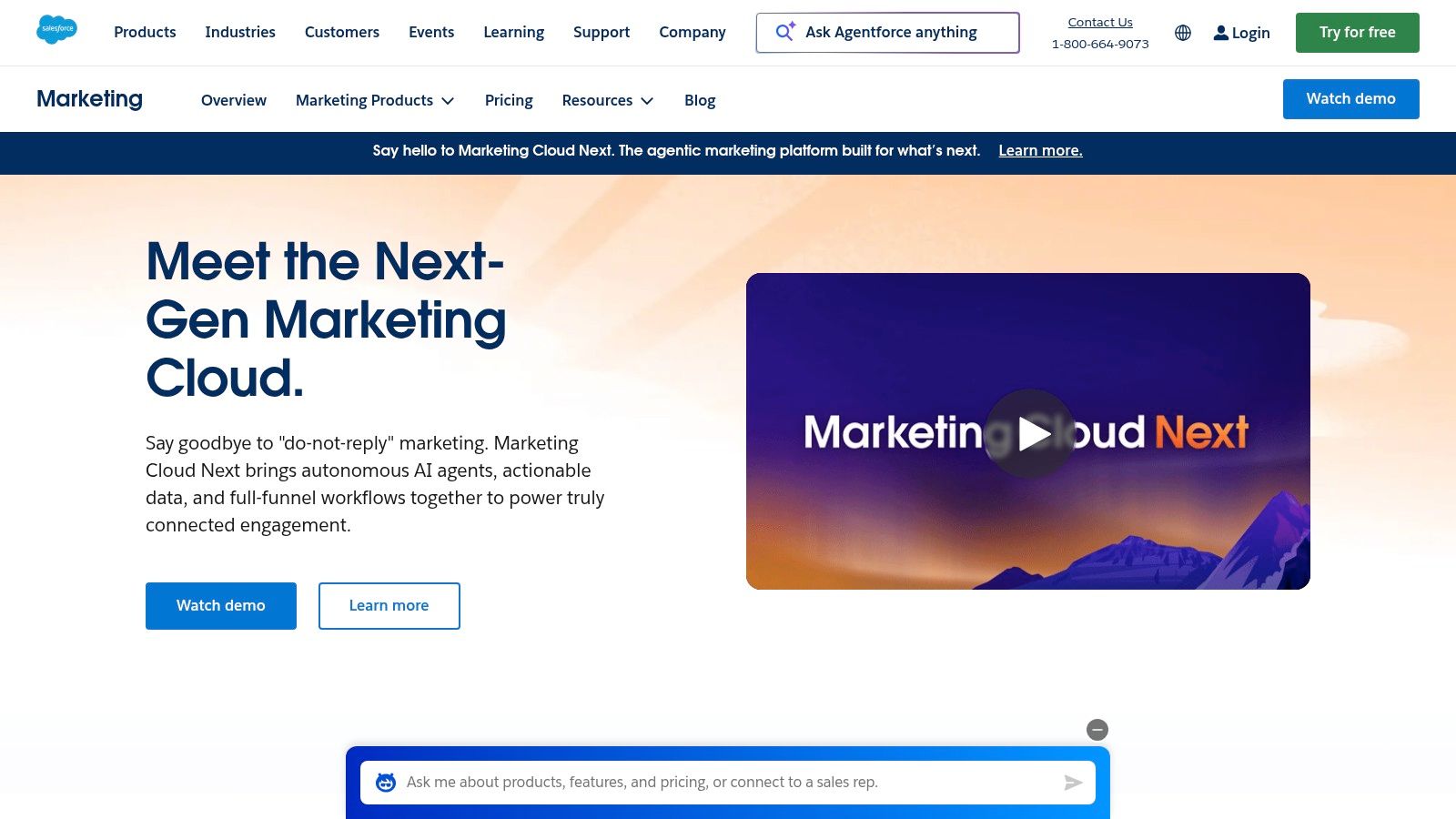
Salesforce Marketing Cloud Engagement is an enterprise-grade platform built for designing sophisticated, cross-channel customer journeys at scale. Its core automation tool, Journey Builder, allows large teams to map out complex interactions across email, SMS, mobile push, and advertising. The platform is distinguished by its prescriptive, developer-friendly approach, offering extensive documentation, Trailhead learning modules, and even machine-readable journey specifications for technical teams.
Strategic Analysis: The Power of Prescriptive Journeys
Salesforce’s strength lies in providing a robust, highly structured framework for automation. Unlike more flexible, open-ended builders, Journey Builder comes with a wealth of official guides, worksheets, and developer resources. This prescriptive methodology ensures that complex, multi-channel programs are built on a solid, scalable foundation, reducing errors and aligning large marketing and development teams.
Key Insight: Enterprise-level automation requires both marketing creativity and technical precision. Salesforce provides a powerful marketing automation example by bridging this gap with resources like Journey Spec JSON and AMPscript, allowing for deep personalization and programmatic control within a visual canvas.
Actionable Takeaways & Unique Features
Salesforce is designed for brands that view customer journeys as core business logic, not just marketing campaigns. The platform’s ability to integrate deeply with the entire Salesforce ecosystem (Sales Cloud, Service Cloud) enables automations that react to every conceivable customer interaction, from a sales call log to a resolved service case. This is one of many advanced digital marketing strategies that can maximize business outcomes.
- Journey Builder Canvas: A drag-and-drop interface with built-in activities like Email, Wait, and Random Split, alongside decision logic and goal-setting capabilities.
- Developer-Focused Resources: Offers unique assets like Journey Spec JSON and AMPscript for advanced personalization, enabling technical marketers to extend the platform’s capabilities programmatically.
- Comprehensive Education: Trailhead, Salesforce’s free learning platform, provides detailed modules on building specific journeys, from onboarding new customers to complex retention and re-engagement campaigns.
Pricing for Salesforce Marketing Cloud is not publicly listed and requires consultation with their sales team, reflecting its enterprise focus. While the investment in both cost and expertise is significant, its comprehensive and structured approach is ideal for large organizations managing intricate, multi-channel customer experiences.
7. Amazon
While not a software platform, Amazon earns its spot as an invaluable resource for marketing automation knowledge. It offers a vast library of books and guides filled with practical workflows, strategic blueprints, and detailed templates. For marketers who want to understand the “why” behind the “what,” these comprehensive resources provide step-by-step instructions and playbooks that can be adapted to any software stack, from HubSpot to Klaviyo.
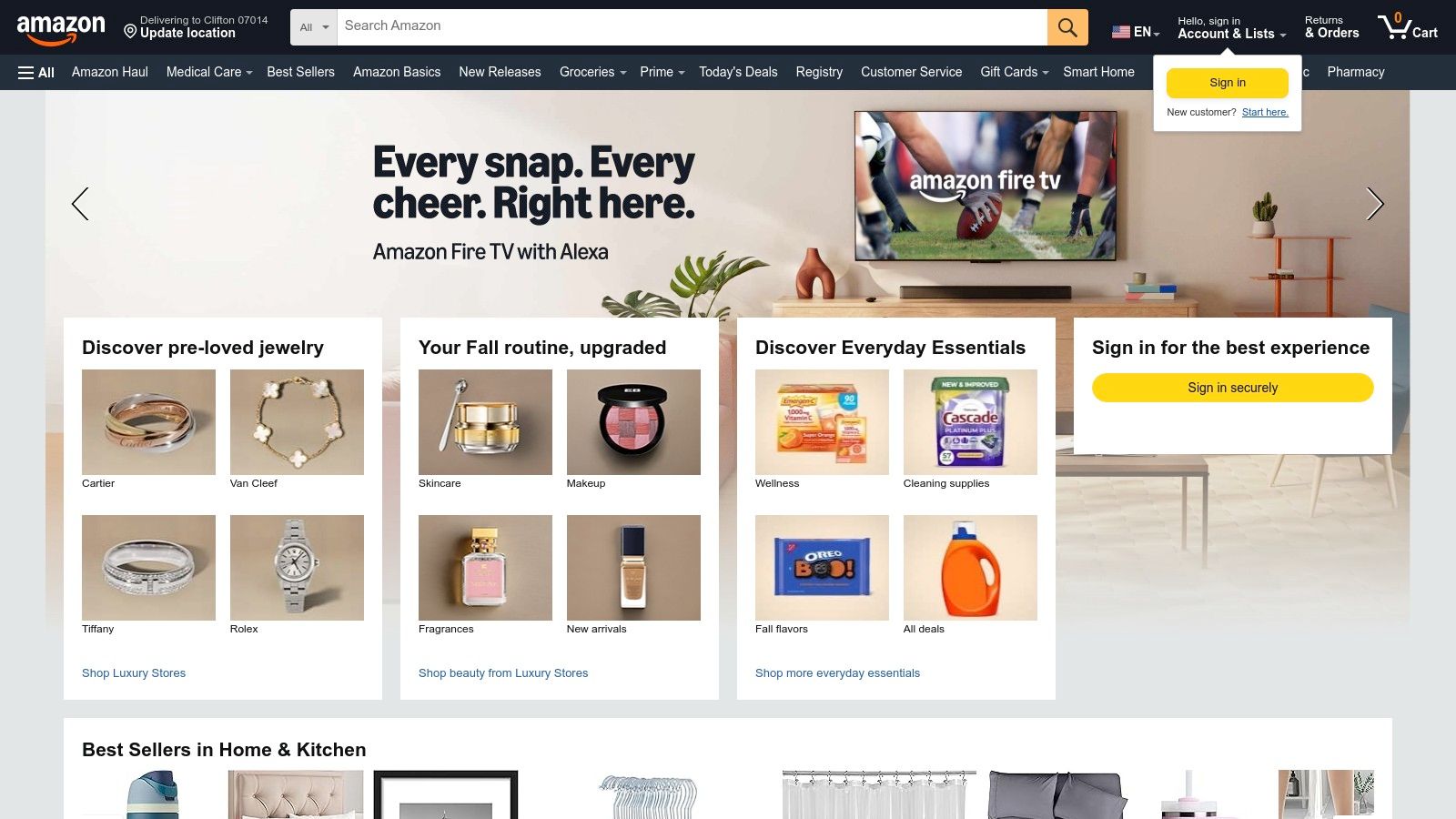
Strategic Analysis: The Power of Foundational Knowledge
Amazon’s primary advantage is providing deep, strategic context that software tutorials often miss. Books authored by industry veterans offer battle-tested frameworks for everything from lead scoring to multi-channel nurturing sequences. This allows marketers to build more resilient and effective automation programs by learning principles that transcend specific platform UIs or feature sets.
Key Insight: Understanding the strategic foundation of automation is crucial for long-term success. Amazon provides access to a wealth of structured knowledge, making it a critical marketing automation example resource for building robust, platform-agnostic strategies that drive real business results.
Actionable Takeaways & Unique Features
Instead of just learning how to use a tool, you learn how to think like an automation strategist. The marketplace structure, with its reader reviews and ratings, provides social proof to help you vet the quality and relevance of different guides. This is particularly useful for finding niche playbooks, such as B2B lead nurturing or advanced e-commerce customer retention tactics.
- Diverse Perspectives: Access strategies from hundreds of different authors and practitioners, allowing you to find a methodology that perfectly fits your business model and goals.
- Cost-Effective Learning: With Kindle editions often available for a fraction of the price of an online course and options for used books, it’s a highly affordable way to access premium marketing education.
- Immediate Access: Digital Kindle versions provide instant access to information, allowing you to find a solution to a specific automation challenge and start implementing it within minutes.
Books are available for immediate purchase and download on the Amazon marketplace. While some content may become dated as software evolves, the core strategic principles remain timeless. For best results, sort by publication date and check recent reviews to ensure the material is still relevant.
Marketing Automation Tools Comparison
| Solution | Implementation Complexity 🔄 | Resource Requirements ⚡ | Expected Outcomes 📊 | Ideal Use Cases 💡 | Key Advantages ⭐ |
|---|---|---|---|---|---|
| CartBoss | Low — plug-and-play, no coding needed | Minimal — no subscription fees, supports 30+ languages | High — boosts sales by up to 50% with 99% SMS open rates | eCommerce cart recovery, SMBs on Shopify/WooCommerce | Automated SMS, GDPR compliant, free trial, high ROAS |
| HubSpot | Medium — visual workflows with templates, requires setup | Moderate — seat/contact-based pricing | Good — fast deployment with rich templates | Teams needing multi-hub marketing automation | Large template library, deep CRM integration, strong community |
| Mailchimp | Low to Medium — drag-and-drop builder with templates | Low to Moderate — free plan limited, paid required for advanced | Moderate — easy multichannel automations | Small teams starting with marketing automation | AI-assisted templates, multichannel flows, ecommerce-centric |
| ActiveCampaign | Medium — import automation recipes with setup wizard | Moderate — some recipes paid, tier-dependent | Good — extensive example library accelerates deployment | Ecommerce marketing and sales automation | Recipe marketplace, strong CRM/ecommerce integration |
| Adobe Marketo Engage | High — enterprise-grade, complex setup | High — sales-led pricing, enterprise investment | Very High — advanced nurture, ABM, segmentation | Large B2B organizations with scalable needs | Robust templates, enterprise CRM integrations |
| Salesforce Marketing Cloud | High — requires expertise for setup and usage | High — sales-led pricing, complex scalability | Very High — sophisticated cross-channel customer journeys | Large enterprises needing detailed journey automation | Developer resources, multi-channel analytics |
| Amazon (Books & Guides) | Variable — self-directed learning from examples and playbooks | Low — purchase or Kindle access | Variable — knowledge gain dependent on resource quality | Individuals seeking comprehensive marketing automation | Wide selection, affordable, instant access to resources |
Start Automating: Turn These Examples into Revenue
Marketing automation is no longer a luxury reserved for enterprise giants. As we’ve explored through detailed examples from CartBoss, HubSpot, Mailchimp, and others, it is a practical, powerful engine for growth that e-commerce brands of all sizes are leveraging right now. These systems are the secret behind recovering lost sales, systematically nurturing leads into loyal customers, and scaling personalized communication without overwhelming your team.
The core lesson from each marketing automation example is clear: start small and focus on impact. Don’t feel pressured to build a complex, multi-channel behemoth from day one. Instead, identify your single biggest business challenge and choose a workflow designed to solve it.
Your First Step: Identify and Solve Your Biggest Pain Point
Is your cart abandonment rate alarmingly high? Are you struggling to convert new subscribers into first-time buyers? Or is customer churn eating into your profits? The examples in this article provide a blueprint for tackling each of these issues.
- For High Cart Abandonment: This is often the lowest-hanging fruit with the highest potential return. A specialized, direct-response tool like CartBoss, which focuses exclusively on SMS cart recovery, can deliver an immediate and significant ROI. Its set-and-forget simplicity and pre-built, optimized templates make it an ideal entry point into high-impact automation.
- For Nurturing New Leads: If your goal is to guide new subscribers toward their first purchase, an email-centric platform like Mailchimp or ActiveCampaign offers robust welcome series and segmentation capabilities. Start with a simple 3-part email sequence to build trust and demonstrate value.
- For Complex, Multi-Channel Journeys: For businesses ready to scale their efforts across multiple touchpoints (email, social, ads, and sales), comprehensive platforms like HubSpot, Adobe Marketo Engage, or Salesforce Marketing Cloud Engagement provide the necessary power. These are long-term investments for building a fully integrated marketing ecosystem.
Implementing Your Chosen Automation Strategy
Once you’ve chosen your starting point, success hinges on thoughtful implementation. Remember to set clear, measurable goals for each workflow. Whether it’s a 15% recovery rate for abandoned carts or a 10% conversion rate from your welcome series, having a target will help you gauge success and optimize your strategy.
As you grow, consider integrating other powerful tools to complement your efforts. For instance, if you’re building a brand ambassador program, you’ll need a system to manage relationships and commissions. In this case, explore the top affiliate management software solutions that can streamline affiliate payouts and automate reporting to boost your sales. The key is to build a tech stack where each component serves a distinct, valuable purpose.
The journey into marketing automation is one of continuous improvement. The examples provided are not just case studies; they are replicable frameworks. Take the strategies, adapt them to your brand’s unique voice and customer base, and start testing. Let the data guide your decisions, and you will unlock a new level of efficiency and revenue for your business.
Ready to tackle your biggest revenue leak and see an immediate return? CartBoss provides the simplest, most effective SMS marketing automation example for recovering abandoned carts. Start recovering lost sales in minutes with our plug-and-play solution.