


In today’s crowded marketplace, simply addressing a customer by their first name is no longer enough. The standard for engagement has shifted, and generic interactions are actively costing businesses sales and loyalty. True competitive advantage now lies in creating deeply relevant, predictive, and seamless experiences that make each customer feel uniquely seen and understood. Customers expect brands to anticipate their needs, not just react to their clicks.
This guide moves past theory to dissect 8 powerful, real-world personalized customer experience examples. We will break down the precise strategies and tactics that make them so effective. You won’t just see what leading brands are doing; you’ll understand the “how” and “why” behind their success.
Inside, we will analyze specific implementations, from sophisticated AI-driven product recommendations and dynamic email content to loyalty programs that reward individual behavior. Each example includes a strategic breakdown and actionable takeaways you can apply directly to your own business. This isn’t just a list of ideas; it’s a tactical blueprint designed to help you transform your customer journey, reduce friction, boost conversions, and drive significant, sustainable growth. Let’s explore how top brands are turning data into delight.
1. AI-Powered Product Recommendations
AI-powered product recommendations are a cornerstone of modern personalized customer experience examples. These systems use sophisticated machine learning algorithms to analyze vast amounts of data, including a customer’s browsing history, past purchases, items viewed, and even the behavior of similar users. By identifying patterns, the AI can predict which products a specific customer is most likely to be interested in next, presenting them in real-time.
This goes far beyond simple “best-seller” lists. It’s a dynamic, learning system that adapts to each user’s unique journey. For instance, Amazon’s iconic “Customers who bought this also bought” feature, a classic example of collaborative filtering, is so effective that it reportedly generates up to 35% of the company’s revenue. Similarly, Netflix estimates its recommendation engine saves it over $1 billion annually by reducing customer churn.
The Impact of AI-Driven Suggestions
The strategic value of AI recommendations lies in their ability to increase both engagement and revenue simultaneously. By showing customers items that genuinely align with their tastes, you reduce friction in the discovery process, making shopping feel less like a chore and more like a curated service.
The following chart illustrates the significant financial impact these systems can have on key e-commerce metrics.
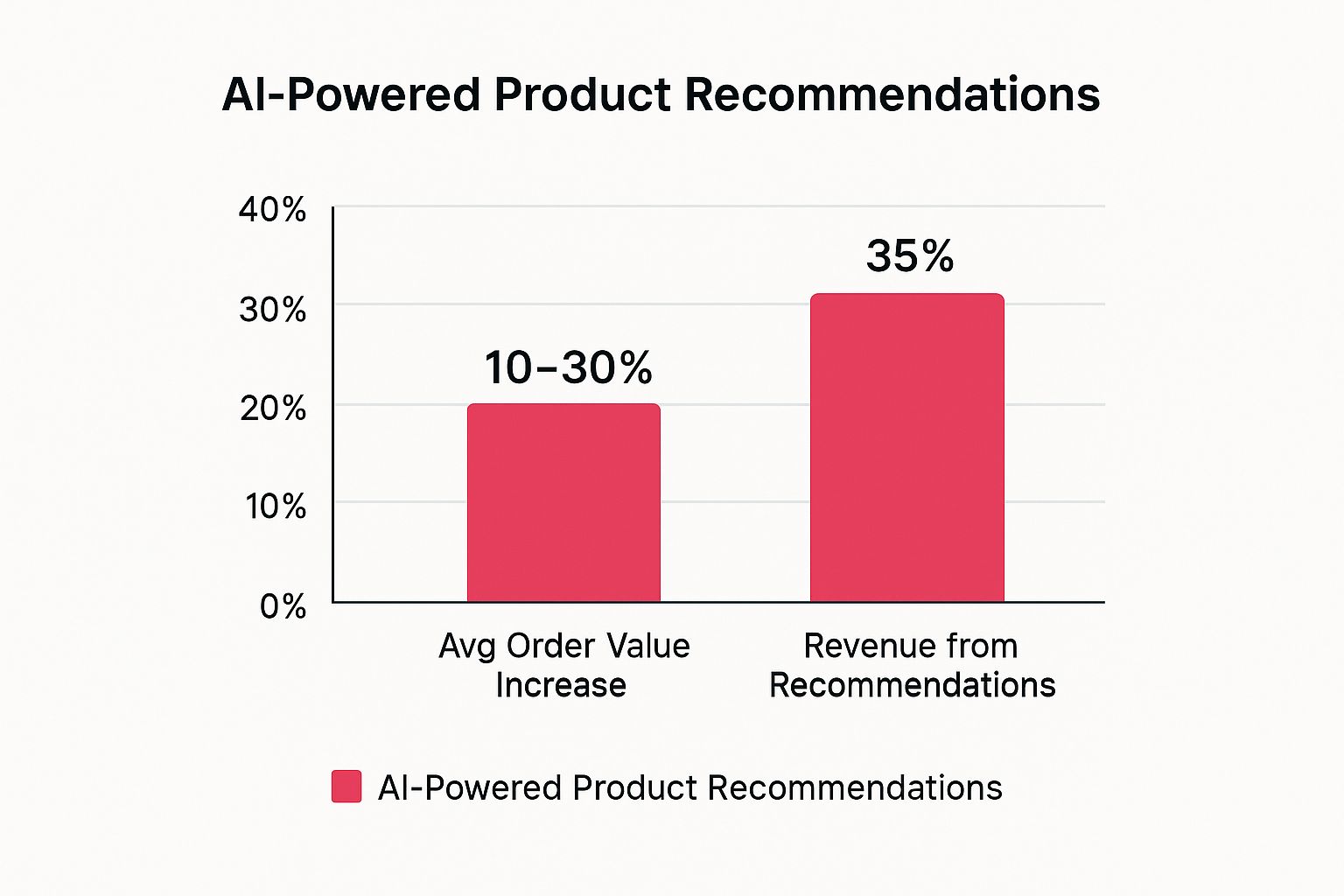
As the data shows, implementing a recommendation engine is not just an enhancement; it’s a powerful revenue-generating tool that can significantly lift a company’s bottom line.
How to Implement AI Recommendations
Getting started with AI recommendations doesn’t have to be overly complex. Many e-commerce platforms like Shopify and WooCommerce have powerful apps and plugins that make implementation accessible for businesses of all sizes.
Actionable Takeaways
- Start with Data: Ensure you are collecting clean, relevant customer data. This includes clicks, add-to-carts, purchase history, and time spent on product pages.
- Balance Personalization and Discovery: While showing relevant items is crucial, also include “serendipity” modules that introduce customers to new but related product categories.
- Be Transparent: Briefly explain why an item is being recommended (e.g., “Because you viewed…” or “Inspired by your shopping trends”). This builds trust and makes the recommendations feel more helpful.
- A/B Test Algorithms: Test different recommendation models. A “frequently bought together” module might work best on a product page, while a “trending for you” section may be more effective on the homepage.
2. Dynamic Email Personalization
Dynamic email personalization moves far beyond simply inserting a customer’s first name. It involves delivering highly customized content, product suggestions, and messaging based on an individual’s real-time data, browsing behavior, and lifecycle stage. These emails can even adapt their content at the moment of opening, ensuring the information displayed is always the most current and relevant.
This approach transforms email from a static broadcast into a living, personalized conversation. For example, Airbnb sends location-specific travel guides based on a user’s upcoming reservation, while Grammarly provides weekly performance reports with statistics unique to each user’s writing habits. This level of detail makes the communication feel inherently valuable.
The Impact of Tailored Email Content
The strategic advantage of dynamic emails is their ability to significantly boost engagement metrics. By tailoring content to individual needs and recent actions, you dramatically increase open rates, click-through rates, and conversions. A well-executed dynamic email campaign makes subscribers feel understood, which strengthens brand loyalty and reduces unsubscribe rates. This is a prime example of a personalized customer experience that directly impacts revenue.
Platforms like Klaviyo and Salesforce Marketing Cloud have made this technology accessible, allowing businesses to create sophisticated, behavior-triggered email journeys that once required a dedicated development team.
How to Implement Dynamic Emails
Implementing dynamic email personalization starts with data integration. Your email service provider (ESP) needs access to your customer data, such as purchase history, browsing activity, and cart contents. Most modern ESPs designed for e-commerce offer seamless integrations with platforms like Shopify and WooCommerce to facilitate this. From there, you can build segments and set rules for what content block a user sees.
Actionable Takeaways
- Segment Beyond Demographics: Create micro-segments based on behavior, such as “viewed a specific product category in the last 7 days” or “abandoned a cart with items over $100.”
- Use Real-Time Triggers: Set up automated emails for key actions like cart abandonment, welcome series for new subscribers, and post-purchase follow-ups with related product suggestions.
- Leverage Dynamic Content Blocks: Design a single email template where specific blocks of content change based on the recipient’s segment. For instance, show different hero images or calls-to-action for new vs. VIP customers.
- Implement Send-Time Optimization: Use AI-powered features in your ESP to send emails at the exact time each individual subscriber is most likely to open them, maximizing visibility.
3. Personalized Website Experiences
Personalized website experiences involve dynamically altering the content, offers, and layout of a website in real-time based on visitor data. This data can include behavior, location, traffic source, or past interactions, creating a unique and relevant journey for each individual. Instead of a one-size-fits-all approach, the website adapts to feel as if it was designed specifically for that user.
This strategy goes beyond simply inserting a customer’s name. For example, Virgin Holidays adjusts its homepage to feature destinations a user previously browsed, while The Economist famously increased subscriptions by 10-fold by presenting personalized pricing and calls-to-action based on user segments. These tactics transform the website from a static brochure into a dynamic, personal consultant.

The Impact of Dynamic Content
The primary benefit of a personalized website is the significant reduction in friction. When users instantly see content that aligns with their needs, they are more likely to engage, explore, and convert. TSB Bank, for instance, increased conversions by 4.5x by tailoring its website to different customer segments, proving the immense value of this approach.
For instance, leveraging features like real-time personalized offers can make a visitor feel understood and valued, dramatically increasing the likelihood of a purchase. This level of customization is a key differentiator in a crowded digital marketplace and is central to modern personalized customer experience examples.
How to Implement Website Personalization
Getting started with website personalization is more accessible than ever, with platforms like Optimizely, Adobe Target, and Dynamic Yield offering powerful tools. These platforms allow businesses to segment audiences and deliver tailored experiences without extensive custom coding. Learn more about how to engage visitors with these personalized strategies.
Actionable Takeaways
- Segment New vs. Returning Visitors: Show a welcome offer or an introductory video to new visitors. For returning customers, display recently viewed items or content related to their past purchases.
- Use Geo-Targeting: Customize content, language, and currency based on the visitor’s location. This is especially effective for promoting local events, stores, or region-specific products.
- Personalize Calls-to-Action (CTAs): Adjust CTA text based on a user’s stage in the sales funnel. A first-time visitor might see “Learn More,” while someone who has viewed products might see “Get a Free Demo” or “Add to Cart.”
- Start with High-Impact Pages: Focus your initial efforts on personalizing high-traffic pages like the homepage, product pages, and landing pages to see the most significant results quickly.
4. Loyalty Programs with Personalized Rewards
Modern loyalty programs are a powerful example of personalized customer experience that evolves beyond simple point collection. Instead of generic discounts, these systems leverage customer data to offer tailored rewards, unique experiences, and communications that resonate on an individual level. They analyze purchase history, browsing behavior, and engagement patterns to deliver incentives that genuinely motivate each member.
This data-driven approach transforms a transactional relationship into an emotional connection. For instance, Starbucks Rewards, a pioneer in this space, uses purchase data to send personalized offers that drive repeat visits, with members accounting for over 50% of its U.S. revenue. Similarly, Sephora’s Beauty Insider program offers customized product samples and birthday gifts, making members feel seen and valued.
The Impact of Personalized Loyalty
The strategic power of a personalized loyalty program is its ability to foster genuine brand advocacy and increase customer lifetime value. By rewarding customers in ways that are meaningful to them, you create a powerful incentive for them to choose your brand over competitors, even when faced with lower prices elsewhere. This deepens engagement and builds a loyal community around your brand.
For businesses looking to build a strong foundation for customer retention, understanding how to structure such a program is key. You can find detailed strategies and tips by exploring how to create a customer loyalty program on CartBoss.io. This is a foundational element for turning one-time buyers into lifelong fans.
How to Implement a Personalized Loyalty Program
Launching a successful personalized loyalty program involves more than just software; it requires a strategic approach to data and rewards. The goal is to make members feel like insiders who receive special treatment tailored just for them.
A key element is communication. Sending regular updates on point balances, tier status, and available rewards keeps the program top-of-mind. These communications should also be personalized, highlighting rewards that align with the member’s past purchases or browsing activity, which reinforces the program’s value.
Actionable Takeaways
- Offer Tiered & Experiential Rewards: Go beyond discounts. Offer early access to new products, exclusive content, or invitations to special events for higher-tier members.
- Simplify Earning and Redemption: Make the process transparent and frictionless. Customers should easily understand how to earn points and how to use them without confusion.
- Use Surprise and Delight: Leverage data to send unexpected personalized rewards, like a special discount on a browsed item or a small gift on their membership anniversary.
- Allow for Reward Choice: Whenever possible, let customers choose their preferred rewards. Some may prefer a product discount, while others might value free shipping or a gift card.
5. Chatbots and Conversational AI
Chatbots and conversational AI have evolved from simple Q&A bots into sophisticated tools for delivering personalized customer experience examples. These systems leverage natural language processing (NLP) and machine learning to understand customer intent, access historical data, and provide tailored, real-time support. They remember past interactions, offer context-aware suggestions, and guide users through complex journeys.
This technology creates a one-on-one dialogue at scale, making customers feel heard and understood 24/7. For example, Sephora’s chatbot offers personalized makeup tutorials and product suggestions, achieving an 11% higher conversion rate than other channels. Similarly, Bank of America’s virtual assistant, Erica, provides personalized financial guidance to over 19 million users, demonstrating the power of conversational AI in complex industries.
The Impact of AI-Driven Conversations
The strategic value of conversational AI lies in its ability to blend efficiency with personalization. By automating routine inquiries, it frees up human agents for more complex issues, while simultaneously providing instant, personalized responses to customers. This dual benefit improves customer satisfaction and operational efficiency.
These systems can handle everything from order tracking to creating personalized product bundles, like H&M’s chatbot that curates outfits based on style quizzes. The result is a seamless, interactive experience that meets modern customer expectations for immediacy and relevance, directly impacting loyalty and sales.
How to Implement Conversational AI
Deploying an effective chatbot is more accessible than ever, with platforms like Google’s Dialogflow, Intercom, and Drift offering powerful tools for businesses of all sizes. These platforms provide frameworks for building, training, and integrating AI-driven chat functionalities into your website, app, or messaging channels.
The key is to start with a clear goal, such as reducing response times or increasing lead qualification, and then building the conversational flows to support it.
Actionable Takeaways
- Use Data for Context: Program your chatbot to access customer history. Greet returning users by name and reference their past orders or browsing activity to make the conversation feel personal.
- Provide an Escape Hatch: Always offer a clear and easy path to escalate the conversation to a human agent. This prevents frustration when the bot cannot resolve a complex issue.
- Set Clear Expectations: From the first message, inform users they are interacting with a bot and outline what it can help with. Honesty builds trust and manages user expectations effectively.
- Train and Refine Continuously: Use transcripts from real customer interactions (both bot and human) to identify common questions and sticking points. Continuously train your AI model to improve its accuracy and conversational skills.
6. Omnichannel Personalization
Omnichannel personalization is the strategy of creating a single, seamless, and unified customer journey across all touchpoints. This approach ensures that a customer’s preferences, history, and context follow them from a brand’s website to its mobile app, physical store, and even customer service interactions. It breaks down the silos between channels to deliver a truly consistent experience.
This sophisticated method uses a central data hub, often a Customer Data Platform (CDP), to track and synchronize interactions in real-time. For instance, a customer might add an item to their cart on a mobile app, receive a personalized email reminder about it, and then get a location-based notification with a special offer when they walk past a physical store. Disney’s MagicBand system is a pioneering example, linking park tickets, hotel keys, payments, and photo passes into one cohesive, personalized adventure.
The Impact of a Unified Journey
The primary value of omnichannel personalization lies in its ability to build stronger, more loyal customer relationships. By recognizing and catering to the customer at every turn, brands eliminate friction and make engagement feel effortless and intuitive. This cohesive approach significantly boosts customer lifetime value and retention.
A well-executed omnichannel strategy removes the frustration of repeating information or seeing disconnected offers. It proves to the customer that the brand understands their journey as a whole, not just as a series of isolated transactions. For a deeper dive into this topic, you can learn more about crafting an effective omnichannel customer experience.
How to Implement Omnichannel Personalization
Building a true omnichannel experience starts with unifying your data and mapping the complete customer journey. You must understand how your customers move between your various touchpoints before you can begin to personalize that flow.
The key is to connect all your platforms, from e-commerce sites and mobile apps to in-store point-of-sale systems. This requires robust technology to identify users across devices and channels, ensuring that a login on a desktop is recognized by the mobile app and in-store staff.
Actionable Takeaways
- Unify Your Data: Start with a Customer Data Platform (CDP) to create a single, comprehensive view of each customer across all channels.
- Map the Entire Journey: Identify all potential customer touchpoints and document how users interact and transition between them.
- Connect Mobile and Desktop: Implement cross-device identification to ensure that experiences like abandoned carts and wishlists are synchronized.
- Empower In-Store Staff: Equip physical retail associates with the tools and training needed to access and utilize customer data to personalize in-person interactions.
7. Predictive Personalization
Predictive personalization leverages AI and machine learning to anticipate customer needs and actions before they happen. By analyzing vast datasets of past behaviors, demographic information, and real-time signals, businesses can proactively offer relevant content, products, or assistance. This advanced strategy moves beyond reacting to customer actions and instead starts shaping the journey itself, creating a seamless and almost prescient experience.
This forward-looking approach is a powerful form of personalized customer experience because it solves needs a customer may not have even fully articulated yet. For example, Netflix famously predicts what users will want to watch with such accuracy that its recommendation engine is credited with saving the company over $1 billion per year by reducing customer churn. Similarly, Spotify’s “Discover Weekly” playlist uses predictive algorithms to introduce users to new music with uncanny precision, fostering deep user loyalty.
The Impact of Anticipating Needs
The core value of predictive personalization lies in its ability to reduce friction and increase relevance to an exceptional degree. By anticipating the next logical step, whether it’s a product recommendation, a support query, or a re-order prompt, you demonstrate a deep understanding of the customer’s context. This not only boosts conversion rates but also builds significant brand affinity and trust.
When a customer feels understood, their loyalty deepens, and their lifetime value increases. This proactive engagement is a key differentiator in crowded markets. You can learn more about how personalization in digital marketing transforms the customer journey.
How to Implement Predictive Personalization
While it sounds complex, the principles of predictive personalization can be applied at various scales. Many CRM and marketing automation platforms now have built-in predictive analytics features, such as lead scoring or churn prediction, making this technology more accessible. The key is to start with a clear, high-impact business goal, such as identifying at-risk customers or predicting the best time to send a promotional offer.
Actionable Takeaways
- Start with Key Predictions: Focus on high-value outcomes first, such as predicting customer churn, identifying the next likely purchase, or estimating a customer’s lifetime value.
- Combine with Business Rules: Don’t rely solely on the algorithm. Overlay predictive models with your own business rules to prevent undesirable outcomes, like offering a huge discount to an already loyal customer.
- Create Feedback Loops: Continuously retrain your models with new data. Track whether a customer acted on a prediction (e.g., did they buy the recommended item?) and feed that outcome back into the system to improve future accuracy.
- Be Ethically Transparent: While you don’t need to explain the complex math, be transparent when it adds value. A simple “We thought you might like this” can feel more helpful than intrusive. Balance predictive accuracy with customer privacy at all times.
8. Personalized Content and Content Marketing
Personalized content marketing is a strategic approach that delivers tailored content, such as articles, videos, and guides, based on a user’s specific attributes. These attributes can include their industry, role, interests, and where they are in the buying journey. Instead of a one-size-fits-all strategy, this creates unique content paths for different audience segments, ensuring the information is highly relevant and engaging.
This method transforms a passive website into a dynamic resource that adapts to each visitor. For instance, HubSpot’s “smart content” feature dynamically changes website copy and CTAs based on a visitor’s lifecycle stage, showing a new visitor a “Learn More” button while a qualified lead sees a “Request a Demo” button. Similarly, LinkedIn’s feed is a prime example, personalizing content based on professional connections and interests to keep users engaged on the platform.
The Impact of Tailored Content
The core value of personalized content is its ability to nurture prospects effectively and build authority. By providing the exact information a user needs at the right moment, you build trust and guide them smoothly through the sales funnel. This relevance drastically increases engagement, accelerates the buyer’s journey, and improves conversion rates.
As one of the most effective personalized customer experience examples, it positions a brand as a helpful expert rather than just a seller. This strategy is central to building long-term customer relationships and is a key driver of inbound marketing success. For more ideas on implementation, you can explore these personalized marketing examples on CartBoss.io.
How to Implement Personalized Content
Getting started with content personalization involves segmenting your audience and mapping content to their specific needs. You can use marketing automation platforms to deliver this dynamic content across your website, emails, and other channels based on user data and behavior.
Start by creating detailed buyer personas and mapping out their customer journeys. Identify the key questions and pain points they have at each stage, from awareness to decision. This map will become the blueprint for creating modular content that can be mixed, matched, and delivered to the right person at the right time.
Actionable Takeaways
- Map Content to the Funnel: Create distinct content pieces for awareness (blog posts, infographics), consideration (case studies, webinars), and decision (demos, free trials) stages.
- Use Progressive Profiling: Gradually collect information about your visitors through forms to better understand their needs and content preferences without overwhelming them upfront.
- Leverage Behavioral Triggers: Send relevant content automatically based on user actions, such as downloading an e-book or visiting a specific pricing page.
- Personalize by Format: Pay attention to how different segments consume content. Offer a video to a user who has previously watched videos, and an in-depth article to another who prefers reading.
8 Key Personalized Customer Experience Examples Comparison
| Personalization Type | Implementation Complexity 🔄 | Resource Requirements 💡 | Expected Outcomes 📊 | Ideal Use Cases 💡 | Key Advantages ⭐ |
|---|---|---|---|---|---|
| AI-Powered Product Recommendations | High — requires significant data and AI expertise | High — data collection, ML infrastructure | ↑ Conversion rates, Avg order value ↑ (10–30%) | E-commerce, retail sites | Scales personalization; measurable ROI |
| Dynamic Email Personalization | Medium to High — complex triggers & dynamic content | Medium — customer data infrastructure | ↑ Open rates (26%), CTR ↑ (14%), 6x transactions | Email marketing campaigns | Cost-effective; strengthens customer relations |
| Personalized Website Experiences | High — technical and integration challenges | High — development and data platforms | ↑ Conversion rates (up to 20%), ↓ bounce rates | Websites needing tailored UX | Enhances engagement; competitive differentiation |
| Loyalty Programs with Personalized Rewards | Medium to High — design & tech intensive | High — data analytics, omnichannel integration | ↑ Retention (5–10%), LTV ↑ (up to 30%) | Customer retention, repeat purchase programs | Drives emotional connection; predictive insights |
| Chatbots and Conversational AI | Medium to High — NLP and training complexity | Medium to High — AI platforms and data training | 24/7 support; ↓ service costs (up to 30%) | Customer service, product support | Fast responses; scales easily |
| Omnichannel Personalization | Very High — complex data unification & integration | Very High — CDP, CRM, automation platforms | ↑ Retention (91%), ↑ LTV, seamless CX | Multi-touchpoint brands, large enterprises | Seamless experience; cross-channel consistency |
| Predictive Personalization | Very High — advanced analytics & modeling | Very High — data science expertise, historical data | Proactive engagement; ↑ conversion and retention | Churn prevention, next-best-action, pricing | Anticipates needs; efficient resource use |
| Personalized Content Marketing | Medium to High — content creation & tech integration | Medium to High — content teams, AI tools | ↑ Engagement (50–100%), better lead quality | B2B/B2C content strategy, lead nurturing | Shortens sales cycles; maximizes content ROI |
Putting Personalization into Practice: Your Next Steps
The diverse range of personalized customer experience examples we’ve explored, from Netflix’s AI-driven recommendations to Starbucks’ customized loyalty rewards, all point to a single, undeniable truth: personalization is no longer a competitive advantage, it’s a baseline expectation. The brands that succeed are not just collecting data; they are transforming it into memorable, relevant, and timely interactions that make customers feel seen and understood.
The common thread weaving through each successful strategy is a commitment to leveraging customer data to add genuine value. This isn’t about using a customer’s first name in an email subject line. It’s about anticipating their needs with predictive analytics, guiding them with conversational AI, and creating a seamless, unified experience across every channel they use. The goal is to move from transactional exchanges to relational partnerships, where every touchpoint reinforces your brand’s commitment to the individual.
Key Takeaways and Strategic Imperatives
As you embark on your own personalization journey, remember these core principles distilled from the leading examples:
- Start with Data, Lead with Value: Your personalization efforts are only as good as the data that fuels them. Focus on collecting clean, first-party data and use it to solve customer problems or enhance their journey, not just to sell more products.
- Embrace an Omnichannel Mindset: Today’s customer journey is not linear. It fluidly moves between your website, social media, email, and physical stores. True personalization connects these dots to provide a consistent and context-aware experience everywhere.
- Technology is the Enabler, Not the Strategy: AI, machine learning, and automation are powerful tools. However, they must serve a clear strategy rooted in customer-centricity. Define what a “better experience” means for your audience first, then select the technology that helps you deliver it at scale.
Your Actionable Roadmap to Personalization
Feeling inspired but unsure where to begin? Don’t aim to implement every strategy at once. Instead, identify the area of greatest impact for your business. For many e-commerce brands, this critical moment is cart abandonment. It’s a point of high intent where a personalized, timely intervention can make all the difference.
Consider starting your journey with a focused, high-ROI initiative. Implementing a system that personalizes the recovery process, for instance, can deliver immediate results and build momentum for broader projects. By tackling this specific, measurable problem, you can prove the value of personalization and secure buy-in for future investments. The most important step is the first one. Begin by transforming a single, crucial touchpoint into a powerful, personalized experience.
Ready to turn abandoned carts into recovered revenue with powerful, personalized SMS? CartBoss automates the entire process, sending language-aware messages with pre-filled checkout links to bring customers back instantly. See how one of the most effective personalized customer experience examples can work for your store by starting your free trial at CartBoss today.