


Imagine your website is a real-world, brick-and-mortar shop. People walk in, browse around, and some of them head to the checkout counter to buy something. Your sales conversion rate is simply the percentage of those browsers who actually become paying customers.
It’s one of the most critical numbers for any online business, cutting right to the chase. It tells you how good you are at turning curious visitors into actual revenue.
What Exactly Is a Sales Conversion Rate?
At its heart, the sales conversion rate is a measure of how persuasive your store is. It answers one simple but powerful question: how effectively do you convince people to do what you want them to do? For an ecommerce store, that “thing” is almost always making a purchase.
Let’s say 1,000 people visit your online store today. If 20 of them end up buying something, your sales conversion rate for the day is 2%. Simple as that. Think of this number as your business’s pulse—it’s a direct sign of how healthy your sales process is.
Why This Metric Is So Important
Honestly, tracking your sales conversion rate isn’t optional if you want sustainable growth. It forces you to look past flashy “vanity metrics” like website traffic and focus on what really pays the bills: revenue. Having tons of traffic is great, but it doesn’t mean much if nobody is buying.
A low conversion rate is usually a symptom of a deeper problem. It might be pointing to a clunky website experience, confusing product descriptions, a nightmarish checkout process, or pricing that’s just plain wrong for your market.
By keeping a close eye on this metric, you can spot the friction points in your customer’s journey and make smart, data-backed decisions to smooth them out. This is the whole idea behind conversion rate optimization (CRO)—a systematic process for bumping that percentage up.
Looking Beyond the Final Sale
While the end goal is always the sale, a “conversion” can mean different things at different stages of the customer journey. Tracking these smaller “micro-conversions” helps you see how every part of your sales funnel is performing.
Some other key conversion points to watch are:
- Adding an item to the cart: This shows someone is seriously interested.
- Subscribing to a newsletter: They’re giving you permission to stay in touch, which shows brand interest.
- Creating a user account: A solid step toward becoming a loyal, repeat customer.
- Downloading a guide or resource: You’re engaging a potential lead with valuable content.
Each of these actions is a small win. When you track and improve them, you’re building a much stronger path that naturally leads more people to the final checkout, boosting your overall sales conversion rate in the process.
How to Calculate Your Sales Conversion Rate
Before you can boost your sales conversion rate, you have to know how to measure it. The good news is that the basic calculation is surprisingly simple, but it gives you an incredibly powerful starting point for tracking what’s working and what isn’t.
Think of it as turning all that chaotic website activity into one clear, concrete number.
The core formula looks like this:
(Total Number of Sales / Total Number of Visitors) * 100 = Sales Conversion Rate (%)
Let’s make this real. Imagine your online store had 10,000 visitors last month. In that same timeframe, you made 200 sales.
When we plug those numbers into the formula, we get:
(200 Sales / 10,000 Visitors) * 100 = 2% Sales Conversion Rate
Just like that, you have your baseline. This simple calculation tells you that for every 100 people who landed on your site, two of them ended up buying something.
Getting the Details Right for an Accurate Calculation
Now, while the math is easy, the accuracy of your 2% depends entirely on how you define your terms. What exactly counts as a “conversion”? And what’s a “visitor”? This is where you need to get specific about your goals.
A conversion isn’t always just the final sale. It’s any meaningful action you want a user to take. Sure, a sale is the ultimate win, but tracking smaller steps—or “micro-conversions”—helps you see the full picture of the customer’s journey.
For instance, a visitor who adds an item to their cart and then leaves has still “converted” on the add to cart action. This gives you a crucial piece of the puzzle. If you see a lot of this happening, you can dig deeper and learn how to calculate cart abandonment rate to pinpoint exactly where you’re losing people.
To get the most out of this, you should identify what actions matter for your specific business.
Examples of Common Conversion Goals
| Business Model | Primary Conversion Goal | Secondary Conversion Goal |
|---|---|---|
| eCommerce Store | Completed purchase | Adding a product to the cart |
| SaaS Company | Subscribing to a paid plan | Starting a free trial |
| B2B Service Provider | Submitting a “Contact Us” form | Downloading a case study |
| Content Creator | Signing up for a newsletter | Watching a video to completion |
Tracking both primary and secondary goals gives you a much richer understanding of user behavior beyond the final sale.
Key Insight: Your definition of a “conversion” dictates your entire strategy. If you only track final sales, you’re flying blind. You miss all the important signals earlier in the funnel, like newsletter sign-ups or free trial requests, that are the lifeblood of long-term growth.
Likewise, you can define a visitor in a couple of different ways:
- Sessions: This counts every single visit. If the same person comes to your site three times in one day, that’s three sessions.
- Unique Visitors: This counts each person only once within a set period (like a month), no matter how many times they pop back in.
For calculating your sales conversion rate, using unique visitors usually gives you a much clearer picture. It tells you what percentage of people you convinced to buy, not just what percentage of visits ended in a sale. This is way more insightful for understanding your audience and the true effectiveness of your sales funnel.
Benchmarking a Good Sales Conversion Rate
So, what’s a “good” sales conversion rate? It’s the question every store owner asks, and the honest answer is always the same: it depends. There’s simply no magic number that works for everyone.
A good rate is completely relative. It shifts based on your industry, how much your product costs, who you’re selling to, and a dozen other factors. Think about it: comparing a high-volume, low-cost online grocery store to a bespoke luxury watchmaker is like comparing apples and oranges. They operate in different worlds with wildly different sales cycles.
To set a realistic benchmark, you have to look at data that’s actually relevant to your business, not some generic global average.
This visual shows how a visitor moves through a typical sales funnel, and you can see how the conversion rate naturally drops at each step.
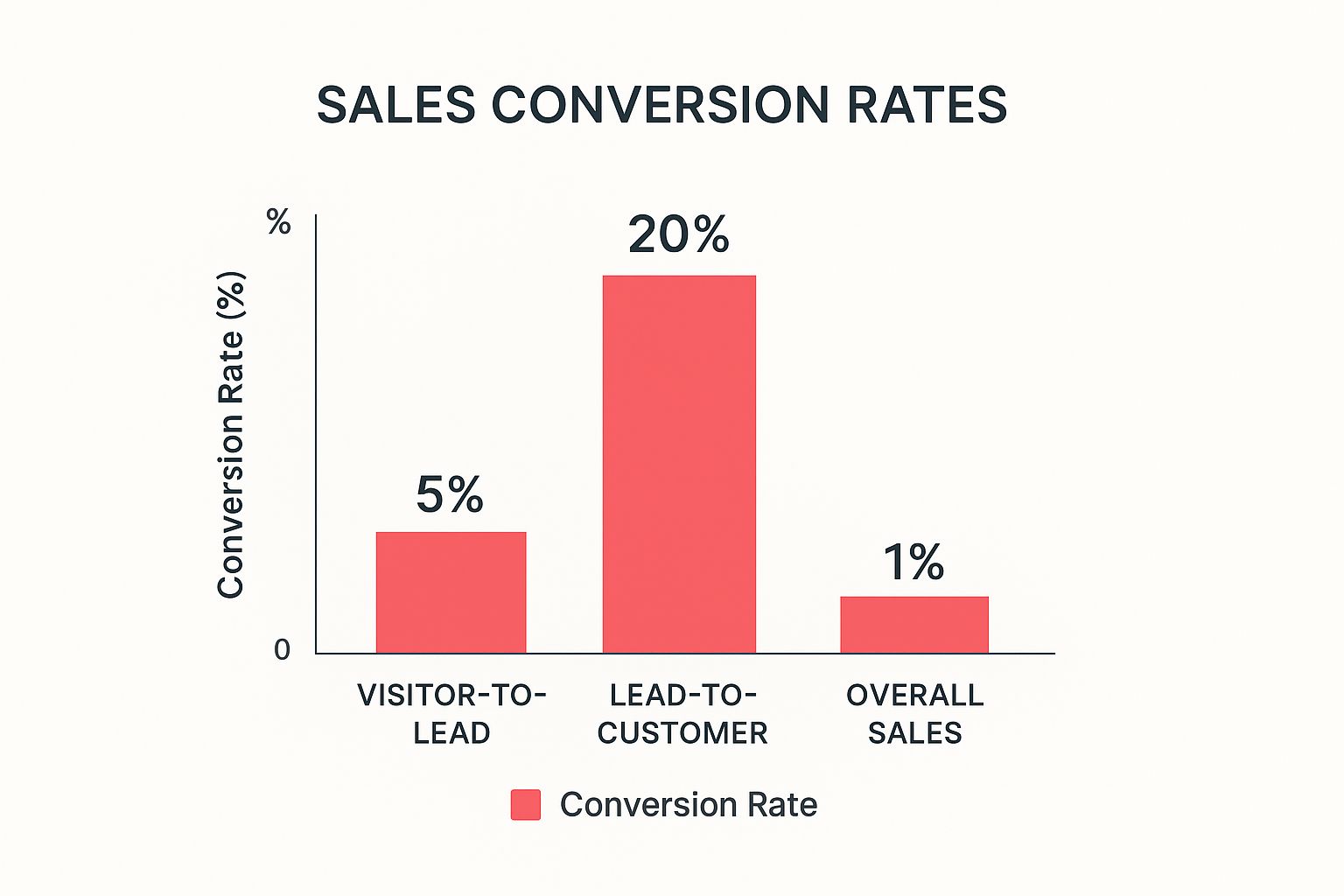
In this example, 5% of visitors turn into leads. Of those leads, 20% become customers. This funnel results in an overall sales conversion rate of 1%.
Industry Averages Provide Crucial Context
To set goals that actually make sense, you need to dive into data from your specific industry. The performance gap between different sectors is huge. For example, the average global e-commerce sales conversion rate in 2023 hovered around 3.21%.
But when you break it down, the Food & Beverage sector was crushing it with rates as high as 7.22%, while Luxury & Jewelry was much lower at 1.04%. For a high-end brand selling expensive pieces, a 1.04% conversion rate could still mean incredible success.
This proves that what works for a food delivery service would be a total disaster for a high-fashion retailer, and vice-versa.
Key Variables That Impact Your Rate
It’s not just your industry that matters. Several other factors can make your conversion numbers swing wildly. You need to understand these variables to get a fair picture of your performance.
Here are the big ones:
- Traffic Source: Someone clicking from a targeted ad is usually ready to buy. That’s a world away from a casual visitor who stumbled upon a link from a social media post.
- Device Type: Desktop users still tend to convert at a higher rate than mobile users, who are often just browsing on the go. This makes a smooth mobile checkout absolutely critical.
- Product Cost: High-ticket items naturally have a lower conversion rate. People take longer to think about big purchases compared to cheap impulse buys.
- Seasonality: A brand selling swimwear is going to see a massive spike in sales in the spring and summer. A company selling holiday decorations lives for the fourth quarter.
Your sales conversion rate isn’t just a static number; it’s a dynamic metric that tells a story. It reflects everything from the quality of your traffic to how clearly you state your value.
Ultimately, the goal isn’t to chase some arbitrary number you saw in an article. The real win is establishing your own baseline and then working to improve it, month after month. For a deeper dive, check out our guide on e-commerce conversion rate benchmarks to see how you stack up. Continuous improvement is the true mark of success.
Proven Strategies for Conversion Rate Optimization

Knowing your sales conversion rate is one thing. Actually improving it is where the real work begins. This whole process is called Conversion Rate Optimization (CRO), and it’s all about systematically tweaking your website and sales funnel to make it easier for visitors to become customers.
Think of it as smoothing out the road to purchase. Every confusing step, every moment of hesitation, is a pothole that can cause a potential customer to turn back. Good CRO fills in those potholes, creating a clear, smooth path from initial interest to the final sale.
Sharpen Your Call-to-Action (CTA)
Your Call-to-Action is probably the single most important element on any page trying to make a sale. It’s the button or link telling visitors exactly what you want them to do next. A vague, uninspired CTA like “Submit” or “Click Here” doesn’t create any excitement and often fails to get the click.
You need to craft CTAs with clear, compelling, and action-focused language. A great CTA instantly communicates the value a user gets for clicking.
- Be Specific: Don’t just say “Download.” Try “Get Your Free Ebook.”
- Create Urgency: Use phrases like “Shop Now Before It’s Gone” or “Claim Your 20% Discount Today.”
- Highlight Value: Instead of a simple “Subscribe,” try “Join 10,000+ Smart Marketers.”
Even a tiny change to your CTA’s wording, color, or placement can make a surprisingly big difference to your sales conversion rate.
Simplify and Streamline the Checkout Process
If there’s one place you’re guaranteed to lose sales, it’s the checkout page. A long, complicated, or confusing checkout is the number one cause of cart abandonment. Every extra form field, unnecessary step, or surprise fee gives a customer another reason to give up and walk away.
Your goal is to make buying from you completely effortless.
The less a customer has to think during checkout, the more likely they are to complete their purchase. Remove distractions, ask only for essential information, and make the entire process feel secure and straightforward.
Page speed is also a huge factor here. Studies show that pages loading within 1 to 3 seconds can boost conversions by up to 2.5 times compared to slower sites. With global cart abandonment rates hovering at a painful 71.3%—and climbing to 77.2% on mobile—a fast, seamless checkout is non-negotiable.
Build Trust with Social Proof
Let’s be honest: people trust other people way more than they trust brands. This is where social proof comes in. It’s the simple but powerful idea of using customer testimonials, reviews, and ratings to build credibility and ease any pre-purchase jitters.
When a potential buyer sees that other people have had a great experience with your product, they feel much more confident about their own decision to buy. You should sprinkle social proof throughout your site, especially on product pages and at checkout.
- Display Customer Reviews: Make star ratings and written reviews impossible to miss.
- Feature Testimonials: Use direct quotes from happy customers. Adding their photo gives it a real human touch.
- Showcase Trust Badges: Display security seals (like SSL certificates) and familiar payment logos (Visa, PayPal) to reassure shoppers their data is safe.
Building this kind of trust is fundamental to improving your conversion rate.
Implement A/B Testing for Data-Driven Decisions
So, how do you actually know which changes will work? You test them. A/B testing is the answer. The method is simple: you create two versions of a page (Version A and Version B) with just one specific element changed, like a different headline or a new CTA button color.
You show each version to different segments of your audience and see which one performs better. A/B testing takes the guesswork out of optimization. It lets you make decisions based on what your users actually do, not what you think they’ll do.
This is a core practice of any serious CRO strategy. If you want to dive deeper, check out our guide on eCommerce conversion rate optimization.
Key Factors That Influence Conversion Rates
Your sales conversion rate doesn’t exist in a vacuum. Think of it more like a living number that reacts to everything around it—from big economic shifts to the simple fact that people buy different things at different times of the year.
If you don’t keep an eye on the bigger picture, you’re setting yourself up for a panic. It’s easy to see a dip in conversions and immediately blame a recent website update, when the real culprit might just be a predictable industry-wide slowdown.
Understanding these outside forces helps you tell the difference between a normal market cycle and a genuine problem you need to fix. This awareness lets you forecast more accurately, plan your campaigns smarter, and make sure you’re ready for the natural peaks and valleys of your market.
The Impact of Global Trends
Major world events can completely change how people shop, and in turn, reset the benchmarks for what a “good” conversion rate even is. We all saw this happen with the massive shift to online shopping a few years back. It fundamentally created a new baseline for what digital storefronts could expect.
Between 2018 and 2023, the average global sales conversion rate more than doubled, jumping from 2.51% to an estimated 5.40%. This wasn’t just a coincidence; it was driven by millions of new consumers getting comfortable with buying things online. If you want to dive deeper into this trend, check out these recent conversion rate studies.
This historical data shows that broad consumer behavior changes can lift all boats. As online shopping becomes more ingrained in daily life, the potential for higher conversions grows across the board, making optimization efforts even more impactful.
Understanding Seasonal and Industry Patterns
Beyond huge global trends, your sales conversion rate is also tied to the specific rhythm of your industry. These seasonal patterns are usually pretty predictable if you know what to look for. A company selling swimwear, for example, is naturally going to see a huge spike in conversions as spring turns into summer.
A perfect example of this is the Baby and Child market. This sector consistently hits its sales peaks during two key periods: the summer months (aligning with baby showers and high birth rates in August) and the big end-of-year holiday rush around Black Friday and Christmas.
Recognizing these patterns is critical for a few reasons:
- Accurate Forecasting: You can predict revenue and manage your inventory without guessing.
- Strategic Campaigning: You know exactly when to launch promotions for maximum impact.
- Performance Analysis: It gives you the right context to compare your performance year-over-year.
If you ignore these trends, you’ll end up drawing the wrong conclusions about your marketing. A dip in conversions during the off-season might not be a red flag—it could just be business as usual. This is also why it’s important to keep an eye on cart abandonment, which can also rise and fall with shopping seasons. You can learn more in our guide on how to reduce cart abandonment to keep your sales on track all year.
Putting Your Conversion Strategy into Action
Alright, we’ve covered a lot of ground. We’ve defined the sales conversion rate, walked through the math, and even looked at benchmarks and optimization tactics. But knowledge is just potential energy—it’s useless until you actually apply it.
Meaningful improvement isn’t about finding one magic bullet that fixes everything. It’s about building a habit of continuous testing, learning, and refining. You have to get your hands dirty.
The biggest takeaway here is to start small. Don’t try to overhaul your entire sales process overnight. That’s a surefire way to get overwhelmed and accomplish nothing. Instead, pick one small, manageable task and see it through.
The path to significant growth begins with a single step. Focus on making one incremental improvement today, and that momentum will build over time, creating substantial results for your business.
So, let’s get started. Challenge yourself to implement just one of the tactics from this guide right now.
- A/B test a single headline on your most popular product page.
- Simplify one form field in your checkout process to make life easier for your customers.
- Add one new customer testimonial to a key page to build instant trust.
By focusing your efforts, you can make a real, measurable impact. For instance, if you’re seeing a lot of people drop off at the final stage, tackling your checkout process is a huge win. For those struggling with this exact problem, our guide to abandoned cart recovery offers specific strategies to bring those customers back and close the sale.
Frequently Asked Questions
Even when you’ve got the basics down, a few practical questions always pop up once you start digging into your sales conversion rate. Let’s tackle some of the common hurdles that trip up business owners and marketers.
What Is the Difference Between Lead and Sales Conversion?
These two track different stages of the customer journey, but both are critical. Think of it like a relay race—you need to nail both handoffs to win.
A lead conversion rate is all about that first handoff. It measures how many anonymous website visitors become known contacts by filling out a form, signing up for a newsletter, or downloading a guide. They’ve raised their hand and shown interest.
The sales conversion rate, on the other hand, is the final finish line. It measures how many of those visitors or leads actually complete a purchase. A high lead conversion rate is great, but your sales conversion rate is what puts money in the bank.
How Often Should I Measure My Sales Conversion Rate?
The right timing really depends on how much traffic your site gets.
For high-traffic ecommerce stores, weekly monitoring is usually the sweet spot. This helps you catch trends, see how new campaigns are performing, and react quickly to any sudden drops without getting lost in the noise of daily ups and downs.
For most other businesses, a monthly analysis strikes a good balance. It gives your marketing efforts enough time to show real results and helps you stay focused on the bigger picture of your long-term performance.
One of the biggest mistakes is freaking out over a single bad day. Always look for sustained trends over a week or a month before you start changing your strategy. Otherwise, you’re just chasing ghosts in the data.
Can High Traffic Hurt My Conversion Rate?
Here’s the thing: high traffic itself won’t hurt your conversion rate, but low-quality traffic absolutely will.
Imagine you run a fancy steakhouse, but your latest marketing campaign accidentally sends thousands of vegans to your front door. Your foot traffic would be through the roof, but your sales would be dead in the water. Your conversion rate would tank because you attracted the wrong crowd.
The goal isn’t just to get more visitors; it’s to get the right visitors who are actually looking for what you sell. Focusing on the quality of your audience over the sheer quantity is the key to healthy, sustainable growth.
Ready to turn more of those visitors into paying customers? CartBoss uses powerful, automated SMS messages to recover abandoned carts and boost your sales on autopilot. Start recovering lost revenue today.