



Sending text reminders is an absolute powerhouse for recovering abandoned carts. Why? Because SMS messages blow email out of the water when it comes to open and engagement rates.
By landing directly on a customer’s phone, you slice through the noise of a crowded inbox and give them a timely, personal nudge to finish what they started.
Why SMS Reminders Are an Ecommerce Game Changer
Let’s be real for a second. How many abandoned cart emails have you personally ignored this week? They’re easy to delete, they get buried, or they just land in spam, never to be seen. This is exactly where SMS shines, turning a potential lost sale into real revenue with a simple, perfectly timed message.
The immediacy of a text is its superpower. Unlike an email that can sit unread for days, a text notification feels urgent and direct, creating a one-on-one connection with your shopper. It shows up on the one device they check constantly, ensuring your message gets seen almost instantly.
The Undeniable Power of SMS Engagement
The stats behind SMS marketing are pretty staggering, and they paint a clear picture of why it’s so effective. There’s a reason the industry has exploded. It just flat-out works.
Globally, SMS marketing spending was reported at $327.1 billion and is only projected to keep growing. The numbers tell a compelling story: consumers open 98% of text messages. That figure absolutely dwarfs the average email open rate.
Even better, SMS drives a remarkable 45% response rate compared to just 6% for email. It’s built for immediate action.
To put it in perspective, here’s a quick rundown of how the two channels stack up for this specific task.
SMS vs. Email for Cart Recovery
| Metric | SMS Reminders | Email Reminders |
|---|---|---|
| Open Rate | ~98% | ~20% |
| Response Time | 90 Seconds | 90 Minutes |
| Click-Through Rate | 25-45% | 2-5% |
| Delivery | Instant, direct to lock screen | Can be delayed or sent to spam |
| Visibility | High, cuts through clutter | Low, competes with hundreds of emails |
It’s clear that for a time-sensitive job like cart recovery, SMS has a distinct advantage. Email has its place, but for a quick, impactful nudge, nothing beats a text.
The core advantage of SMS is its ability to bypass the digital clutter. While an email might sit unread for hours or days, a text message is typically read within three minutes of being received. This speed is critical for cart recovery, where timing is everything.
Turning Abandoned Carts into Sales
This ridiculously high level of engagement translates directly into recovered sales. When you send a text reminder, you’re doing more than just sending a notification; you’re tapping into powerful psychological triggers.
A friendly text can reignite that initial spark of interest, overcome hesitation with a small incentive, and make it incredibly easy for them to jump right back to their pre-filled cart. To really squeeze every drop of value out of this channel, it’s crucial to follow a proven set of SMS marketing best practices for ROI and engagement. This ensures your messages aren’t just seen, but that they actually convert.
Choosing the Right SMS Platform for Your Store
Picking the right SMS software is the foundation of your entire text reminder strategy. This isn’t just some technical box-ticking exercise; it’s the engine that’s going to power your cart recovery. Choosing the right partner here is what turns those abandoned carts back into ringing sales.
The number of options out there can make your head spin, but a few key features separate the truly great platforms from the merely okay ones. Your first priority should be seamless integration with whatever you’re using to run your store, whether that’s Shopify, WooCommerce, or something else. If the connection isn’t smooth, you’re signing yourself up for a world of manual work and messy data.
Core Features You Cannot Overlook
Beyond a simple connection, you need powerful and intuitive automation workflows. The whole point is to send text reminders on autopilot, right? You need a system that lets you build multi-step campaigns that trigger based on specific customer actions—like someone ditching a cart with a high-value item inside.
Also, put platforms with robust compliance tools at the top of your list. Dealing with regulations like TCPA and GDPR isn’t a suggestion—it’s absolutely critical for building trust and avoiding some seriously hefty fines. A good platform will have features for collecting consent and managing opt-outs baked right in, making it almost effortless.
A great platform should feel like an extension of your marketing team, not just another piece of software you have to manage. It has to give you the analytics to prove its own ROI, showing you exactly how much revenue your SMS campaigns are bringing back.
Key Questions to Ask During a Demo
When you’re actually talking to these companies, get past the glossy sales pitch. You need to ask specific, scenario-based questions to see what the platform can really do.
- Segmentation: “Show me, step-by-step, how I can build a segment of shoppers who abandoned carts over $100 and send them a different offer than everyone else.”
- Personalization: “How does your system pull in the specific items left in the cart to make the reminder message feel personal?”
- Analytics: “Let’s see the reporting dashboard. How quickly can I see my conversion rates and the actual revenue generated per message?”
This diagram gives you a good sense of the typical flow for an SMS campaign, from getting permission to sending that final, conversion-focused message.

As you can see, a winning strategy is a lot more than just blasting out a text. It’s a thoughtful process of engagement and timely follow-up.
And make no mistake, the market for SMS is only getting bigger. With smartphone adoption projected to hit 8.064 billion users worldwide by 2029, your potential audience is massive—and it keeps growing.
Here in the U.S., the SMS marketing space is set to grow at a compound annual rate of 20.8% through 2030. That stat alone tells you this channel isn’t a fad; it’s a long-term strategic asset for any online store. You can dive into more SMS marketing growth statistics to see the full picture. Picking the right platform now is what will position you to ride that wave.
Here’s the rewritten section, designed to sound like an experienced human expert.
Building Your First Cart Recovery Automation
Alright, this is where the strategy really comes to life. Setting up your first automated SMS sequence is actually a lot less intimidating than it sounds. The key isn’t to just blast shoppers with messages, but to create a thoughtful, multi-step flow that gently coaxes them back to their cart.
A good automation should feel like a helpful concierge, not a pushy salesperson. And the secret sauce? It’s all in the timing. Think of it as a friendly conversation that unfolds over a day or two. From what I’ve seen work best, a simple three-part series of messages is incredibly effective, with each text serving a unique purpose.
The Anatomy of a High-Converting SMS Flow
Your first message is just a simple, low-pressure nudge. Sending it about one hour after a cart is abandoned seems to be the sweet spot. It’s quick enough that the purchase is still fresh in their mind, but it doesn’t feel like you were creepily watching them shop. This text is purely a gentle reminder that they left something behind.
Then, you give them some breathing room. The second message, which I usually schedule for about 24 hours later, can be a bit more persuasive. This is the perfect time to slide in a small incentive—think free shipping or a modest discount code. It’s a great way to tackle any price sensitivity and give them a little extra motivation to click “buy.” For a deeper dive, our complete guide on how to https://www.cartboss.io/blog/recover-abandoned-carts/ breaks down even more tactics you can use here.
Your final touchpoint, typically sent at the 48-hour mark, is where you can introduce a bit of friendly urgency. A simple “Your cart is about to expire” or “Don’t miss out” works wonders without being aggressive. This last-chance message is often the final push needed to get hesitant buyers across the finish line. If you want to broaden your toolkit, exploring other strategies to recover abandoned carts can complement what you’re doing with SMS.
This flow chart really simplifies the whole process, breaking it down into targeting the right people, scheduling the messages, and then sending them out.
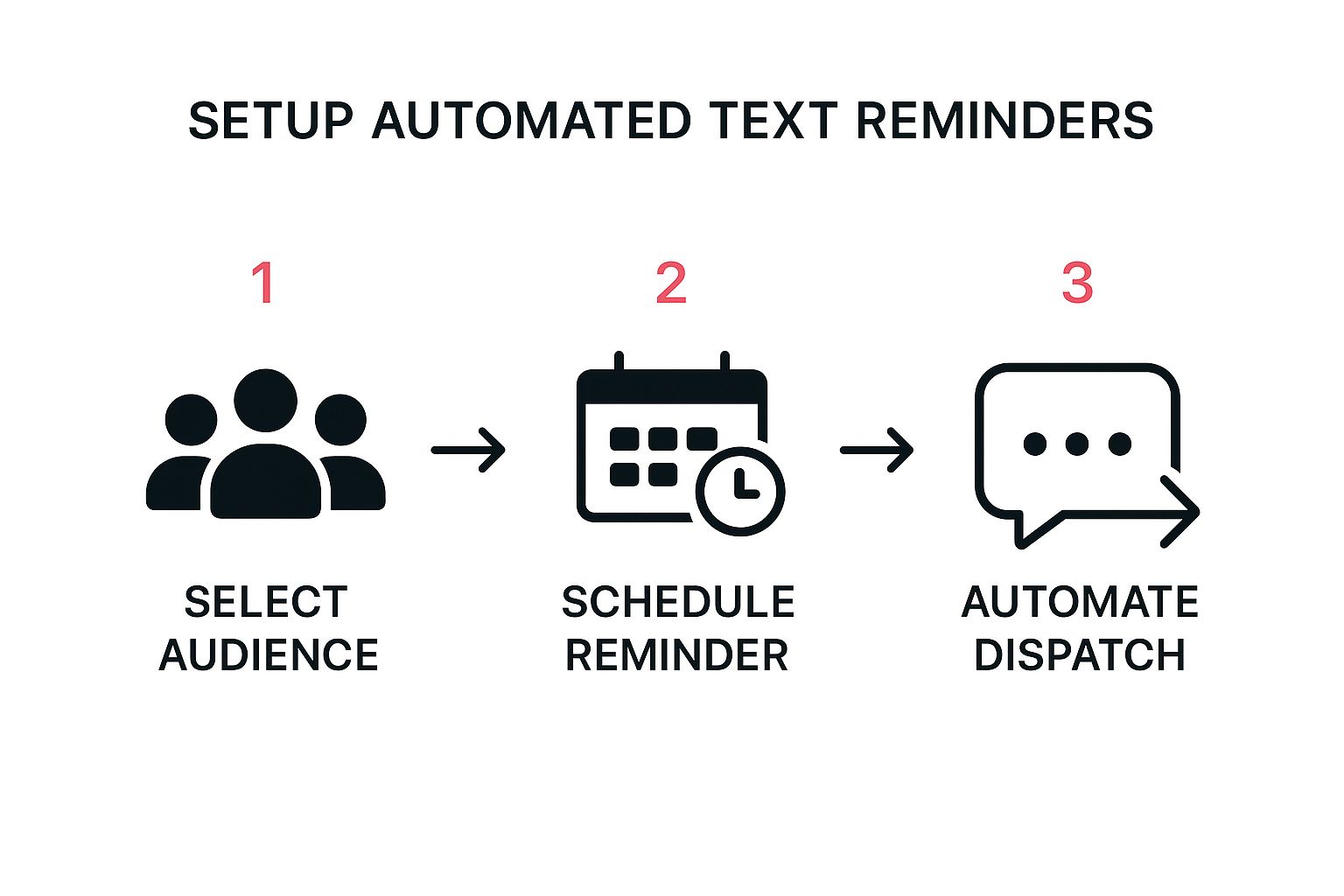
As you can see, it all starts with knowing exactly who you’re talking to before you even think about timing and execution.
Sample Cart Recovery SMS Sequence
To give you a clearer picture, here’s a proven three-part sequence you can use as a starting point. Don’t be afraid to tweak these to better fit your brand’s voice and your customers’ vibe.
| Message | Timing | Content Strategy | Example Message |
|---|---|---|---|
| 1. The Gentle Nudge | 1 Hour Post-Abandonment | Simple reminder, helpful tone | “Hey [Name], did you forget something? Your items from [Store Name] are waiting for you! Return to cart: [Link]” |
| 2. The Helpful Incentive | 24 Hours Post-Abandonment | Add value, overcome hesitation | “Still thinking it over? We saved your cart at [Store Name]. Complete your order today and enjoy free shipping on us! [Link]” |
| 3. The Final Reminder | 48 Hours Post-Abandonment | Create urgency, final call | “Your cart at [Store Name] expires soon! Don’t miss out on your items. Finish your checkout now: [Link]” |
The real magic of this sequence is in its gradual escalation. It kicks off with a simple reminder, then sweetens the deal with an incentive, and finally closes with a touch of urgency to prompt action. This progression respects the customer’s space while still working hard to recover that sale.
Crafting Text Reminders That Get Clicks
Your automation is only as strong as the messages you send out. When a text lands on someone’s phone, you’re competing for attention on their most personal device. The copy has to be sharp, valuable, and genuinely hard to ignore.
Vague, generic messages are dead on arrival—they get deleted instantly. But a personal, compelling text? That gets a click.
The number one mistake I see brands make is blasting out a one-size-fits-all text. Your customer isn’t just a faceless order number. Real, effective copy starts with personalization. Using their first name is just table stakes. The real magic happens when you reference the specific item they left behind, jogging their memory and reminding them why they were interested in the first place.
The Anatomy of a Perfect Reminder Text
Beyond just using their name, the structure of your message is everything. You’ve got limited characters, so every single word counts. A text that converts has to do three things, and do them fast: grab attention, create a little desire, and offer a dead-simple path to finishing the purchase.
I’ve found this simple framework delivers results time and time again:
- A Personal Opener: Always start with their name and keep the tone friendly. “Hey, Sarah…” feels a world away from a cold “Notice: Your cart…”.
- The Specific Item: Call out what they were looking at. Something like, “…your Midnight Blue Hoodie is still waiting!” immediately brings them back to that moment of interest.
- A Clear Call-to-Action (CTA): This part is non-negotiable. You need action-packed language like “Finish your order” or “Claim your items” followed by a direct link that takes them straight back to a pre-filled checkout.
This structure smoothly guides the customer from “Oh yeah, I wanted that” to taking action in a matter of seconds. It respects their time by making it incredibly easy to buy.
I’ve analyzed thousands of cart recovery texts, and the ones that fail almost always have a weak or confusing CTA. Don’t make them think. Give them one clear action and a direct link to take it.
Using Incentives Without Killing Your Profit
Sometimes, a shopper just needs a little nudge to get over that final hump of hesitation. A well-placed incentive can work wonders, but you have to be smart about it.
Believe it or not, free shipping is often a more powerful motivator than a small percentage discount. Why? Because it removes that annoying, often unexpected, final cost that makes people abandon carts in the first place.
Let’s look at two ways to approach this:
Example 1 (Not so great):
“Hi Mark, you left items in your cart. Here’s 5% off if you buy now. Shop here: [Link]”
Example 2 (Much better):
“Hi Mark! Still thinking about that leather-bound journal? We saved it for you. Complete your order in the next 24 hours and we’ll cover the shipping. Get it here: [Link]”
See the difference? The second example feels more personal, mentions the product, and frames the free shipping as a helpful bonus, not a desperate plea. That subtle shift in tone changes everything. Your goal is to be a helpful assistant, not a pushy salesperson.
Navigating SMS Compliance and Best Practices
Jumping into SMS marketing without knowing the rules is a recipe for disaster. When you send text reminders, you’re stepping into a customer’s personal space—their phone. Get it right, and you build trust. Get it wrong, and you’re looking at a damaged brand reputation and some seriously hefty fines.
The whole game is governed by regulations like the Telephone Consumer Protection Act (TCPA) in the US. The main takeaway is simple but absolutely non-negotiable: you must have explicit consent before you send a single marketing text. This means someone has to clearly and knowingly agree to get promotional messages from you, usually by checking a box at checkout or filling out a signup form.
The Golden Rules of Consent and Opt-Outs
Let’s be clear: implied consent doesn’t fly here. Just because a customer gave you their number for shipping updates doesn’t mean you can start hitting them with marketing texts. The permission for promotional content has to be totally separate and unambiguous.
Just as important is giving people an easy way out. Every single text you send needs to include simple instructions on how to unsubscribe, like replying with “STOP”. Honoring those requests instantly isn’t just a nice thing to do; it’s a legal requirement that protects your business and shows you respect your customers.
Think of compliance as the foundation of a healthy customer relationship. It’s not a hurdle to clear, but a way to show your audience that you value their privacy and trust. A compliant program is a sustainable and profitable one.
Best Practices for Time and Frequency
Beyond the legal stuff, a little common sense goes a long way. Nobody wants a text about their abandoned cart at 3 AM. Always be mindful of your customers’ time zones and stick to reasonable business hours. Most platforms, including CartBoss, have “quiet hours” or do-not-disturb features that automate this for you, so there’s really no excuse.
Frequency is the other big piece of the puzzle. Blasting a customer with texts all day is the fastest way to get them to hit that “STOP” button. A good cart recovery sequence is short and sweet, usually just two or three messages spread over a day or two. The goal is to be a helpful nudge, not a persistent pest.
For a deeper dive into the nitty-gritty, check out our full guide on SMS marketing compliance to make sure your strategy is completely airtight.
By baking these practices into your workflow, you can confidently send text reminders that not only bring back sales but also build your reputation as a trustworthy, customer-first brand.
Measuring and Optimizing Your SMS Campaigns

Launching your SMS automation is a massive step, but it’s definitely not the finish line. Honestly, the real money is made in the constant tweaking and improvement that comes next. You can’t improve what you don’t measure, and turning raw data into actionable insights is what separates a decent campaign from an unstoppable revenue engine.
This is where you shift from just sending messages to strategically refining your entire approach. The goal is to stop guessing and start making data-driven decisions that consistently push your performance higher.
Key Metrics You Need to Watch
Think of your SMS platform’s dashboard as a report card for your strategy. It’s more than just a wall of numbers. To really get what’s working, you need to laser-focus on a few critical metrics that directly impact your bottom line.
Here are the non-negotiables:
- Click-Through Rate (CTR): This tells you flat-out if your message and call-to-action are compelling. A low CTR is a clear sign your message isn’t creating enough urgency or value to get that tap.
- Conversion Rate: This is the ultimate measure of success. It tracks the percentage of people who not only clicked the link but actually completed their purchase.
- Revenue Per Message (RPM): This metric ties your efforts directly to profit. It shows you exactly how much money each text message is generating for your store.
- Unsubscribe Rate: A sudden spike here is a major red flag. It could mean your messages are too frequent, aren’t valuable enough, or are being sent at the absolute worst times.
Tracking these metrics isn’t just about seeing what happened; it’s about figuring out why it happened. A high CTR but a low conversion rate might point to a problem on your checkout page, not with the text message itself.
A/B Testing Your Way to Higher Conversions
Once you’ve got a handle on your baseline numbers, it’s time to start optimizing through A/B testing. This is as simple as changing one single variable between two versions of a message to see which one performs better. You’d be amazed how even tiny tweaks can lead to significant gains over time.
For example, you could test different discount offers. Does free shipping pull in more sales than a 10% discount? The data will give you a clear winner, no guesswork required.
You can also experiment with your message tone. Is a friendly, casual voice more effective than one that creates a heavy sense of urgency? For more ideas on what to test, we break it down even further in our guide to abandoned cart SMS strategies.
Another powerful variable to test is timing. Try sending your first reminder at 30 minutes post-abandonment versus 60 minutes. The results might surprise you and reveal the perfect window to re-engage your almost-customers. This cycle of testing, measuring, and refining is how you turn a good SMS program into a truly great one.
Unpacking Common Questions About Sending Text Reminders
When you’re thinking about adding SMS reminders to your strategy, a couple of big questions usually pop up right away. Let’s tackle them head-on.
Is This Even Legal?
The first and most important concern is always legality. You’ve probably heard of regulations like the TCPA in the US, and the rules are pretty clear: you absolutely need explicit opt-in consent before you send a single text.
This isn’t a “check the box for them” situation. A customer has to knowingly and willingly agree to receive marketing messages from your brand via SMS. As long as you have that clear consent, you’re on solid ground.
Won’t I Just Annoy My Customers?
This is a totally valid concern. Nobody wants to be the brand that spams their customers into unsubscribing. But the truth is, annoyance comes from irrelevant, poorly timed messages—not from the channel itself.
The key is to provide genuine value. Think about it: a limited number of helpful, personalized messages can actually build goodwill. A gentle nudge reminding them about their cart, maybe sweetened with an offer like free shipping, feels like good service, not a nuisance. It’s all about how you approach it.
To really nail this, it helps to understand the fundamentals. We’ve put together a guide on what SMS marketing is that dives deeper into doing it the right way from the start.