



Opt in SMS is all about getting explicit permission from a customer before you hit “send” on any marketing text messages. Think of it like a customer handing you a VIP pass to their phone—it’s a clear signal they want to hear from you. This isn’t just a courtesy; it’s the non-negotiable first step for any legal and effective SMS marketing strategy.
What Is Opt In SMS and Why Does It Matter?
Your phone’s inbox is a personal space. It’s for friends, family, and important updates. When a business texts you out of the blue, it feels like an unwelcome intrusion, like a stranger showing up uninvited. Opt in SMS is the simple, powerful concept designed to prevent exactly that. It turns marketing from an interruption into a welcome conversation.
At its core, opting in is a transaction built on trust. A customer gives you their phone number and agrees to your messages in exchange for something they value—maybe a discount, early access, or helpful updates. This simple act of consent is what makes SMS such a powerful channel, one that respects privacy while delivering incredible results.
The Power of Permission-Based Marketing
Unlike blasting ads into the digital void, SMS is direct, personal, and wildly effective. The secret? You’re talking to an audience that has already raised their hand and said, “Yes, I want to hear from you.” This pre-qualified interest is what drives such off-the-charts engagement.
When a customer opts in, they’re not just another number on a spreadsheet. They’re an engaged lead who is actually receptive to your brand. This permission-first approach ensures your messages land with a welcoming audience, which leads directly to:
- Higher Engagement: People who ask for your texts are far more likely to open, read, and click on them.
- Improved Brand Trust: Respecting someone’s inbox shows your brand values their privacy. That’s how you build real, long-term loyalty.
- Better Deliverability: When you only text consented contacts, your number avoids being flagged as spam, making sure your messages actually get delivered.
- Legal Compliance: Getting explicit consent is a legal requirement under rules like the TCPA, protecting your business from some seriously hefty fines.
SMS vs. Email: A Clear Winner in Engagement
To really get why building an opt-in SMS list is such a big deal, just compare it to email. While email is still a workhorse, SMS blows it out of the water when it comes to immediacy and engagement. It’s the perfect channel for driving quick action.
By focusing on an opt-in strategy, brands can achieve SMS open rates as high as 98%, with most messages being read within the first three minutes. That kind of immediate attention is just unheard of in any other marketing channel.
The performance gap gets even clearer when you put the numbers side-by-side.
SMS Marketing vs Email Marketing Performance
This table breaks down just how much more powerful SMS is for getting your message seen and acted upon compared to traditional email marketing.
| Metric | Opt In SMS Marketing | Email Marketing |
|---|---|---|
| Average Open Rate | Up to 98% | Around 21% |
| Average Click-Through Rate | 19% – 35% | Approximately 2.6% |
| Response Rate | As high as 45% | Around 6% |
| Time to Read | Within 3 minutes | 2-3 days average |
As you can see, it’s not even close. The immediacy and personal nature of SMS, combined with a permission-based audience, creates a recipe for engagement that email simply can’t match.
Understanding the Rules of SMS Consent
Jumping into SMS marketing isn’t just about crafting a clever message; it’s about earning the right to send it. Think of a customer’s phone as their personal space. You wouldn’t just walk into someone’s house uninvited, right? The same principle applies here. Getting permission first is the cornerstone of any successful SMS strategy, and this respect is baked into several key regulations you need to know.
Getting consent right isn’t a chore—it’s how you build a healthy, profitable marketing channel. It’s the difference between building a loyal audience that wants to hear from you and shouting into a void. When you’re upfront and clear about getting permission, you attract customers who are genuinely interested, which is infinitely more valuable than a massive list of people who couldn’t care less.
This is the fundamental hierarchy of SMS marketing. Everything starts with permission.
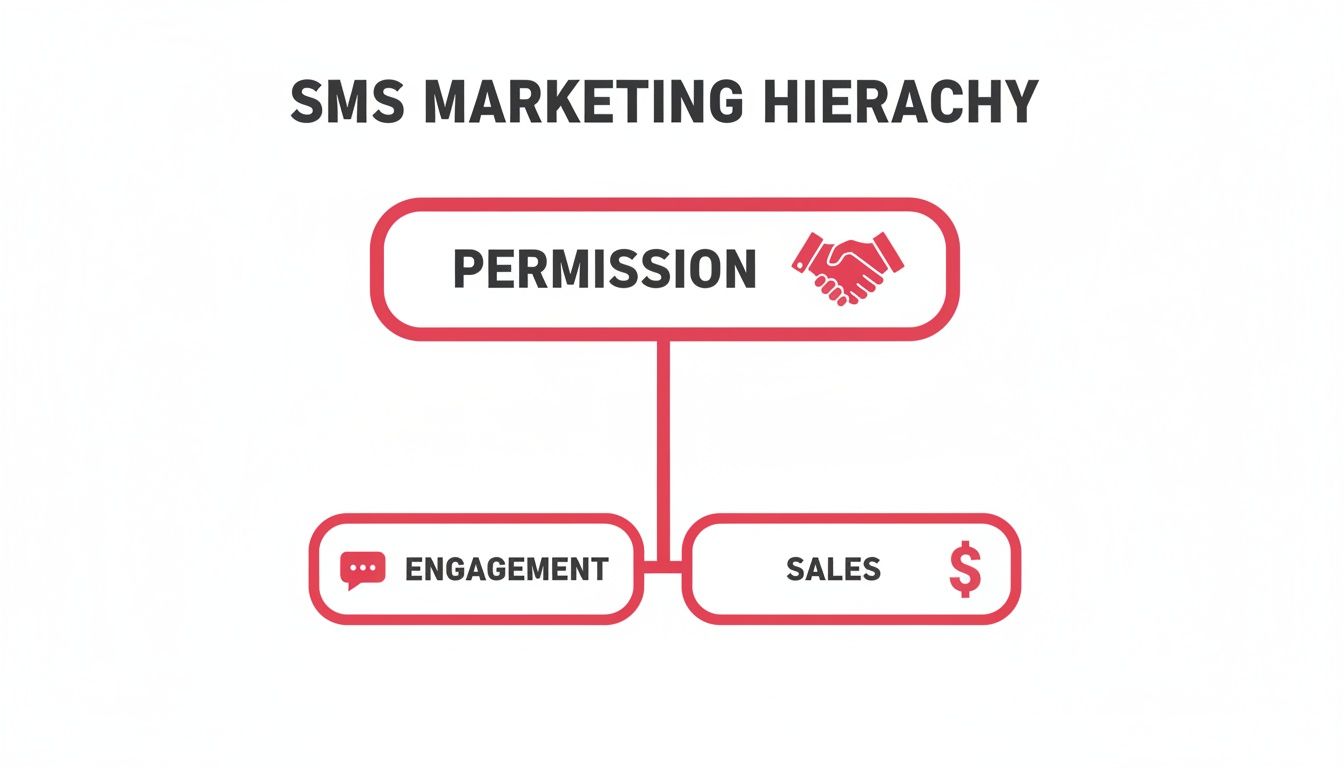
As you can see, that initial handshake of consent is what makes genuine engagement—and ultimately, sales—even possible.
Key Regulations You Must Know
While the specific laws can get granular depending on where you and your customers are, a few major players set the standard globally. Getting the gist of these is non-negotiable for any business sending texts.
- TCPA (Telephone Consumer Protection Act): This is the big one in the U.S. The most important takeaway is the need for prior express written consent. In simple terms, you need documented proof that a customer explicitly agreed to get marketing texts from your brand. No ambiguity allowed.
- GDPR (General Data Protection Regulation): If you have customers in the European Union, GDPR is your rulebook. It demands that consent be freely given, specific, informed, and unambiguous. This means you can’t use pre-checked boxes or hide your intentions in tiny print.
- CCPA (California Consumer Privacy Act): This law empowers California residents with more control over their personal info. For SMS, it doubles down on the need for transparency. You have to be crystal clear about what data you’re collecting (like their phone number) and what you plan to do with it.
If you’re looking for a deep dive, this ultimate TCPA compliance checklist is a great resource to keep your practices on the right side of the law.
Single Opt-In vs Double Opt-In
Okay, so a customer gives you their number. Now what? You have a choice in how you confirm their subscription, and it’s a decision that directly impacts the quality of your list and your legal footing. Let’s break down the two main methods for handling an opt-in SMS process.
Single Opt-In
This one is as simple as it sounds. A customer types their number into a form, hits “submit,” and they’re on your list. Done. It’s fast and removes any extra steps for the user.
- Pros: Super quick and easy for the customer, which can help grow your list faster.
- Cons: You open yourself up to typos, fake numbers, and weaker proof of consent if a dispute ever comes up.
Double Opt-In
This is a two-step handshake. After a customer gives you their number, you immediately send them a text asking them to confirm they want to subscribe, usually by replying with “YES” or “Y”.
- Pros: Builds a high-quality list of genuinely interested people, gives you bulletproof proof of consent, and keeps your bounce rates low.
- Cons: That extra step can cause a small percentage of people to drop off before confirming.
For any e-commerce brand that’s serious about building a high-ROI SMS channel, double opt-in is the gold standard. It guarantees every single person on your list explicitly said “yes,” which leads to way better engagement and gives you a rock-solid defense against any compliance complaints.
This permission-first approach has been a huge hit with consumers. In fact, opt-in SMS has become a massive channel for e-commerce, with recent reports showing nearly 50 million people globally have opted in to receive texts from businesses. This isn’t just a trend; it’s proof that customers trust brands that respect their inbox.
At the end of the day, understanding these rules isn’t about jumping through legal hoops—it’s a massive competitive advantage. For an even more detailed breakdown of the TCPA, you should check out our comprehensive guide to TCPA and text messages. When you build your list the right way, you’re not just collecting numbers; you’re building a powerful communication channel on a foundation of solid customer trust.
How to Effectively Collect SMS Opt-Ins
Knowing the rules of consent is one thing; putting that knowledge into practice is where the magic happens. Collecting SMS opt-ins effectively isn’t about slapping a form on your site and crossing your fingers. It’s about weaving the invitation into the natural flow of your customer’s journey, making it an easy and valuable “yes.”
The key is to meet customers exactly where they are. By figuring out the highest-converting spots in your eCommerce store, you can pop the question at the very moment a customer is most engaged with your brand. This turns the opt-in from a potential annoyance into a smooth part of their shopping experience.

High-Converting Website Placements
Think of your website as prime real estate for growing your SMS list. Instead of relying on a single, static form, you should deploy a few different tools that catch users at different moments.
- Website Pop-Ups: When you time them right, pop-ups are absolute gold. Set them to trigger based on user behavior, like when someone is about to leave the site or after they’ve checked out a few products. The offer needs to be a no-brainer—a 15% discount or free shipping is a classic for a reason.
- Embedded Forms: Stick a simple sign-up form in your site’s footer or sidebar. It’s less in-your-face than a pop-up but gives visitors who are actively looking for updates a consistent place to connect.
- Floating Bars or Banners: A less intrusive option, a banner at the top or bottom of the screen can grab attention without interrupting the browsing experience. It’s a great middle-ground.
Optimizing the Checkout Process
The checkout page is, without a doubt, the most powerful place to ask for an SMS opt-in. At this point, your customer is ready to buy and has already typed in their personal info. Adding one more checkbox is an incredibly low-friction way to get their consent.
The wording here is absolutely critical. It has to be crystal clear, short, and 100% compliant. Never use pre-checked boxes and use explicit language that clearly separates marketing texts from transactional updates.
Pro Tip: Don’t just make it about deals. Frame the checkout opt-in around value-added info like order status updates, shipping notifications, or early access to new product drops. Sometimes, that’s even more compelling than a discount.
For instance, a checkbox with the text, “Sign up for exclusive offers and order updates via text,” followed by the necessary compliance disclosures, makes the value proposition obvious. This simple addition can seriously boost your subscriber count with your most qualified audience—your actual paying customers.
Crafting Compelling Opt-In Language
How you ask for the opt-in SMS matters just as much as where you ask. Your copy needs to instantly answer the customer’s unspoken question: “What’s in it for me?”
Focus on spelling out the benefits. Vague promises like “Sign up for updates” just don’t cut it. You have to be specific about the value they’re getting.
Here are a few examples that work:
- Discount-Driven: “Get 15% OFF your first order! Enter your number to get your code.”
- Exclusivity-Focused: “Join our VIP Text Club for early access to new arrivals and members-only sales.”
- Community-Oriented: “Be the first to know. Sign up for texts and never miss a drop or restock announcement.”
Your messaging should always be transparent. Be upfront about what subscribers can expect, including how often you’ll text them and a reminder that they can opt out anytime. This builds trust from the very first interaction. You can dive deeper into different strategies in our guide to the perfect opt-in message.
And customers are ready for it. Data shows that 84% of consumers have opted in to receive texts from at least one business, and over 52% get messages from four or more brands. The demand is there, especially when 91% prefer text for important reminders and updates.
Beyond getting new subscribers, it’s also vital to understand the nuances of how to get SMS consent from existing customers to stay compliant and maintain trust. Once you master these collection points and nail your value-driven language, you’ll build a high-quality SMS list that becomes a seriously profitable marketing channel.
Designing a Perfect Confirmation Message
The moment a customer trusts you with their phone number is your first, and maybe best, chance to make a great impression. This isn’t just a simple confirmation; it’s the start of a real conversation. A perfect confirmation message makes them feel good about their decision, sets clear expectations, and immediately delivers on whatever you promised, all while keeping you on the right side of the law for an opt in sms.
Think of this first text as a digital handshake. It needs to be firm, friendly, and happen right away. The goal is to make the customer feel smart for subscribing and get them excited for what’s coming next. This initial text sets the tone for your entire SMS relationship and is a critical step in building a list of subscribers who actually want to hear from you.

Anatomy of a Flawless First Message
Your confirmation text has a few important jobs to do: confirm the subscription, provide the necessary legal bits, and deliver on your promise. If you miss any of these, you can create confusion and kill trust before you’ve even started.
Here’s what you absolutely must include in every single confirmation message to make sure you’re covered and your customers are happy.
Essential Components of a Confirmation Message
To get this right, your first message should be a perfect blend of welcome, information, and value. The table below breaks down exactly what you need to include, why it’s important, and what it looks like in practice.
| Component | Purpose | Example Text |
|---|---|---|
| Brand Identifier | Prevents confusion by clearly stating who is texting. | [Brand]: |
| Clear Confirmation | Assures the user their sign-up was successful. | Welcome! You're officially on our list. |
| Frequency Expectation | Manages expectations to reduce future unsubscribes. | Expect 2-4 msgs/month. |
| Compliance Notice | The legally required disclosure for SMS marketing. | Msg&Data rates may apply. |
| Opt-Out Instructions | A legal requirement that also builds trust with subscribers. | Reply STOP to unsubscribe. |
| Incentive Delivery | Immediately delivers the promised value (e.g., discount). | Here's your 15% off code: SAVE15 |
Nailing these components isn’t just about following rules; it’s about starting the customer relationship on a foundation of clarity and trust.
The Power of the Double Opt-In
While a single opt-in gets subscribers on your list faster, the double opt-in is the gold standard for quality. This method requires a user to reply with a keyword like “YES” to finalize their subscription. Why the extra step? It provides undeniable proof of consent and ensures every single person on your list is genuinely engaged.
A double opt-in process acts as a filter. It weeds out accidental sign-ups, phone number typos, and low-interest contacts. What you’re left with is a highly motivated audience that is way more likely to buy from you, giving you a cleaner list and a much higher ROI on your SMS campaigns.
Proven Confirmation Templates to Use
The right message depends on your brand’s voice and the specific offer you made. Here are a few battle-tested templates you can adapt for your opt in sms flow. For even more ideas, check out these powerful opt-in message examples.
-
Welcome Discount Template:
“Welcome to [Brand]! Thanks for signing up. Use code SAVE15 for 15% off your next order. Expect ~4 msgs/month. Msg&Data rates may apply. Reply STOP to end.” -
Simple Thank You Template:
“[Brand]: You’re officially on the list! Get ready for exclusive deals and early access. Expect 2-3 msgs/month. Msg&Data rates may apply. Reply STOP to cancel.” -
Double Opt-In Confirmation Request:
“[Brand]: Please reply YES to confirm you want to receive marketing texts from us. We can’t wait to share our best deals! Msg&Data rates may apply.”
The demand for this kind of direct communication is huge. The explosion of opt in sms in e-commerce is powered by 80% consumer acceptance after they opt-in, with 86% of them demanding personalized and fast communication. This translates to record engagement and ridiculously low opt-out rates of under 1.5%. By perfecting your confirmation message, you tap directly into this demand and build a valuable channel founded on trust and clear communication.
Managing Subscribers and Maintaining Trust
Building an SMS list is just the first step. The real key to long-term success is how you manage it. Think of your opt in sms list as a privilege your customers have given you, not something you’ve earned forever. Managing this channel boils down to treating every single subscriber with respect—honoring their boundaries and consistently giving them something of value.
It’s all about playing the long game. Forget short-term wins and focus on actions that build genuine goodwill. When you do that, your SMS list stops being just another marketing tool and becomes a powerful, sustainable asset built on a solid foundation of customer trust.
Honoring Opt-Outs Instantly
Nothing kills trust faster than ignoring a customer’s request to unsubscribe. Honoring opt-outs isn’t just good manners—it’s a legal must-have. When a subscriber texts back a keyword like “STOP,” your system needs to automatically and instantly pull them from all future marketing messages.
This has to be a seamless, immediate process. Automated platforms like CartBoss are built to handle these requests on autopilot, so you don’t have to lift a finger. This keeps you compliant and, just as importantly, keeps your customer relationship intact. Sending a quick confirmation message that you’ve received their request shows them you respect their choice.
A fast and frictionless opt-out process is a sign of a trustworthy brand. It shows customers you are confident in the value you provide and respect their autonomy, which can even leave the door open for them to re-subscribe in the future.
Respecting Boundaries with Smart Scheduling
Just as important as what you send is when you send it. A text message buzzing on someone’s nightstand at 3 a.m. is a surefire way to get an immediate unsubscribe. You have to respect your subscribers’ personal time and space to keep your list healthy and engaged.
This is where smart scheduling and “Do-Not-Disturb” (DND) features are non-negotiable. These tools prevent messages from going out during disruptive hours, like late at night or early in the morning, all based on the recipient’s local time zone.
Here’s why this matters so much:
- Reduces Unsubscribe Rates: Simply avoiding inconvenient interruptions is a massive act of respect that keeps your opt-out numbers way down.
- Improves Campaign Performance: When messages arrive at appropriate times, people are far more likely to actually read and act on them, which naturally boosts your engagement.
- Enhances Brand Perception: Thoughtful scheduling proves you see your subscribers as people, not just numbers on a spreadsheet.
In the end, it all comes back to a single, core principle: treat your audience like the valued customers they are. For a deeper dive into the rules that shape these practices, you can learn more about the complexities of personal text message privacy laws in our detailed guide. By consistently respecting boundaries and delivering relevant content, you’ll ensure your SMS channel remains one of your most powerful assets.
Automating Your SMS Strategy for Growth
Trying to build an effective opt in sms program by hand is a tough road. You’ve got consent collection, subscriber management, legal rules… it’s a lot to juggle. Manually handling every single step isn’t just slow—it’s a recipe for compliance mistakes and leaving money on the table.
This is where automation comes in. It’s not just a nice-to-have; it’s the key to turning your SMS list into a predictable, hands-off growth engine that works for you around the clock.
Modern platforms are built to do the heavy lifting, freeing you up to think about strategy instead of getting bogged down in the details. By connecting a tool like CartBoss to your store, you can switch on fully compliant, high-converting SMS flows in just a few minutes. The whole thing, from getting that initial opt-in to recovering a lost sale, runs on autopilot.
The CartBoss Automation Advantage
When you bring a dedicated SMS platform into the mix, it completely changes how you manage your program. Instead of manually worrying about legal rules and what messages to send, the system just takes over. It makes sure every text is both compliant and effective. This systematic approach is how you scale your SMS marketing without scaling your workload.
Here’s a quick look at how it works in practice:
- Seamless Integration: It all starts by connecting the tool to your e-commerce platform, whether it’s Shopify, WooCommerce, or something else. This syncs up customer data and shopping cart activity, which lays the groundwork for all the automated magic.
- Compliant Opt-In Collection: During checkout, the system automatically shows a fully compliant opt-in checkbox. The wording is crystal clear and designed to meet TCPA and GDPR rules, so you know you’re collecting valid consent every single time.
- Automated Cart Recovery: Now for the best part. When a shopper who opted in abandons their cart, the system automatically triggers a pre-set SMS sequence. This is where you really see the power of automation—recapturing sales that would have otherwise been lost, without you lifting a finger.
Automation isn’t just about saving time; it’s a revenue multiplier. By instantly reaching out to shoppers who leave their carts, automated SMS can recover a huge chunk of lost sales, directly boosting your bottom line.
Key Features That Drive Results
The right automation tool does a lot more than just send texts. It intelligently manages the entire journey for each subscriber, personalizing their experience and squeezing out as many conversions as possible. For instance, CartBoss has a few killer features that make this whole process incredibly powerful.
- Pre-Translated Templates: Forget about language barriers. Message templates come already translated into dozens of languages. The system figures out the customer’s language on its own and sends the right version.
- Dynamic Discounts: The platform automatically creates unique discount codes to include in recovery texts. This gives shoppers a powerful reason to come back and finish their purchase.
- Pre-Filled Checkouts: When a customer clicks the link in a recovery text, they land on a checkout page that’s already filled out with their info. It removes all the friction and makes it ridiculously easy for them to buy.
By putting these pieces on autopilot, you’re making sure every step—from the initial opt in sms to the final sale—is fine-tuned for performance.
To see how this fits into a bigger picture, check out our guide on SMS marketing automation. This approach doesn’t just keep you compliant and save you a ton of time; it turns your SMS list into a reliable, automated revenue stream.
Got Questions About SMS Opt-ins?
Even when you have a solid plan, a few questions always pop up when you get into the weeds of an SMS opt-in program. Let’s walk through some of the most common ones so you can build your SMS list with confidence.
What’s the Real Difference Between Single and Double Opt-in?
A single opt-in is the fast lane: someone enters their number, and poof, they’re on your list. It’s quick and easy, which can help your list grow faster.
But the double opt-in is where the real magic happens. After signing up, the user gets a text and has to reply with something like “YES” to confirm. This extra step is the gold standard for SMS marketing. Why? Because it gives you bulletproof proof of consent and, more importantly, builds a list of people who are genuinely eager to hear from you.
Can I Text Customers Who Gave Me Their Number for Shipping Updates?
Absolutely not. This is a classic mistake, and it’s a costly one. Getting a number for a transactional alert—like a shipping update—is not the same as getting permission to send marketing messages.
To stay on the right side of the law, you need separate, express written consent specifically for marketing texts. Mixing the two without that clear permission is a surefire way to violate TCPA and other privacy rules.
How Often Should I Actually Be Texting My List?
There’s no single magic number, but a good rule of thumb is to start with 1-4 marketing messages per month. What’s more important than the exact number, though, is being consistent.
If you promised weekly deals when they signed up, you need to deliver weekly deals. The goal is to provide real value in every single message. Blasting your list too often without a good reason is the quickest path to “subscriber fatigue” and a high opt-out rate. Always choose quality over quantity.
What Really Happens If I Ignore These SMS Opt-in Rules?
Bending or breaking the SMS opt-in rules is a massive gamble for any business. Getting caught for non-compliance with laws like the TCPA can lead to some seriously painful fines—we’re talking $500 to $1,500 for a single text message.
But it’s not just about the money. Ignoring the rules shatters customer trust and can do lasting damage to your brand’s reputation. A compliant, permission-based strategy isn’t just about dodging fines; it’s about building a profitable, long-term marketing channel built on respect for your customers.
Ready to turn your abandoned carts into a reliable revenue stream? CartBoss automates your entire SMS marketing process, from collecting compliant opt-ins to recovering lost sales with pre-translated, high-converting messages. See how it works at https://www.cartboss.io.
