



When you need to send a massive number of text messages for marketing or alerts, a standard phone number just won’t cut it. That’s where SMS short codes come in—they’re memorable 5-6 digit numbers built for high-volume campaigns, acting like a VIP lane for your texts to ensure they get delivered fast and reliably.
What Are SMS Short Codes and Why They Matter for E-Commerce

Think of a normal 10-digit phone number as a local street—great for one-on-one chats. A short code for SMS, on the other hand, is like a multi-lane superhighway built exclusively for your brand’s messages. Its whole purpose is to move huge amounts of traffic at incredible speeds without getting stuck in jams or delays.
This is what turns SMS from a simple notification tool into a serious revenue driver, especially for e-commerce stores. While your emails might get buried in a crowded inbox, text messages have near-perfect open rates, usually within just a few minutes of being sent.
The Engine Behind Modern SMS Marketing
For any online store, speed and reliability are everything. The moment a customer abandons a cart or a flash sale kicks off, you have to reach them now. Short codes are the technology that makes this instant connection possible.
With a short code, businesses can:
- Send Mass Alerts: Blast out announcements for new products, flash sales, or company news to your entire subscriber list all at once.
- Automate Cart Recovery: Instantly trigger reminders to shoppers who left items behind, often with a little discount to nudge them back to checkout.
- Run Interactive Campaigns: Use keywords to let customers easily opt-in for promotions, join contests, or ask for support.
A huge advantage of short codes is that they’re pre-approved by mobile carriers, which gives them a higher level of trust. This means messages sent from a short code are far less likely to get mistakenly flagged as spam, making sure your most important marketing messages actually hit your customers’ phones.
The power of this high-speed, reliable communication is clear. Short codes have completely changed the marketing game, fueling the explosive growth of the global SMS marketing market. It was valued at USD 12.09 billion in 2024 and is projected to skyrocket to USD 56.52 billion by 2032.
This massive growth is all thanks to the immediacy that SMS short codes provide, allowing platforms like CartBoss to recover abandoned carts in real-time. If you want to see how these numbers look in the wild, check out our short codes list for some real-world examples.
Choosing Your Path: Dedicated vs. Shared Short Codes
So, you’re ready to jump into SMS marketing with short codes. You’ve hit the first major fork in the road: should you go with a dedicated short code or a shared one?
Let’s break it down with a simple analogy. Think of a dedicated short code as owning your own brick-and-mortar store. You control the sign out front, the branding, the customer experience—everything. That storefront is yours and yours alone.
A shared short code, on the other hand, is like renting a booth in a massive, chaotic flea market. You’re sharing the same address and entrance with a bunch of other sellers. It’s cheaper to get started, but you’re also at the mercy of your neighbors.
The Power of Exclusive Branding with Dedicated Codes
For any serious e-commerce brand looking to build trust and scale, a dedicated short code is the only way to go. It gives you complete, iron-clad control over your messaging identity. Since you’re the only one using that number, every single text your customers get is unmistakably from you.
This exclusivity is a game-changer for brand recall. When a customer sees “TEXT SALE to 25252,” they connect that number directly with your store, building a powerful mental link.
More importantly, it insulates your reputation. You never have to lose sleep worrying that another company’s spammy tactics will get the number flagged by carriers, which would bring your campaigns to a screeching halt.
With a dedicated code, you get:
- Total Brand Control: The number becomes a core part of your brand, just like your domain name.
- Unlimited Keyword Flexibility: Use any keyword you want—JOIN, SAVE, CART, you name it. You’ll never have to worry about another business snagging it first.
- Rock-Solid Security and Reputation: Your message deliverability is entirely in your hands. Your revenue-critical campaigns are safe from anyone else’s mistakes.
Understanding the Tradeoffs of Shared Short Codes
Shared short codes have one major selling point: they’re cheap. Because you’re splitting the cost with a crowd of other users, the barrier to entry is much lower. This might seem tempting for brands on a shoestring budget or those just dipping a toe into SMS marketing.
But that cost-saving comes with some serious strings attached. The biggest risk is the “noisy neighbor” problem. If another business on your shared number starts sending spam and gets the code blacklisted, your messages get blocked, too. Just like that, your cart recovery texts and promos stop dead in their tracks, and there’s absolutely nothing you can do about it.
Key Takeaway: With a shared code, your brand’s messaging fate is tied to the actions of strangers. A single irresponsible user can jeopardize the deliverability and reputation of every other business sharing that number.
Another major headache is keyword scarcity. On a shared number, keywords are a free-for-all. If another company has already claimed “DEALS,” you’re out of luck. You’re forced to come up with clunky, less intuitive keywords, which only confuses customers and tanks your engagement rates.
Choosing the right number is foundational to a successful SMS program that grows with your business. To dive deeper into how this choice impacts your strategy, you can learn more about what a short code text message really means for your brand.
Dedicated vs Shared SMS Short Codes at a Glance
To make the decision even clearer, here’s a side-by-side breakdown of how these two options stack up. This should help you quickly see which path aligns best with your business goals.
| Feature | Dedicated Short Code | Shared Short Code |
|---|---|---|
| Branding | Exclusive: The number is 100% yours, strengthening brand identity. | Non-Exclusive: You share the number with other businesses, which can dilute your brand. |
| Reputation & Security | Controlled: Your deliverability is in your hands, safe from others’ actions. | At Risk: One “bad neighbor” can get the number blocked for everyone. |
| Keywords | Unlimited: Use any keyword you want, whenever you want. | Limited: Keywords are first-come, first-served. Good ones are often already taken. |
| Cost | Higher upfront and monthly fees (typically $500-$1000/month). | Lower cost since expenses are split among multiple users. |
| Best For | Established e-commerce brands, high-volume senders, and businesses focused on trust. | Small businesses testing SMS or those with extremely tight budgets. |
Ultimately, while a shared code might save you a few bucks in the short term, a dedicated code is a long-term investment in your brand’s reputation, security, and growth.
Navigating the Short Code Acquisition Process
Getting your hands on a dedicated SMS short code isn’t as simple as buying a new phone number. Think of it more like applying for a business license—it’s a serious, deliberate process put in place by mobile carriers to keep messaging clean, effective, and spam-free for everyone. It might sound a bit intense, but once you know the steps, it’s a straightforward path.
The whole show is run by a central group called the Short Code Registry, but every single major wireless carrier has to give your application the green light. This isn’t an instant approval. You should expect the process to take anywhere from 6 to 12 weeks, as your business and how you plan to use the code are carefully vetted. Honestly, this strict review is exactly what makes short codes for SMS so powerful and trustworthy.
The Key Players in Your Application
You don’t just pick a number and start blasting messages. Getting a short code means you have to prove your campaign is legit to the gatekeepers of the mobile world.
Here’s who you’ll be working with:
- You (The Brand): You’re the one who will be using the short code to talk to your customers.
- Your Service Provider: A partner like CartBoss that takes care of the technical setup and paperwork, guiding you through the maze of carrier compliance.
- The Short Code Registry: This is the official administrator that leases out the short codes. They handle the first stage of your application.
- Mobile Carriers: Companies like Verizon, AT&T, and T-Mobile each have to review and approve your application before your code can go live on their networks.
Having an experienced service provider on your side is a game-changer. They’re your expert guide, turning complicated carrier rules into simple, actionable steps and making sure your application is rock-solid. This dramatically cuts down the risk of getting delayed or outright rejected.
Crafting a Winning Campaign Brief
Your campaign brief is the heart of your application. It’s a document that spells out exactly how you’ll use the short code, from the messages you plan to send to how you’ll get customers to opt-in. Carriers go over this with a fine-toothed comb to make sure you’re playing by all the legal and ethical rules.
A great brief will clearly lay out:
- Program Description: A quick summary of your SMS campaign (e.g., “Abandoned cart reminders for online shoppers”).
- Opt-In Process: A detailed, step-by-step explanation of how users give you their explicit permission to receive texts.
- Message Templates: Real examples of the messages you’ll send, including the required HELP and STOP keyword responses.
- Terms & Conditions: Links to your terms and privacy policy, specifically for your SMS program.
This tough approval process is precisely why short codes have such amazing deliverability. By kicking out the bad actors from the start, carriers make sure messages from these numbers are trusted and don’t get flagged as spam. It’s a win for both consumers and legitimate businesses.
The Provisioning Timeline Unpacked
That 6 to 12 week timeline breaks down into a few key stages. First, your application goes to the Short Code Registry. Once they approve it, it gets sent to each carrier for their own individual review and network setup. If any of them have questions or want changes, it can add to the timeline.
SMS short codes have been around for a while, first popping up in the early 2000s as a way for brands to send quick, recognizable messages. They’ve gone from being a novelty to a must-have for e-commerce, driving a market that’s expected to hit $12.6 billion by 2025. This boom is fueled by more people using smartphones and a clear desire for direct, instant communication from the brands they love.
The waiting period is actually a great time to get your ducks in a row. You can finalize your SMS strategy, get the tech side integrated, and plan out your big launch campaign. For a deeper dive into the technical setup, our guide on using an API to send SMS is a great resource to help you get ready for a smooth rollout once your number is officially live.
Understanding the Costs and Rules of the Road for Short Codes
Getting a short code isn’t just about filling out an application. You need a solid handle on two things every business owner obsesses over: money and rules. Get these right, and you’ll have an SMS program that’s not just powerful, but also sustainable and bulletproof.
Unlike a regular phone number, you don’t actually buy a short code—you lease it. This means you’ll need to budget for a few recurring fees to keep this high-octane communication channel open and running smoothly.
Decoding Your Investment in a Short Code
Before you send a single text, you’ll run into a few standard charges. These are set by the carriers and the Short Code Registry, and they reflect the premium, high-deliverability nature of the service.
- One-Time Setup Fee: Think of this as the initial payment to get your short code provisioned and green-lit by all the mobile carriers. It’s a one-and-done fee to get the process started.
- Monthly Leasing Fee: This is the big one. Expect to pay a recurring fee, typically between $500 to $1,000 per month, to keep exclusive rights to your dedicated number.
- Per-Message Pricing: On top of the lease, you’ll also pay for each message you send. The rate can fluctuate based on your provider and volume, but it’s a core part of your ongoing operational costs.
Those numbers might look steep, but what you’re buying is unmatched deliverability and sending speed. For a deeper dive into the numbers, check out our full guide on the real cost of SMS marketing explained to build out a proper budget.
The application process itself is pretty straightforward, moving from submission to final carrier approval.
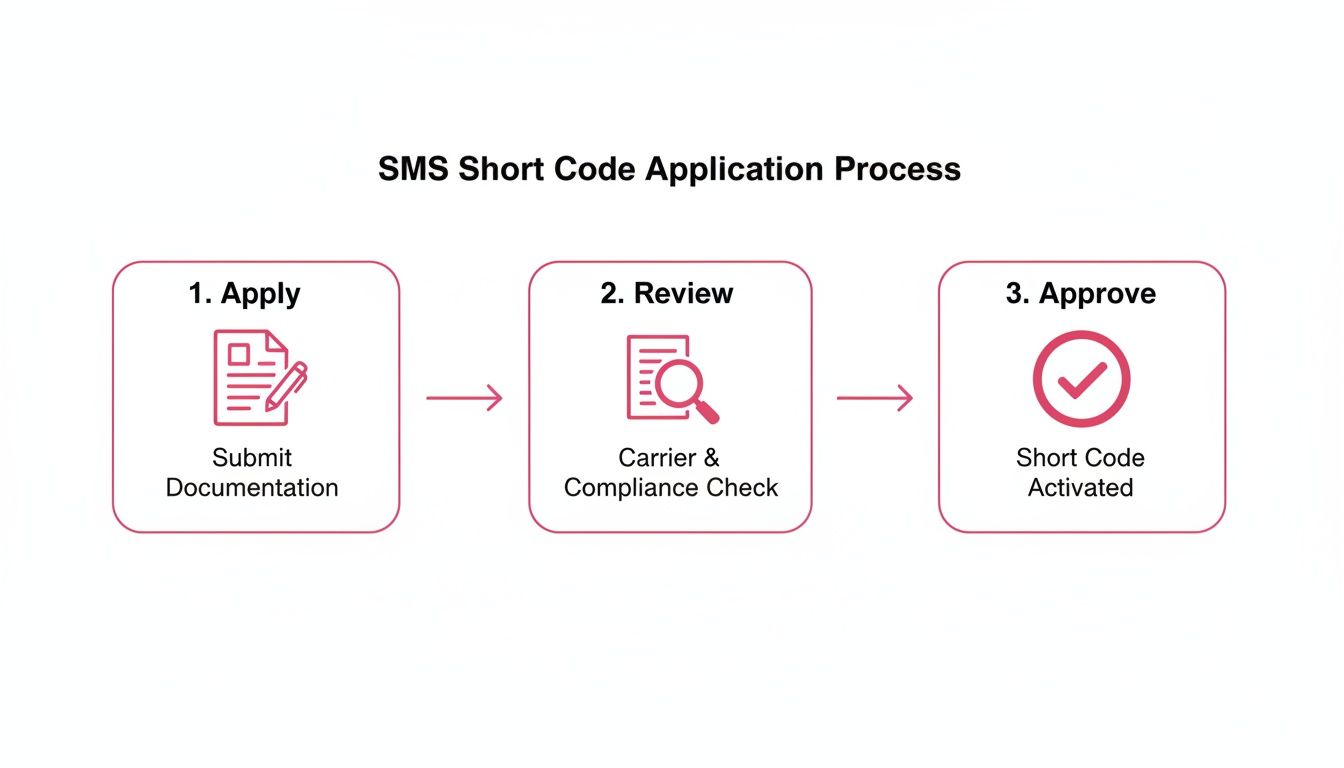
As the visual shows, while the steps are simple, each stage involves a careful review to keep the whole messaging ecosystem clean and trustworthy.
Mastering SMS Compliance: The Non-Negotiables
Beyond the cost, compliance is the most critical piece of the puzzle. Messing this up doesn’t just put you at risk for massive fines; it can get your short code shut down overnight, completely kneecapping your marketing efforts. These rules are here to protect consumers from spam, and carriers enforce them with zero exceptions.
You absolutely need to know two names: the Telephone Consumer Protection Act (TCPA) and the Cellular Telecommunications Industry Association (CTIA). They play different roles, but their rules all circle back to one core principle: explicit consent. You must have a customer’s clear, unambiguous permission before you send them a marketing text.
Key Compliance Takeaway: Never, ever assume you have permission. Consent for email does not count for SMS. You have to get and record express written consent specifically for text messages, making it crystal clear what kind of content they’re signing up for.
To stay on the right side of the law, your opt-in process and your messages need to include a few mandatory elements.
- A Clear Call-to-Action: Your signup forms have to spell out what the user is subscribing to (e.g., “Text DEALS to 55555 for weekly offers and alerts”).
- Required Disclosures: You must include the phrase “Message and data rates may apply” right where they opt-in. This isn’t optional.
- Easy Opt-Out Instructions: Every single message has to offer a clear way out, usually by replying “STOP.” You’re required to honor that request instantly and automatically.
- Customer Support Access: You also need to include a “HELP” keyword that, when texted, provides customers with contact info for support.
Using a platform with built-in compliance features is a huge safety net here. These tools automate many of these requirements, like managing opt-out lists and adding the necessary disclosures. This lets you focus on crafting great campaigns, knowing you’re protected from making a costly mistake.
Short Codes vs. 10DLC and Toll-Free Numbers
In the world of business texting, not all numbers are built the same. Choosing the right one is like picking the right tool for a job—you wouldn’t bring a sledgehammer to hang a picture frame. When it comes to SMS, you have three main options: short codes, 10DLC, and toll-free numbers. Each has its own job to do.
They all send text messages, sure, but how they perform in terms of speed, volume, and even how your customers see your brand couldn’t be more different. Picking the right one has a direct impact on how fast your messages get delivered and, ultimately, how much money you make.
Short Codes: The High-Speed Marketing Champions
Think of a short code as the Formula 1 car of text messaging. It’s a 5-6 digit number built for one thing: pure, unadulterated speed at a massive scale. This is the number you want for high-stakes marketing campaigns where every second is money.
For e-commerce, this is a game-changer.
- Flash Sales: You’ve got a limited-time offer and need to tell thousands of people right now. A short code blasts that message out instantly, creating a powerful sense of urgency that drives sales.
- Cart Recovery: Speed is everything when a customer abandons their cart. A short code can deliver that reminder text in minutes, catching the shopper while your store is still fresh in their mind.
- Mass Alerts: Launching a new product? Announcing a major update? A short code gets the word out to everyone at once, without the delays or filtering issues that can plague other number types.
The real power of a short code is that it’s pre-approved by the mobile carriers. This gives it a VIP pass straight to your customers’ inboxes, bypassing the spam filters that can kill a campaign. It’s the guaranteed delivery you need for your most important, revenue-generating messages.
10DLC: The Conversational Workhorse
If a short code is a race car, then a 10-Digit Long Code (10DLC) is your trusty daily driver. It’s a standard, local 10-digit phone number, which makes it feel much more personal and perfect for real, two-way conversations.
You wouldn’t use a 10DLC number for a massive marketing blast—it just doesn’t have the horsepower. But it’s the perfect tool for building relationships. Think appointment reminders, customer support follow-ups, or personalized check-ins from a sales rep. That local area code adds a touch of familiarity that makes people more likely to engage.
Toll-Free Numbers: The Customer Service All-Stars
Toll-free numbers (like the classic 800 or 888 numbers) are the SUVs of the messaging world. They’re versatile, they’re trusted, and they’re fantastic for brand recognition. The best part? They can handle both phone calls and text messages, making them the ultimate hub for customer service.
Customers already know and trust toll-free numbers for support. Adding SMS to the mix just makes it easier for them to get help. While they can handle more message volume than a 10DLC, they still can’t compete with the raw speed of a dedicated short code for a marketing blitz. Their real strength lies in creating a single, reliable point of contact for your entire brand.
The rise of SMS short codes has unlocked incredible consumer engagement. A staggering 72% of people worldwide have made a purchase after getting a text from a brand. This is all about delivering urgent, can’t-miss messages—like the automated reminders from CartBoss—that make people act. And it’s only getting better: 86% of recipients now make at least two purchases a year from SMS, a huge leap from just 55% in 2022. You can dig into more of these powerful SMS statistics from recent studies to see just how big the opportunity is.
So, what’s the bottom line? Your goal dictates your number. For huge, time-sensitive campaigns meant to drive immediate sales, nothing touches the performance of a short code. For building personal connections, 10DLC is the way to go. And for an all-in-one, trusted customer service channel, the toll-free number is king. Knowing when to use each is the secret to a truly effective SMS strategy.
Putting Short Codes to Work for Cart Recovery
Okay, let’s move from theory to action. This is where the rubber meets the road—turning those abandoned carts into cold, hard sales. With the average cart abandonment rate hovering around a staggering 70%, every person who leaves your checkout is a massive opportunity just waiting to be seized.
And this is exactly where a short code for SMS becomes your secret weapon.
A perfectly timed, compelling text message can be that final nudge a customer needs to click “buy.” Thanks to the incredible speed and deliverability of a short code, your recovery text lands in their hands within minutes, not hours. That immediacy is everything when it comes to closing a sale.
Your Strategic Cart Recovery Checklist
Just sending a message isn’t enough; you need a game plan. The most successful campaigns are built on three pillars: timing, personalization, and a clear, compelling reason to act now.
Here’s a simple checklist to get you started:
- Time It Perfectly: Don’t let the trail go cold. Your first message should land within 30-60 minutes after they’ve left. The purchase is still fresh in their mind, making them much more likely to reconsider. A second gentle reminder about 24 hours later can catch those who just needed a little more time to think it over.
- Personalize Your Approach: Nobody likes feeling like a number. Use the customer’s name and mention a specific item they left behind. A generic blast feels like spam, but a personalized text feels like a helpful reminder from a brand that’s paying attention.
- Create Gentle Urgency: You want to prompt action, not panic. Frame your offer with a bit of scarcity or a time limit. Simple phrases like “Your cart expires soon” or “This 15% off code is good for 24 hours” work wonders by encouraging them to act without being pushy.
Mastering these fundamentals is just the start. Digging into various strategies to reduce shopping cart abandonment can seriously boost your bottom line, and short codes are the engine that drives those recovery efforts.
Proven Message Templates You Can Use Today
The words you choose make all the difference. Your message has to be short, punchy, valuable, and incredibly easy to act on. The best part? Modern automation platforms can link directly to a pre-filled checkout, removing all friction for the customer.
Pro Tip: Always, always include a direct link back to their pre-filled cart. The goal is to make finishing the purchase ridiculously easy. One click should take them straight back to their items, with any discount you offered automatically applied.
Here are a few templates you can steal and adapt for your own brand:
- The Friendly Nudge:
“Hey [Name]! Looks like you left something behind at [Your Store]. Your items are saved and waiting for you! Complete your order here: [link]” - The Incentive Offer:
“Hi [Name], your cart at [Your Store] is about to expire! Don’t miss out—grab your items with 15% OFF for the next 24 hours. Finish checkout now: [link]” - The Scarcity Angle:
“Heads up, [Name]! The items in your cart are popular and stock is running low. Secure your [Product Name] before it’s gone! Your cart: [link]”
When you combine a smart checklist with compelling, automated messages, you start turning those lost opportunities into a reliable revenue stream. For even more ideas on building out your program, you can learn how to recover abandoned carts with text messages.
Your Top Questions About SMS Short Codes, Answered
Even with the best strategy, it’s normal to have a few questions about SMS short codes. Let’s cut through the noise and give you some straight answers to the most common hang-ups, so you can move forward with confidence. We’ll cover everything from activation times to the real-world risks you need to know about.
My goal here is to clear up any confusion and get you focused on what really matters for your e‑commerce store.
How Long Does It Really Take to Get a Short Code Activated?
Let’s get one thing straight: getting a dedicated short code isn’t an overnight thing. The official process, called provisioning, usually takes anywhere from 6 to 12 weeks. This isn’t just red tape; it’s a required vetting period where your application gets reviewed by the Short Code Registry and then green-lit by all the major mobile carriers.
Every single carrier looks at your proposed use case to make sure it meets their strict rules, which are all about protecting their users from spam. While a good provider can help you nail the paperwork, that carrier approval timeline is pretty much set in stone.
Can I Use One Short Code for Both Marketing and Support?
You can, but you have to be incredibly careful with how you manage it and make sure it’s all documented in your application from day one. You need to declare exactly how you plan to use it. If you’re mixing marketing and support, you must ensure every single message follows regulations like the TCPA, which has iron-clad consent rules for marketing texts.
A lot of brands like using a single code because it looks clean and consistent, but they segment their campaigns like their business depends on it—because it does.
- Marketing Messages: These can only go to users who explicitly opted in for promotions. No exceptions.
- Transactional Alerts: Things like order confirmations or shipping updates have different consent requirements.
Here’s the bottom line: never send a marketing blast to a customer who only signed up for shipping alerts. Nailing your segmentation is absolutely critical for staying compliant and keeping your customers’ trust.
What Happens If a Shared Short Code I Use Gets Blocked?
This is the number one reason to be wary of shared short codes. If another company using that same number starts spamming people and gets the code blacklisted by carriers, your messages will stop getting delivered immediately. You have zero control over what the other tenants are doing.
One bad actor can bring your entire SMS campaign to a screeching halt, wrecking your sender reputation and killing your revenue literally overnight. For any serious e-commerce business that relies on SMS for cart recovery or other critical messages, a dedicated short code isn’t a luxury—it’s the only way to guarantee you’re in full control.
Ready to turn abandoned carts into your biggest revenue stream? CartBoss uses the power of high-deliverability SMS to bring customers back and boost your sales on autopilot. Start recovering lost sales today!