



When you pair SMS and email marketing, you’re not just adding another channel—you’re creating a powerful, cohesive strategy that drives far more engagement and revenue than either could ever manage on its own. The smartest brands have stopped treating them like separate tools. Instead, they orchestrate them to play complementary roles, building a seamless customer journey that feels personal while maximizing conversions.
Why SMS and Email Marketing Work Better Together
Stop thinking about your marketing in silos. In a world where customer attention is split across a dozen different apps and screens, relying on a single channel means you’re leaving money on the table. The reality is, your best customers are already interacting with you on multiple fronts. In fact, a staggering 85% of people who subscribe to a brand’s text messages are also on their email list.
That overlap isn’t a problem; it’s a massive opportunity. The trick isn’t to blast the same message everywhere. It’s to build a cohesive experience where each platform serves a distinct, strategic purpose. This is the heart of a modern multi-channel marketing approach that savvy e-commerce brands are using to pull ahead of the competition.
Defining Channel Roles for Maximum Impact
To build an effective, integrated workflow, you first need to understand the unique strengths of each channel. Think of them as two specialists on the same team, each with a specific job to do.
To get started, it’s helpful to see their strengths side-by-side.
Channel Strengths At a Glance: SMS vs. Email
Here’s a quick breakdown of how SMS and email stack up in the e-commerce world, highlighting their primary roles and typical performance.
| Attribute | SMS Marketing | Email Marketing |
|---|---|---|
| Primary Role | Immediacy, urgency, direct action | Nurturing, storytelling, detailed content |
| Best For | Cart recovery, flash sales, shipping alerts | Newsletters, product launches, brand stories |
| Open Rate | 98%+ (often within minutes) | 15-25% (industry dependent) |
| Content Format | Short, concise text (under 160 characters) | Rich text, images, videos, long-form copy |
| Customer Perception | Personal, urgent, and high-priority | Informational, less time-sensitive |
This table makes it clear: they aren’t competitors. They are teammates, each perfectly suited for different tasks in your customer communication strategy.
- SMS for Immediacy: Text messages feel personal and urgent. With open rates hitting over 98%, usually within minutes, SMS is your go-to for anything time-sensitive. It absolutely shines for flash sale announcements, shipping updates, and—most importantly—abandoned cart reminders that demand immediate attention.
- Email for Storytelling: Email gives you the space to share richer, more detailed content. It’s the perfect place for nurturing customer relationships, sharing your brand’s story, showcasing new product collections with beautiful visuals, and sending out weekly newsletters. It’s how you build loyalty for the long haul.
By assigning these specific roles, you avoid overwhelming your audience. An SMS about a cart they just left feels helpful. An email a day later with thoughtful product recommendations feels considered. It’s a one-two punch that respects the customer’s time and attention.
Cutting Through the Inbox Noise
Email has been a marketing cornerstone for years, but its effectiveness is getting watered down by sheer volume. We’re all drowning in emails. An estimated 376 billion emails are sent every single day, and reports show that 40% of users have at least 50 unread messages sitting in their inbox. This “inbox fatigue” means many of your promotional emails, including those critical abandoned cart reminders, might never even be seen.
This is exactly where SMS breaks through. It gives you a direct, uncluttered line to your customer for the messages that absolutely cannot be missed. By integrating SMS and email marketing, you create a safety net. You ensure your most critical communications are delivered and seen, dramatically improving your chances of recovering a sale or getting action on a limited-time offer. You can learn more about this strategy in our guide to multi-channel marketing.
Building Your Integrated Cart Recovery Funnel
Every single abandoned cart is a story of a near-miss. It’s a customer who was seconds away from buying before life, a technical glitch, or simple distraction got in the way. A smart recovery funnel, one that uses both SMS and email marketing, is your best shot at turning those almost-sales into real revenue.
But this isn’t about just blasting reminders. The magic is in the timing and the channel. You need an intelligent, sequential flow that feels helpful, not pushy. Think about it: a customer might totally ignore an email but glance at a text instantly. By layering your communication, you get multiple chances to catch them on whatever platform they’re paying attention to.
The goal here is to build a persistent but respectful recovery sequence. You’re gently guiding the customer back to their cart, making it as easy as possible to finish what they started. This whole approach just acknowledges how people shop today—we get distracted, and a friendly nudge is often all it takes.
The First Hour: The Crucial Window
Those first few moments after a cart is abandoned are your golden opportunity. The customer’s interest is still piqued, and the items are fresh in their mind. This is the perfect time for a low-pressure, helpful email.
- Timing: Send the first email 30-60 minutes after they leave.
- Channel: Email. It feels less intrusive than an immediate text and gives you space for nice product images.
- Goal: A simple, friendly reminder. They might have just gotten pulled away or had their Wi-Fi drop.
Your first message shouldn’t be aggressive at all. Treat it like a customer service touchpoint. A subject line like “Did you forget something?” or “Your items are waiting for you” works great. Inside, make sure you visually showcase the products they left behind, complete with clear images and a big, obvious button that links directly back to their pre-filled cart.
Pro Tip: Don’t make them do the work again. The link in your email absolutely must lead them back to a checkout page with their items already in it. Forcing someone to re-add everything is a surefire way to lose the sale for good.
Four to Six Hours Later: The High-Impact SMS
If that initial email didn’t seal the deal, it’s time to bring in the heavy hitter: SMS. A text message is direct, personal, and almost guaranteed to be seen.
- Timing: Send an SMS 4-6 hours after abandonment.
- Channel: SMS. With a 98% open rate, you know your message is getting through.
- Goal: Create a little urgency and sweeten the deal.
By now, that initial impulse to buy might be fading. You need to give them a new reason to act now. This is the perfect moment to introduce a small, time-sensitive discount to nudge them over the finish line.
Example SMS Template:
“Hey [Customer Name]! Still thinking it over? The items in your cart are popular and might sell out. Complete your order in the next 12 hours and get 10% off with code SAVE10. Your cart: [Pre-filled Checkout Link]”
This message just works. It’s personalized, hints at scarcity (“might sell out”), gives a clear incentive, and provides a direct path to purchase. There are tons of other creative strategies to reduce cart abandonment and win back lost sales you can explore for even more advanced tactics.
The 24-Hour Follow-Up Email
For the shoppers who are still holding out, a final email at the 24-hour mark acts as a last-chance reminder. You can use this message to tackle common reasons for hesitation, like shipping costs or confusing return policies.
- Timing: Send the final email 24 hours after abandonment.
- Channel: Email.
- Goal: Overcome any lingering objections and remind them why your brand is great.
This is your chance to build a little more trust. Use this email to highlight what makes you stand out from the competition.
What to Include in Your Final Email:
- Reinforce the Offer: Remind them about that discount code you sent via SMS.
- Showcase Social Proof: Pop in a customer testimonial or show off the star ratings for the items in their cart.
- Address Common Questions: Briefly mention your free shipping policy, easy returns, or customer support contact info.
- Final Call-to-Action: Use a clear, direct CTA like “Complete Your Purchase” or “Claim Your 10% Off Now.”
Setting up these automated sequences is fundamental for any serious e-commerce store. For a deeper look at the tech that makes this all possible, check out our guide on marketing automation for ecommerce. When you properly sequence your SMS and email marketing for cart recovery, you transform a leaky funnel into a powerful, automated engine for driving sales.
Crafting Messages That Convert on Both Channels
Getting your strategy and timing right is only half the job done. The actual words you use in your sms and email marketing are what will either convince a customer to come back or make them hit the delete button.
Each channel plays by different rules, and you have to approach them with a completely different mindset.
Email gives you room to breathe. You can use great visuals and more detailed copy to remind shoppers what they’re missing. SMS, on the other hand, is all about speed and precision. Every character counts.
Mastering the Art of Email Copywriting
An abandoned cart email isn’t just a notification; it’s a second chance to reignite the excitement that brought a shopper to your store. You can’t just say, “You left stuff in your cart.”
Here’s how to make your emails stand out in a crowded inbox:
- Write Subject Lines That Spark Curiosity: Ditch the generic “Complete Your Order.” Try something a little more intriguing, like, “Still Thinking It Over?” or “Your Items Are Waiting…” A great subject line gets the open, but the content inside seals the deal.
- Use High-Quality Product Visuals: The single most powerful part of your email is a sharp, clear photo of the products they left behind. That visual reminder is often more persuasive than anything you could write.
- Embed a Clear Call-to-Action (CTA): Nobody should have to hunt for the link. Use a big, bold button with text that screams action, like “Return to My Cart” or “Claim My Items.” One click should take them straight to a pre-filled checkout.
If you want to go deeper on this, we’ve got a whole guide covering the best practices and strategies for abandoned cart emails that you can check out.
Winning with High-Impact SMS Copywriting
With SMS marketing, you’ve got about 160 characters to make your case. Your message has to be direct, personal, and urgent. There’s simply no room for fluff.
This flow chart breaks down how a simple but effective recovery sequence can work using both channels.
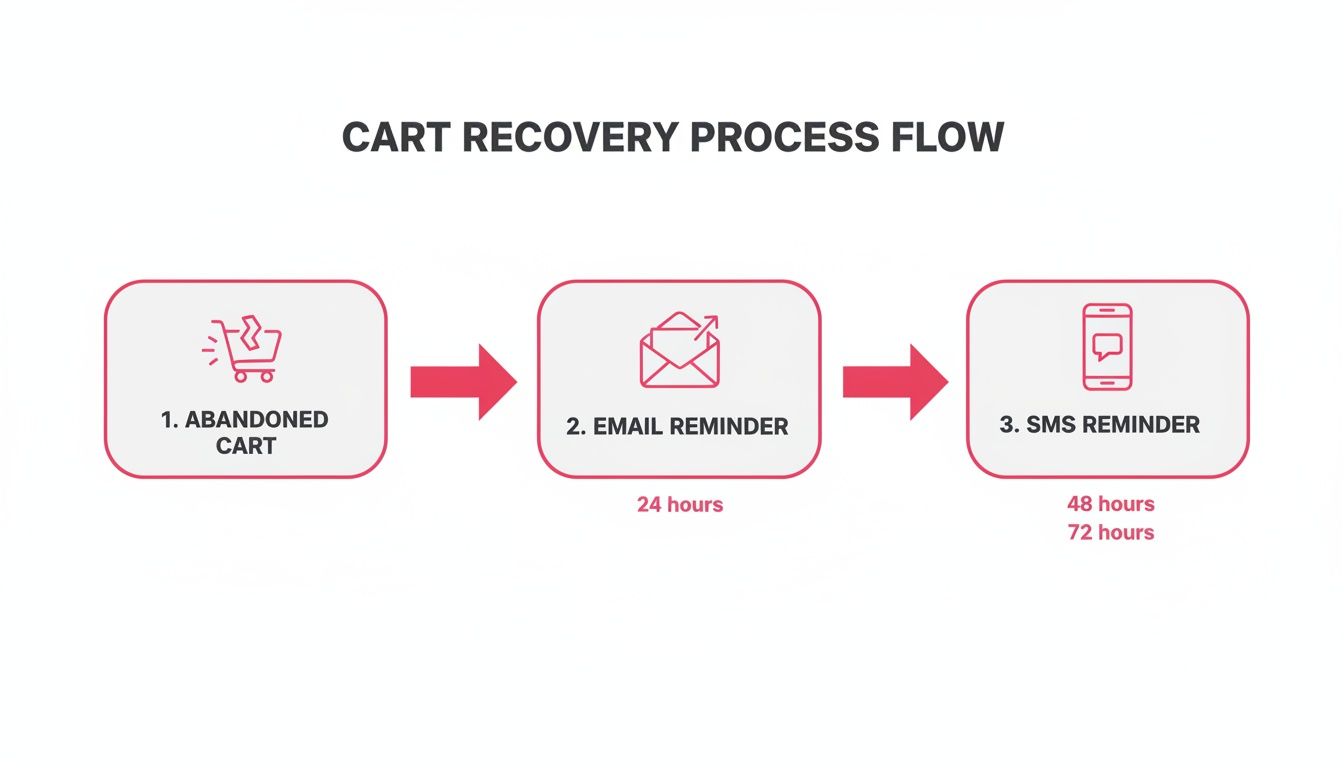
As you can see, an email might go out first, followed by a punchy SMS that creates a second, more immediate touchpoint. The goal is to grab their attention in seconds.
Your SMS isn’t a conversation starter; it’s a conversation finisher. Its sole purpose is to get the customer to click the link and complete the purchase they already started.
To make every text message count, stick to these fundamentals:
- Lead with Personalization: Always, always start with their name. A simple “Hey, [Name]” makes the message feel like it was sent just for them, which instantly boosts engagement.
- Create Genuine Urgency: Don’t be cheesy. Instead of a generic “Your cart expires soon,” try something that feels more real, like “Your items are popular and might sell out.”
- Provide a Clear Incentive: A small, time-sensitive discount can work wonders. Offering 10% off for completing the order in the next few hours gives them a solid reason to act now.
Here’s what that looks like in the real world:
“Hey, Sarah! Still thinking about those items? Complete your order in the next 4 hours to get 15% off. Your cart is waiting: [link]”
This text nails it. It’s personal, it creates urgency with a deadline, and it offers a clear reward. That’s the winning formula. By tailoring your messaging for each channel, you ensure your sms and email marketing efforts work together to bring back sales you would have otherwise lost.
Using Segmentation to Personalize Your Outreach
Sending the same generic message to every single customer is a massive wasted opportunity. In a world where everyone expects personalization, a one-size-fits-all approach to SMS and email marketing doesn’t just fall flat—it can actually push your audience away.
The real key to breaking through the noise is smart segmentation.
This goes way beyond just plugging in a customer’s first name. True personalization is about grouping your audience based on their actual behaviors and history. This lets you send messages that feel relevant, timely, and genuinely helpful. When you tailor your outreach, you stop marketing at people and start having a real conversation with them.
Of course, before you can segment, you need an engaged audience. If you’re starting from scratch, your first step should be to build an email list that drives revenue—that’s the foundation you’ll build everything on.
Segmenting by Purchase History
One of the most powerful ways to segment your audience is by looking at what they’ve bought from you in the past. It just makes sense: a first-time shopper needs a completely different message than a loyal VIP who has bought from you ten times.
- New Customers: Their journey with your brand is just beginning. Your main goal here is to welcome them into the fold and nudge them toward that all-important second purchase.
- Returning Customers: These folks already know and trust you. Your messaging should focus on reinforcing that loyalty and maybe introducing them to new products they’ll love.
- VIPs/High Spenders: This group is the backbone of your brand. They deserve the red-carpet treatment—exclusive access, special rewards, and genuine recognition for their loyalty.
This kind of segmentation allows you to craft messages that connect on a much deeper level. A new customer might get a “Welcome to the family!” email series, while a VIP gets an exclusive SMS heads-up about a new product drop before anyone else sees it.
The goal of segmentation isn’t just about selling more stuff. It’s about making each customer feel seen and valued. When you acknowledge their specific relationship with your brand, you build the kind of loyalty that lasts way longer than any single campaign.
Segmenting by Cart Value and Browsing Behavior
Another incredibly effective strategy is to segment based on what customers are doing right now—like the value of their abandoned cart or the specific products they’ve been looking at. This lets you tailor your recovery offers for maximum impact.
Think about it: a shopper who abandons a $500 cart is a much hotter lead than someone who leaves a $25 cart behind. It makes zero sense to send them both the same discount.
- High-Value Carts ($200+): These are worth a more aggressive recovery strategy. You might hit them with a bigger discount, like 15% off, delivered via a high-impact SMS to grab their attention immediately.
- Low-Value Carts (Under $50): For these smaller carts, a simple email reminder might be all it takes. Or, you could offer a fixed-dollar amount off, like $5 off, which often feels more substantial on a smaller purchase.
This data-driven approach ensures your incentives are both profitable for you and effective at bringing shoppers back. For a deeper dive into these methods, check out our complete guide on customer segmentation techniques.
Ensuring Compliance and Building Customer Trust
Aggressive, out-of-the-blue messages will kill a customer relationship before it even starts. In the world of SMS and email marketing, trust is everything, and the best way to earn it is by respecting your customers’ privacy and playing by the rules. This isn’t just about dodging fines; it’s about showing your audience you value their time and attention.
Regulations like the General Data Protection Regulation (GDPR) in Europe and the California Consumer Privacy Act (CCPA) in the US have set clear guidelines for how businesses handle customer data. The legalese can get dense, but the core idea is simple: be upfront and always, always get permission first.
The Foundation of Consent
Every solid SMS and email strategy starts with a clear, undeniable opt-in. You can’t just scrape a phone number or email from a past purchase and dump it into your marketing list. That’s a fast track to getting blocked and reported.
- Explicit Opt-In: Customers must actively choose to receive marketing messages. This means using checkboxes at checkout that are unchecked by default. No sneaky pre-checked boxes allowed.
- Clear Language: Tell them exactly what they’re signing up for. Ditch the vague “Subscribe” button for something crystal clear, like, “Sign up for exclusive offers and updates via email and SMS.”
That first moment of consent sets the stage for your entire relationship. It tells the customer you’re a trustworthy brand that respects boundaries—a must-have for building any kind of long-term loyalty.
Making Unsubscribing Effortless
Getting permission to start the conversation is half the battle. The other half is giving them an easy way to end it. Hiding the unsubscribe link or making the process a confusing mess only leads to angry customers and spam complaints, which will absolutely wreck your sender reputation.
An easy opt-out process is a sign of a confident brand. It shows customers you respect their choice and are focused on building a community of engaged followers, not just a list of captive names.
For SMS, this is non-negotiable. Every single promotional text has to include clear opt-out instructions. The industry standard is simple because it works.
Example SMS Opt-Out Language:
“Reply STOP to unsubscribe.”
For email, the unsubscribe link needs to be easy to spot, usually in the footer of every message. It should take just a single click for someone to manage their preferences or opt out completely. Making this difficult is a surefire way to lose that customer forever.
For a deeper dive into the rules, check out our comprehensive guide on SMS marketing compliance.
Measuring Success and Optimizing Your Campaigns
You can’t improve what you don’t measure. Simple as that. Once your integrated SMS and email marketing campaigns are humming along, the real work starts. This is where you roll up your sleeves to track performance, figure out what’s actually working, and fine-tune your approach for better results.
Forget about vanity metrics like open rates. To prove your campaigns are pulling their weight and delivering a real return, you need to focus on the numbers that directly impact your bottom line.

Key Metrics to Track
Your analytics dashboard is your mission control. Instead of drowning in data, you need to zero in on the handful of metrics that truly matter for a cart recovery funnel.
- Conversion Rate Per Message: Is it the first email, the follow-up text, or the final Hail Mary email that’s actually closing the deal? This metric tells you which message is the MVP of your sequence.
- Revenue Recovered: This is the big one. The total dollar amount of sales you’ve clawed back directly from these campaigns. It’s the ultimate proof of success.
- Click-Through Rate (CTR): This shows you how compelling your message is. A low CTR is a huge red flag that your copy or call-to-action isn’t creating enough urgency or value to get that click.
- Return on Ad Spend (ROAS): For every dollar you put into your messaging platform, how many dollars are you getting back? This is the profitability gut-check for your entire strategy.
When you put SMS and email head-to-head in these recovery campaigns, the performance difference can be staggering. We’re talking 95–98% open rates and 45% response rates for SMS, which blows email’s typical 6% response rate out of the water.
A shopper is roughly 7 to 8 times more likely to actually respond to a text. That’s a massive difference that can completely change your recovery numbers. You can dig into more of these SMS marketing stats to see the full picture.
A/B Testing for Continuous Improvement
So, you’ve identified a weak link. Maybe your SMS has a fantastic open rate, but the CTR is dismal. It’s time to start A/B testing. This is all about changing one single variable at a time to see what your audience really responds to.
Optimization isn’t a one-and-done task. It’s an ongoing process of making small, smart tweaks. A simple change to a discount or the timing of a message can lead to a huge lift in recovered revenue over time.
Don’t try to test everything at once, or you’ll never know what actually worked. Isolate one element to get clear, actionable insights.
Here are a few powerful variables to start testing in your SMS and email messages:
- The Offer: Pit a 10% discount against a $15 off coupon. You might be surprised which one drives more sales.
- The Timing: Does sending a text four hours after they bail work better than waiting six hours? Test it.
- The Angle: Try a message that pushes urgency (“Your items are selling out fast!”) against one that highlights a benefit (“Complete your order now for free shipping”).
- The Call-to-Action (CTA): In your emails, test different button copy. Does “Complete My Order” outperform “Take Me Back to My Cart”?
By systematically testing and refining, you turn your analytics from a boring report into a powerful roadmap for growth.
Got Questions About SMS and Email? Let’s Clear Them Up
Even with the best strategy, jumping into a combined SMS and email approach can feel like a big step. A few questions always pop up, so let’s tackle the most common ones head-on.
Will I Just End Up Annoying My Customers?
This is the number one fear, but it’s completely avoidable if you’re smart about it. Annoyance comes from spammy, repetitive, and irrelevant messages. The trick is to make sure every single touchpoint—whether it’s an email or a text—offers real value.
A well-planned workflow doesn’t just blast the same discount on two different channels. Think of it as a conversation. You might start a cart recovery sequence with a friendly email reminder. If they don’t bite, the SMS comes in a few hours later, but it brings something new to the table, like a small discount that expires soon. By layering your channels and making each message count, you become a helpful guide, not a pushy salesperson.
What Kind of Results Can I Actually Expect?
While your mileage will always vary depending on your industry and audience, adding SMS to your email strategy almost always delivers a serious boost. The numbers don’t lie: SMS messages have an insane open rate of over 95%, usually within just a few minutes.
Compare that to email, which sits around a 20-42% open rate and can go unread for hours, or even days.
This speed translates directly into more engagement and higher conversion rates, especially for time-sensitive stuff like abandoned cart reminders. So many businesses discover a huge lift in recovered revenue just because they’re finally reaching customers who live in their text inbox, not their email.
The real magic isn’t in one channel’s stats, but how they work together. An integrated SMS and email marketing strategy creates a powerful safety net, making sure your most important messages actually get seen.
How Hard Is This to Set Up?
Getting a sophisticated, automated system running is way easier than it sounds, especially with today’s tools. Platforms built for Shopify and WooCommerce have done the heavy lifting, giving you pre-built templates and simple triggers to get started.
Honestly, the setup is pretty straightforward. You install an app or plugin, tweak a few messages to match your brand’s voice, and flick the switch. You can launch a powerful workflow that runs 24/7 for you, often in less than an hour.
Ready to stop losing sales to abandoned carts? CartBoss makes it incredibly easy to set up automated, high-converting SMS campaigns that work on autopilot. See how much revenue you can recover at https://www.cartboss.io.