


When you hear about the Telephone Consumer Protection Act (TCPA), think of it as the rulebook for all business texting in the United States. It’s basically a digital do-not-knock sign for every cell phone out there, and it gives businesses strict rules on how and when they can send SMS messages.
Why the TCPA Is a Big Deal for Text Message Marketing
The TCPA has been around since 1991, originally created to put a stop to those annoying, nonstop telemarketing calls. As technology changed, the law adapted, and now its principles are the foundation for modern channels like SMS and MMS. At its heart, the TCPA is all about protecting consumer privacy by giving people total control over who gets to contact them on their personal phones.
For any e-commerce store using SMS marketing, this isn’t just a “best practice”—it’s the law. Getting it wrong can cost you, big time. The TCPA draws a very clear line between two kinds of messages:
- Promotional Messages: This is anything designed to sell something. Think flash sale announcements, coupon codes, new product alerts, or any text trying to drive a purchase.
- Transactional Messages: These are purely informational texts tied to something the customer already did. This includes order confirmations, shipping updates, and appointment reminders.
The Staggering Cost of Unwanted Texts
The TCPA has become more critical than ever as texting has exploded, not just for legitimate brands but for scammers, too. People are naturally skeptical of unsolicited messages, and for good reason. The Federal Trade Commission recently revealed that in 2024 alone, consumers reported losing an incredible $470 million to text message scams.
That’s a five-fold jump from 2020, mostly driven by fake package delivery alerts and other sneaky tactics. You can dig into the FTC’s findings on text message scams to see just how serious the problem is.
The TCPA isn’t just about dodging fines; it’s about building trust. When you respect a customer’s inbox, you’re sending a clear message: you value their privacy more than a quick sale. That respect is what turns a one-time buyer into a loyal, long-term customer.
Violating the TCPA comes with a hefty price tag. Fines run from $500 to $1,500 for a single illegal text. Now, imagine sending a blast to a list of a few thousand people without getting the right consent. Those fines can skyrocket into the millions, easily becoming a threat to your entire business. That’s why mastering the rules of telephone consumer protection act text messages is the absolute first step to building an SMS strategy that’s both successful and sustainable.
Mastering Consent for Marketing and Transactional Texts
Under the TCPA, not all text messages are created equal. The law splits them into two distinct categories based on their purpose, and each has its own rulebook for getting permission. Think of it like inviting someone to your house—there’s a big difference between a casual “stop by anytime” and a formal, written invitation to a specific party.
For any business using SMS, getting this distinction right is the single most important part of compliance. A misstep here isn’t just a minor slip-up; it’s the kind of mistake that can spiral into serious legal and financial trouble. And make no mistake, the burden of proof is always on you, the business, to show you had the right permission before you hit send.
This decision tree gives you a quick visual of the basic flow for figuring out which rules apply to your texts.
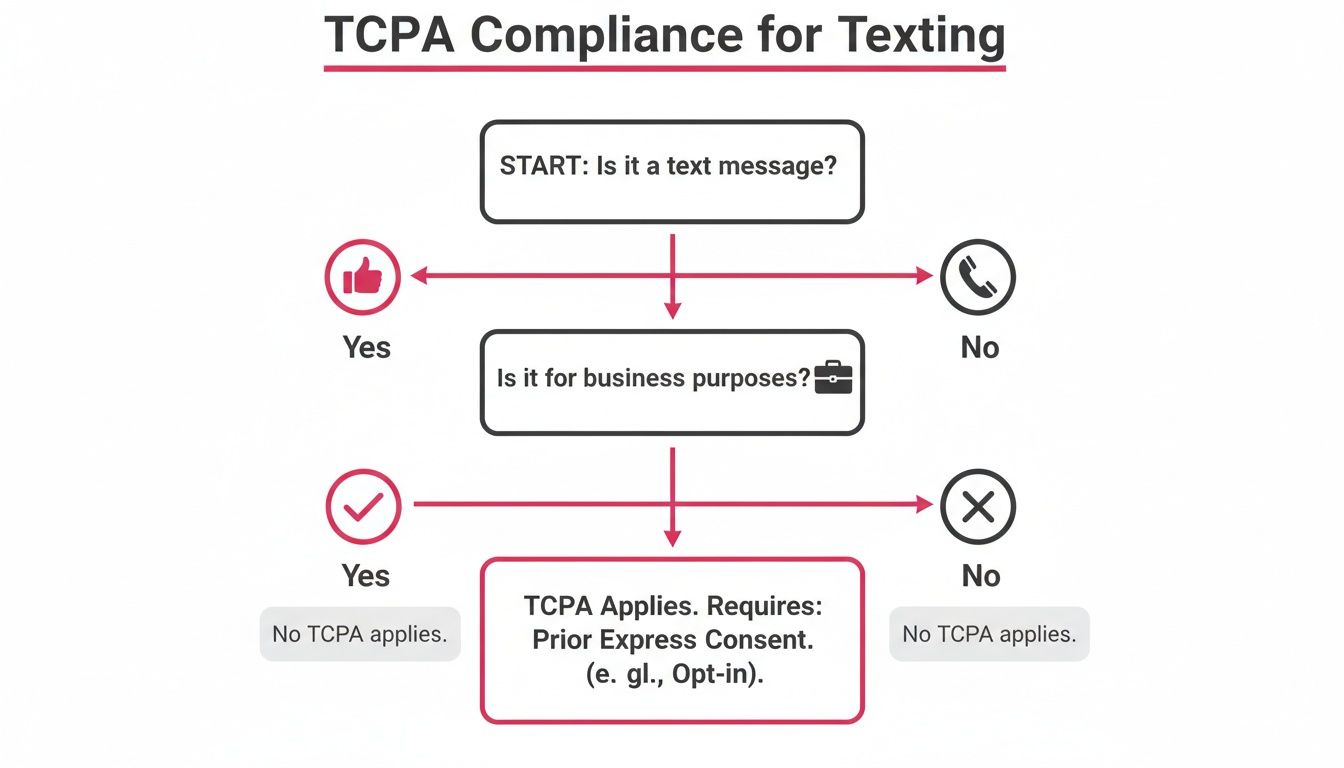
The key takeaway here is simple: the moment a message contains any kind of commercial or sales-driven intent, the compliance bar gets raised—a lot.
The Two Tiers of Text Message Consent
Navigating the rules for TCPA and text messages really starts with one question: are you sending a simple update or trying to drive a sale? The answer changes everything.
- Express Consent (Informational Texts): This is your baseline level of permission. It’s what you need for non-promotional, purely informational messages. Think shipping updates, appointment reminders, or fraud alerts. A customer gives you express consent simply by providing their phone number during a normal business interaction, like at checkout. They’re implicitly agreeing to get texts directly related to that transaction.
- Prior Express Written Consent (Marketing Texts): This is the gold standard of consent, and it’s completely non-negotiable for any message that promotes a product or service. This includes texts about sales, new product drops, discount codes, and even cart recovery reminders. The “written” part is crucial—it demands a clear, documented, and affirmative agreement from the consumer to receive marketing texts from you.
What is Prior Express Written Consent?
This stricter form of consent isn’t something you can assume. It requires a crystal-clear disclosure from your business, and the customer has to take a deliberate, affirmative action—like checking an otherwise unchecked box—to agree. You can’t bury it in the fine print.
The disclosure must state upfront that by giving their number, the consumer agrees to get recurring automated marketing text messages from your brand. It also has to clarify that their consent is not a condition of any purchase.
For instance, a compliant checkbox on your checkout page might say: “Sign me up for exclusive offers and updates via text! Msg & data rates may apply. Consent is not a condition of purchase.” This language leaves absolutely no room for misunderstanding.
To help you compare, here’s a quick breakdown of what’s needed for different types of messages.
TCPA Consent Requirements for Text Messages
This table lays out the consent levels required for the most common types of business text messages you’re likely to send.
| Message Type | Consent Level Required | Common Examples | Consent Method Example |
|---|---|---|---|
| Marketing & Promotional | Prior Express Written Consent | Sales alerts, discount codes, new product announcements, cart recovery reminders | An unticked checkbox at checkout with clear disclosure language that the user must actively check. |
| Informational & Transactional | Express Consent | Order confirmations, shipping notifications, appointment reminders, fraud alerts | Customer provides their phone number in a form field specifically for receiving order updates. |
| Mixed-Content Messages | Prior Express Written Consent | An order confirmation that also includes a coupon for a future purchase. | If a message contains both informational and promotional content, the higher consent standard applies. |
Getting that written permission nailed down is your single best defense against a TCPA lawsuit. If you’re looking for a deeper dive, you can find a detailed guide that offers an actionable checklist for securing express written consent.
Remember, meticulous records are everything. You must be able to prove exactly how and when a customer gave you their permission to text them. Without that proof, you have no defense.
How to Handle Opt-Outs and Consent Revocation
Getting a customer’s permission to send them texts is only half the battle. Honoring their request to stop is just as critical, if not more so.
Under the TCPA, consent isn’t a one-and-done deal. Customers have the absolute right to change their minds and revoke that consent at any time. Your business must be ready to act on that request instantly.
Think of it like the “unsubscribe” link in an email campaign. When a customer replies with a standard keyword like STOP, END, CANCEL, UNSUBSCRIBE, or QUIT, your system has to recognize it immediately and pull them from your marketing lists. Failing to do this isn’t just bad for customer relationships—it’s a direct violation of the law.

Recognizing Any Reasonable Method of Opting Out
While the standard keywords are the most common, the TCPA’s rules go much further. The law actually requires you to honor any opt-out made through a “reasonable manner.” This is a purposely broad definition that puts all the responsibility right on your shoulders.
So, what does “reasonable” really mean? It could be almost anything. A customer might send an email to your support desk, call your service line, or even reply to a text with something informal like “please don’t text me anymore.” Your team and your systems have to be trained to catch and process all of these, no exceptions.
The principle here is simple: if a customer has made it clear they don’t want your texts, you have to stop. There’s no wiggle room, and pretending you didn’t see the request is not a defense that will hold up.
This requirement is only getting stricter. Upcoming TCPA changes are reinforcing the “any reasonable manner” standard and tightening the timeline for processing these requests. Keeping your opt-out process sharp is non-negotiable.
Automation and the Final Confirmation Message
Let’s be real: the only way to manage opt-outs effectively is with automation. Trying to do this manually is a recipe for disaster. Human error is inevitable, and one accidental text to someone who opted out can lead to a very expensive violation. An automated system makes sure that when a user texts “STOP,” they are instantly and permanently removed.
After someone opts out, you are allowed to send one final text. This message is purely to confirm that you’ve processed their request and can’t contain any marketing whatsoever.
A compliant confirmation looks something like this:
- “You have been unsubscribed from all future messages. No more messages will be sent.”
This single message closes the loop, providing a clear record for both you and the customer. To get a deeper look into the mechanics of managing subscribers, check out our complete guide on both opting-in and opting-out of SMS marketing. Handling opt-outs correctly protects your brand and keeps you safely on the right side of the law.
The Real Cost of TCPA Non-Compliance
Ignoring the rules for telephone consumer protection act text messages isn’t just a bad habit; it’s a financial gamble where the stakes are terrifyingly high. The law was intentionally designed with teeth, packing severe penalties to make businesses think twice. Every single text you send is a potential liability.
The penalties are unforgiving and, critically, they’re calculated on a per-message basis.
For just one negligent violation, the fine is $500. If a court decides you knew the rules and broke them anyway—what they call a “willful or knowing” violation—that fine triples to a staggering $1,500.
Think about that for a second. Imagine you make a simple mistake, like sending a promotional text to a list of 1,000 people who didn’t give you the right kind of written consent.
That single campaign could instantly land you in hot water for anywhere from $500,000 to $1.5 million in damages. It happens faster than you think.
How Fines Explode into Class-Action Lawsuits
Here’s the part that catches most businesses off guard. Unlike other regulations where a government agency is the main enforcer, TCPA compliance is driven almost entirely by consumer lawsuits. There are no routine government audits. Instead, enforcement comes from individuals and, more often than not, class-action lawsuits filed by motivated law firms.
This “private right of action” means any person who gets an illegal text can sue you directly.
This model essentially puts a target on your back. One slip-up can attract legal action that bundles hundreds or thousands of individual claims into one massive, company-killing lawsuit. The penalties for illegal text messages are famously severe because they’re meant to stop mass texting violations in their tracks.
With damages starting at $500 per text and no cap on the total payout, it’s no surprise that class-action filings have skyrocketed.
The critical takeaway is that your biggest TCPA risk isn’t a government watchdog. It’s the people receiving your texts. Every message you send is a potential trigger for litigation that can cost millions.
A small business could send one non-compliant Black Friday campaign and find itself facing a lawsuit that threatens its very existence. For a deeper dive into what that looks like, check out our guide on the consequences of a violation of TCPA rules. The financial risk is simply too great to ignore.
Building Your TCPA-Compliant SMS Program
Alright, let’s move from the legal jargon to what really matters: building an SMS program that works, makes you money, and doesn’t get you into hot water. Getting compliant with the Telephone Consumer Protection Act text messages rules isn’t about memorizing paragraphs of law. It’s about building a rock-solid system from the ground up.
Think of it this way: the burden of proof is always on you. If a customer ever says, “I never signed up for these texts,” you need to have a bulletproof, time-stamped record showing exactly how and when they did. Without it, you’re walking into a “he said, she said” argument you’re almost guaranteed to lose.
The Core Pillars of a Compliant Program
Beyond just getting that initial “yes,” a truly compliant program is about respecting your customers and being transparent every step of the way. It’s how you build trust and turn subscribers into loyal fans.
There are three things you absolutely can’t skip:
- Meticulous Record-Keeping: You need to log everything. This means the customer’s phone number, the exact consent language they saw, a timestamp of when they agreed, and the IP address they used. You’ll want to hang onto these records for at least four years, which covers the statute of limitations for most TCPA claims.
- Respecting Quiet Hours: This one’s a biggie. The TCPA says no marketing texts before 8 a.m. or after 9 p.m. in the recipient’s local time zone. Blasting out a promo code at 3 a.m. is a surefire way to get an angry reply and a potential complaint.
- Clear Business Identification: Who is this text from? Your very first message—and really, every message—needs to clearly state your brand’s name. A text from a random number feels like spam, and that’s the fastest way to lose a customer’s trust before you’ve even earned it.
Essential Consent Language for Your Website
The words you use to ask for permission are your first line of defense. This language has to be crystal clear and right there at the point of collection—like on your pop-up forms or checkout page. Hiding it in the fine print of your Terms and Conditions won’t cut it.
Here’s some sample language you can adapt for your site. Notice how direct it is:
Example for a Pop-Up Form: “By entering your phone number and subscribing, you consent to receive marketing text messages (e.g., promos, cart reminders) from [Your Brand Name] at the number provided, including messages sent by autodialer. Consent is not a condition of purchase. Msg & data rates may apply. Msg frequency varies. You can unsubscribe at any time by replying STOP or clicking the unsubscribe link (where available).”
This little block of text does a lot of heavy lifting. It says who you are, what kind of texts they’ll get, mentions the autodialer, and makes it clear they don’t have to subscribe to buy something.
Your Actionable Compliance Checklist
Whether you’re starting from scratch or giving your current SMS program a check-up, you need a system. A good checklist turns compliance from a headache into a simple, repeatable process.
To make it even easier, we’ve put together a comprehensive guide to walk you through every step. Our detailed SMS compliance checklist for e-commerce gives you a clear framework to follow. Using an approach like this doesn’t just cut down on legal risks; it shows customers you respect their privacy, which is always a good look.
Getting a Handle on Federal and State Texting Laws
Getting the federal Telephone Consumer Protection Act (TCPA) right is a huge first step, but it’s really just the baseline for compliance. A growing number of states have their own laws, often called “mini-TCPAs,” and they can be a whole lot stricter than the federal rules.
Think of the TCPA as the national speed limit on the interstate. It sets the standard everywhere. But once you get off the main highway, states can—and do—set much lower speed limits on their own roads. For your business, this means you always have to follow the most restrictive rule for any given customer, which adds a tricky but essential layer to your SMS strategy.
The Rise of Stricter State Rules
States are getting more aggressive with their own regulations. Florida, for example, passed a law with a much broader definition of what counts as an automated dialer. Other states have different rules for quiet hours or demand more specific wording for getting consent. A text that’s perfectly legal under federal law could easily get you into hot water with a state-specific rule.
The golden rule here is simple: always follow the strictest law that applies. If a state requires a more detailed consent disclosure than the TCPA, that’s the standard you have to meet for every customer in that state.
This legal patchwork makes it absolutely critical to understand not just the federal requirements, but also the specific personal text message privacy laws in the states you’re texting. Ignoring this is a common and expensive mistake. State-level penalties can hit just as hard as federal ones, and you don’t want to be caught off guard.
Common Questions About TCPA and Text Messages
When you start digging into the rules for Telephone Consumer Protection Act text messages, a lot of practical questions pop up. Let’s tackle some of the most common points of confusion we see brands struggle with every day and get you some clear, direct answers.
Do TCPA Rules Apply to B2B Text Messages?
Yes, they almost always do. This is one of the most persistent myths out there—that business-to-business texts get a free pass. The law doesn’t care if a cell phone number belongs to a CEO or a college student; it protects the number itself.
That means all the strict rules about using an autodialer and getting prior express written consent for your marketing messages still stand. The smartest, safest approach is to treat your B2B contacts with the exact same care as your B2C customers. Always get proper consent before you hit send on any promotional texts.
What Really Counts as an Autodialer These Days?
The official definition of an “autodialer,” or Automatic Telephone Dialing System (ATDS), has been a legal battleground for years. After the big Supreme Court ruling in Facebook v. Duguid, the definition got much narrower. Now, it specifically means gear that can either store or create phone numbers using a random or sequential number generator.
While most modern SMS platforms probably don’t fit this tight definition, the legal winds can and do shift.
The most bulletproof strategy is to act as if your system could be classified as an ATDS. By always getting the gold standard of consent—prior express written consent—for all marketing messages, you’re protected no matter what tech you use or how the law gets interpreted down the road.
How Long Should I Keep My Consent Records?
You absolutely must keep detailed consent records for a minimum of four years. This isn’t an arbitrary number; it matches the federal statute of limitations for a consumer to sue you under the TCPA. Think of these records as your ultimate insurance policy.
Your records need to prove, without a doubt, how and when you got that consent. Make sure you capture:
- The person’s phone number.
- The exact consent language they saw and agreed to.
- A precise timestamp of when they opted in.
- The IP address they used when giving consent.
Without this hard proof, any legal challenge becomes a messy “he said, she said” situation. That’s a fight no business wants to be in.
Ready to turn those abandoned carts into sales while staying fully compliant? CartBoss is Shopify’s #1 SMS recovery tool, designed to boost your revenue on autopilot. Learn more and get started at CartBoss.io.
