



Customer touch points are, simply put, every single interaction a potential or existing customer has with your brand. From seeing a social media ad to unboxing a package, these moments all add up to shape their perception and can make or break the entire relationship.
Every single one is an opportunity.
Why Every Customer Touch Point Is a Growth Opportunity
The modern customer journey is no longer a straight line from A to B. It’s a complex web of interactions spread across countless channels and devices. A potential buyer might first discover your product on Instagram, research reviews on their laptop, and then add it to their cart on their phone—only to get distracted and leave.
This fragmented journey highlights a crucial reality for e-commerce stores. Each of these interactions, no matter how small, is a critical moment that influences a customer’s decision. A clunky website, a confusing ad, or a slow-loading page can introduce just enough friction to make a potential sale vanish into thin air.
The Modern Maze of Customer Interactions
The average customer now interacts with brands through 20 to 500+ distinct touch points before making a purchase. That’s a massive range, and it shows just how varied the shopping experience has become across different industries and customer types. For e-commerce businesses, getting a handle on this complexity isn’t just a good idea; it’s essential for survival.
A single negative experience at one touch point can undo all the positive work you’ve done everywhere else. This is why mapping and optimizing these interactions has shifted from a “nice-to-have” to a core business strategy. When you understand where and how customers connect with you, you can make sure each moment is seamless, positive, and gently guides them toward a purchase.
To help visualize this, let’s break down the journey into key stages and the touch points that typically fall within each.
Key Stages of the E-commerce Customer Journey
This table outlines the primary phases of a customer’s journey, their main goal in each stage, and the common places they’ll interact with your brand.
| Journey Stage | Primary Goal | Common Customer Touch Points |
|---|---|---|
| Awareness | Discovering a problem or a brand that can solve it. | Social media ads, blog posts, influencer mentions, word-of-mouth referrals. |
| Consideration | Evaluating different options and solutions. | Product pages, customer reviews, comparison guides, YouTube videos, FAQ pages. |
| Purchase | Making the decision and completing the transaction. | Shopping cart, checkout page, payment gateway, confirmation email/SMS. |
| Service | Receiving support during or after the purchase. | Shipping notifications, customer support chats, return/exchange process. |
| Loyalty | Becoming a repeat customer and brand advocate. | Post-purchase follow-ups, loyalty programs, exclusive offers via SMS/email. |
Understanding these stages helps you see the bigger picture and pinpoint exactly where you need to focus your optimization efforts.
By viewing each interaction as a chance to build trust, you shift from simply selling products to creating genuinely valuable customer experiences. This mindset is the foundation of long-term loyalty and sustainable growth.
Turning Moments Into Momentum
Think about that abandoned cart scenario again. This specific touch point represents a moment of high intent followed by hesitation. A well-timed SMS from a tool like CartBoss can be the perfect final nudge, turning a potential loss into a confirmed sale. It’s a prime example of how optimizing a single, critical interaction delivers a direct and measurable return.
This principle applies across the entire customer journey. For a deeper dive into creating a seamless experience that fuels growth, it’s worth exploring comprehensive strategies on how to improve ecommerce customer experience. You can also get into more specific tactics by checking out our ultimate guide for increasing customer engagement.
By obsessing over the quality of your touch points, you build a resilient customer journey that not only captures sales but also fosters the kind of brand affinity that keeps people coming back.
Mapping Your Key Customer Touch Points
To really nail your customer’s experience, you have to see your brand through their eyes. This whole process is called customer journey mapping, and it’s all about pinpointing every single interaction someone has with your business. It’s not just about the obvious stuff like your homepage or checkout page. We need to go deeper.
So many businesses get stuck focusing only on the digital path to purchase. But the real journey is full of overlooked moments that can make or break their perception of you. Think about the little packaging insert that comes with an order, a quick live chat with your support team, or even the tone of a return confirmation email. Every one of these moments adds up.
Uncovering Every Interaction
First things first, let’s brainstorm every possible interaction. I mean everything, from the second a potential customer first hears your brand’s name to long after they’ve made a purchase. The goal is to build a master list that reflects what people actually experience.
To get this right, you need to pull data from a few key places:
- Dive into Analytics: Use tools like Google Analytics to see how people move through your website. Where do they come from? What pages do they love? And, most importantly, where are they dropping off?
- Ask Your Customers: Don’t be afraid to just ask! Simple surveys with questions like, “How did you first hear about us?” or “Was anything confusing during checkout?” can give you absolute gold.
- Dig Through Feedback: Your support tickets, chat logs, and feedback forms are treasure troves. They show you exactly where customers get stuck or frustrated.
When you blend all this information together, you can start building a visual map of all your customer touch points. For a more detailed guide, check out our post on creating a visual guide with our customer journey mapping template guide.
A customer journey map isn’t just a marketing exercise; it’s a tool for empathy. It forces you to step out of your business-owner shoes and experience your brand exactly as a customer does, revealing both your strengths and your most urgent weaknesses.
Visualizing the Path to Purchase
Laying out all these interactions visually makes the whole process much clearer. This diagram shows a simplified flow, breaking down how a customer moves from discovering your brand to finally taking action.
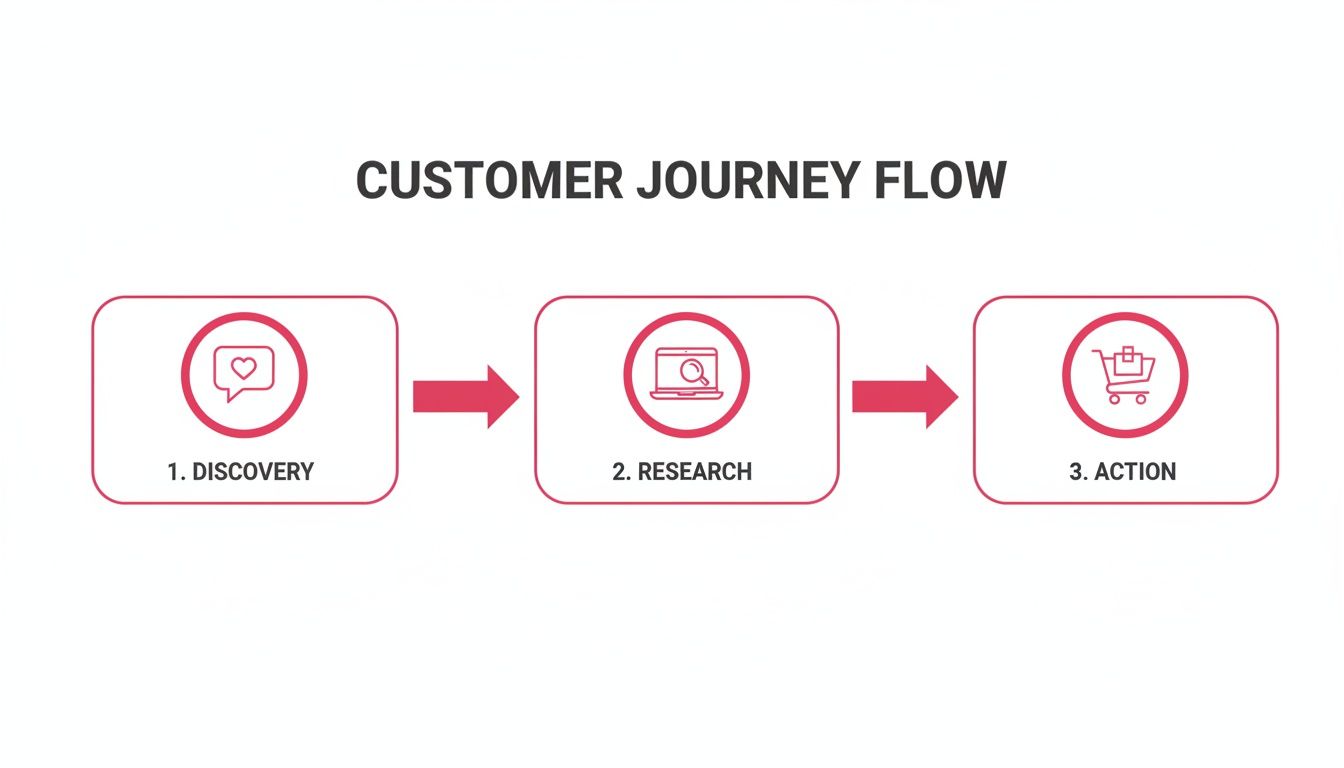
As you can see, the journey isn’t a straight line. It’s a process with distinct stages—Discovery, Research, and Action—and each one has its own set of touch points that need your attention. A customer’s experience is cumulative; it’s built from a chain of connected moments.
Once you have this map, the real work begins. Start looking for opportunities. Are there gaps in your communication? Are there high-friction moments that are causing people to give up and leave? Answering these questions is how you turn a simple map into a powerful plan for growth.
How to Prioritize Touch Points for Maximum Impact
Once you’ve got a complete map of all your customer interactions, the big question is: where do you start? Let’s be real, you can’t fix everything at once. Not all touchpoints are created equal. Some are minor bumps in the road, while others are make-or-break moments that decide whether you get the sale or lose a customer for good.
The trick is to find those high-stakes moments and pour your energy into them.
This brings us to what marketers call “moments of truth.” These are the critical interactions that have a massive impact on how a customer feels about your brand and what they decide to do next. For any e-commerce store, the cart abandonment touchpoint is the ultimate moment of truth. Someone liked your products enough to add them to their cart and start checking out, only to bail at the last second. That’s a massive opportunity staring you right in the face.
Using an Impact vs. Effort Framework
To take the guesswork out of this, a simple impact-versus-effort scoring system works wonders. This framework gets you out of your head and into the data, helping you decide where your resources will deliver the biggest bang for your buck. It’s a refreshingly simple way to rank every single touchpoint you’ve mapped out.
Here’s how you can do it:
- Score the Impact (1-10): How much does this touchpoint really affect your conversion rate, customer happiness, or brand perception? A clunky, confusing product page could easily score a 9. A random social media post? Maybe a 4.
- Score the Effort (1-10): How much time, money, and tech know-how will it take to improve this? Tweaking your SMS copy is a low-effort 2. A full-blown website redesign is a monster of a task, so that’s a 10.
- Calculate the Priority Score: The easiest way is to just divide Impact by Effort. The higher scores point you directly to your top priorities—the low-hanging fruit that will get you real results without burning through your budget.
This quick exercise will shine a spotlight on the touchpoints that give you the most leverage. You’ll probably discover that just a handful of interactions are causing most of your customer friction and costing you the most money.
Focusing on high-impact, low-effort touch points first creates immediate momentum and quick wins. For most online stores, cart recovery is the number one opportunity, offering the highest potential return for the least amount of setup effort.
Focus on What Truly Moves the Needle
By prioritizing this way, you can start making strategic improvements where they count the most. For example, you might realize that your post-purchase follow-up sequence (high impact, low effort) is a much bigger win than redesigning your blog (low impact, high effort).
When you focus on these high-impact areas, you’ll see a direct effect on the metrics that actually matter. You can learn more by checking out our guide on how to calculate customer lifetime value to see exactly how these small improvements connect to your long-term profitability.
Ultimately, this kind of strategic focus ensures you’re not just staying busy—you’re being productive. You’re putting your efforts into optimizations that directly boost conversions and build genuinely stronger relationships with your customers.
Using SMS to Optimize the Cart Abandonment Touch Point
Once you’ve mapped out your customer journey and started prioritizing, you’ll almost always find that cart abandonment screams for attention. It’s the most critical—and profitable—touch point to fix. This is that gut-wrenching moment when a customer who is this close to buying just… stops. Your job is to reel them back in with a timely, personal nudge, and SMS is hands-down the best tool for it.
With a staggering average open rate of 98%, text messages slice right through the clutter of a packed email inbox. They feel immediate and personal, and when you get them right, they work like a charm. The secret sauce is a combination of perfect timing and copy that makes it ridiculously easy for them to finish what they started.
Timing Your First Message Perfectly
That window of opportunity after someone ditches their cart closes faster than you think. Wait too long, and they’ve already moved on—either to a competitor or just on with their day. From what we’ve seen, the sweet spot for that first recovery text is between 30 and 60 minutes post-abandonment.
This timing is deliberate. It’s just long enough that you don’t come across as desperate or creepy, but short enough that the items they wanted are still fresh in their mind. A message at this point feels more like a helpful reminder than a hard sell.
Crafting Compelling and Frictionless SMS Copy
Great SMS copy is all about being short, clear, and giving the customer a direct line back to their cart. You want to create a little bit of urgency, but gently. This is where a tool like CartBoss really shines, offering pre-written and translated messages that are already proven to get results.
Here’s the anatomy of a recovery text that actually converts:
- A Gentle Nudge: Start by simply jogging their memory about the great stuff they left behind.
- A Clear Path Forward: Always, always include a direct link that takes them right back to their cart.
- Remove All Friction: This is the game-changer. Use a pre-filled checkout link. Instead of making them re-enter all their info, this link drops them right onto the payment page with everything already loaded.
- A Smart Incentive: Consider adding a dynamic discount that applies automatically when they click. It’s often the final push they need to hit “buy.”
By combining a pre-filled checkout with an automatically applied discount, you eliminate the two biggest sources of cart abandonment friction: thinking and effort. The customer doesn’t have to re-enter info or remember a coupon code; they just have to click and pay.
For example, a text could say: “Hey [Customer Name]! Looks like you left some great items in your cart at [Store Name]. Finish your order now and get 10% off automatically! [Pre-filled Checkout Link].” This frictionless approach is a massive reason why you should recover abandoned carts with text messages.
To give you a clearer picture, here’s a blueprint for a simple, automated SMS sequence you could set up.
SMS Cart Recovery Campaign Blueprint
This table outlines a typical two-message sequence designed to win back customers without being annoying.
| SMS # | Timing (Post-Abandonment) | Message Focus & Goal | Example Copy Snippet |
|---|---|---|---|
| 1 | 30-60 Minutes | Gentle Reminder. The goal is to simply jog their memory while the purchase is still fresh. No discount needed yet. | “Hi [Name]! Still thinking it over? Your items from [Store Name] are waiting for you. Complete your purchase here: [Link]” |
| 2 | 24 Hours | Incentive & Urgency. For those who didn’t convert on the first try, a small discount can create the urgency needed to close the deal. | “Hey [Name], good news! We’re holding your cart for you at [Store Name]. Complete your order in the next 24h and get 15% off at checkout: [Link]” |
This kind of multi-touch sequence covers your bases, first with a soft reminder and then with a more compelling offer for those who need an extra push.
Leveraging Automation for 24/7 Recovery
Manually sending these texts is impossible. The entire process can, and absolutely should, be automated. Automation and AI are changing how we manage these customer moments. In fact, projections show that by 2026, many B2B companies will use AI to eliminate 40% of human touchpoints in marketing and sales alone. For e-commerce stores, automated SMS campaigns are a prime example of this in action—working for you around the clock.
A system like CartBoss can detect an abandoned cart in real-time, wait for that perfect 30-60 minute window, and then fire off a personalized, translated message complete with a unique checkout link and discount. This means that whether a customer abandons their cart at 3 PM or 3 AM, you have an automated salesperson ready to win them back.
Creating a Consistent Experience Across All Channels
A perfectly timed SMS can work wonders, but its power is completely undermined if it leads to a disconnected experience.
Imagine sending a text offering a 15% discount, only for the customer to click through and find a banner on your site promoting just 10% off. That tiny inconsistency creates instant friction. It immediately breaks trust, and you can kiss that sale goodbye.
This is why consistency across all touch points with customers is non-negotiable. Your brand’s voice, visuals, and offers must feel like a single, unified conversation—whether a customer is reading an email, scrolling your Instagram, or getting a text from you. A seamless experience tells customers you’re reliable, and that’s the bedrock of long-term loyalty.

This isn’t just about good branding; it’s about meeting a fundamental customer expectation. Today, 79% of customers expect consistent interactions across every channel. Disconnected experiences are their single biggest source of frustration. When your SMS campaign feels like it’s from a different company than your website, you’re not just confusing people—you’re actively pushing them away.
Auditing Your Brand’s Consistency
To make sure every interaction strengthens your brand, you need to regularly audit your channels for consistency. It’s a simple check-up that prevents the kind of jarring experiences that cost you sales. Think of it as quality control for your customer’s journey.
A simple checklist is the best place to start. Run through it every quarter or before any major campaign launch to ensure everything is perfectly aligned.
- Tone of Voice: Does the language in your SMS messages—casual, urgent, formal—match your website copy and social media posts?
- Visual Identity: Are your brand colors, logos, and fonts consistent across your emails, website, and any images used in MMS messages?
- Promotional Offers: This one is huge. Are discounts and special offers identical everywhere? A mismatch between a text and a landing page is a guaranteed way to lose a sale.
- Customer Support: Is the help you offer via SMS chat in sync with the information in your on-site FAQ? The experience should feel the same no matter how they reach out.
A consistent brand experience isn’t about being repetitive; it’s about being reliable. When customers know what to expect from you at every touch point, they feel more confident in their decision to buy.
Maintaining a Cohesive Experience
Keeping everything in sync across multiple platforms can feel like a headache, but the right tools can automate a lot of the heavy lifting.
For example, using a platform like CartBoss ensures your SMS messages automatically pull product names, images, and prices directly from your store. This simple step eliminates the risk of manual errors and mismatched information.
Ultimately, a cohesive strategy turns individual touch points with customers into a powerful, interconnected system that guides people smoothly from one interaction to the next. For more on this, you might be interested in our deep dive into creating an omnichannel customer experience. Building this seamless journey is how you convert one-time buyers into loyal brand advocates.
How to Measure and Continuously Improve Your Strategy
Setting up your customer touchpoints isn’t a “set it and forget it” kind of deal. It’s a living, breathing part of your business that needs constant attention. Once your strategies are out in the wild—especially your SMS campaigns—you have to know what’s hitting the mark and what’s missing it completely.
This is where you turn raw data into real, actionable insights. Forget the vanity metrics. We’re talking about focusing on the numbers that directly impact your bottom line and keep your customers happy.
Key Metrics to Track for SMS Campaigns
When it comes to SMS cart recovery, a handful of core metrics tell you almost the entire story. These are the numbers you should be checking religiously to see how your campaigns are actually performing.
Here’s what I always keep my eye on:
-
Delivery Rate: This is basic but critical. It’s the percentage of texts that actually made it to your customers’ phones. If this number is low, you might have a problem with your contact list or even your SMS provider.
-
Click-Through Rate (CTR): This tells you what percentage of people clicked the link in your message. A healthy CTR is a great sign that your copy is grabbing their attention and the offer is on point.
-
Conversion Rate: This is the big one—the ultimate measure of success. It tracks how many of those clicks turned into a completed purchase.
-
Return on Ad Spend (ROAS): This is the clearest indicator of profitability. Platforms like CartBoss make this easy by showing you exactly how much money you’re making for every dollar you spend on texts.
Keeping a close watch on these figures lets you quickly diagnose what’s working. For instance, if you have a killer CTR but a low conversion rate, the problem probably isn’t your text message; it might be friction on your checkout page.
A Simple Framework for Continuous Improvement
To make sure your strategy gets better over time—not stale—you need a simple, repeatable process. This isn’t about guesswork; it’s about making smart, data-driven decisions.
The goal is to create a feedback loop where customer behavior directly informs your next move. This iterative process turns good campaigns into great ones.
Here’s a four-step cycle that works every time:
-
Measure: First, you need a starting point. Consistently track the key metrics we just covered. Use your dashboard to establish a baseline for your current performance.
-
Analyze: Now, dig into the data. Where are people dropping off? Are certain messages outperforming others? Look for patterns, both good and bad.
-
Optimize: Based on what you found, make one specific change. Try A/B testing your SMS copy. Maybe send a message 45 minutes after abandonment instead of 30. Or perhaps test a different discount offer. Only change one thing at a time!
-
Repeat: Measure the results of your change against your baseline. Did it work? Great, keep it. Did it flop? Ditch it and try something else. Then, start the cycle all over again.
This constant process of tweaking and testing is what empowers you to adapt to what your customers actually want, ensuring your touchpoints stay effective and profitable for the long haul.
Your Questions About Customer Touch Points, Answered
Even with the best strategy, you’re bound to run into questions once you start getting into the nitty-gritty of the customer journey. Let’s tackle some of the most common ones we hear about identifying, managing, and optimizing your touch points with customers.
What Exactly Is a Customer Touch Point?
Think of a customer touch point as any single interaction someone has with your brand. This isn’t just about when they’re clicking around on your website; it’s the entire experience, both the parts you control and the parts you don’t.
Direct interactions are pretty straightforward—things like a customer service chat or an SMS you send. Indirect interactions are wild cards, like a customer reading a third-party review or seeing an influencer unbox your product. Every single one of these moments shapes how they see your business.
How Many Touch Points Should a Business Have?
Honestly, there’s no magic number. The goal isn’t just to pile on more touch points for the sake of it. It’s to make sure every single one you already have delivers a positive, consistent, and genuinely helpful experience. A small, focused brand might have a few dozen, while a massive enterprise could have hundreds.
The real key is quality over quantity. A handful of highly-optimized, seamless touch points will always outperform hundreds of disconnected or frustrating ones. Nail the interactions you already have before you even think about adding more.
What Are the Most Important Customer Touch Points?
The most important touch points are the ones that have the biggest impact on a customer’s decision to buy and their overall happiness. These are often called “moments of truth” for a reason—they can make or break the entire relationship.
For any e-commerce business, a few moments are absolutely critical:
- The product page, which is where they decide if your offer is the real deal.
- The checkout process, where the smallest bit of friction can kill a sale instantly.
- Cart abandonment recovery messages, which are your last real shot to bring them back.
- Post-purchase communication, which is what separates a one-time buyer from a loyal fan.
If you focus your energy on perfecting these high-impact moments, you’ll always get the best return on your time and money.
Ready to turn your most critical touch point into a revenue machine? CartBoss makes it dead simple to recover abandoned carts with automated, high-converting SMS messages. See how much you can recover.