


So, what exactly is CCPA compliance? In simple terms, it’s about following the rules set by the California Consumer Privacy Act. This landmark law puts California residents back in the driver’s seat when it comes to their personal data.
For businesses, this means being upfront about the data you collect, making it easy for people to see or delete their information, and giving them a clear way to say “no” to their data being sold. It’s a fundamental shift, moving from a company-first approach to a consumer-first model for data privacy.
What CCPA Compliance Really Means for Your Business

Instead of seeing CCPA as another regulatory headache, think of it as a digital bill of rights for your customers. It’s a clear set of rules for how for-profit businesses need to handle the personal information of California residents.
And we’re not just talking about names and email addresses. The CCPA has a surprisingly broad definition of personal data. It covers everything from browsing history and geolocation data to even the “inferences” you draw from that data to build a customer profile.
The California Consumer Privacy Act (CCPA) first rolled out in 2018, but it got a major upgrade with the California Privacy Rights Act (CPRA) in 2023. These regulations give residents powerful control over their personal info and place serious responsibilities on any business that handles it.
Do These Rules Apply to You?
A common mistake is thinking the CCPA only matters if your business is physically based in California. That’s not the case at all. Its reach extends globally to any business that serves California residents and hits at least one of these three thresholds:
- Has an annual gross revenue over $25 million.
- Buys, sells, or shares the personal information of 100,000 or more California consumers or households annually.
- Makes 50% or more of its annual revenue from selling or sharing the personal information of Californians.
If your business ticks any of these boxes, CCPA compliance isn’t optional—it’s mandatory. This is especially true for e-commerce stores that use SMS marketing, since customer names and phone numbers are squarely in the “personal data” category. Getting a handle on personal text message privacy laws is a critical piece of the puzzle.
To make it even clearer, let’s run through a quick checklist.
Does CCPA Apply to Your Business? A Quick Checklist
Use this simple checklist to determine if you need to comply with CCPA based on the three main applicability thresholds.
| Applicability Threshold | Criteria Met (Yes/No) |
|---|---|
| Revenue: Does your business have an annual gross revenue of over $25 million? | |
| Data Volume: Do you buy, sell, or share the personal information of 100,000 or more California consumers or households per year? | |
| Business Model: Do you derive 50% or more of your annual revenue from selling or sharing the personal information of California residents? |
If you answered “Yes” to any of the above, it’s time to get serious about compliance.
The core principle is simple: if you profit from California consumers’ data, you must respect their privacy rights. This includes everything from cart recovery text messages to targeted advertising campaigns.
Getting compliant is more than just updating a privacy policy; it requires a real shift in mindset. You need to be transparent about how you use data, create straightforward ways for consumers to exercise their rights, and implement solid security to protect the information you hold. Failing to do so doesn’t just put you at risk of fines—it puts you at risk of losing customer trust, which is far more valuable in the long run.
Understanding the Core Consumer Rights Under CCPA
CCPA compliance isn’t just a list of rules for your business to follow; it’s about the very real powers it hands over to consumers. Think of these rights as a new toolkit California residents can use to manage their digital footprint. As a business, your job is to build the doors and windows that let them exercise this control, simply and transparently.
These rights fundamentally rewire the relationship between businesses and their customers, shifting the balance of power. The best way to get a handle on them is to walk through some real-world examples so you’re ready when the requests start rolling in.
The Right to Know and Access
Imagine a loyal customer who’s been buying from your online store for years. Under CCPA, that person can now ask you for a complete rundown of every piece of personal information you’ve ever collected on them.
And this isn’t some vague request. You have to be ready to show them:
- The specific pieces of information you have, from their name and email all the way to their browsing history on your site.
- The categories of sources where you got that data (e.g., directly from them, a data broker, etc.).
- Your business purpose for collecting it in the first place.
- A list of any third parties you’ve shared their data with.
This right is all about transparency. It forces businesses to pull back the curtain and show customers exactly what they know.
The Right to Know is a cornerstone of what is ccpa compliance, turning abstract data collection into a tangible record that consumers can actually review and question.
The Right to Delete
Let’s stick with that same customer. After looking at their data report, they might decide they’re not comfortable with you holding onto their information anymore. The Right to Delete gives them the power to ask for a complete wipe of their personal data from your records.
When you get a verifiable request to delete, you’re obligated to remove their personal info from your systems. You also have to tell any of your service providers who have the data to do the same. It’s essentially a digital “forget me” button.
More Key Consumer Powers
Beyond just knowing and deleting, the CCPA grants several other critical rights that have a direct impact on business operations, especially in marketing and e-commerce. These include:
- The Right to Opt-Out: Consumers can flat-out tell you not to sell or share their personal information. This is why you see that “Do Not Sell or Share My Personal Information” link popping up on so many websites.
- The Right to Correct: If a customer sees that the information you have on them is wrong, they have the right to ask you to fix it.
- The Right to Limit Use: This one applies to sensitive personal information, like precise geolocation or health data. Consumers can direct you to use this data only for providing the specific product or service they asked for.
For e-commerce stores, these rights have a massive impact on common activities like cart recovery. To get into the specifics, you can learn more about how CCPA impacts abandoned cart SMS strategies and make sure your marketing stays on the right side of the law.
Your Essential Business Obligations for CCPA Compliance
Knowing the consumer rights is one half of the puzzle. The other half is actually meeting your obligations as a business. Getting CCPA compliance right means making real, operational changes that show you’re serious about data privacy. This isn’t just a matter of tweaking a policy document; it’s about building a framework of transparency and accountability from the ground up.
First things first: you absolutely must create and maintain an up-to-date, easy-to-understand privacy policy. A huge part of CCPA is clearly explaining how your business collects, uses, and shares personal data. You can get a deeper understanding by learning about drafting comprehensive privacy policies to make sure you’re not missing any key disclosures.
This policy has to spell out the categories of personal information you collect, where you get it from, and the specific business reasons for collecting it. Think of it as your public promise to be transparent with your customers.
Creating Accessible Request Channels
But just having a policy tucked away on your site isn’t enough. You have to give consumers straightforward, accessible ways to actually use their rights. The CCPA is very clear on this: you need to offer at least two different methods for people to submit data requests.
These channels should be convenient and easy to find. Common options include:
- A dedicated web form on your website.
- A toll-free telephone number.
- A specific email address set up for privacy inquiries.
The whole point is to remove any friction. It should be dead simple for a customer to ask for their data or request to have it deleted. Your team also needs to be trained to spot these requests and handle them correctly within the required 45-day window.
The Do Not Sell or Share Mandate
One of the most visible parts of the CCPA is the requirement to honor opt-out requests. If your business “sells” or “shares” personal information—and this includes using it for cross-context behavioral advertising—you have to place a clear and obvious link on your website.
This link must be titled “Do Not Sell or Share My Personal Information” and take users directly to a page where they can easily opt out. This gives consumers a powerful, direct way to control how their data is used for ads and other commercial purposes.
Getting this right is especially critical for your marketing efforts. Properly managing consent and opt-outs is the bedrock of responsible marketing, and it’s vital to understand the full picture of SMS marketing compliance to stay out of trouble.
On top of that, the law adds extra protections for minors, requiring opt-in consent before selling the data of anyone under 16. This puts another layer of responsibility on businesses that might have younger people in their audience.
Your Step-by-Step CCPA Compliance Action Plan
Getting a handle on CCPA compliance can feel like a huge task, but when you break it down into a straightforward action plan, it becomes much more manageable. This isn’t just about dodging fines; it’s about building real trust with your customers by showing you respect their data.
Think of it like building a house. You wouldn’t put up walls without pouring a solid foundation first, right? For CCPA, that foundation is knowing exactly what data you have and where it is.
Conduct a Comprehensive Data Inventory
Your first, most critical step is to map your data. You can’t protect what you don’t know you have. This means digging in and identifying every single piece of personal information your business collects—from customer names and emails to website browsing history and IP addresses.
This audit needs to answer a few key questions:
- What specific data points are you collecting?
- Where is this data stored? Think CRMs, email platforms, analytics tools.
- Why are you collecting it? Is it for order fulfillment, marketing, or site personalization?
- Who do you share it with? This includes payment processors, advertising partners, and other third parties.
Getting this done gives you the clarity you need for everything that follows. It becomes the single source of truth for your entire privacy program.
Update Your Privacy Policy and Procedures
With your data map in hand, your next move is to tackle your privacy policy. This document needs to be transparent and easy to read. Most importantly, it has to spell out the consumer rights granted under CCPA. You need to clearly state what data you collect, why you collect it, and the types of third parties you share it with.
This is also when you need to add mandatory features to your website. CCPA requires a clear and obvious link on your homepage that reads “Do Not Sell or Share My Personal Information.” This link has to take users to a page where they can easily opt out of having their data sold or used for cross-context behavioral advertising.
This simple flowchart shows how the whole process fits together.
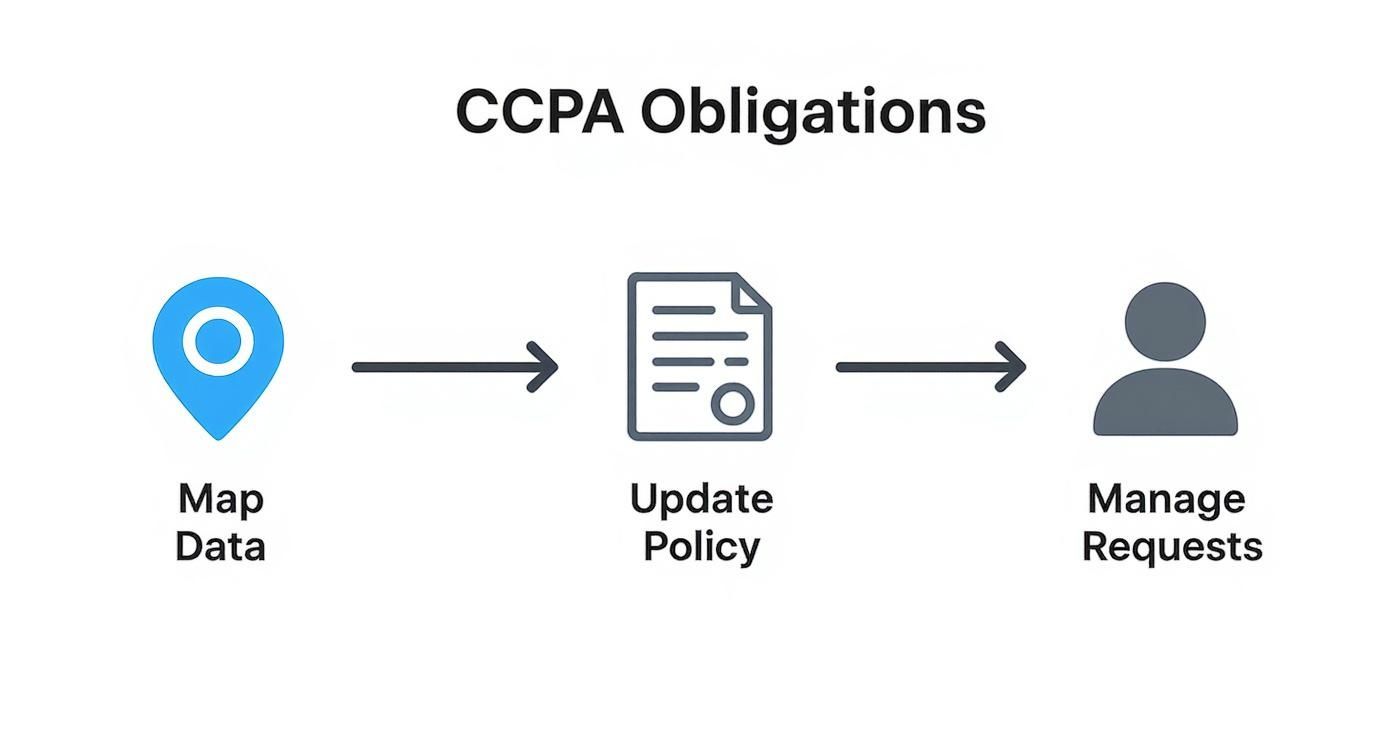
As you can see, mapping your data is the foundational step that informs both your public policies and your internal systems for handling requests.
Implement Consumer Request Workflows
A policy is just a piece of paper without a real process to back it up. You are legally required to give consumers at least two ways to submit data access or deletion requests, like a web form and a toll-free number.
You have 45 days to respond to a verifiable consumer request. A solid internal workflow is non-negotiable for tracking requests, verifying identities, and hitting that deadline every single time.
Your system needs to be reliable and efficient, ensuring every request is handled accurately. For businesses using different marketing channels, it’s crucial that these workflows are integrated. If you’re using text messaging, for example, your process has to line up with a broader SMS compliance checklist to keep things consistent across all customer touchpoints.
Finally, train your team. Everyone who handles customer data or communications needs to understand CCPA’s rules, know how to spot a consumer rights request, and follow the correct procedure for escalating it. Proper training is what turns your compliance plan from a document into a living, breathing practice.
CCPA vs GDPR: How Are They Different?
If your business is already GDPR-compliant, you’re off to a fantastic start, but don’t assume you’re automatically in the clear for CCPA. While both laws are all about data privacy, they have some key differences that really matter for your operations, especially if you’re selling to a global audience.
Think of them as two different rulebooks for the same game. A lot of the principles overlap, but the specific plays you need to run are distinct.
The biggest difference right out of the gate is their approach to consent. GDPR is famously opt-in, meaning you need clear, definite consent from a user before you can process their data for most marketing. CCPA, on the other hand, works on an opt-out model. You can generally process data until a consumer tells you to stop by using their “Right to Opt-Out of Sale/Sharing.”
Scope and Definitions
Another major difference is who each law protects. GDPR applies to any data subject from the European Union, no matter where they are in the world. CCPA is much more specific, protecting only residents of California. This geographical line directly impacts which set of rules you need to follow for different parts of your customer base.
The laws also define personal information differently:
- GDPR is focused on data that can identify a specific person.
- CCPA has a much broader scope, including data that can be linked to a household or even a device. This wider net pulls a lot more data types under its protection.
Looking at how companies handle these rules in the real world can make things clearer. For a solid example, you might find it helpful to review PledgeBox’s GDPR policy to see how they outline their responsibilities.
Enforcement and Penalties
The financial hit for getting it wrong also varies quite a bit. GDPR is known for its massive penalties, which can climb as high as €20 million or 4% of your global annual revenue—whichever is higher. That structure is designed to make even the biggest multinational companies pay attention.
CCPA’s fines are calculated differently, usually on a per-violation basis. Fines can go up to $2,500 for each unintentional violation and up to $7,500 for each intentional violation. While that might seem smaller at first, those numbers can multiply fast if you have a large-scale issue affecting thousands of consumers.
CCPA vs GDPR Key Differences at a Glance
To make it even clearer, let’s break down the core differences between these two landmark privacy laws. While they share the goal of protecting consumer data, their methods and scopes are unique. This table gives you a quick side-by-side comparison to help you pinpoint exactly what you need to focus on for each regulation.
| Feature | CCPA (California) | GDPR (European Union) |
|---|---|---|
| Primary Scope | California residents and households. | Data subjects of the European Union (EU), regardless of location. |
| Consent Model | Opt-out. Businesses can process data until a consumer opts out. | Opt-in. Requires explicit, affirmative consent before data is processed. |
| “Personal Data” Definition | Broader: Information linked to individuals, households, or devices. | Stricter: Information that can directly or indirectly identify an individual. |
| Consumer Rights | Right to know, delete, opt-out of sale/sharing, non-discrimination. | Right to access, rectification, erasure (“right to be forgotten”), data portability, object to processing. |
| Penalty Structure | Fines per violation: $2,500 (unintentional) to $7,500 (intentional). | Up to €20 million or 4% of global annual revenue, whichever is greater. |
| Data Breach Notification | Required when unencrypted personal information is compromised. | Mandatory notification to authorities within 72 hours of discovery. |
Understanding these distinctions is the first step toward building a robust, global compliance strategy. It’s not just about which law is “stricter” but about respecting the specific rights granted to consumers in each jurisdiction.
For businesses in cross-border e-commerce, it’s critical to get a handle on both frameworks. Our guide on ensuring GDPR compliance in e-commerce SMS marketing offers practical advice for navigating these international waters.
Ultimately, complying with both isn’t just about dodging fines—it’s about building a global reputation for truly respecting your customers’ privacy.
The Real Costs of CCPA Non-Compliance

Ignoring your duties under the CCPA isn’t just a compliance headache; it’s a massive financial risk. The penalties are designed to hit where it hurts—your bottom line—turning the abstract concept of data privacy into a very real business threat. If you’re serious about protecting your business, you need to understand exactly what’s at stake.
The California Privacy Protection Agency (CPPA) is the primary enforcer, and they have the authority to issue some hefty fines. An unintentional slip-up can cost you up to $2,500 per violation. But if they decide you broke the rules on purpose? That number skyrockets to a massive $7,500 per violation.
Understanding “Per-Violation” Fines
This is where it gets scary. “Per violation” doesn’t mean a single fine for one mistake. Imagine a broken opt-out link on your site. If 1,000 California users were affected, each one of them could be considered a separate violation. You can see how the penalties multiply at an alarming rate.
This structure means that even a seemingly minor oversight can snowball into a crippling financial penalty. Being proactive about compliance is always cheaper than dealing with an enforcement action after the fact.
Recent actions from the CPPA prove they aren’t messing around. Fines have ranged anywhere from $85,000 to $1.55 million for things like unclear privacy notices and faulty opt-out processes. You can explore a retrospective on state data privacy laws to see just how seriously regulators are taking this.
On top of the regulatory fines, the CCPA gives consumers a private right of action if a data breach happens. This means people can sue your business directly for statutory damages.
If unencrypted personal data gets stolen because your security wasn’t up to snuff, you could be staring down the barrel of a class-action lawsuit. Consumers can demand damages between $100 and $750 per consumer, per incident—or their actual damages, whichever is higher. For a breach that hits thousands of people, the total cost could easily sink a business. It’s clear proof that solid data security is a non-negotiable part of CCPA compliance.
CCPA Compliance: Your Questions Answered
When you’re trying to get a handle on the CCPA, a lot of specific, practical questions pop up. Getting clear, straightforward answers is the only way to build a compliance strategy that actually works. Let’s tackle some of the most common questions businesses have when they start digging into the CCPA.
Think of this as the no-nonsense guide to cut through the legal jargon and give you information you can actually use.
Does CCPA Apply to Businesses Outside of California?
Yes, absolutely. This is one of the biggest misconceptions out there. People assume that if they don’t have an office or warehouse in California, they’re off the hook. That’s not how it works.
The law follows the consumer, not the company. If you process the personal data of people who live in California—and you meet one of the three main thresholds—you have to comply. It doesn’t matter if your headquarters are in New York, London, or Tokyo.
The bottom line is simple: if you have customers in California and you meet the revenue or data processing criteria, CCPA compliance is your job.
What Is the Difference Between Selling and Sharing Data?
This is a really important distinction, and getting it right is key to understanding your obligations. Under the CCPA, “selling” data means disclosing personal info to someone else for money or other valuable consideration. That last part is broad and goes way beyond just a simple cash transaction.
The term “sharing,” which was added by the CPRA, is more specific. It’s all about disclosing personal information for the purpose of cross-context behavioral advertising—basically, tracking users across different websites to show them targeted ads. This applies whether or not money is exchanged.
Consumers have the right to opt out of both, so you need a clear handle on how you’re managing each activity.
How Long Do We Have to Respond to a Data Request?
Once you get a verifiable request from a consumer to see or delete their data, the clock starts ticking. You have 45 days to give them a real, substantive response.
You can get a one-time extension for another 45 days if it’s truly necessary, but there’s a catch. You have to tell the consumer you’re taking the extension within the first 45-day window and explain why you need the extra time. This tight deadline makes having a slick internal process absolutely essential.
Ready to turn abandoned carts into revenue while staying fully compliant? CartBoss makes it easy. Our automated SMS cart recovery tool is built with GDPR and CCPA compliance in mind, helping you win back customers effortlessly. Start converting lost sales today at https://www.cartboss.io.
