



So, what exactly is customer journey analytics? Think of it as connecting the dots. It’s the practice of tracking and piecing together every single interaction a customer has with your brand—across every channel, over time—to tell a single, coherent story.
We’re talking about everything from a social media ad click and a website visit to a support call. Customer journey analytics takes all these scattered data points and weaves them together.
Your Customer’s Path Is No Longer a Straight Line

Remember the old sales funnel? Nice, neat, and linear. Well, you can pretty much toss that idea out the window. The modern customer journey looks more like a tangled web than a straight line.
A potential buyer might see your ad on Instagram while scrolling in the morning, browse your site on their laptop during their lunch break, ask your chatbot a question on their phone that evening, and then pop into your physical store on the weekend to finally make the purchase. Each of these actions is a separate piece of a much larger puzzle.
Connecting the Dots Across Channels
Without a way to link all these interactions, you’re left with a hopelessly fragmented picture. You might see that someone clicked an ad and that someone else made a purchase in-store, but you’d have no idea it was the exact same person. This is where customer journey analytics comes in to save the day.
It gathers all those scattered puzzle pieces from different rooms and snaps them together, finally revealing the complete picture of that person’s experience.
This unified view is absolutely critical for creating a seamless omnichannel customer experience, where every touchpoint feels connected and consistent. By truly understanding the entire journey, you can pinpoint:
- The key touchpoints that actually influence buying decisions.
- Painful friction points where customers get stuck or give up.
- The most successful paths that consistently lead to conversion and loyalty.
Instead of just looking at isolated events, customer journey analytics helps you see the cause-and-effect relationship between every touchpoint. It uncovers the why behind what your customers do, not just the what.
Ultimately, this whole discipline is about turning a mountain of raw data into insights you can actually use. It makes having a complete, 360-degree view of your customer not just a nice-to-have, but a fundamental part of doing business well.
What Is Customer Journey Analytics, Anyway?
Let’s get straight to it. Customer journey analytics is all about connecting the dots. Think of every single interaction a customer has with your brand—every click, call, purchase, or social media comment—and stringing them all together to see the full picture. It’s about moving past isolated data points to tell the complete story of a customer’s relationship with you.
Imagine you’re a detective. Traditional analytics is like finding a single clue in one room, say a footprint on the website. Customer journey analytics is what lets you follow that trail of footprints from the website to the mobile app, then to a support ticket, and finally to an in-store purchase. You see the entire path, not just one isolated event.
It’s More Than Just a Map
It’s easy to mix this up with customer journey mapping, but they play very different roles. A journey map is your ideal plan—it’s the treasure map you draw showing the perfect path you want customers to take.
Analytics is the real-time GPS tracking every single person, showing the messy, unpredictable routes they actually take to find that treasure. It brings your map to life with cold, hard data.
Suddenly, you can answer the questions that really matter:
- Where are people really getting stuck or confused?
- Which paths are my most valuable customers taking?
- Why are they ignoring my beautifully designed “ideal” path?
This is where you stop guessing and start knowing. You finally get to the why behind their actions, not just the what.
Uncovering the “Why” Behind the “What”
At its heart, customer journey analytics is a supercharged form of behavioral analysis. It works by stitching together data from your website, app, CRM, support desk, and even physical stores to reveal the hidden patterns in how people behave. If you want to dive deeper into the basics, check out our guide on what behavioral analytics is all about.
This unified view is incredibly powerful because it shows you how an action in one place causes a reaction somewhere else.
For example, you might discover that customers who watch a specific demo video on your website are 40% more likely to buy from you within the next 24 hours—even if they complete that purchase on your mobile app.
You’d never spot that connection if your website data and app data were stuck in separate silos. By bringing it all together, customer journey analytics reveals the real motivations and friction points that drive your business.
Before we go further, it’s helpful to see just how different this approach is. Here’s a quick breakdown:
Traditional Analytics vs. Customer Journey Analytics
The old way of looking at data focused on individual channels. You’d have your website analytics, your email stats, your social media numbers—all telling separate stories. Customer journey analytics tears down those walls to tell one unified story.
| Attribute | Traditional Analytics | Customer Journey Analytics |
|---|---|---|
| Scope | Channel-specific (e.g., website, email) | Cross-channel and cross-device |
| Focus | Isolated events (e.g., clicks, opens) | The entire sequence of events over time |
| Questions Answered | “What happened on this channel?” | “How did one channel impact another?” |
| Timeframe | Session-based or short-term | Long-term customer lifecycle |
| Business Outcome | Optimizing a single channel | Optimizing the entire customer experience |
As you can see, the shift is from looking at snapshots to watching the entire movie of your customer’s experience. This holistic view is what unlocks deeper insights and allows for more meaningful improvements.
The Three Pillars of Effective Journey Analytics
Getting customer journey analytics right isn’t a one-and-done task. It’s more like a three-legged stool—if you take away any leg, the whole thing topples over. These three core components work together, turning raw customer data into smart, profitable actions.
1. Data Unification
The first and most critical pillar is Data Unification. Think about all the places your customer data lives right now: your CRM, web analytics, support tickets, social media mentions. They’re all separate silos. Unification is the process of breaking down those walls and bringing all that information into one central place.
Without this, you’re flying blind. Imagine your marketing team sending a cheerful “buy now!” email to a customer who just spent an hour on a frustrating support chat. It’s a terrible experience. Bringing all your data together creates a single, coherent picture of each customer, preventing these kindsal of disjointed interactions.
This infographic gives a good visual of how journey analytics connects the dots.
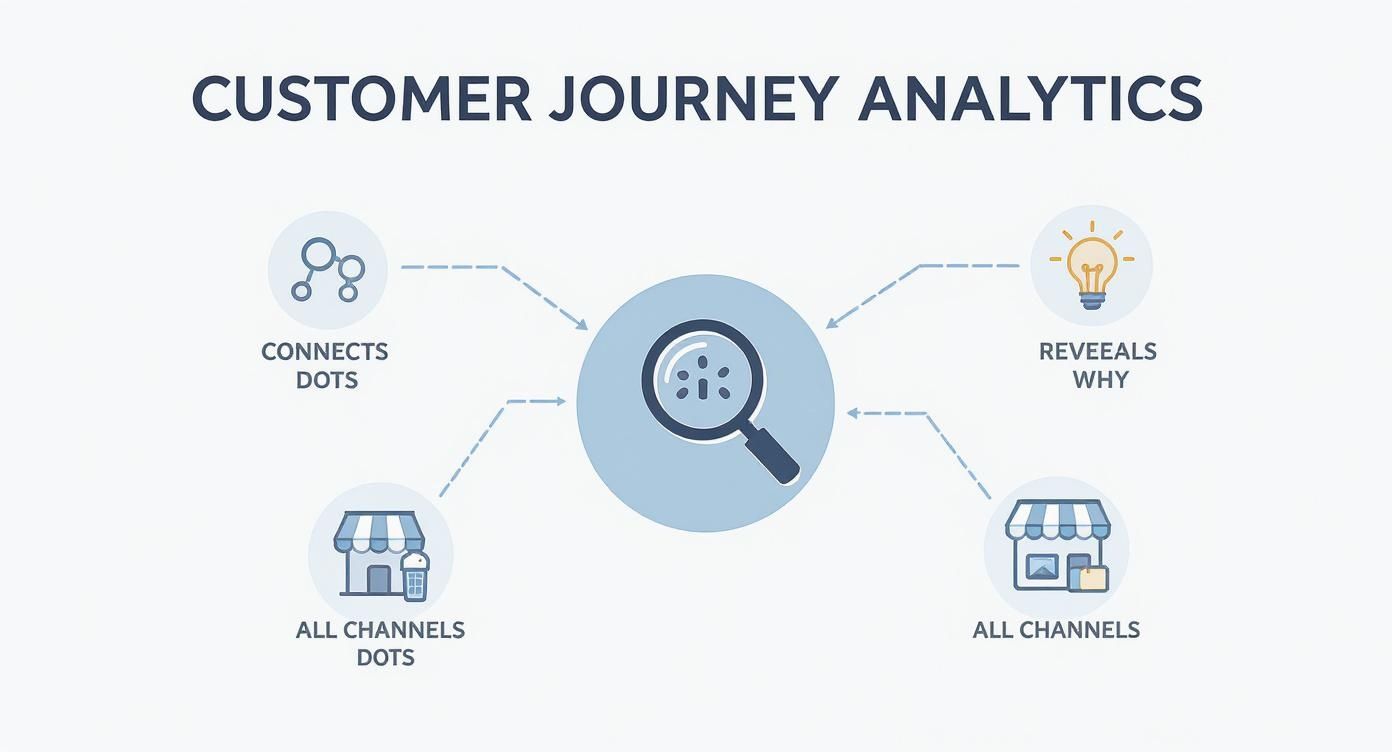
As you can see, it’s all about linking interactions across every channel to finally understand the “why” behind what your customers do.
2. Advanced Analytics and AI
Once your data is in one place, the second pillar comes into play: Advanced Analytics and AI. This is where you graduate from basic reports to something much more powerful. Using machine learning, you can start to uncover hidden patterns, predict what customers will do next, and pinpoint what truly drives your business.
AI can, for example, identify the specific sequence of actions that most often leads to a purchase. On the flip side, it can flag behaviors that signal a customer is about to churn. The tech behind this has come a long way, and today, cloud computing is essential for handling the sheer volume of data pouring in from web, mobile, and even in-person channels. You can learn more about the market’s shift toward cloud solutions and why it’s happening.
3. Cross-Channel Orchestration
The final pillar, Cross-Channel Orchestration, is where all that insight turns into action. It’s about using what you’ve learned from your data to deliver consistent, personal, and perfectly timed experiences at every single touchpoint.
For instance, when you know a customer just abandoned a cart with a specific pair of shoes, orchestration lets you automatically send a relevant SMS reminder—not just another generic marketing email.
This is how you actively shape the customer journey in real-time. Nailing this final piece is the key to boosting important customer engagement metrics and building the kind of loyalty that lasts.
Why Journey Analytics Is a Business Game Changer
Figuring out the customer journey isn’t just a box-ticking exercise; it’s your direct line to fixing some of the most expensive headaches your business faces. Instead of just reacting when customers leave, journey analytics lets you see the warning signs long before they decide to walk away.
By stitching together data from all your different channels, you can pinpoint the exact moments of frustration. Did a customer have a terrible support experience right after their mobile app crashed? Analytics connects those dots for you. This lets you step in and fix the real problem, not just the symptom.
From Guesswork to Growth
This proactive approach completely changes how you operate. You can finally stop throwing money at broad, hope-for-the-best marketing campaigns and start having targeted, personal interactions that actually land. This is exactly why effective customer journey management has become so essential.
It gives you the power to:
- Boost Customer Lifetime Value (CLV) by figuring out what your best customers do and then encouraging those same behaviors in others.
- Deliver True Personalization because you understand the full story of their interactions, not just the last thing they clicked.
- Optimize the Entire Experience to build the kind of deep, lasting loyalty that turns customers into your biggest fans.
The core benefit is simple but incredibly powerful: You stop guessing what customers want and start knowing what they need based on how they actually behave. This shift turns your entire strategy from reactive to predictive.
The market is taking notice, too. The global customer journey analytics market has already ballooned to a value of around $15.0 billion. It’s projected to climb to almost $18 billion, growing at a rate of about 14.8% each year, cementing its place as a must-have business practice. You can find more details about this market growth on superagi.com.
How Businesses Use Journey Analytics to Win

The theory is nice, but seeing how customer journey analytics actually works in the real world makes its value click. Businesses everywhere are using these insights not just to tweak things, but to solve specific, expensive problems and get a real leg up on the competition. It’s all about turning messy data into clear, decisive action.
Think about a major retail brand. They can track the entire path from a customer seeing a social media ad all the way to picking up their order in-store. By looking at this journey, they might discover that 30% of customers bail after hitting a clunky online reservation page. Boom—that’s an immediate signal to redesign the user experience.
Or take a financial services firm. Their new account opening process is long and complicated. Journey analytics can show them exactly where people get stuck, frustrated, and ultimately abandon the application. This allows the firm to simplify the right steps, smooth out the friction, and get more people to the finish line.
Pinpointing Problems and Opportunities
The applications go way beyond simple marketing metrics. The real goal is to solve genuine business challenges by digging deep into how customers actually behave. This lets companies get ahead of problems before they start losing customers.
Here are a few common ways businesses are putting these insights to work:
- Reducing Customer Churn: By spotting patterns that signal a customer might be about to leave—like using the product less or sending in multiple support tickets—companies can jump in proactively with a special offer or extra help.
- Improving Onboarding: Analytics can shine a light on where new users are struggling. That allows businesses to create better tutorials or in-app guides to make sure everyone has a great first experience.
- Optimizing Marketing Spend: Instead of throwing money at different channels and hoping for the best, companies can finally see which touchpoints actually lead to sales. This means they can shift their budget to what’s truly working.
Mapping these paths gives businesses a clear roadmap for what to fix next. If you’re looking for some practical first steps, our guide to eCommerce customer journey mapping is a fantastic place to start. And to make sure it’s all working, you’ll need to understand key performance indicators for your loyalty initiatives to connect your analytics back to real results.
Common Questions About Customer Journey Analytics
Digging into customer journey analytics brings up a handful of recurring questions. Clear, practical answers help you feel confident before diving in. Let’s walk through the big ones together.
How Is It Different From Google Analytics
People often lump customer journey analytics and Google Analytics into the same bucket—but they’re really built for different stories.
- Google Analytics tracks behavior in one place (your website or app) and nails down how visitors click, scroll, and convert there.
- Customer journey analytics connects all touchpoints—online and offline—so you see how an email opens leads to a call-center interaction, which then sparks an in-app purchase.
Customer journey analytics maps the full, chronological experience, not just a single chapter.
What Is The First Step To Getting Started
Before you even pick a platform, define a clear business objective. Data alone won’t tell you what to do next.
Are you aiming to:
- Reduce customer churn by 10% over the next quarter?
- Streamline your new-user onboarding flow?
- Boost repeat purchase rates?
Once you’ve nailed down that goal, choose one high-impact journey to analyze first. Sketch out its key touchpoints. Figure out which data sources you need. Starting small keeps things manageable and delivers quick wins.
Focus on a single pain point—like cart abandonment—and map only the related touchpoints. It prevents overwhelm on day one.
What Are The Main Implementation Challenges
Most companies hit two big roadblocks when rolling out journey analytics:
- Data Integration
Pulling info from your CRM, marketing automation tool, e-commerce backend, call-center logs and more is no small feat. Every system speaks its own “language,” so you need a plan to unify formats and schemas. - Organizational Silos
Marketing, sales, and support teams often guard their data like treasure. Breaking down those barriers takes strong executive sponsorship and a genuine shift toward customer-centric decision-making.
Stop losing sales to abandoned carts. With CartBoss, you can automatically recover lost revenue using targeted SMS campaigns that bring customers back. Turn your abandoned carts into profit today!