


Return on investment (ROI) is one of the most fundamental metrics in business, but what does it actually mean?
Put simply, ROI tells you how much money you made compared to how much you spent on any given venture. It boils down all the complexity into a single percentage, answering the ultimate question: “Was this worth it?”
Understanding The Core Of ROI

Think of it like planting a money tree. The “investment” is everything you put in—the seeds, the pot, the soil, the water. The “return” is the cash you harvest from its branches. ROI is the simple calculation that shows you just how fruitful your efforts were.
This metric cuts through the noise to give you a clear score on performance. Its real power is its versatility; you can use it to compare completely different types of opportunities on a level playing field. For instance, you could weigh the ROI from a new marketing campaign against the ROI of upgrading your company’s software.
Before we get into the math, let’s break down the two key pieces of the ROI puzzle. It all comes down to what you put in and what you get out.
The Core Components of ROI
A quick look at the two essential elements you need to understand and calculate Return on Investment.
| Component | What It Really Means | Simple Analogy |
|---|---|---|
| Investment | This is the total cost to get something off the ground. It’s not just the sticker price; it includes all associated expenses like labor, materials, and marketing spend. | The price of the ingredients you buy to bake a cake. |
| Return (or Net Profit) | This is the pure profit generated after subtracting all your costs from the revenue. It’s the money you actually get to keep. | The money you have left over after selling the cake and paying for the ingredients. |
Understanding these two elements is the foundation of mastering ROI. Once you have a firm grip on your true costs and your actual profit, the rest is just simple math.
Why This Metric Matters
So, why do we obsess over this number? Because it provides a standardized, objective way to judge financial outcomes. A positive ROI means your venture was profitable. A negative ROI, on the other hand, signals a loss.
This straightforward calculation empowers you to:
- Evaluate past decisions to see what worked and what didn’t.
- Compare potential opportunities on an equal footing.
- Justify spending on new projects, equipment, or marketing campaigns.
While it’s a powerful, high-level metric, it’s important not to confuse it with more specialized calculations. For example, in the marketing world, it’s often compared to another key metric. You can dive deeper into this in our guide explaining what ROAS is in marketing.
Ultimately, ROI is about turning a gut feeling about an investment’s success into a concrete, data-backed conclusion.
The Simple Formula To Calculate ROI
You don’t need a finance degree to figure out what is return on investment. The formula itself is straightforward once you get the hang of its two main parts. It’s a beautifully simple way to cut through the noise and see if something was actually worth the effort.
The standard equation looks like this:
ROI (%) = (Net Profit / Cost of Investment) x 100
Let’s pull that apart so you know exactly what you’re looking at and can use it with confidence.
Breaking Down The Equation
Before you can plug in any numbers, you need to find the two key pieces of the puzzle.
- Cost of Investment: This is the total cash you put into the project. It’s not just the sticker price; it includes all the associated expenses. Think materials, labor, marketing spend, or any other fees. It’s literally every single penny that went out the door to get the thing going.
- Net Profit: This is what’s left after you’ve paid back your initial investment. To get this number, just take your total revenue (the money you brought in) and subtract that Cost of Investment. The number you’re left with is your pure profit.
Why multiply by 100? That just turns the final number into a percentage, making it much easier to compare different investments side-by-side.
A Practical Example Step By Step
Let’s make this real. Imagine you find an old wooden chair at a flea market for $50.
You then spend another $30 on supplies—paint, sandpaper, and some new fabric. That brings your total Cost of Investment to $80 ($50 + $30).
After putting in the work, you sell the refurbished chair online for $200.
- Calculate Net Profit: $200 (Final Value) – $80 (Cost of Investment) = $120 Net Profit.
- Divide Net Profit by Cost: $120 / $80 = 1.5.
- Convert to a Percentage: 1.5 x 100 = 150% ROI.
That 150% ROI tells you that you not only made your money back but also earned an extra 150% on top. For marketers, learning how to calculate marketing ROI applies this very same logic to things like ad campaigns. Once you’ve nailed this basic formula, applying it to specific areas like learning how to measure SEO ROI effectively is just a matter of correctly tracking your costs and revenue.
How ROI Works In The Real World
Theory is great, but seeing ROI in action is where it all clicks. This simple metric is incredibly versatile, helping you make sense of everything from your personal stock portfolio to a multi-million dollar business decision. Let’s walk through a few different scenarios to see how the same basic formula brings clarity to wildly different situations.
First up, a classic example: the stock market. Imagine you buy 10 shares of a company at $100 a pop. That’s a $1,000 investment. Fast forward a year, the stock is now trading at $125 per share. You sell, pocketing $1,250. Your net profit is that $250 difference, which gives you a clean 25% ROI.
Of course, that’s a simplified case. If you look at the big picture, the S&P 500 index has historically returned about 10% annually since 1926, though that number hides a lot of ups and downs from year to year. Knowing these long-term trends helps keep expectations in check. You can dig into the historical data yourself over at NYU’s Stern School of Business.
Applying ROI To Business Ventures
This same logic applies perfectly to business moves. Take real estate, for instance. You buy a small property for $200,000, planning to flip it. You then sink another $40,000 into renovations, bringing your total cost to $240,000. After a few months of hard work, you sell it for $330,000. Your net profit is $90,000, giving you a very healthy 37.5% ROI.
It works just as well for marketing. Let’s say a small eCommerce shop spends $5,000 on a new digital ad campaign. If that campaign brings in $25,000 in fresh sales, the net profit is $20,000.
The resulting 400% ROI ($20,000 / $5,000) is a massive green light, showing that every dollar spent on ads brought back four dollars in profit.
This calculation is absolutely essential for marketers who need to justify their budgets and prove their strategies are working. For a more granular look at ad performance, you can use our Return on Ad Spend calculator to drill down into specific campaigns.
This infographic really simplifies how the formula flows.
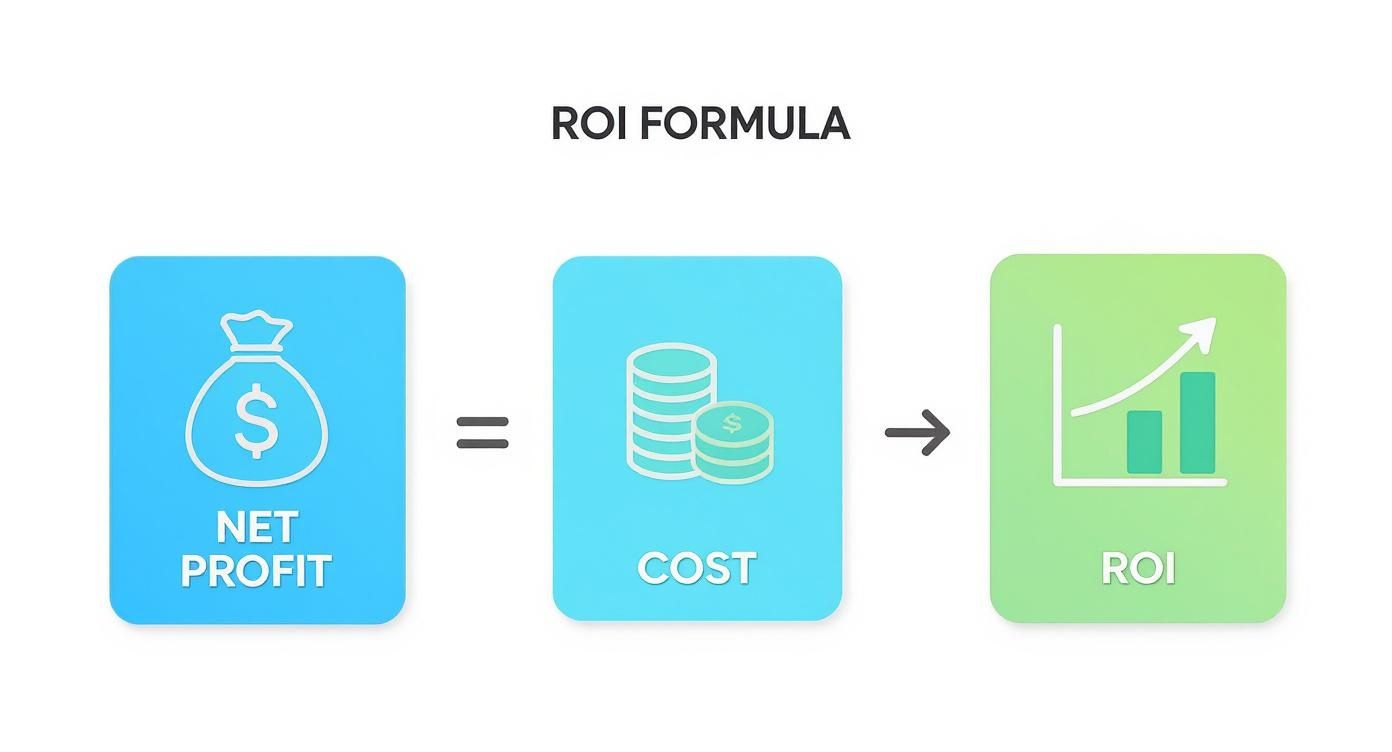
As you can see, it’s a straightforward two-step dance: figure out your net profit, then see how it stacks up against what you originally spent. Whether you’re evaluating stocks, property, or a new marketing push, the core idea is the same. That’s what makes ROI such a universally powerful measure of success.
Why Calculating ROI Is A Smart Move
Figuring out your return on investment isn’t just a backward glance at what you’ve done. It’s actually one of the sharpest tools you have for making better decisions down the road. ROI cuts through the noise and gut feelings about what feels successful, giving you cold, hard numbers.
This simple percentage lets you compare completely different opportunities on a level playing field.
For example, an investor can use ROI to decide whether to sink money into a hot tech stock or buy a rental property. The math makes it clear which option stretches each dollar further.
The same goes for any business trying to navigate strategic choices. Is that fancy new project management software a better investment than hiring a freelance consultant for a few months? Calculating the potential ROI for each path takes the guesswork out of the equation and gives you a data-driven answer.
A Story Of Strategic Growth
Let’s look at a small eCommerce owner, Maria. She has a tight marketing budget and decides to run a one-month test on two different channels: social media ads and an influencer collaboration.
- Social Media Ads: She puts in $1,000 and generates $3,000 in sales. That’s a 200% ROI.
- Influencer Collaboration: She pays an influencer $1,500, which pulls in $7,500 in new sales, giving her a 400% ROI.
Suddenly, her next move is crystal clear. The influencer partnership delivered double the return for every dollar she spent. She knows exactly where her marketing budget needs to go next.
This kind of insight is the bedrock of sustainable growth, especially when every dollar counts. It’s a fundamental part of smart digital marketing budget allocation.
By consistently calculating ROI, businesses and individuals can systematically identify what works, cut what doesn’t, and direct their resources toward the most profitable ventures, ensuring better outcomes over time.
Understanding The Limits Of ROI

While ROI is a powerhouse metric for gauging profitability, it doesn’t give you the full story. It’s a fantastic tool, but to use it wisely, you have to know where it falls short. A sky-high ROI can look amazing on paper, but it can be seriously misleading if you don’t dig into the context.
For starters, the standard ROI formula has one massive blind spot: time. It tells you what you earned, but not how long it took. A 15% ROI that you nail in just six months is way more impressive than the exact same 15% return that took five long years to achieve.
Beyond The Bottom Line
ROI is also completely silent on risk. A new venture might promise an eye-watering return, but it could also come with an enormous chance of failure. The simple percentage doesn’t capture this critical risk-reward balance, which is why you always have to evaluate risk on its own terms.
On top of that, not everything that matters can be measured in dollars. A marketing campaign might crush its ROI goals, but it could also be building priceless brand loyalty and customer trust—things the formula simply can’t quantify. Figuring out all the moving parts of a successful campaign is a core part of what marketing attribution is.
Think of ROI as a single instrument in an orchestra. It plays a vital part, but you need the whole ensemble of metrics to get the full picture and make truly informed decisions.
This is especially true when you’re looking at global markets. Take the MSCI EAFE Index, a major benchmark for international stocks. It saw a massive 22.66% return in 2019, only to plummet by -24.36% in 2022. These wild swings show how things like regional economic factors introduce risks and opportunities that a simple ROI figure just can’t capture on its own.
Common ROI Questions Answered
Even after you get the hang of what return on investment is, a few questions always seem to pop up. We’ll tackle the most common ones here to clear up any confusion and sharpen your understanding of this vital metric. Let’s get into it.
What Is Considered a Good ROI
There’s no magic number here. A “good” ROI is completely dependent on the context of the investment.
An annual return of 8% might be fantastic for a stable, low-risk stock portfolio. But if you’re talking about a high-risk tech startup, investors are going to be looking for a much, much higher return to make the gamble worth their while. The best approach is to benchmark against industry averages for that specific type of investment and always balance potential returns with the risk involved.
Can ROI Be Negative
Absolutely. A negative ROI just means you lost money. It happens when your final earnings are lower than your initial costs.
For instance, if you buy an asset for $1,000 and have to sell it later for $800, your ROI is -20%. Nobody wants to see that, but a negative ROI isn’t useless—it’s valuable feedback. It tells you exactly what isn’t working so you can make smarter choices next time.
How Does ROI Differ From Other Metrics
Think of ROI as your go-to tool for measuring the profitability of one specific investment, whether that’s a new piece of equipment or a single ad campaign. Other metrics, like Return on Equity (ROE) or Return on Assets (ROA), are more specialized. They’re accounting ratios used to get a picture of a company’s overall financial health.
ROE tells you how well a company is generating profit from its shareholders’ investments. ROA, on the other hand, shows how efficiently the company is using all its assets to create profit. They measure the health of the whole business, not just one project.
For anyone in marketing, it’s also worth exploring the distinction between ROI and ROAS. Each metric tells a different piece of the financial story, and knowing which one to use in the right situation is key.
At CartBoss, we help e-commerce stores turn insights into profit. Our automated SMS cart recovery tool is designed to maximize your marketing ROI by winning back lost customers effortlessly. See how it works at https://www.cartboss.io.