


Think of express checkout as the E-ZPass lane for online shopping. Instead of getting stuck in the slow lane, manually digging out your credit card and typing in your address for every single purchase, it lets you fly through.
With just a single click, your customers can use securely stored info from digital wallets like Apple Pay or Google Pay to complete their order. It’s that simple.
The Power of a Frictionless Checkout
Picture this: a customer loves your products, fills their cart, and heads to the checkout, ready to buy. But then they hit a wall. They’re forced to create an account, then painstakingly type in their name, address, and credit card details. This hassle is a huge reason why so many shoppers just give up right at the finish line.
Express checkout demolishes these barriers. It acts as a secure bridge, instantly pulling all the necessary details from trusted sources your customer already uses. What was a multi-step chore becomes a single, satisfying click of a “Buy Now” button.
Key Benefits for Your Store
By making that final step incredibly simple, you’re not just offering convenience; you’re directly improving your store’s performance. The advantages are crystal clear:
- Higher Conversion Rates: Fewer steps mean fewer chances for customers to get frustrated and bail on their purchase.
- Improved Customer Experience: A fast, painless process is something people remember. It builds loyalty and encourages them to come back.
- Enhanced Mobile Shopping: This is a game-changer for mobile users. No one likes typing their full address on a tiny screen. Our guide on what is mobile commerce dives deeper into this connection.
It’s all about creating the smoothest possible path from cart to confirmation. The data doesn’t lie: online stores offering four express checkout options see a 67% conversion rate. That’s a massive jump compared to the 52% rate for stores with no express options at all.
To really see the difference, let’s break down the two experiences side-by-side.
Standard Checkout vs Express Checkout At a Glance
The table below gives you a quick snapshot of just how much friction express checkout removes from the buying process. It’s the difference between a quick tap and a tedious task.
| Feature | Standard Checkout | Express Checkout |
|---|---|---|
| Number of Steps | Multiple (5-7 on average) | One or two clicks |
| Time to Complete | 1-3 minutes | Under 30 seconds |
| Customer Effort | High (manual data entry) | Minimal (authentication) |
| Account Creation | Often required | Not necessary |
| Device Friendliness | Can be clumsy on mobile | Optimized for all devices |
Looking at it this way, it’s easy to see why customers increasingly prefer—and even expect—an express option. It respects their time and gets them what they want, faster.
How Does One-Click Purchasing Actually Work?
When a customer clicks a button like “Pay with PayPal” or “Buy with Apple Pay,” a super-fast and secure process called tokenization springs into action. Your store never actually touches the customer’s raw credit card information. Instead, it gets an encrypted token—think of it as a unique digital stand-in for their payment details.
This token is sent from the digital wallet provider (like Google or Shop Pay) straight to your payment processor. At the same time, the customer’s saved shipping address is securely passed along to pre-fill all those tedious checkout fields. The whole thing happens in seconds, turning what used to be a chore into a simple, quick confirmation.
This graphic really drives home the difference between a clunky, traditional checkout and the sleek flow of an express checkout.
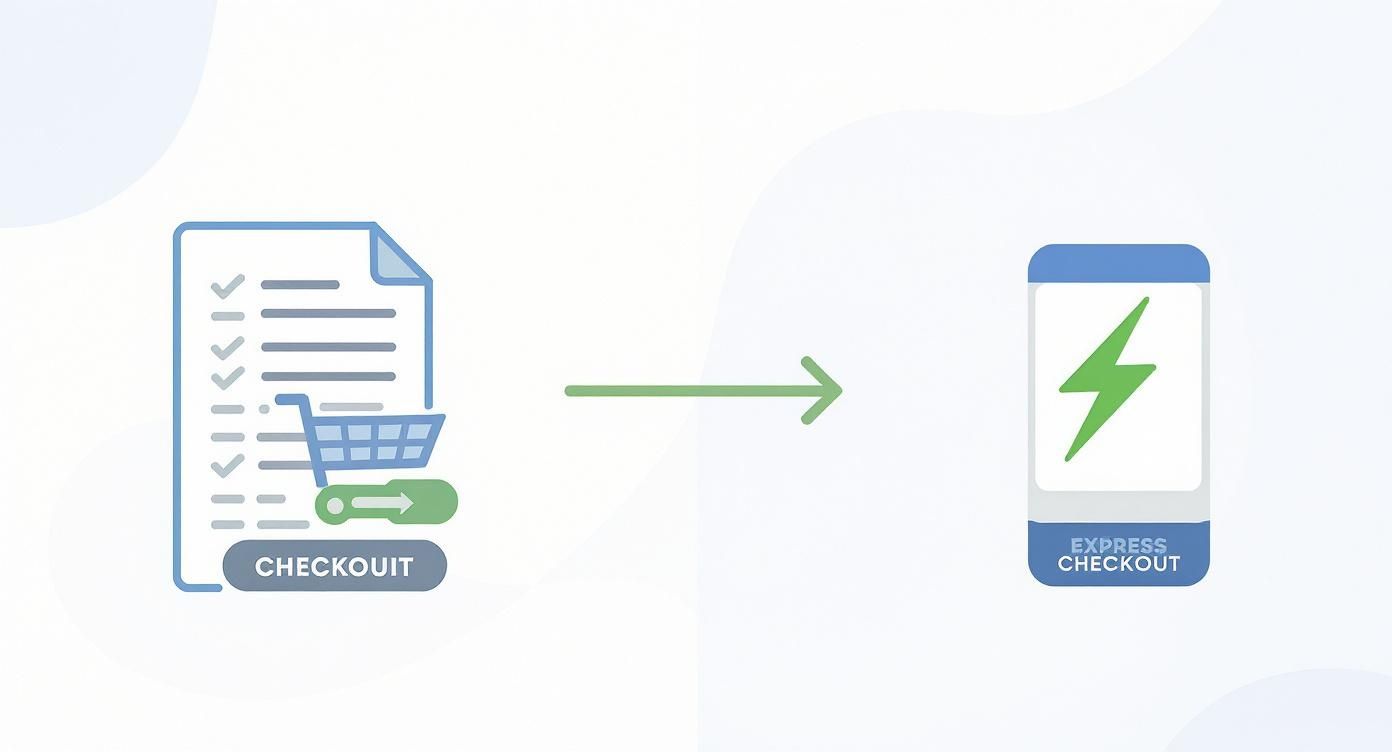
As you can see, express checkout boils down multiple pages and form fields into a single, efficient approval step.
The Journey of a Token
The real magic here is how this process protects both you and your customer. Since you never store the actual card number, your security burden drops significantly.
Here’s a simple breakdown of what happens behind the scenes:
- Customer Clicks: The shopper picks an express payment option on your product or cart page.
- Authentication: They verify their identity on their device using Face ID, a fingerprint scan, or a password.
- Token Generation: The digital wallet securely creates a one-time-use token that represents the payment data.
- Secure Transmission: That token, along with the shipping info, is sent to your payment processor and website to instantly fill out the final order summary.
- Final Confirmation: The customer just has to glance over the pre-filled order and click to confirm the purchase. It’s that easy.
This entire process is designed to eliminate friction. That’s critical when you consider that over 69% of online carts are abandoned, often because of a long or confusing checkout. By making this final step painless, you’re directly tackling one of the biggest reasons for lost sales.
Getting this flow right is a cornerstone of any high-converting store. For a deeper look into smoothing out the entire buying journey, check out our guide on checkout process optimization. A secure, quick transaction doesn’t just make a sale—it builds trust and brings customers back.
Exploring the Top Express Checkout Providers
Think of express checkout not as a single button, but as a collection of powerful payment options. You don’t need to offer every single one. In fact, picking the right mix is key, since different customers have their own trusted favorites based on the devices they use and their online shopping habits. A smart strategy is to feature a few of the big names to cover all your bases.
Each provider connects your store to a unique audience and brings its own advantages. For example, Shop Pay is woven directly into the Shopify ecosystem, creating a ridiculously smooth experience for millions of shoppers who frequent Shopify stores. It remembers their details across that entire network, making repeat buys almost instantaneous.
Then you have providers like Apple Pay and Google Pay, which lean into their native mobile operating systems. Apple Pay offers unbeatable convenience for anyone on an iPhone with Face ID and Touch ID, while Google Pay does the same for the massive Android user base. Both are absolute must-haves for nailing mobile sales.
The screenshot below from PayPal shows how they frame their Express Checkout—as a way for customers to pay without ever leaving your site.
This really gets to the heart of a core benefit: keeping the entire experience wrapped up in your brand’s environment. It cuts down on distractions and builds a ton of trust at that critical final step.
Understanding the Major Players
Of course, we can’t forget the giants with massive, long-standing user bases. PayPal has been a trusted name in online payments for decades; just seeing its logo can be enough to boost a customer’s confidence. Amazon Pay is another powerhouse, letting the hundreds of millions of Amazon users check out on your site using their saved account information in just a couple of clicks.
The goal isn’t to clutter your checkout with every option under the sun. It’s about strategically choosing the ones your target audience already knows and uses. Ask yourself: Are my customers mostly on mobile? Do they care more about brand recognition and trust than anything else?
Here’s a quick rundown of where each one shines:
- Shop Pay: The go-to for Shopify stores focused on bringing customers back again and again.
- Apple Pay: Absolutely essential for converting shoppers on iPhones, iPads, and Macs.
- Google Pay: A no-brainer for reaching the enormous market of Android users.
- PayPal: A universal symbol of trust with a gigantic global user base.
- Amazon Pay: Perfect for tapping into Amazon’s huge customer database for fast, familiar checkout.
Once you get these distinctions, you can build a much smarter payment strategy. To get a better feel for how different payment options can fit into your store’s setup, check out some of the best Shopify checkout apps to grow your conversions and see how they all work together.
The Real Business Impact of a Faster Checkout
Beyond just making customers happy, a fast checkout delivers a real, measurable return on your investment. The most immediate win is a solid lift in conversion rates. You simply stop losing shoppers to clunky, multi-step forms.
When buying is easy, abandonment rates naturally drop. It’s that simple.
This simplicity builds momentum that goes far beyond a single sale. A seamless experience encourages people to come back again and again, directly boosting a key metric for long-term growth: customer lifetime value (CLV). Effortless transactions create loyal customers.
Driving Higher Revenue and Growth
Removing friction also reduces the mental effort required from shoppers. With fewer distractions and hoops to jump through, customers are less likely to second-guess their purchases.
This often leads to higher average order values (AOV). Think about it—they might be more willing to add that one extra item when the final step is just a single click away.
Data shows that customers using one-click checkout features don’t just buy once; they become better long-term shoppers. They increase their spending by 28.5% on average, visit more often, and boost their purchase frequency by a remarkable 43%.
These individual improvements—higher conversions, CLV, and AOV—all stack up to create a powerful engine for your business. For a deeper dive, read our guide on how to increase ecommerce conversion rates.
Since boosting conversions is a huge benefit of express checkout, it’s also worth exploring strategies for optimizing your conversion rate on platforms like Shopify. At the end of the day, a faster checkout isn’t just a nice feature; it’s a core strategy for building a more profitable online store.
Combining Express Checkout with SMS Cart Recovery
So, what happens when a customer starts an express checkout but gets pulled away before hitting that final button? Their intent to buy was sky-high, but life got in the way. This is exactly where a smart recovery strategy can build a safety net, turning what looks like a lost sale into a win.
When you pair express checkout with an automated SMS tool like CartBoss, you get a second chance to capture that sale. As soon as a shopper begins the process, their phone number is captured. If they bail for any reason, it triggers an automatic text message.
This isn’t just your average reminder, though. The SMS they receive contains a direct link that instantly reloads their cart with all the items they picked out.
Creating a Seamless Recovery Loop
Here’s the magic: that link doesn’t just dump them back on a generic product page. It picks up right where they left off, re-engaging the express checkout flow. With one tap, they’re back to the pre-filled confirmation screen, ready to finish their purchase in seconds.
The screenshot below gives you a peek inside the CartBoss dashboard, where you can set up and monitor these automated recovery messages.
This partnership turns a simple payment feature into a powerful sales recovery machine. It bridges the gap between a customer’s strong desire to buy and the final click.
Instead of just hoping customers remember to come back later, you’re actively bringing them back when the moment is right. This is how you turn abandoned carts into revenue you would have otherwise lost.
This combination is so effective because it sticks to the same principle that makes express checkout a winner in the first place: it’s completely frictionless.
If you’re looking for more ways to automate your customer communication, it’s worth learning how to set up an auto SMS responder. By connecting these two tools, you create a checkout experience that doesn’t just convert visitors—it actively works to bring them back and maximize every single sales opportunity, even after they’ve left your site.
Time to Build Your Frictionless Checkout
In today’s hyper-competitive world of e-commerce, express checkout isn’t just a “nice-to-have” feature anymore—it’s a core part of any serious online store’s strategy. We’ve walked through how it cuts down the steps for your customers, gives your conversion rates a real boost, and even opens the door for powerful cart recovery tactics.
So, the next logical step is to take a hard look at your own checkout. Are there hidden hurdles and unnecessary steps that are quietly killing your sales?
When you add express payment options, you’re doing more than just slapping a few new buttons on your site. You’re fundamentally investing in a better customer experience, and that investment pays you back with more sales and happier, more loyal shoppers.
The path forward is pretty clear: make it ridiculously easy for customers to say ‘yes’ to a purchase. It’s all about mastering their entire journey.
And speaking of the journey, it doesn’t just start at the checkout page. Making sure the entire shopping experience is smooth can dramatically reduce friction. Learning expert strategies for shopping online like a pro means customers show up at your checkout already feeling confident and ready to buy.
Got Questions About Express Checkout?
We get it. Adding a new payment flow can feel like a big step, so let’s clear up some of the common questions and concerns merchants have about express checkout. Here are the straightforward answers you’re looking for.
Is Express Checkout Actually Secure?
Absolutely. In fact, it’s one of the safest payment methods out there. Express checkout providers rely on a technology called tokenization.
Instead of your website handling sensitive credit card information, that data is swapped for a unique, encrypted token. Your store never even sees—let alone stores—the customer’s actual card details. This process massively cuts down on your security and PCI compliance headaches while keeping customer data locked down tight.
How Do I Add It to My Store?
Getting started is usually pretty simple. Most modern eCommerce platforms like Shopify or WooCommerce come with built-in integrations for all the big players—PayPal, Shop Pay, Apple Pay, you name it.
You can often switch them on right from your store’s payment settings dashboard. You’ll need an account with the payment provider you want to add, but the setup itself is typically well-documented and only takes a few clicks.
Some merchants worry that adding more payment options will just confuse customers. The reality is the exact opposite. Seeing a recognizable logo like ‘Buy with Apple Pay’ is a huge trust signal. It offers a welcome shortcut that boosts confidence and makes shoppers feel right at home.
Will This Just Confuse My Customers?
Not a chance. Shoppers see these buttons on major retail sites all the time, so they know exactly what to do.
Far from causing confusion, seeing a familiar option like Google Pay gives them a faster way to buy. It’s a huge relief for anyone who hates filling out tedious forms, which leads to happier customers and, more importantly, more completed sales for you.
Ready to turn those abandoned carts into profit? CartBoss uses the power of SMS to bring customers back and recover sales on autopilot. Start recovering lost revenue with CartBoss today.