


When someone gives you expressed consent, they’re giving you a direct, explicit, and unmistakable ‘yes’. It’s the clear green light you need for a specific action, like sending them marketing messages.
Think of it this way: expressed consent isn’t like finding a door unlocked and walking in. It’s like someone personally handing you the keys to their house.
Decoding This Powerful Permission

So, what is expressed consent at its core? It’s a clear, voluntary agreement given through a direct action. This isn’t about guesswork or making assumptions; it’s about a customer consciously and deliberately deciding to engage with your brand.
This kind of permission is the strongest foundation you can build for trustworthy customer relationships, all while keeping your business on the right side of the law. It’s the gold standard for respectful and legal communication, ensuring the person fully understands what they’re agreeing to before they give you their ‘yes’.
The Core Components of Expressed Consent
For permission to be truly “expressed,” it needs a few key ingredients that wipe away any doubt. These components guarantee the user is making an informed choice, which is crucial for both legal compliance and earning customer trust.
For consent to be valid, it absolutely must be:
- Clear and Specific: The request has to spell out exactly what the user is agreeing to. No confusing jargon or hidden clauses in the fine print.
- A Deliberate Action: The user has to do something specific, like checking a box that isn’t pre-ticked, clicking a button that says “I agree,” or replying “YES” to a text.
- Freely Given: The consent can’t be forced or be a requirement for making a purchase. The decision has to be made without any pressure.
To make these components easier to remember, here’s a quick breakdown of what makes expressed consent so solid.
Key Characteristics of Expressed Consent
| Characteristic | Description | Why It Matters |
|---|---|---|
| Active & Affirmative | Requires a positive action from the user (e.g., ticking a box). | This eliminates ambiguity and proves the user actively opted in, rather than just failing to opt out. |
| Informed & Specific | The user knows exactly what they’re signing up for. | Builds trust and ensures you meet legal requirements for transparency under laws like GDPR and TCPA. |
| Freely Given | The choice is voluntary and not a condition of service or purchase. | This respects the user’s autonomy and prevents manipulative consent-gathering tactics. |
| Documented | There’s a clear record of who, when, and how consent was given. | Provides a legal paper trail that protects your business in case of disputes or audits. |
Having a clear record of this consent is your best defense and a cornerstone of ethical marketing.
How Expressed Consent Works in the Real World
Legally speaking, expressed consent is a clear authorization given by an individual, either verbally or in writing, for a specific action. It’s so fundamental that it’s a standard element in legal agreements and disclosures, often captured through signed documents or digital forms.
These forms must clearly explain what the person is consenting to, leaving no room for misunderstanding.
By demanding a specific ‘yes,’ expressed consent transforms the customer relationship from a passive acceptance into an active partnership. It’s a transparent agreement built on mutual respect.
This direct permission is absolutely essential for activities like SMS marketing. Knowing how to get it and manage it isn’t just a smart move—it’s a legal necessity. For a deeper dive into the nuts and bolts, check out our actionable guide to express written consent for business compliance.
Expressed Consent Versus Implied Consent
This is where so many well-intentioned businesses get into hot water. The difference between expressed consent and implied consent might seem small, but in the eyes of the law—and your customers—they are worlds apart. Nailing this distinction is absolutely fundamental to doing marketing the right way.
Expressed consent is a clear, direct, and provable “yes.” Think of it as someone actively checking an empty box next to the words, “Sign me up for weekly marketing texts and exclusive offers.” They took a specific, deliberate action to opt-in. There’s no room for doubt.
Implied consent, on the other hand, is all about assumptions. It’s when a business infers permission from a customer’s actions. A classic example is assuming someone wants marketing emails just because they bought a product from you. This is a legally shaky foundation because there’s no clear, unambiguous agreement from the user.
Why Assumptions Are Dangerous
Relying on implied consent is like assuming it’s okay to borrow your neighbor’s lawnmower just because they left it on their front yard. You might be right, but you could also be very, very wrong. That leads to an awkward conversation at best—and a very expensive legal headache in business.
Regulators are cracking down hard on the use of implied consent for marketing. For high-stakes activities like sending automated SMS campaigns or handling sensitive data, settling for anything less than explicit permission is a gamble most businesses simply can’t afford to take.
This is especially true under strict laws like the TCPA in the US, which often demands express written consent for automated marketing messages. Making an assumption in this context could lead to some seriously steep financial penalties.
Comparing Verbal and Written Consent
Even within the world of expressed consent, how you get it matters. Permission can be given verbally or in writing, and each comes with a different level of proof and formality.
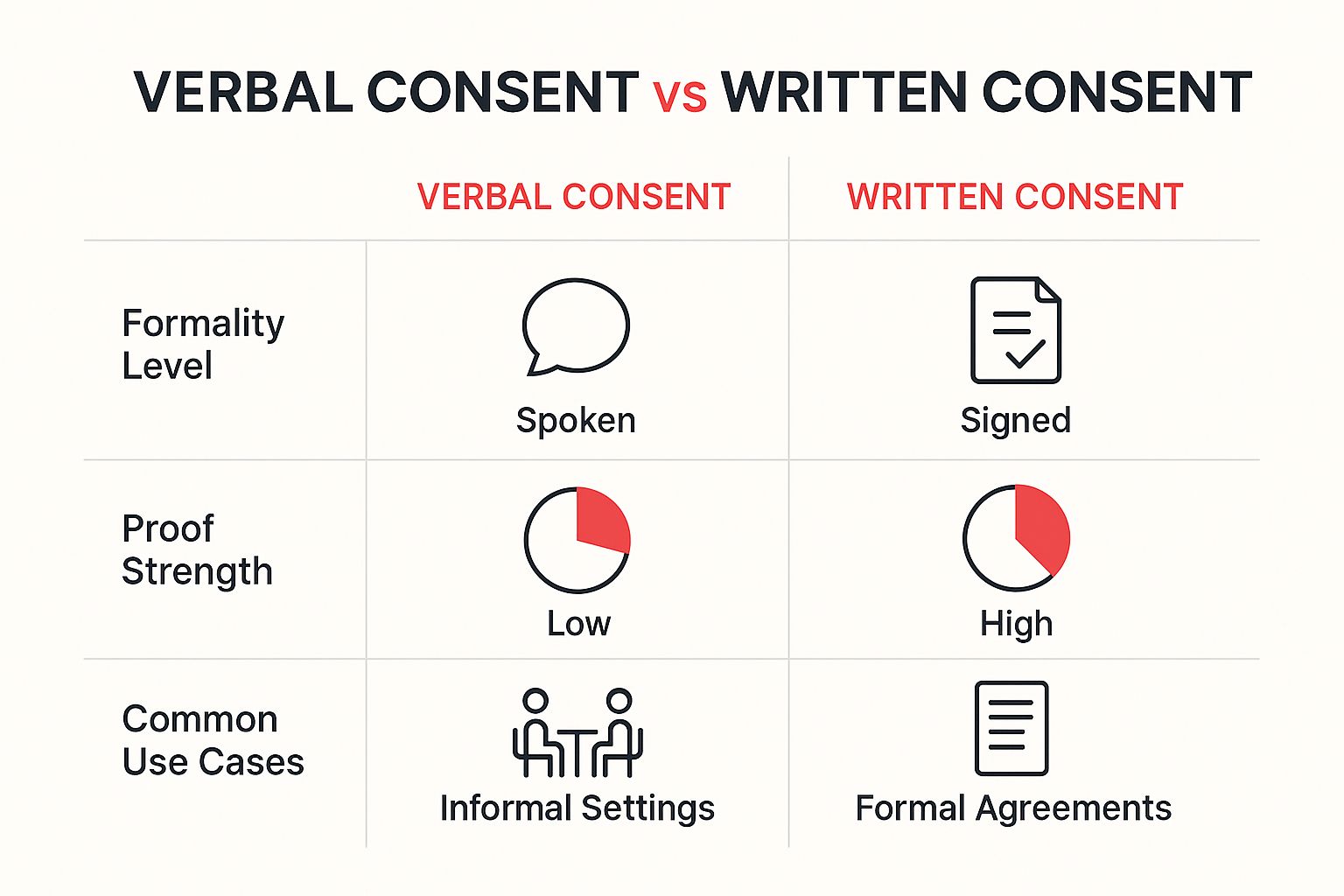
The key takeaway here? While a quick verbal “yes” might be fine for informal situations, written consent provides the solid, verifiable proof that is essential for legal compliance in marketing.
Expressed vs. Implied Consent Head-to-Head
To really see the difference, it helps to put them side-by-side. The core distinction always comes down to clarity and your ability to prove you got permission.
| Aspect | Expressed Consent | Implied Consent |
|---|---|---|
| Permission | Direct, explicit “yes” | Inferred from user’s actions |
| User Action | Affirmative opt-in (e.g., ticking a box) | No direct action (e.g., making a purchase) |
| Documentation | Clear, provable record (digital or physical) | Vague and difficult to prove |
| Legal Strength | The gold standard for TCPA, GDPR, etc. | Risky and often non-compliant |
This table makes it crystal clear: expressed consent is the only truly safe and effective path forward for serious marketing efforts.
The Bottom Line on Permission
The fundamental difference boils down to clarity and proof. Expressed consent gets rid of any gray areas, creating a transparent and legally defensible record of someone’s permission.
Let’s break it down one more time:
- Action Required: Expressed consent needs a direct, positive action (like clicking a button or signing a form). Implied consent is just guessed from other behaviors (like buying something).
- Proof: With expressed consent, you have a solid paper trail (digital or physical). Implied consent is nearly impossible to prove if a customer complains.
- Legal Standing: Expressed consent is the benchmark for major privacy laws. Implied consent just doesn’t meet the legal requirements for many marketing activities, especially SMS.
For any e-commerce business, especially those using direct channels like SMS marketing with tools like CartBoss, understanding what expressed consent is isn’t just a good idea—it’s non-negotiable. Always, always aim for that explicit “yes.” It’s how you build a compliant, trustworthy, and ultimately more profitable relationship with your customers.
How Major Privacy Laws Define Expressed Consent

Understanding expressed consent isn’t just about good business—it’s a legal must-have. Around the world, major privacy laws have put strict rules in place for how you handle customer data, and getting clear permission is at the heart of it all. These aren’t just dusty legal documents; they’re the playbooks for building trust and running marketing campaigns that people actually appreciate.
Get it wrong, and you’re not just looking at a slap on the wrist. We’re talking massive fines, getting your messages blocked by carriers, and doing real, lasting damage to your brand. Let’s break down what the big players in privacy law say about consent, so you can turn all that legal jargon into clear, smart moves for your store.
GDPR: The European Gold Standard
The General Data Protection Regulation (GDPR) in Europe sets a very high bar. Under GDPR, consent has to be “freely given, specific, informed, and unambiguous,” which is confirmed by a “clear affirmative action.” In simple terms, this kills any sneaky tactics like pre-ticked boxes, hiding consent in your terms and conditions, or assuming silence means “yes.”
For an eCommerce store, this boils down to a few key things:
- Unbundled Consent: You have to ask for marketing permission separately. You can’t force someone to sign up for your texts just to buy a product.
- Clear Language: Your request for consent needs to be in plain English. Tell them exactly what they’re signing up for, like “Get weekly promo texts from us.”
- Easy Withdrawal: It must be just as easy for a customer to say “stop” as it was for them to say “yes.”
These rules are all about treating your customers with respect. If you’re working through these requirements, we’ve got a great resource on ensuring GDPR compliance in e-commerce SMS marketing.
TCPA: Rules for the US Airwaves
Over in the United States, the Telephone Consumer Protection Act (TCPA) is the big boss for telemarketing, which absolutely includes SMS. The TCPA demands “prior express written consent” before you can send marketing texts using an autodialer—and that’s one of the toughest standards out there.
The word “written” is key here, but it doesn’t mean you need a pen and paper. An electronic signature, a customer actively checking a box on your website, or them texting “YES” back to you all count as valid written consent.
The main takeaway? You need a clear, documented record that someone gave you the green light to text them. Just having their phone number is never, ever enough under the TCPA.
CCPA and CPRA: California’s Consumer Rights
California’s laws, the California Consumer Privacy Act (CCPA) and the California Privacy Rights Act (CPRA), are built around a consumer’s right to know and control how their personal info is used. While it’s known for its “opt-out” approach to selling data, the spirit of the law is all about transparency.
When it comes to marketing, getting expressed consent is still your best bet. Being upfront about why you’re collecting a phone number and getting a clear opt-in for marketing texts aligns perfectly with what these laws are trying to achieve. It shows respect and protects your business.
This move toward explicit permission isn’t just a trend; it’s the new standard. In fact, over 75% of the biggest companies in the US and EU have made expressed consent a core part of how they handle data, leaving the old, vague “implied consent” model in the dust.
How to Properly Obtain Consent For SMS Marketing
https://www.youtube.com/embed/APM1IN3q51k
While all the legal stuff gives you the “why,” the real question for your store is the “how.” When you’re using SMS marketing, you’re reaching customers on their most personal device. Getting permission the right way isn’t just about avoiding huge fines; it’s about building trust. Mess this up with confusing language or shady processes, and you’ll kill your campaign before it even has a chance to work.
Think of it like inviting someone into your home. You wouldn’t just leave the front door wide open and hope they wander in. You’d give them a clear invitation and wait for them to say “yes.” The same idea applies here. You need a straightforward, unmistakable invitation that your customer actively accepts. This is the bedrock of any SMS strategy that’s both successful and compliant.
The Anatomy of a Compliant Opt-In
To get valid expressed consent for text messages, your request has to be crystal clear and cover a few non-negotiable points. If you get lazy here, you create confusion and put your entire business at risk.
Your opt-in method, whether it’s a popup on your site or a simple checkbox at checkout, must tell the customer:
- Who is sending the messages: State your brand or store name clearly. No hiding behind generic phrases.
- What kind of messages they’ll get: Be specific. Are they “marketing alerts,” “special promotions,” or “cart reminders”? Tell them.
- How often they can expect texts: Give a realistic idea, like “messages are recurring” or “expect 2-4 texts per month.”
- That message and data rates may apply: This is a standard disclosure that you absolutely must include.
- How to opt-out: Make the exit clear from day one. Something like “Text STOP to cancel” should be right there in the opt-in.
Here’s a perfect example of how CartBoss builds a compliant consent checkbox right into the checkout. It’s totally seamless for the customer and completely transparent.
This works because the language is direct and simple. The checkbox isn’t pre-checked, and the reason for the texts is spelled out right next to the box. No tricks, no confusion.
Crafting Unambiguous Language
The words you pick are incredibly important. Your only goal is to leave zero room for misunderstanding. A customer needs to know exactly what they’re signing up for without having to dig through a wall of fine print.
Let’s look at what separates language that keeps you safe from language that gets you in trouble:
| Compliant Example | Why It Works |
|---|---|
| “Text YES to 54321 to receive marketing alerts from [Your Brand]. Msg&data rates may apply. Reply HELP for help, STOP to cancel.” | This is perfect. It uses a clear keyword (YES), names the brand, explains the message type (marketing alerts), and includes the required opt-out info. |
| Non-Compliant Example | Why It Fails |
| “Enter your phone number to get updates.” | This is a recipe for disaster. “Updates” is way too vague—it could mean anything from shipping info to aggressive daily marketing. It completely fails the test for specific, expressed consent. |
A critical rule to burn into your memory: consent can never be a condition of purchase. You cannot force a customer to agree to marketing texts just to buy something. This is a massive violation of laws like the TCPA and is strictly forbidden.
The idea of clear consent isn’t unique to SMS. It applies across all your marketing channels. While this guide is all about text messages, you can check out these practical GDPR email consent examples for B2B outreach to see how the same core principles work for email.
And for a full deep-dive into building an effective and totally compliant SMS program, make sure to read our complete guide on SMS marketing best practices.
Documenting And Managing Consent Records

Getting a customer’s permission is just the beginning. The real test—and your strongest legal shield—is whether you can prove you got it. This is why keeping great records isn’t just a boring chore; it’s a core part of managing risk and protecting your business.
Think of your consent records as your marketing program’s black box. If something goes wrong, like a customer complaint or a surprise audit from regulators, these documents are the first thing they’ll ask to see. Without solid proof, your claim of having “expressed consent” is just hearsay.
The Essential Elements Of A Consent Record
For every single person who opts into your messages, you need a clear, permanent record. A messy entry in a spreadsheet just won’t cut it. Your documentation has to be specific, secure, and easy to pull up when you need it.
A solid consent record should always capture these key details:
- Who Gave Consent: The person’s identity, which is almost always tied to their phone number.
- When It Was Given: A precise timestamp showing the exact date and time the user said yes.
- How It Was Given: The specific action they took, like texting a keyword, submitting an online form, or ticking a box at checkout.
- What They Agreed To: The exact wording of the disclosure they saw, which spells out what kind of messages they signed up for.
Proper record-keeping transforms a simple “yes” into a legally defensible asset. It’s your undeniable evidence that you respected the customer’s choice and followed the law.
Why Centralized Management Is Non-Negotiable
Trying to manage these records across a bunch of disconnected platforms is a recipe for disaster. It’s almost impossible to keep track of everything, especially when someone wants to opt out. A centralized system is the only way to go.
A platform like CartBoss handles all this documentation for you, automatically. When a customer texts “STOP,” the system instantly updates their status everywhere, making sure you honor their request right away. This kind of automation is crucial for staying compliant and keeping your customers’ trust, particularly as your marketing grows. It’s a key piece of an effective strategy for abandoned cart recovery that puts user preferences first.
The need for detailed records is even more critical in high-stakes industries like healthcare. Research shows that in medical settings, express consent is documented with signed forms that detail treatments, risks, and alternatives. In fact, around 90% of hospitals require this written proof for major procedures to protect patient rights. You can discover more about the legal importance of consent documentation and how it applies across different sectors.
Common Questions About Expressed Consent
As you get your SMS marketing strategy up and running, you’re bound to run into some tricky situations. Questions about what counts as expressed consent will pop up, and getting the answers right is crucial for staying compliant and keeping your customers happy.
Let’s clear up some of the most common points of confusion so you can move forward with confidence.
Can I Just Add Consent to My Terms and Conditions?
This is a question we hear all the time, and it points to one of the biggest—and most tempting—shortcuts businesses try to take. The short answer is a hard no. Hiding your consent request inside a massive Terms and Conditions document is a major violation of regulations like GDPR.
Consent needs to be “unbundled” from everything else. That means it has to be a separate, clear, and obvious request. You need a dedicated opt-in for marketing, not a sneaky clause buried in a legal document you know nobody reads. It’s all about being transparent, and this tactic is the exact opposite.
Think of it this way: You wouldn’t sign a single document that covers your car loan, your gym membership, and permission for a neighbor to borrow your lawnmower. Each of those is a distinct agreement that needs its own clear “yes.”
This approach guarantees the user is making a conscious, informed choice specifically about getting marketing messages from you, which is the entire point of expressed consent.
How Long Does Expressed Consent Last?
This is a great question, and the answer isn’t as simple as you might think. Expressed consent doesn’t come with a universal expiration date, but it is absolutely not a lifetime pass to message a customer forever. The value of that consent can definitely fade over time, especially if a customer stops interacting with your brand.
It’s a best practice—and a legal expectation in some places—to refresh consent from time to time. For example, if a customer hasn’t bought anything or engaged with you in over a year, it’s a smart move to reconfirm they still want to hear from you. This shows respect for the customer and helps keep your contact list clean and effective.
Here’s how different rules see it:
- TCPA (US): Under the Telephone Consumer Protection Act, the consent itself doesn’t technically expire. But—and this is a big but—the customer can revoke it at any time, and you have to honor that request immediately.
- GDPR (EU): This regulation is more focused on the principle of the thing. It states that consent should be reviewed at “appropriate intervals.” While it doesn’t give a hard timeline, the expectation is clear: you can’t just rely on old, stale permissions.
- Best Practice: The most important thing is to make opting out incredibly easy and to honor those requests instantly. To learn more about building and maintaining a healthy, engaged list, check out our complete guide on SMS marketing best practices for ROI and engagement.
What Are the Real Risks of Messaging Without Proper Consent?
Bending the rules on expressed consent isn’t just poor form; it’s a massive financial and reputational gamble. The penalties are very real and can be severe enough to seriously damage a growing business.
These aren’t just theoretical threats. Here’s what you’re up against:
- Massive Financial Penalties: The fines can be truly eye-watering. Under the TCPA, you could be on the hook for $500 to $1,500 per single violation (that means per text message). Under GDPR, the fines can climb as high as €20 million or 4% of your company’s global annual revenue, whichever is greater.
- Carrier-Level Blocks: Mobile carriers have their own rules. If they detect spammy behavior or get a flood of user complaints, they can—and will—block your phone numbers. This could shut down your entire SMS marketing channel in an instant.
- Devastating Brand Damage: Even if you avoid the fines, the damage to your brand can be permanent. In an age of social media and online reviews, word about angry customers spreads fast. The negative fallout can be swift, widespread, and very hard to recover from.
When you look at it this way, the risks of cutting corners are just not worth it.
Ready to turn your abandoned carts into sales with a fully compliant SMS tool? CartBoss handles all the complexities of expressed consent for you, from compliant opt-in checkboxes to automated opt-out management. Start recovering lost revenue on autopilot today!
