



So, what exactly is behavioral targeting? Put simply, it’s the art of showing people ads and content based on what they’ve actually done online. Think of it as using digital clues—like the websites they visit, the products they look at, or the searches they make—to deliver a much more relevant and personal experience.
Putting Behavioral Targeting Into Simple Terms
Let’s ditch the marketing jargon for a moment. Imagine you walk into your favorite bookstore and head straight for the travel section. A savvy employee notices you’re spending a lot of time with guides to Italy. A few minutes later, they don’t just shove a random book in your face; they approach you with a brand new release about hidden gems in Tuscany.
That’s behavioral targeting in a nutshell, just translated to the online world.
Instead of a person watching you browse, websites use digital tools to observe your actions. These tools track what you do to build a picture of your interests, helping the business understand what you might be looking for next.
The Digital Clues That Tell the Story
This whole strategy hinges on gathering the right kind of information to make an educated guess about a customer’s intent. It’s not about random data; it’s about specific, actionable clues.
To get a clearer picture, let’s break down the core components marketers look at.
Core Components of Behavioral Targeting
| Component | What It Is | Example |
|---|---|---|
| Website Engagement | How a visitor interacts with your site—what pages they see, how long they stay, and what they click. | A user spends 5 minutes on a product page for a specific running shoe, then clicks to read reviews. |
| Purchase History | A record of everything a customer has bought from you in the past. | A customer has previously bought a dog collar and leash from your pet store. |
| Search Queries | The exact words or phrases a user types into your website’s search bar. | Someone searches for “waterproof winter boots for hiking” on your outdoor gear site. |
| Cart Activity | The items a customer adds to their shopping cart, even if they don’t complete the purchase. | A shopper adds three different t-shirts to their cart but leaves before checking out. |
This process transforms marketing from a generic shout into a meaningful, one-on-one conversation. It’s the difference between getting a random flyer in the mail and a personalized tip for something you were just thinking about buying.
And it works. In fact, 76% of consumers say they’re more likely to buy from brands that personalize their marketing. By showing people things they actually care about, businesses don’t just see better click-through rates and ROI—they create a genuinely more helpful experience for the shopper.
By truly understanding what users are doing, companies can craft campaigns that hit the mark. For instance, this kind of behavioral data is the engine behind powerful channels like SMS marketing, where sending a timely, relevant message is everything. To see just how effective this can be, check out our deep dive into what is SMS marketing and how it gets results.
How Behavioral Targeting Actually Works
So, how does a simple website visit transform into a perfectly timed, personalized ad? It’s not magic. It’s a methodical, four-stage journey that turns raw user actions into marketing campaigns that just work. The whole system is designed to figure out what a customer wants, sometimes even before they know it themselves.
This all starts with a single, anonymous interaction. Every time someone lands on your site, clicks a link, or adds an item to their cart, they’re leaving behind digital breadcrumbs.
At its core, behavioral targeting is about listening. It’s a shift from broadcasting one message to everyone to having thousands of individual conversations at once, guided by user actions.
This process is what separates a casual browser from a serious buyer. And it all begins with collecting the right information.
Stage 1: Data Collection
First things first, you need to gather data. This is usually done with tools like cookies and tracking pixels—small snippets of code on your website. These tools anonymously log what users are doing, like:
- Pages Visited: Which product or content pages did they look at?
- Time on Page: How long did they stick around on a certain page?
- Clicks and Interactions: Did they play a video or download a guide?
- Purchase History: What have they bought from you before?
- Search Terms: What did they type into your site’s search bar?
This initial data is all about actions, not personal identity. It’s completely anonymous and builds the foundation for everything else, creating a profile based purely on interest and intent.
This infographic gives you a good idea of how a marketer looks at these digital clues to build a campaign.
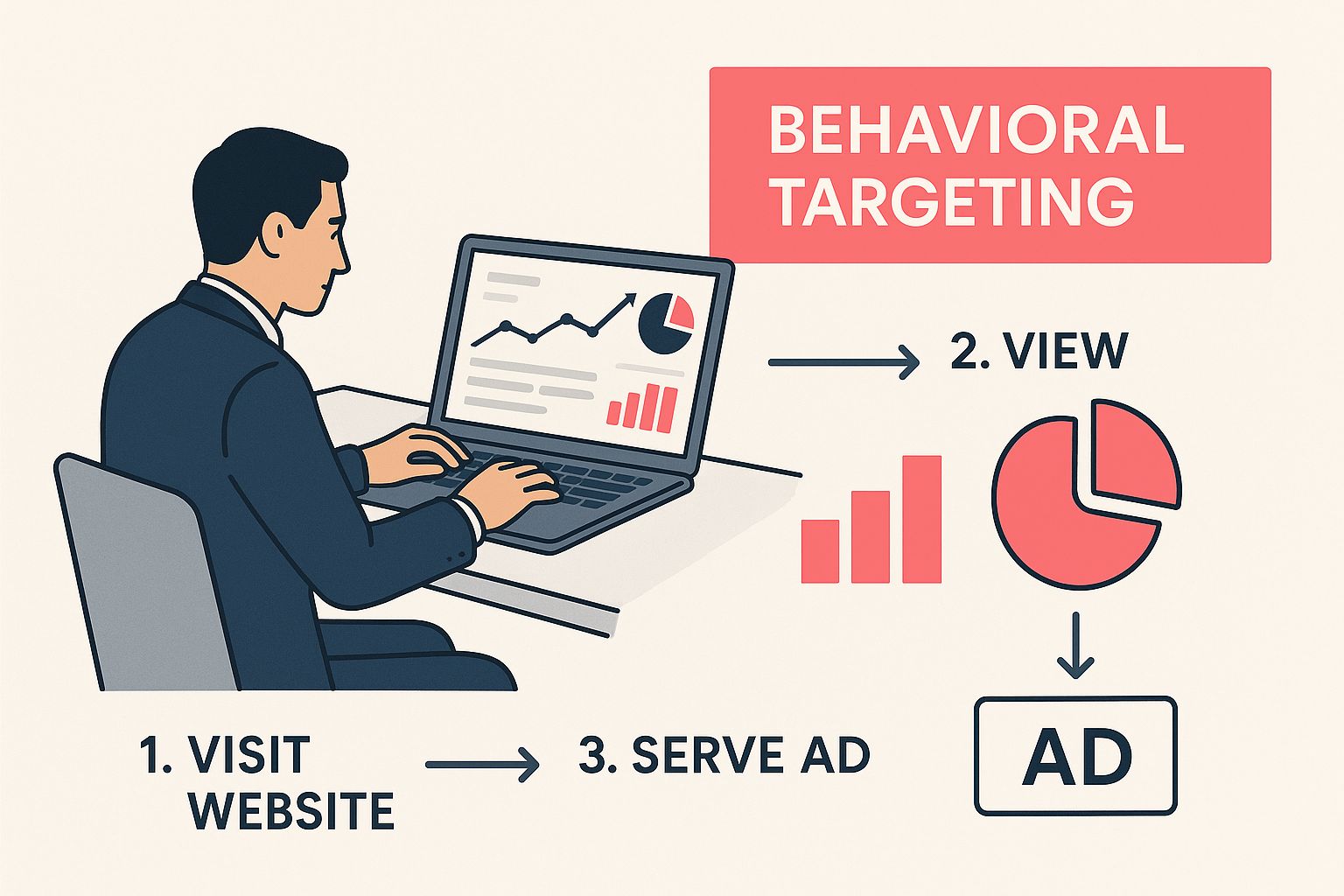
As you can see, it’s about turning raw analytics into real marketing strategies, directly linking what a user does to what a business should do next.
Stage 2: Audience Segmentation
Once you have all this raw data, the next step is to organize it into distinct groups, or segments. This is where behavioral targeting gets really powerful. Instead of shouting at one big, generic audience, you can talk to smaller, highly specific groups based on what they’ve done.
For example, you could segment users into buckets like:
- New Visitors: People on your site for the very first time.
- Frequent Buyers: Your loyal customers who keep coming back for more.
- Cart Abandoners: The ones who added items to their cart but bailed before checking out.
- High-Intent Users: Visitors who checked out the same product page a few times.
Stage 3: Campaign Application
With these clearly defined segments, you can finally launch your targeted campaigns. Each group gets a message that makes sense for their specific behavior.
For instance, a “cart abandoner” might get an SMS with a special discount to nudge them over the finish line. Meanwhile, a “frequent buyer” might get early access to a new product line as a thank-you for their loyalty.
Stage 4: Analysis and Optimization
The last stage isn’t really an end—it’s a continuous feedback loop. You have to analyze how your campaigns are doing. Track metrics like click-through rates, conversions, and revenue. Did that cart abandonment campaign actually work? Did the early access offer drive sales?
This analysis tells you what’s working and what isn’t, so you can tweak your segments and messages to make the next campaign even better. It’s all about learning and improving.
What This Actually Does for Your Business

It’s one thing to understand the mechanics of behavioral targeting, but what really matters is the impact it has on your bottom line. When you ditch the generic, one-size-fits-all approach to marketing, you unlock some seriously powerful advantages that fuel growth, make your spending more efficient, and build real relationships with your customers. It’s about making every dollar and every interaction count.
The first thing you’ll notice is a big jump in conversion rates. Think about it: when you show someone an offer that’s directly related to what they were just doing—like looking at the same product three times—the path to buying becomes incredibly simple. You’re not just guessing they’re interested; you have the data to back it up.
This targeted approach also creates a much better experience for your visitors. Instead of spamming them with ads they don’t care about, you’re sending helpful suggestions and timely reminders. This simple shift turns your marketing from an interruption into a service, encouraging people to come back and building genuine brand loyalty.
Behavioral targeting turns your marketing from a shot in the dark into a direct investment in the people who are already paying attention. It makes sure your budget is spent talking to people who are already listening.
This kind of precision is exactly how you maximize your return.
Higher ROI and Smarter Spending
When your marketing messages are laser-focused on users who’ve already shown you they’re interested, you slash wasted ad spend. Every dollar goes toward an audience that’s far more likely to convert, which is how you drive a much stronger Return on Ad Spend (ROAS).
This is especially true for retargeting. A shopper who abandons their cart is the perfect example—they’re a hot lead who just got distracted. Using their behavior as a trigger, you can send a personalized SMS with a small discount to nudge them back. That one text can turn a lost sale into fresh revenue. Learning how to reduce cart abandonment with these kinds of tactics is a great next step to mastering this.
Effective behavioral targeting can also supercharge your existing marketing automation strategies by delivering these personalized experiences at scale, without any extra manual work.
Increased Customer Lifetime Value
Finally, the benefits go way beyond a single sale. When you consistently deliver relevant content and offers, you build a relationship based on understanding what your customers actually want. This leads to a domino effect of positive outcomes:
- Repeat Purchases: Happy customers who feel like you “get” them are much more likely to buy from you again.
- Higher Average Order Value: Smart, personalized recommendations can introduce shoppers to complementary products they might have missed otherwise.
- Stronger Brand Affinity: A positive, relevant experience turns customers into loyal fans who advocate for your brand.
Ultimately, this approach doesn’t just help you get new customers more efficiently—it helps you keep them for the long haul.
Real-World Examples of Behavioral Targeting

To see how common behavioral targeting is, you don’t need to look much further than your own screen. This strategy is humming away behind the scenes on nearly every website and app you use, from social media to your favorite online shops. It’s all about turning the digital clues you leave behind into personalized, relevant experiences.
The most classic example is e-commerce retargeting. Picture this: you’re browsing an online store for a new pair of running shoes. You click on a specific pair, check the price, and maybe look at the different colors available. But you get distracted or decide to think about it, so you close the tab.
A few hours later, you’re scrolling through Facebook, and there they are—an ad for those exact running shoes. That’s no coincidence. The store used your browsing behavior (looking at that specific product) as a strong signal of your interest. They then used that signal to serve you a reminder, hoping to entice you back to finish the purchase.
Beyond Simple Retargeting Ads
But behavioral targeting is much more sophisticated than just showing you ads for stuff you’ve already looked at. It’s about predicting what you might want next based on everything you’ve done before. Streaming services like Netflix are absolute masters of this.
When Netflix suggests a new show for you, they aren’t just taking a wild guess. They’re crunching the data on your viewing history:
- Genres you binge most often (like sci-fi or true crime documentaries)
- Actors or directors whose work you seem to follow
- Shows you finish quickly versus the ones you abandon after one episode
- What time of day you typically settle in to watch
All these data points build a surprisingly detailed profile of your tastes. This allows the platform to serve up recommendations that feel like they were picked just for you, keeping you engaged and, most importantly, subscribed.
The same logic powers modern SMS marketing, where behavioral triggers can turn a lost sale into a recovered one. When a shopper adds items to their cart but leaves without buying, that’s a massive signal of purchase intent. A smart system uses this action as a trigger to automatically send a text message an hour or so later.
This message might be a simple, friendly reminder or even include a small discount to sweeten the deal. It’s direct, timely, and incredibly effective. For any online business, learning to use these triggers is a key to growth, and our guide on abandoned cart recovery strategies gives you the exact steps to do it right.
Behavioral vs Contextual Targeting Comparison
It’s easy to get behavioral targeting mixed up with another common method: contextual targeting. While they sound similar, their approaches are fundamentally different. Behavioral targeting looks at the person’s past actions, while contextual targeting looks at the environment where the ad is shown.
To make it crystal clear, let’s break it down.
| Feature | Behavioral Targeting | Contextual Targeting |
|---|---|---|
| Data Source | A user’s browsing history, clicks, and past purchases. | The content of the webpage the user is currently viewing. |
| Focus | “Who is this person?” | “What is this page about?” |
| Example | An ad for running shoes follows you to a news website. | An ad for running shoes appears on an article about marathon training. |
While both methods have their place, behavioral targeting usually delivers a much deeper level of personalization. It’s built on a history of demonstrated interests over time, not just what a person happens to be looking at in a single moment.
Navigating Privacy in a Cookieless World
Let’s be honest, the conversation around behavioral targeting always comes back to one big topic: privacy. With major regulations like GDPR and the slow death of third-party cookies across web browsers, the old playbook is being thrown out. It’s easy to see this as a huge problem, but it’s really more of a strategic pivot—a move toward a more transparent and trust-based way of doing marketing.
This new reality doesn’t spell the end of personalization. Not at all. It just changes where we get our data. The future of smart behavioral targeting is all about first-party data, which is simply information customers give you directly and willingly. Instead of piggybacking on third-party cookies that creepily follow users across the internet, businesses are now focused on building their own data goldmines.
This shift puts the focus back where it should have been all along: creating real connections with your audience.
The Rise of First-Party Data
So, where does this fantastic first-party data come from? It’s gathered from any direct interaction where customers actually choose to share their info with you.
Think about it:
- Email and SMS Sign-Ups: When someone subscribes to your newsletter or text alerts, they’re literally giving you the green light to contact them.
- Loyalty Programs: Shoppers who join a rewards program are happy to share their purchase history and what they like in exchange for some sweet perks.
- On-Site Activity: Simple actions on your own website, like creating an account or using the search bar, offer direct clues into what a customer wants.
This whole model is built on being upfront. When you’re clear about why you’re collecting data and what the customer gets out of it, you build trust. This is where the concept of consent becomes your best friend. To get a better handle on the rules, you can check out our guide that explains what is expressed consent and why it’s so important.
Adapting with Customer Data Platforms
Trying to manage all this first-party data without the right setup is a recipe for a headache. This is where Customer Data Platforms (CDPs) are becoming a must-have. A CDP is like a central brain for all your customer information. It pulls data from all your different tools—your website, CRM, marketing platforms—and organizes it into one clean, single profile for each user.
By focusing on first-party data, marketers aren’t just playing by the new rules; they’re building stronger, more authentic customer relationships based on direct interaction and mutual trust.
This unified view lets you keep delivering powerful, personalized experiences without crossing any privacy lines. You can still segment your audience and trigger campaigns based on behavior, but you’re doing it with data that was collected ethically and with the customer’s permission. The industry is adapting on the fly. By 2025, behavioral targeting is navigating challenges from growing privacy rules like GDPR and the end of third-party cookies, forcing a major shift in how data is used. Despite this, the strategy remains highly effective as marketers pivot to first-party data and CDPs to maintain personalization. You can discover more insights about this marketing evolution on brandmotech.com.
This cookieless future isn’t a setback—it’s a step toward smarter, more respectful marketing.
Best Practices for Effective Implementation
Knowing how behavioral targeting works is one thing, but making it work for your store without creeping out your customers is another challenge entirely. To get real results, you need a solid plan built on clear goals and genuine respect for the user. This process starts long before you ever send a single message or launch a campaign.
First off, you need to know what you’re trying to achieve. Are you aiming to slash cart abandonment rates, encourage repeat business, or maybe introduce a hot new product to your most loyal fans? Setting a specific, measurable goal—like “cut cart abandonment by 15%“—gives your strategy a clear direction and makes it a whole lot easier to see what’s working later on.
The line between helpful and creepy is razor-thin. When it’s done right, behavioral targeting feels like a thoughtful suggestion from a friend. When it’s done wrong, it feels like you’re being watched. The key is to always add value, not just follow people around the internet.
This all comes down to balancing personalization with privacy. You have to be transparent and give your customers obvious, easy-to-use controls over their own data.
Prioritize the User Experience
To keep your targeting helpful instead of just annoying, you really need to think about the customer’s journey. One of the most important tactics here is setting a frequency cap. This simply limits how many times one person sees your ad in a set period. Nobody likes being hammered with the same ad over and over—it just leads to “banner blindness” and irritation.
You also need to be constantly tweaking your audience segments based on how they perform. If a particular group isn’t converting, don’t just keep hitting them with the same message. Dig in and figure out why. Is the offer wrong? Is the timing off? The data will tell you the story if you listen.
Combine and Conquer
Behavioral targeting is a beast on its own, but it gets even more powerful when you mix it with other methods. For a truly effective strategy, you should:
- Mix Behavioral with Contextual: Imagine showing an ad for a product a user just viewed (behavioral) but only when they’re browsing a relevant blog post about that product category (contextual). That’s a powerful combo.
- Layer in Demographic Data: Sharpen your aim by adding demographic filters like age or location. This helps you make your messaging even more specific and relatable.
- Focus on Retention: Use behavioral triggers to send special offers or thank-you messages to your loyal, repeat customers. It’s a fantastic way to increase customer retention and build a real community around your brand.
By blending these different approaches, you start to build a much more complete, three-dimensional picture of your customer. This lets you create a sophisticated and respectful marketing plan that doesn’t just hit your business goals but also builds the kind of customer trust that lasts.
Frequently Asked Questions
Even when you’ve got the basics down, a few questions always seem to pop up when you’re trying a new marketing approach. Let’s tackle some of the most common ones about behavioral targeting to clear up any confusion.
Is Behavioral Targeting Legal?
Yes, it is, but you have to play by the rules. Regulations like GDPR in Europe and CCPA in California are strict, and for good reason. The key to staying compliant is transparency and consent.
You have to be upfront with people about what data you’re collecting and why. You also need to give them a simple, no-fuss way to opt out if they want to. As long as you treat user data with respect, it’s a perfectly legal and powerful way to grow your business.
The goal isn’t to find sneaky ways around privacy laws. It’s to build trust by being open and honest with your audience about how you handle their data.
This shift toward first-party data—information you collect directly with permission—is the only way forward. It keeps your marketing effective and ensures you stay on the right side of the law as it continues to evolve.
What’s the Main Difference Between Behavioral and Contextual Targeting?
It all comes down to what you’re looking at.
Behavioral targeting is all about the person. It looks at their past actions—the sites they’ve visited, the products they’ve clicked on, what they’ve bought before—to build a picture of who they are and what they like.
Contextual targeting, on the other hand, is about the place. It looks at the webpage an ad is on and serves up something relevant to that page’s content. Think of it like seeing an ad for hiking boots on a blog post about the best mountain trails. That’s contextual targeting in a nutshell.
How Does Behavioral Targeting Affect User Experience?
When it’s done right, it makes the user experience way better. Instead of getting blasted with random ads, people see offers and products that actually line up with what they’re interested in. It feels less like an annoying interruption and more like a helpful suggestion.
But there’s a fine line. If you get too aggressive or creepy with your targeting—too many ads, or ads that are too personal—it can backfire and make people uncomfortable. The aim is to be helpful, not a stalker.
Ready to put these insights to work? CartBoss uses smart behavioral triggers to send perfectly timed SMS messages, recovering abandoned carts and driving sales while you sleep. Start recovering lost revenue today.