



Ever wondered which of your marketing efforts actually bring in the money? That’s the million-dollar question marketing attribution sets out to answer.
At its core, marketing attribution is how you figure out which marketing touchpoints—the ads, emails, blog posts, and social media interactions—are responsible for leading a customer to a conversion. It’s about connecting the dots between your actions and the customer’s final decision to buy. Instead of just guessing what works, you get a clear, data-driven map of the entire customer journey.
Understanding The Core of Marketing Attribution

Think of the path to purchase like a basketball play. The point guard brings the ball up the court (maybe that’s your social media ad). They pass it to a forward who drives toward the basket (your blog post). The forward then kicks it out to a shooter in the corner (an email promotion), who sinks the final shot (the purchase).
Who gets the credit for the basket? Just the shooter? No way. It was a team effort, with each pass—or “assist”—playing a vital role. Marketing attribution is the art of analyzing every single one of those assists to see how much each one contributed to the final score. It helps us move beyond only crediting the very last click and gives us a full picture of what really persuades customers.
Why It Matters More Than Ever
If only marketing were simple. In a perfect world, a customer would see one ad, click, and buy. But that’s rarely how it happens. The modern customer journey is a winding road, often involving dozens of interactions across different channels over weeks or even months. Without a way to connect these scattered touchpoints, you’re flying blind, working with a fragmented and often inaccurate view of your performance.
This is where understanding what is marketing attribution becomes a game-changer. It empowers you to:
- Allocate Your Budget Smarter: Pinpoint which channels deliver the best return on investment (ROI) so you can double down on what’s working and cut what isn’t.
- Sharpen Your Campaigns: Attribution insights show you which messages, creative, and content hit the mark at different stages of the funnel.
- Truly Understand Your Customers: You can map out the most common paths people take to conversion, learning how different customer segments engage with your brand.
Consider a business with a sales cycle of 6-9 months. They might see an average of 14 touchpoints before closing a deal. If they only look at the last touchpoint, they’re ignoring the 13 other crucial interactions that nurtured that lead.
Ultimately, attribution turns a messy pile of data into clear, actionable intelligence. It gives you the confidence to make data-backed decisions, justify your marketing spend, and drive real growth. By looking at the entire journey, you stop guessing and start knowing.
To make this clearer, let’s break down the fundamental attribution concepts. The table below outlines the different ways marketers can assign credit, from simple, single-touch models to more sophisticated, multi-touch approaches.
Quick Overview of Core Attribution Concepts
| Attribution Concept | Core Principle | Best For |
|---|---|---|
| First-Touch Attribution | All credit goes to the very first interaction a customer has with your brand. | Understanding top-of-funnel channels that generate initial awareness. |
| Last-Touch Attribution | All credit goes to the final interaction right before a conversion. | Simple funnels; identifying bottom-of-funnel “closing” channels. |
| Linear Attribution | Credit is split equally among all touchpoints in the customer journey. | Long sales cycles where every interaction is considered valuable. |
| Time-Decay Attribution | More credit is given to touchpoints closer to the conversion. | Shorter sales cycles where recent interactions have more impact. |
| U-Shaped Attribution | Credit is split between the first and last touchpoints (40% each), with the remaining 20% distributed among the middle touches. | Valuing both the initial awareness-driver and the final conversion-driver. |
| W-Shaped Attribution | Credit is split between the first touch, the lead creation touch, and the last touch (30% each), with 10% for others. | B2B marketing; highlights key milestone conversions in a longer journey. |
| Custom / Algorithmic | Uses data science and machine learning to assign credit based on the actual impact of each touchpoint. | Mature marketing teams seeking the most accurate and nuanced view. |
As you can see, there’s no single “right” answer. The best model depends entirely on your business, your sales cycle, and what you’re trying to measure. This foundational understanding is the first step toward building a more efficient and impactful marketing engine.
The Evolution From Simple Clicks To Complex Journeys

It’s easy to think of marketing attribution as a modern digital invention, but its story started long before anyone ever clicked a banner ad. The first attempts to connect marketing spend to sales results were much broader, relying on a top-down view that paved the way for the granular tools we have today.
The real beginning was with Media Mix Modeling (MMM), a statistical technique that became popular in the mid-20th century. Marketers would feed aggregate sales data into these models to figure out how channels like TV, radio, and print ads were affecting the bottom line. It was a macro-level approach, great for high-level budget planning, but it couldn’t tell you a thing about an individual person’s path to purchase.
The Rise Of The Last Click
Then the internet happened, and everything changed. For the first time, we could track individual actions with amazing precision. The click became the holy grail of measurement. When tools like Google Analytics hit the scene in the early 2000s, a new king was crowned: last-click attribution.
The appeal was obvious—it was simple. Last-click attribution gives 100% of the credit for a sale to the very last touchpoint a customer engaged with. Someone clicked a Google Ad and bought something? Boom. The ad gets all the glory. It was easy to implement, straightforward to explain, and gave a beautifully clear (if dangerously incomplete) answer to the question, “What worked?”
And for a while, that was enough. Customer journeys were simpler back then. But as the online world grew crowded with social media, email, blogs, and more, the shortcomings of the last-click model became impossible to ignore. It was like crediting only the player who scored the winning goal, completely forgetting the assists, the defense, and the coaching that made the shot possible.
The last-click model creates a massive blind spot. It consistently undervalues the channels that build awareness and nurture interest early on, which can lead to disastrous budget cuts for the very activities that fill your funnel.
Adapting To Modern Customer Journeys
As marketers started feeling the pain of this blind spot, it became clear a new approach was needed. The modern customer journey isn’t a straight line from A to B; it’s more like a tangled web of interactions across dozens of platforms and devices.
A customer might see your brand on TikTok, read a review on a blog, click a retargeting ad on Facebook, and finally search for your brand on Google to make a purchase. How do you give credit where it’s due?
This is where multi-touch attribution comes in. Instead of giving all the credit to one touchpoint, these models spread it across the various interactions that influenced the final decision. This shift signals a more mature understanding of marketing—it’s not about single, isolated events but a continuous, ongoing conversation with your customer. The move to multi-touch models is a direct reaction to the ever-changing digital world, a topic we explore further in our guide to the top eCommerce trends reshaping the digital marketplace.
Exploring Different Marketing Attribution Models
If you’ve ever felt like single-click attribution is giving you an incomplete picture, you’re right. It’s like judging a championship game based only on the final score—you miss all the critical plays that led to the win. To get the full story, we need to look at multi-touch attribution models.
Think of these models as different ways of telling that game-winning story. Each one emphasizes different moments in the customer’s journey, assigning credit to the various marketing “plays” that ultimately led to a conversion. Some models credit the opening kickoff, others the final touchdown, and some give props to every single yard gained in between.
The Linear Model: A Simple, Even Split
The Linear attribution model is the most democratic of the bunch. It’s built on a simple, fair-minded principle: every single touchpoint that a customer interacts with on their path to purchase gets an equal slice of the credit. No favorites, no special treatment.
So, if a customer reads a blog post, sees a social media ad, clicks an email, and then converts from a retargeting ad, each of those four touchpoints gets exactly 25% of the credit. This approach is fantastic for businesses with longer sales cycles, where you know that every little nudge and piece of information plays a vital role in nurturing a lead over time. It makes sure no touchpoint gets left behind.
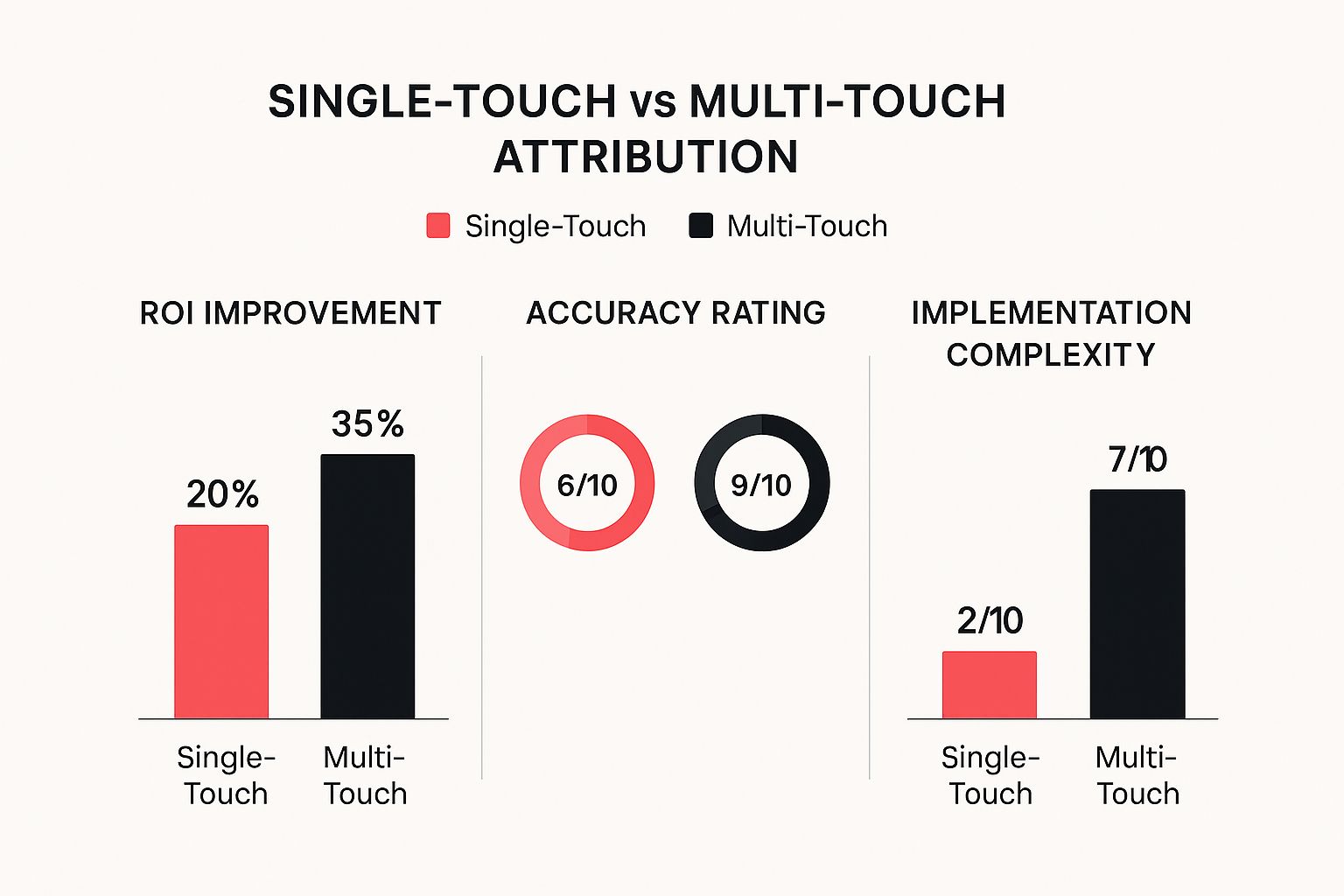
As you can see, while multi-touch models take a bit more setup, they provide a much more accurate view of what’s really driving your ROI.
The Time Decay Model: More Credit for Recent Touches
The Time Decay model works on the idea that timing is everything. It assumes that the marketing efforts closest to the moment of conversion had the biggest impact on that final “yes.” So, it gives more and more credit to touchpoints as they get closer to the sale.
Imagine four interactions lead to a $75 sale. With time decay, that first touchpoint might only get credit for $3.75, while the final click right before the purchase gets the lion’s share. It’s a smart way to think, especially since those last-minute interactions are often your most powerful closing channels. For many brands, that final nudge comes from timely promotions, which is why it’s so important to master tactics like SMS marketing strategies for driving open rates.
This model is a go-to for businesses with shorter sales cycles, where a well-timed ad or promotional email can be the deciding factor that pushes a customer over the edge.
Key Takeaway: The Time Decay model is brilliant for figuring out which of your channels are the true “closers”—the ones that consistently seal the deal.
Comparison of Rule-Based Attribution Models
To help you decide which model might fit your business best, let’s break them down side-by-side. Each one has its own logic and reveals a different facet of your customer’s journey.
| Model Name | How It Works | Pros | Cons |
|---|---|---|---|
| Linear | Distributes credit equally across all touchpoints in the customer journey. | Simple to implement and ensures every touchpoint is valued. Good for brand-building. | Can undervalue key touchpoints that had a disproportionate impact, like the first or last touch. |
| Time Decay | Gives more credit to touchpoints that happen closer in time to the conversion. | Highlights the channels that are most effective at closing deals. | Can undervalue top-of-funnel activities that introduce customers to your brand initially. |
| U-Shaped | Assigns 40% of credit to the first touch, 40% to the last touch, and splits the remaining 20% among the middle touches. | Balances credit between the channels that generate awareness and those that drive conversions. | Overlooks the potential importance of a key middle touchpoint, like lead creation. |
| W-Shaped | Assigns 30% credit each to the first touch, lead creation touch, and last touch. The final 10% is split among the rest. | Provides a nuanced view for longer sales cycles by crediting a key mid-funnel milestone. | Can be more complex to set up, as it requires tracking the specific lead creation event. |
Ultimately, there’s no single “best” model—the right choice depends on your sales cycle, your marketing channels, and what you’re trying to learn.
The U-Shaped Model: Highlighting the Beginning and the End
The U-Shaped model, often called the position-based model, focuses on what it considers the two most heroic moments in any customer journey: the first hello and the final handshake. The logic here is that the touchpoint that introduced a customer to your brand and the one that finally convinced them to buy are the most valuable.
This model gives the first and last touchpoints the star treatment, assigning each of them a hefty 40% of the credit. The remaining 20% is then distributed evenly across all the interactions that happened in between.
The U-Shaped model is popular for good reason—it offers a really balanced perspective:
- It properly values your top-of-funnel marketing that brings new people in the door.
- It also gives credit to the bottom-of-funnel channels that get the conversion across the finish line.
- It still acknowledges the nurturing steps in the middle, just with less weight.
The W-Shaped Model: Adding a Critical Mid-Point
For businesses with a more complex path to purchase, the W-Shaped model provides an even deeper level of insight. It takes the U-Shaped idea and adds a third pivotal moment to the mix: the point where a visitor officially becomes a lead.
In this model, credit is split three ways, with 30% going to each of these milestones:
- First Touch: The initial interaction that kicked off the journey.
- Lead Creation Touch: The moment a person filled out a form, signed up for a newsletter, or otherwise became a known lead.
- Last Touch: The final interaction right before the sale.
The last 10% of the credit is then shared among all the other touchpoints. This model is a powerhouse for B2B companies or any business where that transition from anonymous visitor to qualified lead is a huge win. It helps you see exactly what’s driving awareness, what’s capturing leads, and what’s closing deals. For further reading, platforms like Klaviyo offer more great insights on this topic.
Moving Beyond Rules: Data-Driven and Algorithmic Attribution
Rule-based models like Linear and U-shaped are a massive leap forward from single-touch attribution, but they still operate on a big assumption. We, the marketers, are the ones setting the rules and deciding that a first touch is worth 40% or that every touchpoint deserves an equal slice of the pie.
But what if the data itself could tell us which interactions really mattered?
This is the core idea behind data-driven and algorithmic attribution. Instead of forcing a one-size-fits-all formula onto your customer journeys, these advanced models use machine learning to analyze every single converting and non-converting path. They churn through huge amounts of data to find the patterns and pinpoint the actual impact of each touchpoint.
Think of it like this: a rule-based model is like giving every player on a championship team the same pre-decided bonus. An algorithmic model is like a coach poring over game footage to see which specific plays and players made the biggest difference, then rewarding them based on their actual performance.
How Does Algorithmic Attribution Work?
Algorithmic models don’t just follow rules; they learn. They constantly compare the paths of customers who eventually bought something with the paths of those who didn’t. By running these comparisons over and over, they can calculate the probability of a conversion happening after any given sequence of interactions.
For instance, an algorithm might discover that customers who watch a product demo video and then receive a follow-up email are 50% more likely to convert. Based on that finding, it will automatically assign a much higher value to those two touchpoints than to others that showed a weaker connection to sales.
This approach pulls the guesswork out of the equation. It shifts the conversation from “we think this channel is important” to “the data proves this channel’s value,” giving you an unbiased and dynamic view of what’s working.
Many major ad platforms, like Google Ads, have their own built-in data-driven models. They’re accessible, powerful, and use the platform’s own data to automatically optimize your campaigns. For companies wanting even more control, building a custom algorithmic model is the ultimate goal, though it requires serious data and technical resources.
The Power of Dynamic Credit
While the position-based (U-shaped) model is popular for giving credit to both the first and last touch, it often overlooks the critical nurturing that happens in the middle of the journey. The real magic of algorithmic models is how they assign this credit dynamically.
- Adaptability: The model evolves as your customers do. If a new social media channel suddenly becomes a key driver of sales, the algorithm will spot the trend and adjust credit accordingly, long before you might notice it manually.
- Objectivity: Credit is handed out based on pure statistical impact. This removes human bias and gut feelings from your analysis.
- Accuracy: By analyzing thousands or even millions of data points, these models deliver a far more precise and reliable measure of how much each channel contributes to your bottom line.
Of course, getting this set up isn’t a walk in the park. It demands clean, comprehensive data from all your marketing channels, plus the technical know-how to manage and interpret what the model is telling you.
For those ready to take that next step, our guide on how to measure marketing campaign effectiveness is a great starting point for building a solid measurement framework. It’s a challenge, for sure, but the payoff is a level of insight into your marketing engine that rule-based models simply can’t provide.
How To Choose The Right Attribution Model
Picking an attribution model isn’t about finding one “perfect” answer. It’s more like choosing the right pair of glasses—you need the one that brings your marketing performance into the clearest focus. The best model for your business will slot right in with your unique rhythm, from how you find new customers to how long it takes to make a sale.
So where do you start? Look at your main business objectives. A startup trying to get its name out there will measure success very differently than a big company nurturing enterprise leads over six months. Your goals are the best filter right from the get-go, helping you instantly trim down the options.
Align Your Model With Your Business Goals
The first question to ask is simple: “What are we actually trying to do here?” Your answer will probably point you straight to the right model.
- If you’re all about Lead Generation: Is your top priority just getting new people into your funnel? A First-Touch or U-Shaped model makes a lot of sense. They put the spotlight on the channels that introduce your brand to fresh faces.
- If you’re chasing Sales-Driven Results: When the only thing that matters is what pushes a customer to buy, a Last-Touch or Time Decay model can be incredibly useful. These models are great at identifying your best “closers.”
- If you focus on Nurturing and Education: For businesses with a longer sales cycle, a Linear model gives you a more balanced picture. It respects the fact that every blog post, webinar, and email played a part in the final decision.
When you match the model to your strategy, the insights you get are actually useful. It keeps you from undervaluing that brilliant awareness campaign just because your model is obsessed with the final click.
Consider Your Sales Cycle And Journey Complexity
How long and winding is the road your customers take? This is a huge factor. A quick, straightforward purchase on an e-commerce site is a completely different beast than a nine-month B2B sales process with a dozen meetings.
For a business where sales happen in a matter of days, a Time Decay model often works beautifully because the most recent touchpoints really are the most important. But if you tried to apply that same model to a long B2B cycle, you’d get a completely warped view—it would ignore all the crucial groundwork laid months earlier.
The longer and more complex the journey, the more you need a multi-touch model. For businesses with tangled customer paths, a W-Shaped or even a custom model is the only way to really see how the top, middle, and bottom of the funnel all work together. For a deeper look, check out our guide on effective customer journey management.
Establish Your Technical Foundation
At the end of the day, a model is only as good as the data you feed it. Before you can truly rely on any attribution model, you need to have your technical house in order. That means making sure your data is clean, complete, and trustworthy.
This really comes down to three key things:
- Implement Consistent UTM Tracking: This is non-negotiable. Use UTM parameters on every single campaign link so you can actually tell where your traffic is coming from. If you don’t, your analytics platform is just guessing.
- Ensure Data Cleanliness: Make it a habit to audit your data. Look for errors and inconsistencies. Bad data leads to bad insights, no matter how fancy your model is.
- Integrate Your Tech Stack: Your analytics, CRM, and marketing tools need to talk to each other. Connecting them properly is the only way to get a single, clear view of the entire customer journey.
Choosing the right model is a mix of art and science. It’s about understanding your goals, respecting the customer’s path, and building a solid data foundation. Don’t be afraid to start simple and get more sophisticated as you go—it’s a process of constant refinement.
Navigating The Future Of Marketing Attribution

Putting an attribution framework in place is a huge win, but let’s be honest—it’s not a set-it-and-forget-it solution. The road ahead is filled with new and evolving challenges that can trip up even the most sophisticated models.
To build a measurement strategy that lasts, you have to know what you’re up against.
A classic headache is cross-device tracking. Think about your own buying habits. You might see an ad on your work laptop, browse on your phone during your commute, and finally make the purchase on your tablet at home. If you can’t stitch those touchpoints together into one customer story, the data is fragmented, and you end up giving credit to the wrong channels.
Then you have the “walled gardens” of platforms like Google and Meta. They have a treasure trove of user data, but they don’t exactly share it freely. This creates blind spots, making it incredibly tough to see how, for example, a Facebook ad influenced a later Google search.
The Privacy-First Era And Its Impact
The biggest disruptor right now is the massive shift toward user privacy. With third-party cookies crumbling and new regulations taking hold, the old ways of tracking people across the web are quickly becoming obsolete.
This isn’t just a small tweak; it’s a fundamental change in strategy. Marketers simply can’t rely on following users around the internet anymore. The new game is all about building direct relationships and earning the right to collect data with a customer’s full consent.
The death of third-party cookies isn’t the end of measurement. It’s the start of a more honest, trust-based approach. The brands that win will be the ones who earn their customer’s data, not just scrape it.
This privacy-first world requires a whole new toolbox and a different mindset. If you don’t adapt, you risk flying blind, unable to see what’s working while your competitors who embrace the change pull ahead.
The Rise Of New Solutions
The good news? The industry is already innovating. The future of attribution isn’t about one magic bullet but a smarter blend of tried-and-true methods and new technology. It’s about building a more complete, resilient measurement system.
Three key trends are really paving the way:
- First-Party Data Strategy: This is non-negotiable now. Collecting data directly from your audience—through website activity, email sign-ups, loyalty programs, or purchases—is paramount. This data is not only more accurate but is given with consent, which builds trust. For instance, learning how to optimize your marketing with text messages is a fantastic way to gather first-party data and communicate directly with customers.
- AI-Powered Marketing Mix Modeling (MMM): The old-school, top-down approach is making a major comeback, but with a modern twist. Today’s MMM uses AI to crunch aggregated, anonymous data, helping you see the big-picture impact of your channels without needing to track individual users.
- Unified Measurement Frameworks: This is the holy grail for many. These frameworks are designed to bridge the gap between granular, user-level attribution and the high-level strategic insights of MMM. The goal is to create a single source of truth that informs everything from tactical campaign tweaks to major budget decisions.
Common Questions About Marketing Attribution
Even when you’ve got the basics down, a few questions always pop up when it’s time to put marketing attribution into practice. Let’s tackle some of the most common ones to clear up any confusion and set you on the right path.
What’s The Difference Between Marketing Attribution And MMM?
People often use these terms interchangeably, but they’re fundamentally different tools for different jobs. Think of it like this: attribution is a microscope, and Marketing Mix Modeling (MMM) is a telescope.
Marketing attribution gives you a close-up, bottom-up view. It follows individual customer journeys, looking at specific digital touchpoints—like a click on a social ad or an email open—to figure out what led directly to a conversion. It’s highly tactical and fantastic for fine-tuning your digital campaigns week to week.
On the other hand, Marketing Mix Modeling (MMM) is a top-down, big-picture approach. It uses high-level data, like total channel spend versus total sales over several months or years, to gauge the overall impact of everything you’re doing. This includes offline channels like TV, radio, or print ads. MMM is strategic; it helps you decide how to allocate your entire marketing budget, not just which ad copy to A/B test.
How Long Does It Take To See Results?
This is the classic “it depends” answer, but it really does. The time it takes to get meaningful insights from a new attribution model hinges on two things: the length of your sales cycle and the amount of data you’re collecting.
If you’re an e-commerce store where customers buy within a few days, you could start seeing useful patterns in just a few weeks. But for a B2B company with a 6-9 month sales cycle, you’ll need to be much more patient. You have to wait for enough customer journeys to actually complete before you can analyze them properly.
The most important thing is to get your tracking set up correctly from day one. Once that’s done, the clock starts on collecting enough clean data to make smart decisions. Don’t rush it.
Can I Use Marketing Attribution For Offline Channels?
Absolutely, though it’s not as simple as tracking a click. Bringing offline channels like print ads, direct mail, or TV commercials into your attribution model requires a bit of creativity to connect the physical and digital worlds.
Here are a few proven ways to do it:
- Unique Promo Codes: Create a specific discount code for each offline campaign (e.g., “PODCAST20”).
- Dedicated Phone Numbers: Use a different trackable phone number for your billboard ad versus your magazine ad.
- Custom Landing URLs: Print a short, memorable URL on a flyer that redirects to a trackable page.
- Customer Surveys: The old-fashioned way still works! Just ask “How did you hear about us?” during checkout.
You can then feed this data into your analytics platform. For the most complete picture, many businesses use this kind of granular attribution for their digital channels and lean on MMM to understand how offline and online efforts work together.
Ready to stop losing sales to abandoned carts? CartBoss uses the power of automated SMS to re-engage customers and recover lost revenue on autopilot. With expertly translated messages and pre-filled checkouts, you can boost your sales effortlessly. Turn Abandoned Carts into Profit with SMS.