



Navigating Today’s Ecommerce Reality

The ecommerce world is constantly changing. To effectively boost online sales, businesses need to understand this environment. This means recognizing how consumer behavior has evolved and adjusting strategies accordingly. The shift to online shopping, accelerated by the pandemic, is here to stay. Businesses still relying on outdated tactics are likely struggling. You might be interested in: How to master SMS Abandoned Cart Recovery.
Understanding the Evolving Consumer
Today’s online shopper is more informed, demanding, and less loyal. They want smooth experiences, personalized suggestions, and instant results. They’re also constantly bombarded with marketing, making capturing their attention a challenge. This increased competition requires moving away from generic marketing and toward targeted, personalized approaches. This represents both a challenge and an opportunity for businesses. One key trend is the massive growth of global ecommerce. By 2025, global ecommerce sales are expected to hit $8.3 trillion, up from $4.2 trillion in 2020. Find more statistics here: Clearly Payments Blog Post.
Adapting to the New Normal
Smart brands are adapting by prioritizing customer experience, data-driven decisions, and agile marketing strategies. They’re focusing on platforms and channels that deliver a clear return on investment (ROI). They are also abandoning strategies that drain resources without producing results. For instance, many businesses are seeing less success with traditional advertising and are instead using strategies like search engine optimization (SEO) and influencer marketing. Search engine optimization (SEO) and influencer marketing allows for better targeted reach and personalized messages. However, even with these approaches, ongoing analysis and adaptation are key.
The Importance of Platform Evaluation
Not every ecommerce platform is the same. Some are better for certain business models, products, or audiences. Picking the right platform and using its features well can greatly impact sales. Businesses also need to assess their sales channels. Are social media campaigns driving conversions or just producing vanity metrics? Is email marketing still effective, or are SMS messages better? Answering these questions is crucial for maximizing ROI and increasing sales. This requires careful tracking of key performance indicators (KPIs) across channels. By understanding what works, businesses can improve their strategies and use resources effectively. This constant evaluation is vital for ongoing success in the competitive ecommerce world.
Transforming Your Site Into a Conversion Machine
Your website is the core of your online sales strategy. It’s more than just a digital shop; it’s a dynamic platform that can either propel your business forward or hold it back. By studying successful ecommerce sites, we can identify key elements that genuinely boost online sales. Often, small adjustments produce minimal results, while significant structural changes create immediate and substantial improvements.
The Psychology of Product Pages
Effective product pages leverage consumer psychology. They don’t just display products; they tell compelling stories, build trust, and alleviate customer concerns. Why do some products consistently outperform others? The answer often lies in their presentation. High-quality images, engaging product descriptions, and strategically placed social proof influence buying decisions. For instance, including customer reviews and testimonials can significantly increase conversion rates. 93% of consumers read reviews before making a purchase.
Data-Driven Optimization: Heatmaps, User Testing, and Analytics
Tools like Hotjar heatmaps and user testing reveal how visitors interact with your website. Heatmaps visually represent clicks, scrolls, and mouse movements, highlighting areas of interest and potential pain points. This data illuminates what’s working and what needs improvement. User testing lets you observe real users navigating your site, providing qualitative data about their experience and revealing unexpected usability issues. By understanding user behavior, you can pinpoint improvement areas and boost online sales. These techniques provide actionable insights, not just surface-level metrics. Combined with comprehensive analytics tools like Google Analytics, you can make data-driven decisions to optimize your site for conversions. Learn more in our article about How to increase average order value.
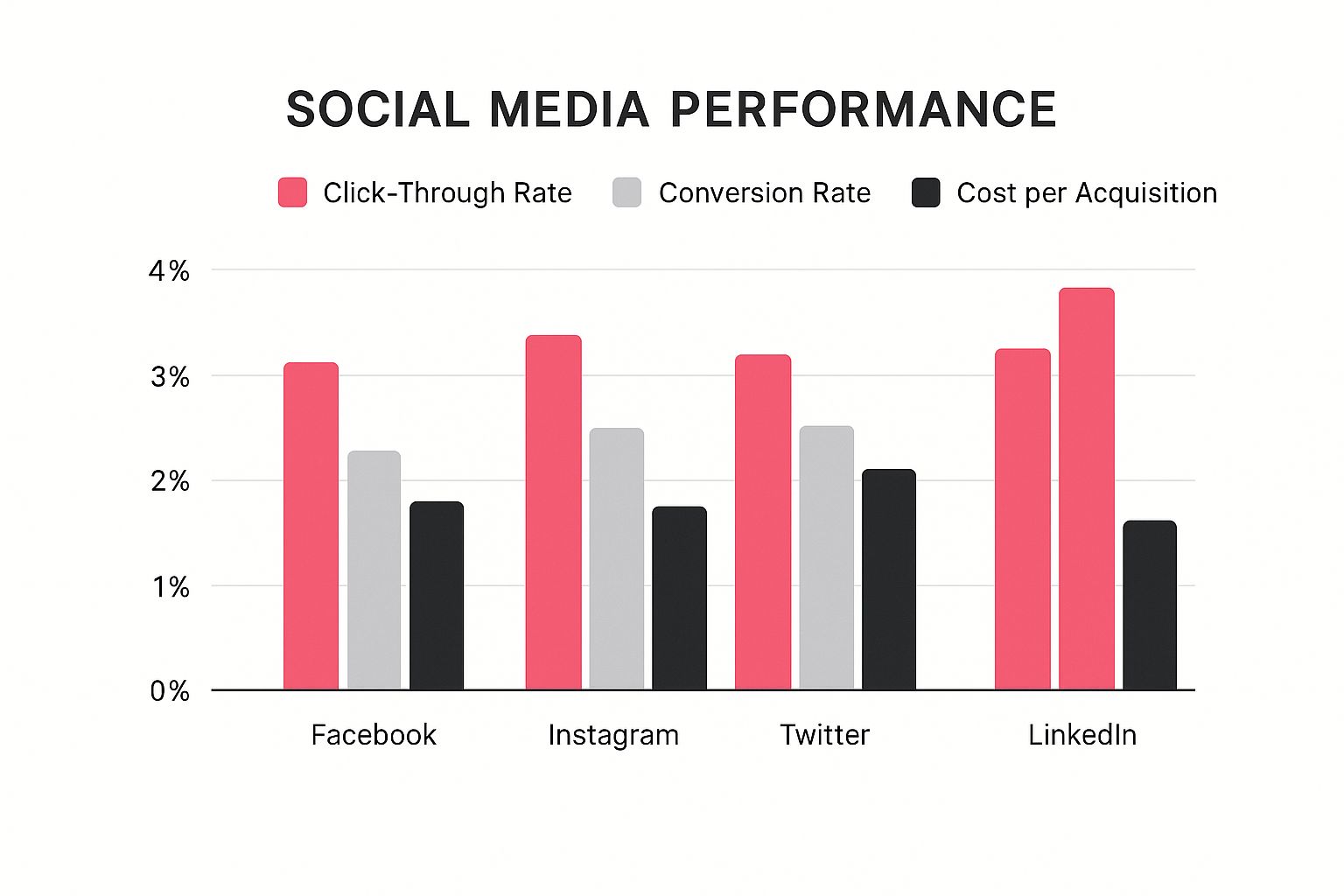
The infographic above shows Click-Through Rate (CTR), Conversion Rate (CR), and Cost per Acquisition (CPA) data across different social media platforms. Clearly, some platforms excel in certain metrics, highlighting the importance of selecting the right platform for your target audience and marketing objectives. Understanding different business models, such as those explored in our article on ecommerce subscription models, can be beneficial as you navigate the world of online sales.
Continuous Improvement and Avoiding Conversion Killers
Website optimization is an ongoing process, not a one-time fix. Regularly analyze data, A/B test elements like headlines, calls to action, and product images, and adapt based on the results. This iterative approach keeps you aligned with evolving consumer behavior. Also, beware of common “best practices” that can actually hurt conversions. For example, complex navigation, excessive pop-ups, and unclear pricing can deter potential customers.
To illustrate common website issues and their solutions, let’s look at the table below:
Common Website Pain Points and Solutions
This table identifies frequent conversion obstacles on ecommerce websites and provides effective solutions to address each issue.
| Conversion Obstacle | Impact on Sales | Recommended Solution | Expected Improvement |
|---|---|---|---|
| Complex Navigation | Decreased user engagement and higher bounce rates | Implement clear and intuitive navigation menus, breadcrumbs, and search functionality | Increased user engagement and conversion rates |
| Excessive Pop-ups | Annoy users and disrupt the shopping experience | Minimize the use of pop-ups and ensure they are relevant and non-intrusive | Improved user experience and conversion rates |
| Unclear Pricing | Creates confusion and mistrust | Display clear and concise pricing information, including any applicable taxes and shipping costs | Increased customer trust and conversion rates |
| Slow Loading Times | Leads to frustration and cart abandonment | Optimize website performance by compressing images, minimizing HTTP requests, and using a Content Delivery Network (CDN) | Improved user experience and conversion rates |
| Lack of Mobile Responsiveness | Alienates mobile users | Implement a responsive design that adapts to different screen sizes | Increased mobile conversions and overall sales |
This table highlights the negative impact of common website issues on sales and offers solutions to improve conversions. By addressing these obstacles, businesses can create a more user-friendly experience and drive sales growth.
By prioritizing user experience and data-driven optimization, you can turn your website into a powerful conversion machine.
Marketing That Actually Converts (Not Just Collects Data)

Many businesses gather significant amounts of data. However, turning that data into higher revenue often proves challenging. The key is to move beyond visually appealing reports. Instead, focus on using data insights to boost online sales.
This requires identifying the important signals within your analytics and discarding the irrelevant noise. This shift from data collection to data application is essential for successful ecommerce marketing.
Understanding Purchase Intent Through Segmentation
Effective customer segmentation involves more than just basic demographics. Rather than simply grouping customers by age or location, analyze their behavior. This helps you understand their purchase intent.
This might include segmenting customers based on past purchases, browsing history, or engagement with marketing campaigns. For example, customers who frequently abandon their carts could receive targeted SMS reminders. Services like CartBoss specialize in this type of communication.
Additionally, consider integrating technologies like augmented reality. This can enhance the customer experience and provide a more interactive way to explore products. Learn more about the potential of augmented reality for ecommerce. This personalized approach caters to each segment’s specific needs.
Scaling Personalized Experiences
Personalization doesn’t need to be complicated or costly. Begin with simple steps, such as personalized product recommendations. These can be based on browsing history. Targeted email campaigns offering discounts on previously viewed items are also effective.
This focused approach is more effective than generic marketing blasts. Personalized SMS messages, particularly for abandoned cart recovery, can significantly boost online sales. CartBoss, with its automated SMS campaigns and pre-written messages, is a valuable tool for this purpose. These tactics can be implemented even with limited resources.
Adaptive Marketing Systems
Successful ecommerce businesses develop adaptable marketing systems. These systems respond to customer behavior in real time. Instead of relying on fixed marketing flows, they use data to adjust strategies dynamically.
This could involve changing website content based on user preferences. It might also involve sending targeted SMS messages based on real-time actions. Examples include browsing specific product categories or adding items to a cart.
Focusing solely on sales volume can be misleading. The growth of ecommerce within the total retail market also plays a crucial role. You can find more detailed statistics at Exploding Topics. By 2025, ecommerce is projected to represent roughly 24% of all retail sales. This dynamic approach allows for more relevant and effective marketing, ultimately boosting online sales.
Building Trust That Translates to Revenue
Trust is absolutely essential in the online marketplace. It’s the foundation of any thriving online business and is key to boosting online sales. But it’s not as simple as just displaying security badges or certifications. It’s about building genuine credibility that resonates with today’s discerning consumers.
This means understanding the psychology behind online trust and how it directly affects purchasing decisions. Some businesses, despite having all the visible “trust signals,” still struggle to turn visitors into paying customers. This often happens because of a gap between what looks like trust and what actually feels authentic.
The Elements of Genuine Credibility
Authentic trust begins with transparency. Be upfront about your business practices, values, and product information. This openness fosters confidence and lays the groundwork for a strong customer relationship.
Also, showing true expertise in your niche builds credibility. Sharing valuable content, providing knowledgeable customer service, and showcasing real-world results increases customer confidence.
For example, a skincare company can increase consumer trust by publishing articles about the science behind its ingredients or by offering free consultations with skincare experts. This shows a commitment to customer education and reinforces their authority in the field.
These actions demonstrate real value, creating stronger trust than superficial badges ever could. This base of transparency and expertise lets you cultivate more meaningful relationships with your customers.
Let’s explore some of the key trust signals that impact consumer behavior and how you can implement them:
To help illustrate this, the following table breaks down various trust signals and their impact:
Trust Signals That Drive Conversions
This table presents different types of trust signals and their relative impact on consumer purchasing decisions.
| Trust Signal | Consumer Impact | Implementation Difficulty | Return on Investment |
|---|---|---|---|
| Secure Checkout (SSL Certificate) | High | Low | High |
| Customer Reviews | High | Medium | High |
| Money-Back Guarantee | Medium | Low | Medium |
| Contact Information (Phone, Email) | Medium | Low | Medium |
| Social Media Presence | Medium | Medium | Medium |
| Professional Website Design | Medium | Medium | Medium |
| Third-Party Security Badges | Low | Low | Low |
| Detailed Product Information | High | Medium | High |
| Transparent Shipping & Returns Policy | Medium | Low | Medium |
As the table indicates, certain trust signals, like secure checkout and customer reviews, have a higher impact on consumer decisions. These should be prioritized when building a trust architecture. Other signals, like third-party security badges, while still valuable, have a lower relative impact.
Handling Negative Feedback to Build Trust
Even with the best efforts, negative feedback is bound to happen. How you handle it, however, can either hurt your reputation or, surprisingly, build customer trust. Addressing negative feedback openly and constructively shows you’re willing to take responsibility and improve. This means responding to complaints publicly, offering solutions, and demonstrating a commitment to customer satisfaction.
Facing negative reviews head-on, instead of trying to hide them, proves to customers that you value their input. This can actually turn a bad experience into a good one, highlighting your dedication to customer service and building stronger trust. This reinforces authenticity and improves customer relationships. You might be interested in: How to master reducing cart abandonment by building credibility.
Building Trust Architectures for Long-Term Growth
Creating a “trust architecture” means aligning every part of your online presence to project trustworthiness. This covers everything from your website design and user experience to your marketing messages and customer service interactions.
A consistent brand voice, clear product descriptions, and a secure checkout process all contribute to a cohesive experience that fosters trust. This approach leads to repeat business and higher average order values.
Also, think about the role of social proof in building trust. Customer testimonials, reviews, and social media engagement can greatly influence buying decisions. These genuine endorsements from actual customers act as strong trust signals, prompting new customers to make a purchase. In the end, a comprehensive trust architecture promotes long-term growth and increases online sales by creating lasting customer loyalty.
Pricing Psychology That Drives Purchase Decisions

Smart pricing strategies can do much more than just lower prices; they can significantly boost online sales. These strategies tap into the psychology of how customers perceive value and make buying decisions. Understanding this connection is crucial for online success.
The Power of Price Perception
The same product can perform very differently at different price points. A higher price can sometimes indicate better quality or exclusivity. But set the price too high, even for a great product, and it can scare customers away.
This highlights how price influences perceived value. For example, a high-end watch brand might set high prices to create an aura of exclusivity and desirability. This perceived value can drive sales, even if production costs are similar to a less expensive brand. Finding that sweet spot for pricing takes careful analysis and testing.
Tiered Offerings and the Decoy Effect
Offering products in tiers can subtly guide customers towards higher-value purchases. This means presenting several options, each with increasing features and corresponding price points.
This strategy uses the decoy effect. A less attractive option makes a more expensive option seem more appealing. Imagine offering “basic,” “premium,” and “deluxe” subscriptions. Customers often choose the premium option, even if it’s not the cheapest. This tactic cleverly boosts online sales by leading customers to select higher-priced tiers.
Discounting Strategies: When Less Is More
Discounts can definitely drive sales, but too many can hurt your brand’s image. Constant sales can train customers to only buy when there’s a discount. This reduces profits over time.
However, well-timed discounts, like during promotions or holidays, can be very effective. The goal is to balance attracting customers with discounts while maintaining a premium image. Learn more about strategic discounting for cart recovery. Understanding when a discount will boost online sales versus when it will lower perceived value is key.
Bundling and Upselling for Increased Value
Bundling products can increase the average order value. This strategy offers a group of products at a lower price than buying them separately. This encourages larger purchases and increases overall revenue.
Upselling encourages customers to choose a more expensive product version or add extra features. Both bundling and upselling are proven ways to boost online sales by adding value to every purchase.
Creating Urgency Without Manipulation
Creating a sense of urgency can encourage purchases without being manipulative. This could involve highlighting limited-time offers, limited quantities, or bonuses for quick purchases. This prompts immediate action and reduces abandoned carts.
For example, a message like “Only 5 left in stock!” can effectively create urgency. This works especially well when combined with other pricing strategies like discounts or bundles. The key is to be ethical and authentic and avoid misleading customers.
Crafting Customer Journeys That Actually Convert
The difference between a thriving ecommerce business and one that’s just scraping by often comes down to the customer experience. This isn’t just about keeping customers happy; it’s about strategically designing customer journeys that consistently increase online sales. This involves understanding how customers interact with your brand at every point, from their first encounter to what happens after they buy, and then fine-tuning each step for maximum conversions.
Identifying and Eliminating Friction Points
Imagine the customer journey as a river. Any obstacles, like rocks or debris, create friction and disrupt the smooth flow. In the world of ecommerce, these “rocks” are friction points that get in the way of someone making a purchase. These can be anything from a website that’s hard to navigate to a checkout process that’s overly complicated. Pinpointing these friction points is the first step to a better customer journey.
For example, if shoppers frequently abandon their carts when they get to the shipping information, there might be a problem with your shipping options or the cost. Or, if customers have trouble finding product details, the issue could be with your site’s search function or how product pages are organized. Addressing these problems directly creates a smoother experience and makes a sale more likely.
Personalization Without the Tech Overhaul
Personalization is key for boosting online sales, but you don’t need to spend a fortune on new technology. Start with the basics: suggest products based on what a customer has browsed or bought before. Targeted emails with discounts on items they’ve looked at can also be very effective. These simple, data-driven approaches improve the customer experience and encourage repeat purchases.
Using dynamic content on your website can also add a personal touch. You could display different main images or promotional banners based on customer groups. Returning customers might see new arrivals or loyalty programs, while first-time visitors see introductory offers or bestsellers. These personalized touches can noticeably improve conversion rates.
Transforming One-Time Buyers into Loyal Advocates
The customer journey doesn’t stop after a purchase. What happens after the sale is crucial for building loyalty and encouraging repeat business, which ultimately drives online sales. This is more than just sending order confirmations; it’s about building a relationship.
Send personalized follow-up emails with product care tips or suggestions for related products. Offering exclusive discounts or early access to sales makes customers feel valued and encourages them to shop with you again. Check out our guide on Customer Journey Mapping. Proactive customer support, like follow-up SMS messages to check on their satisfaction or offering helpful resources related to their purchase, can also greatly improve the post-purchase experience. This not only takes care of immediate questions but also lays the groundwork for long-term loyalty.
Auditing and Optimizing Your Customer Journey for Measurable Growth
To really boost those online sales, regularly review your current customer journey. Find areas to improve by looking at website data, customer feedback, and sales reports. This big-picture approach helps you see what’s working and what’s not, so you can focus on improvements with the greatest impact.
Focus on the changes that give you the biggest bang for your buck. For example, if lots of customers abandon their carts during checkout, making the checkout process easier should be a top priority. If navigation is a problem, fixing that should come before other less important changes. This strategic approach ensures you’re putting your energy where it matters most for your bottom line.
By making changes that create memorable experiences and remove obstacles, you can drive real sales growth. Remember, optimizing the customer journey is an ongoing process. By paying attention to customer behavior and making data-driven decisions, you can make sure your customer journey is always working to boost your online sales.
Measuring What Matters: Beyond Basic Sales Metrics
To consistently boost online sales, you need to dig deeper than just looking at overall revenue. While top-line numbers offer a glimpse of your current performance, they don’t tell the whole story about future growth. This section explores the data points that truly indicate long-term success and how to avoid getting sidetracked by vanity metrics.
Establishing Meaningful Benchmarks
Before you can accurately measure progress, you need to set relevant benchmarks. This means understanding the industry averages for key metrics like conversion rates, average order value (AOV), and customer lifetime value (CLTV). Looking at successful ecommerce businesses in your niche can reveal realistic goals and inspire new strategies. For example, if the average conversion rate in your industry is 2%, aiming for 3% could be a reasonable starting point. This focused approach allows for targeted optimization.
Actionable Insights, Not Data Overload
Implementing tracking systems that offer actionable insights is critical. Many businesses get bogged down collecting mountains of data without a clear plan for how to use it. This leads to information overload and missed opportunities. Focus on tracking the metrics that directly impact revenue growth and build systems that deliver concise reports highlighting key trends and actionable recommendations. Focusing on the right data ensures your efforts directly contribute to maximizing sales.
For example, instead of just monitoring website traffic, analyze which sources are driving the most conversions. This nuanced approach allows you to optimize your marketing budget and concentrate on the channels delivering the best ROI. This targeted strategy maximizes your resources and drives online sales growth.
Testing Frameworks for Continuous Improvement
Creating robust testing frameworks is essential for ongoing improvement. This involves A/B testing various website elements, marketing campaigns, and pricing strategies. Testing helps you understand what resonates with your audience and refine your approach based on data-driven insights. It’s like perfecting a recipe: through experimentation and measurement, you find the best ingredients and proportions for the desired outcome.
Beyond Simple Acquisition Cost: Understanding True Value
Calculating true customer acquisition cost (CAC) goes beyond the initial expense of acquiring a customer. It requires considering their long-term value, their potential for repeat purchases, and how likely they are to refer new business. This comprehensive view of CAC provides a clearer picture of marketing ROI and improves budget allocation.
Mastering Attribution in Complex Buying Journeys
Customer journeys are becoming increasingly intricate, involving many touchpoints across various channels. Correctly attributing conversions to the right marketing initiatives is essential for optimizing your strategy. This might involve using advanced attribution models that factor in the influence of each touchpoint along the customer’s path to purchase.
Balancing Data with Innovation
Finally, nurturing a culture of data-driven decision-making is crucial. However, this shouldn’t stifle creative innovation. It’s vital to strike a balance between analytical rigor and creative experimentation. Data should inform your decisions, but it shouldn’t prevent you from exploring new ideas and adapting to the evolving ecommerce landscape.
Ready to transform abandoned carts into profit and boost your online sales by up to 50%? Explore the power of CartBoss today!