


At its core, marketing automation for ecommerce is all about using smart software to handle the repetitive, time-sucking marketing tasks that bog you down. Think of it as the engine powering perfectly timed abandoned cart reminders or personalized welcome emails—all without you lifting a finger. It completely changes how you talk to customers, making every interaction feel relevant and personal, even as you scale.
Why Automation Is a Game Changer for Ecommerce
Let’s cut through the noise. In a market this crowded, a great product isn’t enough. The real differentiator is an exceptional customer experience, and this is where marketing automation for ecommerce becomes your growth engine, not just another tool. It closes the gap between what customers expect and what your team can realistically deliver by hand.
Today’s shoppers demand conversations that are tailored to their journey. A generic email blast to your entire list just doesn’t work anymore. Automation lets you build experiences based on actual customer behavior. For instance, if someone spends time browsing your sneaker collection, they can automatically get an email showing off related new arrivals. This isn’t robotic—it’s just being incredibly responsive at the perfect moment.
From Manual Effort to Scalable Growth
Could you imagine trying to personally track every single abandoned cart? Or manually sending a “thank you” email after every purchase? It’s simply impossible for a growing store. Automation steps in and handles these critical touchpoints consistently, 24/7.
This frees up your team to focus on big-picture strategy—like product development or brand building—instead of getting lost in the weeds of repetitive tasks. For smaller shops, it’s a massive force multiplier. To see how it empowers even the smallest teams, check out our guide on how marketing automation for small business levels the playing field.
The results are tangible and directly tied to your bottom line. With smart automation, you can drive real improvements in key metrics:
- Higher Customer Lifetime Value (CLV) by nurturing relationships with post-purchase follow-ups and loyalty rewards.
- Increased Conversion Rates through timely abandoned cart reminders that bring back otherwise lost sales.
- Improved Customer Engagement by sending personalized birthday offers or re-engagement campaigns to shoppers who’ve gone quiet.
At the end of the day, the magic of automation is its ability to create personalized dialogues at scale. It makes every customer feel seen and valued, which is the absolute cornerstone of building a loyal brand community.
The Undeniable Link Between Automation and Growth
The data doesn’t lie. Research shows a powerful link between using automation and business expansion. A recent study found that a staggering 85.7% of companies that grew their sales by 30% to 50% were actively using automation tools.
On the flip side, nearly 60% of companies that saw no growth weren’t using any automation at all. The takeaway is clear: integrating automation is no longer just an option; it’s a strategic must for any ecommerce business serious about growth.
To give you a clearer picture, I’ve broken down some of the most critical automation workflows and the specific goal they help you achieve.
Core Automation Workflows and Their Business Impact
This table outlines the essential automated campaigns that deliver the biggest bang for your buck in ecommerce, connecting each workflow to a clear business objective.
| Workflow Type | Primary Goal | Key Metric to Track |
|---|---|---|
| Welcome Series | Nurture new subscribers and drive the first purchase. | First-time purchase rate |
| Abandoned Cart | Recover lost sales from shoppers who left checkout. | Cart recovery rate |
| Browse Abandonment | Re-engage window shoppers who viewed products. | Click-through rate |
| Post-Purchase Follow-up | Build loyalty, get reviews, and encourage repeat sales. | Repeat purchase rate |
| Customer Win-Back | Re-activate dormant customers before they churn. | Re-engagement rate |
| Birthday/Anniversary | Delight customers with personalized, timely offers. | Redemption rate |
These are just the starting points. Once you have these foundational workflows running, you can get even more creative with VIP campaigns, back-in-stock alerts, and cross-sell recommendations. Each one plays a part in building a smarter, more profitable business.
Setting Up Your Ecommerce Automation Engine

Diving into marketing automation for ecommerce without a plan is like building a house without a blueprint. It’s a recipe for disaster. Before a single automated workflow can go live, you need to pour a solid foundation. This means picking the right tools for your store, ensuring your data is connected properly, and setting goals you can actually measure.
Getting this initial setup right is non-negotiable. It’s what separates a fine-tuned revenue machine from a clunky system that just spams the wrong people at the wrong time. Let’s walk through how to build your foundation the right way.
Choosing Your Automation Platform
First things first: you need to select the software that will power your entire strategy. The market is flooded with options, but the decision really comes down to one thing: how well does it play with your specific ecommerce platform, whether that’s Shopify, WooCommerce, or something else.
Deep integration is everything. Your automation tool can’t just be a glorified email sender. It needs to be the central nervous system for all your customer data, seamlessly pulling in who your customers are, what they’re buying, and how they behave on your site.
When you’re shopping around, keep an eye out for these must-have features:
- Native Ecommerce Integration: A one-click connection to your store is a non-starter. This ensures order history, product catalogs, and customer profiles sync up without you having to lift a finger.
- Visual Workflow Builder: You shouldn’t need a computer science degree to build powerful automations. A simple drag-and-drop interface is key for visualizing and creating customer journeys.
- Multi-Channel Capabilities: Customers don’t just live in their inboxes anymore. You need a platform that can send messages across different channels like SMS and push notifications. Our guide on SMS marketing best practices is a great resource if you’re looking to add text messages to your strategy.
- Robust Segmentation: The magic of automation lies in personalization. Your tool absolutely must let you create dynamic customer segments based on real-time behavior, like purchase frequency or products viewed.
Connecting Your Data Sources Correctly
Once you’ve picked your platform, it’s time to hook it up to your store. This is more than just flipping a switch. You need to double-check that all the right data is flowing through, because a bad connection leads to bad segmentation and, ultimately, irrelevant messages.
Think of it like plumbing. If the pipes aren’t connected right, water won’t get where it needs to go. Same deal with your customer data.
Pro Tip: After you integrate, run some tests. I always recommend placing a test order and abandoning a cart yourself. Then, log into your new tool and see if that activity showed up correctly. This one simple step can save you a world of headaches later.
The end goal here is to create a unified view of your customer. You want to be able to see every single interaction they’ve had with your brand—every product viewed, every cart addition, every purchase. That complete picture is the fuel for truly effective automation.
Defining Specific and Measurable Goals
With your tech stack sorted, it’s time to move from the “how” to the “why.” Vague goals like “increase sales” are completely useless in the world of automation. You need to get specific. Every single workflow you build should be tied to a clear, measurable objective.
Instead of shooting for the moon with generic targets, get granular. Your goals should sound like this:
- “Reduce our abandoned cart rate from 75% to 60% within the next 90 days.”
- “Boost the repeat purchase rate from our welcome series to 15%.”
- “Generate an extra $10,000 in monthly revenue directly from our win-back campaign.”
See the difference? These goals are powerful because they’re actionable. They give you a clear target to aim for and let you measure the direct financial impact of your marketing automation for ecommerce. Every workflow should be built to achieve one of these outcomes, turning your automation efforts from a simple marketing task into a core driver of growth.
With your automation platform picked out and your goals locked in, it’s time to get to the good stuff. This is where we stop talking theory and start building the automated email sequences that will become your store’s most reliable money-makers. Think of these workflows as your elite sales team, working 24/7 behind the scenes.
We’re going to focus on three core workflows that, in my experience, deliver the biggest punch right out of the gate. These aren’t complicated, pie-in-the-sky ideas; they are proven, high-performing sequences that drive sales, build loyalty, and claw back revenue you would have otherwise lost. Getting these right is the foundation of solid marketing automation for ecommerce.
The stats here are almost hard to believe until you see them in action. Automated emails generate up to 30 times more revenue per recipient than your typical one-off campaigns. And get this—while they make up only 1.8% of total email sends, they drive a staggering 31% of all email orders. It’s a crystal-clear sign that relevance and timing are everything. You can dig into more of these powerful marketing automation statistics to see the full picture.
The Essential Welcome Series
Your welcome series is your one and only shot at making a killer first impression. The moment someone hands over their email address, they are at their absolute peak engagement. Your job is to grab that moment by rolling out the red carpet, sharing what your brand is all about, and gently steering them toward that first purchase.
A great welcome series does more than just spit out a “thanks for signing up” message. It needs to:
- Tell Your Story: What makes you different? Share your mission, your origin story, or the unique problem you’re solving.
- Set Expectations: Let people know what you’ll be sending and how often. No one likes surprises in their inbox.
- Give Instant Value: Hook them up with a small discount, free shipping, or a useful piece of content. Reward them for joining the club.
A simple but super effective three-part welcome series usually looks something like this:
- Email 1 (Immediately): Deliver the goods. Send that 10% off code you promised and give them a warm, genuine welcome.
- Email 2 (1 Day Later): Show off your greatest hits. Highlight best-selling products or popular categories, and sprinkle in some social proof like customer reviews.
- Email 3 (3 Days Later): Go a little deeper. Talk about what makes you unique. This is how you build a real connection that goes beyond just selling stuff.
Here’s a pro tip: Don’t just build one generic welcome flow. Think about creating a separate journey for a first-time buyer versus someone who just subscribed to your newsletter. The buyer already knows your products, so their welcome series can focus more on loyalty and getting the most out of their new purchase.
The Abandoned Cart Recovery Machine
This is it. This is hands-down the single most profitable automation you will ever build for your store. Nearly 70% of all online shopping carts are abandoned. Let that sink in. That’s a massive pile of potential revenue just sitting there, waiting for a little nudge. A well-timed abandoned cart sequence is your secret weapon for bringing those shoppers back to finish what they started.
The trick to a successful cart recovery flow is a simple mix: speed, a little persuasion, and a gentle reminder. Don’t wait around.
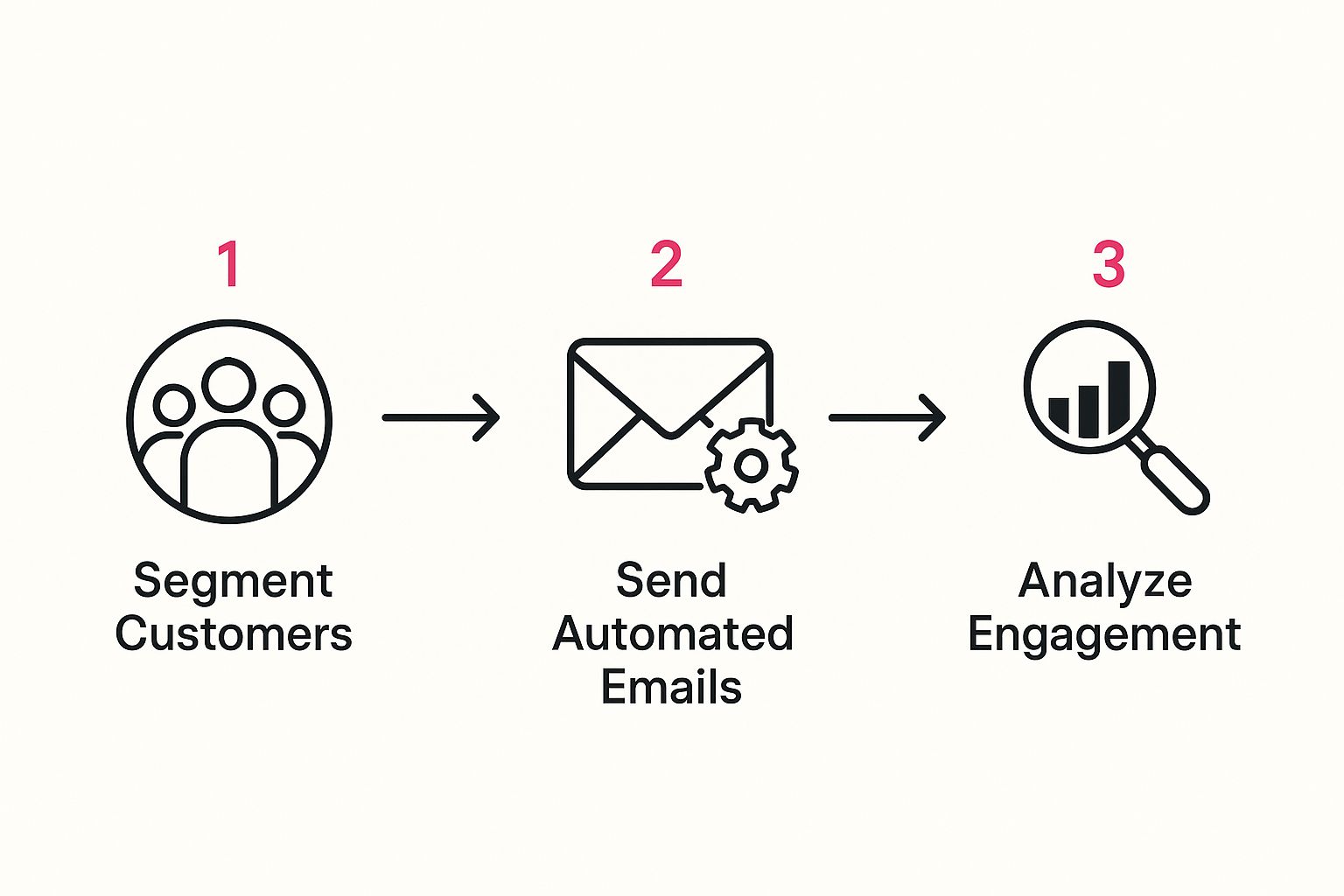
This flow isn’t just about blasting out emails; it’s about sending the right emails based on smart segmentation. From there, you learn from the engagement data and keep making it better over time.
A proven timing strategy that works for most stores is:
- Email 1 (1 Hour After Abandonment): A simple, helpful reminder. Something like, “Did you forget something?” Keep the tone light and always include a direct link back to their cart.
- Email 2 (24 Hours Later): Time to add a touch of urgency or address common hang-ups like shipping costs. This is a good spot to introduce a small incentive—think free shipping or a modest discount—if they still haven’t bitten.
- Email 3 (48-72 Hours Later): This is your final shot. Amp up the urgency (“Your cart is about to expire!”) and really sell the value of your products one last time.
The Post-Purchase Follow-Up
So many stores drop the ball here. They think the customer journey ends at checkout. The truth is, that’s where the most important part begins: building a real, long-term relationship. The post-purchase window is your golden opportunity to turn a one-time buyer into a repeat customer and, eventually, a loyal fan.
A solid post-purchase workflow has a few key jobs:
- Build Excitement: Confirm their order and thank them. You want to reinforce that they just made a really smart decision.
- Ask for a Review: A week or two after the product has landed, ask for their feedback. User-generated content is pure marketing gold.
- Cross-Sell or Upsell: Look at what they bought and recommend complementary products they might actually love.
- Educate and Add Value: Send them tips on how to use or care for their new item. This adds value way beyond the initial transaction.
By putting these three workhorses in place, you’re not just sending emails. You’re building an automated system that nurtures new leads, recovers lost sales, and builds lasting customer relationships—all while you sleep.
Using Customer Data for Smarter Personalization
If you’ve set up your core automation workflows, you’ve built the engine. Now it’s time to add the high-octane fuel: your customer data. This is where solid marketing automation for ecommerce becomes truly exceptional. We’re moving beyond just scheduling messages and diving into the kind of deep, data-driven personalization that makes customers feel like you genuinely get them.
A generic automated message is a decent starting point, but its effectiveness has a cap. To really break through that ceiling, you need to start turning your broad campaigns into what feel like one-on-one conversations. That means using every bit of data you’ve collected—from what they’ve bought before to the pages they browsed last week—to craft experiences that are uniquely relevant to each shopper.
Moving Beyond Basic Segmentation
Real personalization is so much more than just dropping a {{first_name}} tag into a subject line. The magic happens with intelligent, dynamic segmentation. Instead of lumping your entire audience into one bucket, you can create segments that automatically update based on what your customers are doing in real-time.
Just think about the different types of shoppers you have. There are first-time buyers testing the waters, die-hard fans who buy every new release, and the bargain hunters who only show up for a sale. Sending the same email to all three is a massive missed opportunity.
With smart segmentation, you can speak directly to what motivates each group. For instance, you could create segments for:
- VIP Customers: Anyone who has spent over $500 total.
- Brand Enthusiasts: Shoppers who have bought multiple items from a specific category, like your “Outdoor Gear” collection.
- Deal Seekers: Customers who have only ever bought something using a discount code.
- At-Risk Customers: People who haven’t made a purchase in the last 90 days.
These aren’t static lists you have to manually update. They’re living, breathing groups that customers flow in and out of based on their behavior, ensuring the right message always hits the right inbox at the perfect time.
Putting Advanced Segments into Action
Once these smart segments are in place, you can build some incredibly targeted and effective automation workflows. Let’s walk through a couple of real-world scenarios you could set up right now to get immediate results.
Scenario 1: The Proactive Win-Back Campaign
Don’t wait six months to realize a customer has churned. Use your “At-Risk Customers” segment to trigger a win-back flow the moment they start to drift away.
- Trigger: A customer automatically enters this segment after 90 days of no purchase activity.
- Email 1 (Day 91): Send a friendly, low-pressure “We Miss You!” email. Don’t push a sale just yet. Remind them what makes your brand great and maybe show off a few new arrivals you think they’d like.
- Email 2 (Day 97): If they still haven’t engaged, now’s the time for an incentive. Send a small, exclusive offer like 15% off their next order, framed as a special gift to welcome them back.
This proactive approach can stop customer churn in its tracks, turning a potential loss into another sale.
Scenario 2: The Hyper-Relevant Cross-Sell Flow
Imagine a customer just bought a new tent from your “Outdoor Gear” collection. Instead of a generic “Thanks for your order!” email, you can use their purchase data to offer the perfect add-on.
- Trigger: The customer purchases any item from the “Outdoor Gear” category.
- Email (3 days later): Send an email with a subject line like “Complete Your Adventure Kit.”
- Content: Inside, showcase products they’ll actually find useful, like a high-quality sleeping bag, a durable backpack, or a portable stove that complements their new tent.
This isn’t just a random upsell; it’s a genuinely helpful recommendation that makes their original purchase even better. When you truly embrace data-driven marketing strategies, you start turning customer insights directly into profit.
By deeply understanding where each customer is in their lifecycle, you can create automations that feel less like marketing and more like a personal shopping assistant. This level of detail is what builds loyalty and drives significant long-term revenue.
To make this even more powerful, you can map out these touchpoints visually. Our guide on building an https://www.cartboss.io/blog/ecommerce-customer-journey-map/ is a great place to start identifying those key moments for personalization. This is the secret to making every single customer feel like they’re your only customer.
How to Measure and Scale Your Automation Success
Getting your first automated workflows live is a fantastic milestone, but the real work starts now. The single biggest mistake I see stores make with marketing automation for ecommerce is treating it like a crock-pot—”set it and forget it.” That’s a recipe for leaving money on the table.
True success comes from a relentless focus on measuring what works and strategically scaling up. Your initial automations are just the first draft. Now, it’s time to refine, edit, and expand based on real customer behavior. This is how you turn a neat tool into a core engine for your store’s growth.
Looking Beyond Surface-Level Metrics
Open rates and click-throughs are fine for a quick pulse check, but they don’t pay the bills. To understand the real impact of your automation, you have to tie everything back to revenue. It’s great that people are opening your emails, but are those emails actually convincing them to buy?
For every single workflow—from your welcome series to abandoned carts and post-purchase follow-ups—you need to be tracking these KPIs:
- Conversion Rate per Email: What percentage of people who get a specific email in a sequence actually complete a purchase?
- Revenue per Recipient: On average, how much money does each person entering a workflow generate for your store?
- Total Revenue per Workflow: What’s the total dollar amount each automated sequence has brought in? This is your bottom line.
- Average Order Value (AOV): Are customers who interact with your automations spending more than those who don’t?
Most automation platforms make this easy to track right from your dashboard. Keep a close eye on these numbers. You’ll get a crystal-clear picture of what’s working, and you’ll quickly find that your abandoned cart flow is probably your most valuable player. To really double down on that, our guide on how to master ecommerce checkout optimization can give you some powerful complementary strategies.
The Art of Continuous A/B Testing
Once you have a handle on your baseline performance, the real fun begins. A/B testing is your secret weapon for making small, consistent improvements that stack up into massive gains over time. The key is to be methodical. Don’t try to test five things at once; you’ll never know what actually moved the needle. Isolate one variable at a time for clean, actionable data.
Start by testing the highest-impact elements in your most profitable workflows. For an abandoned cart sequence, that could mean testing:
- Subject Lines: Pit a direct, urgent subject line (“You left something behind”) against one focused on benefits (“Your items are waiting… and they’re worth it”).
- Send Times: Does an email sent one hour after abandonment crush one sent three hours later? There’s only one way to find out.
- Incentives: Does a 10% discount convert better than a simple free shipping offer? The answer often isn’t what you’d expect.
The point of A/B testing isn’t just to find one “winner” and call it a day. It’s about creating a culture of continuous optimization where you’re always learning what makes your customers tick.
Scaling Your Automation Strategy
With your core workflows dialed in and performing well, it’s time to look for new opportunities. Scaling your automation means identifying more moments in the customer journey where a timely, relevant, and automated message can make a real difference. The goal is to create more personalized touchpoints that feel genuinely helpful, not spammy.
Think about adding some of these powerful automations to your strategy:
- Birthday and Anniversary Campaigns: This is low-hanging fruit. A simple “Happy Birthday!” email with a special discount is one of the easiest ways to delight a customer and drive an impulse purchase.
- Replenishment Reminders: An absolute must-have if you sell consumables like coffee, supplements, or skincare. Automatically ping customers with a re-order reminder right when they’re about to run out.
- Loyalty Program Triggers: Don’t just let customers earn points in silence. Send automated messages when they reach a new loyalty tier, unlock a reward, or have points that are about to expire.
Looking ahead, the future of marketing automation for ecommerce is getting even smarter. The global AI-powered automation market is on track to hit $8.65 billion by 2025 for a reason. Sales teams already report a 14.5% productivity bump from using these tools. Modern AI can now help predict customer churn or suggest the next best product, giving you an incredible edge. This is how you stay ahead of the curve.
Common Questions About Ecommerce Automation
Diving into marketing automation for your ecommerce store can feel like a huge leap, so it’s totally normal to have questions. You’re probably wondering about the costs, whether you need to be a tech wizard, or how soon you can actually expect to see a return.
Let’s clear up some of the most common uncertainties. Getting these answers will help you move forward with confidence, knowing your strategy is built on solid ground.
How Much Does Ecommerce Automation Cost?
The price tag on automation tools can swing wildly, but it’s probably more accessible than you think. Costs usually depend on the size of your contact list and the features you’re after. Many platforms offer free or very affordable entry-level plans for stores just getting their feet wet, often starting in the $20-$50 per month range.
Of course, as your store grows, these costs can scale up into the hundreds or even thousands each month. The key thing to focus on is the return on investment (ROI). A solid automation platform should bring in way more revenue through recovered sales and repeat business than it costs you.
Can I Set Up Automation Without a Developer?
Yes, absolutely. Modern ecommerce automation platforms are built for marketers, not coders. The days of needing a developer just to get a simple email campaign off the ground are long gone. These tools are packed with intuitive, visual, drag-and-drop workflow builders that make the whole process a breeze.
You can set up all the high-impact essentials we’ve talked about—like welcome series and cart recovery—without ever looking at a line of code. Most have seamless one-click integrations with major platforms like Shopify and WooCommerce that handle all the technical heavy lifting for you.
Today’s tools are all about empowerment. They’re designed to put sophisticated marketing power right in your hands, letting you react to customer behavior in real-time without hitting any technical walls.
How Quickly Will I See Results?
This is one of the most exciting parts—marketing automation can deliver results incredibly fast. You can see a measurable impact almost immediately after you launch your first couple of workflows.
An abandoned cart sequence, for instance, will start bringing back lost sales the very first hour it goes live. In fact, many store owners find this one workflow pays for the platform’s subscription cost several times over. For a deeper look, our guide breaks down some powerful ways to recover abandoned carts and pump up your revenue.
While a fully fleshed-out strategy will mature over time, you should definitely be able to measure a real lift in both conversions and revenue within your first 30 days.
What Are the Biggest Mistakes to Avoid?
The most common trap is trying to do too much, too soon. It’s tempting to build out a dozen complex workflows on day one, but that usually just leads to confusion and burnout. Instead, start with the fundamentals:
- The Welcome Series: Perfect for nurturing new leads.
- The Abandoned Cart Flow: Your go-to for recovering immediate revenue.
- The Post-Purchase Follow-Up: A must-have for building customer loyalty.
Another mistake is blasting out generic, one-size-fits-all messages. You have to use segmentation to personalize the experience. Finally, avoid a “set it and forget it” mindset. The best results always come from constantly testing and optimizing your automations based on real performance data.