


An SMS autoresponder is a handy tool that automatically sends out pre-written text messages when certain conditions are met. Think of it as a digital assistant for your text messages, always ready to reply so no customer is left hanging.
This isn’t just about sending automated replies; it’s a system that works for you 24/7 to engage customers, confirm their actions, and deliver information the moment they need it.
How an SMS Autoresponder Actually Works
At its heart, an SMS autoresponder runs on a simple but very effective “if-then” logic. When a specific thing happens (the “if”), the system automatically does something you’ve already told it to do (the “then”).
This whole process is automated, which means you don’t have to manually reply to every common question or action. It’s all about providing instant, relevant communication, which is exactly what people expect these days. SMS is a huge deal globally, with a user base expected to hit about 5.9 billion by 2025.
The Trigger and Response Formula
The real power of an SMS autoresponder is how it connects a trigger to a response. A trigger is just the specific event that starts the automated message. This could be something a customer does, or even just a pre-set time.
Once that trigger is pulled, the system instantly sends out the message you’ve already written for that exact situation. This makes sure every message is not only sent at the perfect time but also sounds exactly like your brand.
This simple graphic shows you the basic flow of how an autoresponder handles a message.
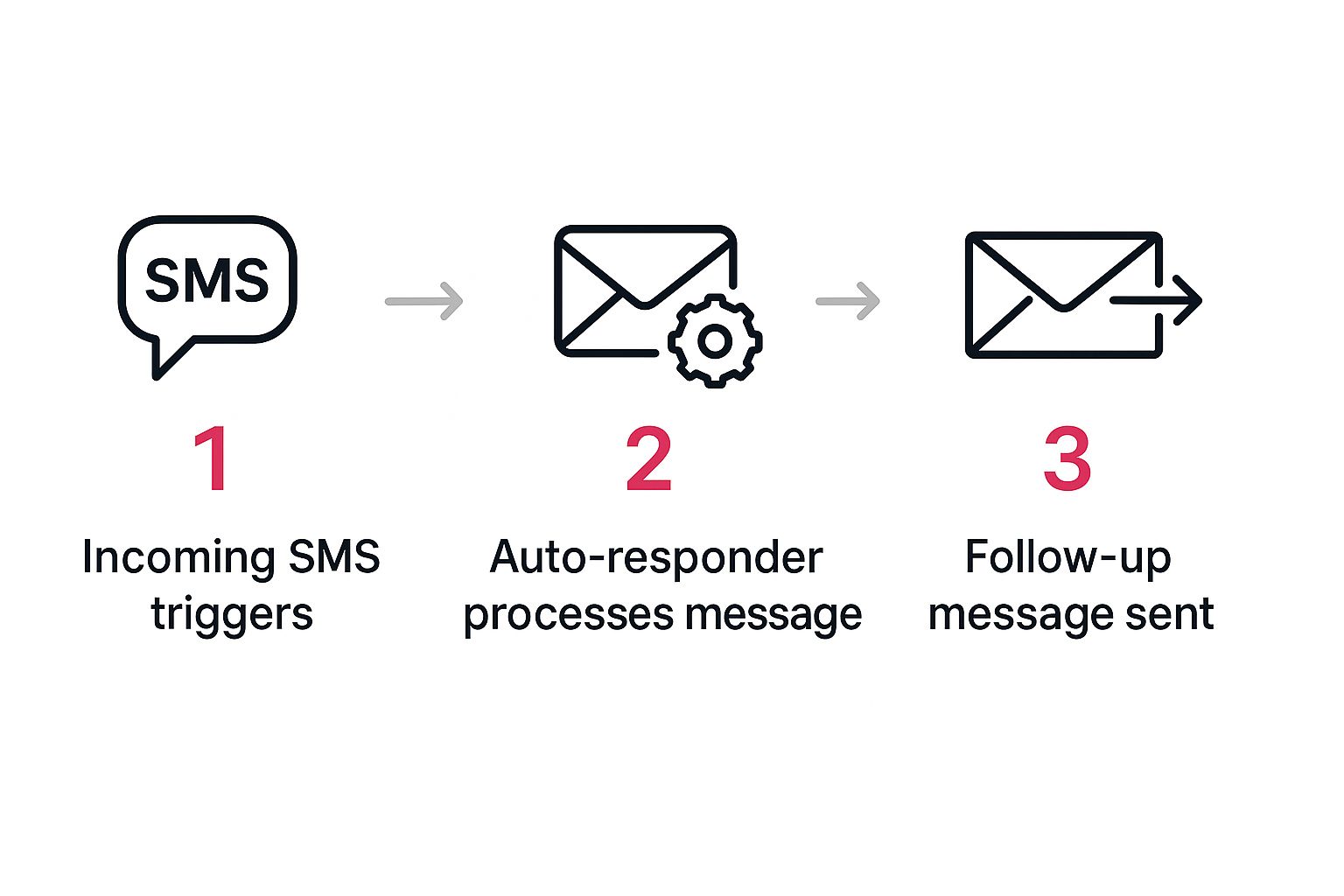
As you can see, it’s a clean, three-step sequence: a customer takes an action, the system processes it, and an automated text is sent right away.
Common Triggers for Automated Texts
The beauty of an SMS autoresponder is its flexibility, which all comes down to the different triggers you can set up. Each one can be used for a different part of your business, from customer support to making a sale.
Here are a few of the most common and effective triggers:
- Keyword-Based Triggers: A customer texts a specific word to your number, like “SALE” or “HELP”.
- Action-Based Triggers: A customer does something, like completing a purchase, signing up for your newsletter, or abandoning their cart.
- Time-Based Triggers: A message is scheduled to go out a certain number of hours or days after something happens, like sending a follow-up survey a week after a purchase.
By setting up these triggers, you’re basically creating a system that works around the clock for you. It’s not just about firing off messages; it’s about delivering the right message at the right moment. For a deeper look, check out our guide on how to set up an automatic text message response.
Why Automated Texting Is a Game Changer
An SMS autoresponder does a lot more than just send out messages on its own. It fundamentally changes how you connect with customers and run your business day-to-day. Think of it as a force multiplier, letting you achieve so much more without having to do all the work yourself. It turns your business number into a smart, always-on tool.
This simple shift moves your business from being reactive—always trying to catch up with questions and requests—to being proactive. Instead of spending your day manually typing out order confirmations or business hours, you get that time back to focus on tasks that actually grow your business. The impact on your daily workflow is immediate and huge.
Reclaim Your Time with Automation
Just think about all the repetitive questions your team answers every single day. Things like “Where’s my order?”, “When are you open?”, or “Do you have any sales on?” can eat up hours of precious time. An SMS autoresponder takes care of these common queries instantly, freeing up your team to handle the more complex customer issues that really need a human touch.
This isn’t just about being more efficient; it’s about being able to scale. As your business grows, so does the flood of messages. An automated system handles that increase without breaking a sweat, ensuring every customer gets a quick reply without overwhelming your staff.
Create an Unforgettable Customer Experience
In a crowded market, the experience you provide can make all the difference. Instant responses make customers feel like you’re paying attention and that you value their time. Getting an immediate text confirming their order, for example, builds confidence right after a purchase and cuts down on that dreaded buyer’s remorse.
This kind of instant communication really sets a high bar for customer service. Let’s break down the benefits:
- Immediate Acknowledgment: Your customers know their message landed, which gets rid of the anxiety of waiting for someone to get back to them.
- Consistent Brand Voice: You craft every automated message, so you can be sure the tone and accuracy are on-brand, every single time.
- 24/7 Availability: Your business is essentially always “open” to provide info and support, even when your team is at home. This builds a ton of trust and reliability.
When you meet the modern customer’s expectation for immediate answers, you’re laying the groundwork for real, long-term loyalty. A customer who gets a quick shipping update is far more likely to come back than one left in the dark wondering where their package is.
Drive Sales and Nurture Leads Around the Clock
Here’s where it gets really powerful. You can turn your SMS channel into a sales engine that never sleeps. When a potential customer texts a keyword like “DEAL” at midnight, an SMS autoresponder doesn’t wait for business hours. It fires back a promo code right away, capturing their interest when it’s at its absolute peak.
This completely changes how you can approach lead generation and sales. The system can nurture leads with perfectly timed follow-ups, win back abandoned carts with automated reminders, and drive sales with promotions that hit at just the right moment. It’s a proactive tool that works 24/7 to boost your bottom line. To get a better sense of how this works on a larger scale, digging into the principles of marketing automation can shed light on the broader power of these tools. This constant engagement means you never miss an opportunity, turning every incoming text into a potential sale.
Putting Your Auto Responder to Work
Knowing how an SMS autoresponder works is one thing, but seeing it drive real growth for your store is something else entirely. In e-commerce, these automated messages aren’t just a convenience; they’re your secret weapon for boosting sales, delighting customers, and building a brand people love.
Think of each automated text as a direct line to your customer at the perfect moment. From the second they hit “buy” to long after their package arrives, you have a golden opportunity to create a smooth, reassuring experience that keeps them coming back for more.
High-Impact E-commerce Scenarios
The most powerful SMS strategies all follow a simple “trigger and response” formula. A specific customer action triggers a perfectly timed, pre-written message designed to achieve a clear business goal. This keeps every text you send feeling relevant and valuable, not spammy.
Here are some of the most profitable ways e-commerce stores put an SMS auto responder to work:
- Instant Order Confirmations: The moment a customer completes a purchase, an automated text hits their phone confirming the order. This simple message instantly wipes away any post-purchase anxiety and reinforces their buying decision, starting the relationship off on the right foot.
- Automated Shipping Notifications: Stop the flood of “Where is my order?” support tickets before they even start. Send automated texts when an order ships, is out for delivery, and finally, when it’s been delivered. Customers love being kept in the loop, which builds trust and frees up your support team.
- Abandoned Cart Recovery: This is where an SMS auto responder really shines. When a shopper leaves items in their cart, a timed text can be the nudge they need to come back and finish the purchase. A gentle reminder an hour later, maybe followed by a small discount code 24 hours later, can recover a massive amount of otherwise lost revenue.
An abandoned cart isn’t a lost sale—it’s an opportunity. A well-timed SMS with a clear call-to-action is often the final push a customer needs to complete their purchase.
The table below breaks down some common e-commerce triggers and the automated SMS campaigns you can build around them.
| E-commerce SMS Auto Responder Campaign Examples | ||
|---|---|---|
| Customer Action (Trigger) | Automated SMS Response (Message) | Business Goal |
| Customer abandons their cart | “Hey [Name], you left something behind! Your items are saved. Complete your order here: [Link]” | Recover lost sales |
| A new customer makes a purchase | “Welcome to the family, [Name]! Thanks for your first order. Here’s 10% off your next one: [Code]” | Encourage repeat business |
| An order is delivered | “Good news! Your order from [Store Name] has been delivered. We’d love to hear what you think! [Link]” | Generate reviews & feedback |
| A customer hasn’t purchased in 60 days | “We miss you, [Name]! Here’s a special treat to welcome you back: [Discount Code]” | Re-engage inactive customers |
| A product comes back in stock | “Great news! The [Product Name] you wanted is back in stock. Grab it before it’s gone again: [Link]” | Drive immediate sales |
These are just a few examples, but they show how a simple trigger-and-response setup can tackle some of the biggest challenges in e-commerce.
Expanding Your Automated Strategy
Once you’ve nailed the basics, you can deploy more advanced automated campaigns to nurture customer relationships and drive repeat business. These plays are what turn one-time buyers into loyal fans. The industry is catching on fast, with the U.S. SMS marketing sector projected to hit $12.6 billion by 2025. This explosion is all thanks to the direct, personal connection that only texting can provide.
Here are a few more creative ways to use your auto responder:
- Welcome Series: When someone new joins your SMS list, don’t just send one message. Kick off a welcome series. The first text can be a warm greeting with a discount, followed a few days later by a message sharing your brand story or showcasing best-sellers.
- Post-Purchase Feedback: About a week after an order is delivered, automatically send a text asking for a review. Making it this easy for happy customers to share their thoughts is the fastest way to gather powerful social proof.
- Keyword Campaigns: Run a promotion on social media using a keyword like “FLASH30.” When customers text that keyword to your number, the auto responder instantly fires back with a unique discount code, creating a fun, interactive sales event.
Mastering these playbooks will make your communication smarter and more effective. If you’re looking for more ways to build out your strategy, our deep dive into SMS marketing automation is packed with even more insights.
Setting Up Your First Automated Campaign
Jumping into your first SMS autoresponder campaign might seem like a huge leap, but when you break it down, the process is surprisingly simple. This is where the magic happens—where you connect the tech to your business goals and build an automated system that works for you 24/7. The trick is to take it one step at a time, from picking your tools to writing that perfect message.
Think of it like building with LEGOs. You start with a solid base (your platform), add the essential bricks (your phone number and opt-in method), and then arrange the smaller pieces (your triggers and message copy) to create your masterpiece. Each step builds on the last, making the whole thing feel manageable.
Choosing the Right Platform
Your journey kicks off with picking an SMS marketing platform. This will be the command center for all your automated campaigns. Not all platforms are created equal, though, especially for e-commerce. You need a tool that’s built to drive sales, not just send out bulk texts.
Look for a few key features that will make or break your success:
- E-commerce Integrations: This is a non-negotiable. The platform absolutely must connect seamlessly with your store, whether it’s Shopify, WooCommerce, or something else. This is how you’ll automate triggers for things like abandoned carts or order updates.
- Transparent Pricing: You need to know what you’re paying for. Many services charge based on message volume or the size of your contact list, so find a partner that can scale with your business without hitting you with surprise fees.
- Compliance Tools: A good platform will have built-in features to help you manage consent and opt-outs. This protects your business and, more importantly, respects your customers’ privacy.
Choosing your platform is the single most important decision you’ll make. A powerful, user-friendly tool makes campaign creation intuitive, while a clunky or limited one will cause endless frustration.
Securing Your Number and Opt-In Method
Once you’ve got your platform, the next move is to get a dedicated phone number. This could be a short code (a 5-6 digit number) or a long code (a standard 10-digit number). Having a dedicated number gives your brand a professional and consistent identity for all your text communications.
At the same time, you need to set up a compliant and user-friendly way for customers to opt in. Remember, you have to get their explicit permission before sending any marketing texts.
- Website Pop-ups: A classic for a reason. Offer a small discount in exchange for a phone number.
- Checkout Checkbox: Add a clear, unchecked box at checkout so customers can choose to receive texts.
- Keyword Opt-In: Promote a specific keyword (like “Text JOIN to 12345”) on your social media, packaging, or in-store signs.
Defining Triggers and Crafting Copy
Now for the fun part. First, you need to define the exact trigger that will fire off your automated message. This is the “if” in your “if-then” setup. Is it when a customer texts the keyword ‘DEALS’? Or is it 30 minutes after they abandon their shopping cart? Get specific.
Next, it’s time to write the message itself. SMS copy has to be incredibly concise, clear, and compelling—every single character counts. State the value right away, include a clear call-to-action (CTA), and let your brand’s personality shine through. For a deeper dive into setting all this up, this modern guide to send automated texts offers even more great strategies.
Finally, test everything. Before you go live, run a few tests to make sure your triggers are firing correctly and the messages look exactly how you want them to.
Writing Automated Texts That People Love
Setting up an sms auto responder is the technical part. Making customers feel seen and valued? That’s the art. The difference between an automated text that gets ignored and one that drives a sale comes down to the quality of the copy and the strategy behind it.
This is where you graduate from just sending texts to building real connections. The key is to write messages that feel personal and helpful, not like they came from a robot. Think of it less like an automated broadcast and more like a one-on-one chat, even though you’re sending it at scale. This approach builds loyalty and gets people to actually engage.
Personalize Beyond the First Name
Real personalization goes way deeper than just dropping in a customer’s first name. While that’s a decent start, the best automated texts use other bits of data to feel uniquely relevant. This is what turns a generic notification into a thoughtful, helpful interaction.
Here’s how you can layer on that personal touch:
- Reference Recent Purchases: An automated text like, “Hi [Name], hope you’re loving your new sneakers! Here are a few care tips to keep them looking fresh,” shows you’re paying attention.
- Acknowledge Browsing History: For an abandoned cart, try something like: “Still thinking about that [Product Name]? It’s waiting for you!” That specificity is so much more powerful.
- Use Location Data: If you have physical stores, you can send targeted offers for local events or in-store promos, making the message hyper-relevant.
A personalized message makes the customer feel like an individual, not just another number on your list. Simply acknowledging their specific journey with your brand can seriously boost engagement and sales.
Nail the Timing and Frequency
Sending the right message is only half the battle. Sending it at the right time is just as crucial. An sms auto responder gives you the power to perfect your timing, but it’s a delicate balance. You want to be helpful without being annoying, which can lead to people getting tired of your texts and opting out.
The data backs this up. As of 2025, nearly half of all consumers said they made a purchase after getting a text from a business. This shows just how much these messages can influence buying decisions when they land at the perfect moment. You can check out more insights from the 2025 consumer texting report.
For some great ideas on crafting messages that convert, take a look at our guide on SMS marketing message examples and templates.
Prioritize Clarity and Compliance
Every automated text you send has to be crystal clear and legally compliant. No exceptions. Always include a strong, direct call-to-action (CTA) so the customer knows exactly what to do next, whether that’s clicking a link or replying with a keyword.
Most importantly, TCPA compliance is non-negotiable. Make it dead simple for people to opt out. Including a line like “Reply STOP to unsubscribe” is a must. This kind of transparency doesn’t just keep you on the right side of the law; it also builds trust with your audience, making your whole SMS program more effective and sustainable in the long run.
Common Questions About SMS Auto Responders
Even after you get the hang of what an SMS autoresponder can do, a few practical questions almost always pop up. Getting these sorted out first is key to building a strategy that’s not just effective, but also compliant and perfectly aligned with what you want to achieve.
Let’s clear up some of the most common points of confusion. Think of this as the final checklist before you hit “launch” on your automated campaigns.
SMS Auto Responder vs. Chatbot: What’s the Difference?
It’s easy to get these two mixed up, but they’re built for completely different jobs. An SMS autoresponder runs on simple, direct logic. It’s all about a pre-set “if this, then that” system. If a customer texts a keyword like “SALE,” it instantly fires back the specific message you wrote for that trigger. It’s perfect for straightforward tasks like order updates or keyword-based promos.
A chatbot, on the other hand, is designed to have a conversation. It often uses more sophisticated tech—sometimes even AI—to understand a whole range of questions and provide dynamic answers that go way beyond a fixed script.
- Use an Auto Responder for: Simple, trigger-based actions that need an instant, pre-written reply.
- Use a Chatbot for: Complex customer service questions that require a flexible, back-and-forth dialogue.
For most e-commerce marketing and notifications, an SMS autoresponder is exactly what you need. It’s efficient, a breeze to set up, and incredibly effective for its intended purpose.
Is It Legal to Send Automated Text Messages?
Yes, it’s completely legal, but you absolutely have to play by the rules. The big one in the United States is the Telephone Consumer Protection Act (TCPA), a law designed to shield consumers from unwanted marketing messages.
The golden rule of SMS marketing is simple: always get express written consent before sending a single promotional message. This means a customer has to knowingly and clearly agree to receive texts from you.
This isn’t just a friendly suggestion; it’s a legal requirement. You also need to provide a dead-simple way for people to opt out, usually by replying with a standard keyword like “STOP.” Skipping these steps can lead to massive fines, so it pays to be transparent. To make sure you’re covered, it’s smart to get familiar with the details of SMS marketing compliance.
How Much Does an SMS Auto Responder Service Cost?
The price tag for an SMS autoresponder service can swing quite a bit, mostly depending on what you need. Most platforms base their pricing on a couple of key things: how many texts you send per month and how big your contact list is.
A small shop just getting started might find a plan for around $25-$50 per month, which usually covers a decent number of messages and all the essential features. As your store and subscriber list grow, you can expect those plans to climb into the $100 to over $300 per month range. These higher-tier plans come with more messages, advanced tools like detailed analytics, and better e-commerce integrations.
For enterprise-level businesses sending huge volumes of texts, the pricing is almost always custom-tailored to fit their specific scale.
Ready to turn abandoned carts into your biggest revenue source? CartBoss uses powerful SMS automation to bring customers back and boost your sales on autopilot. Start recovering lost sales today with CartBoss.