



When you’re pouring money into digital ads, there’s one question that matters more than anything else: is it actually working? Return on Ad Spend (ROAS) is the metric that gives you the answer. It’s the ultimate report card for your marketing, telling you exactly how much money you make for every single dollar you spend.
Getting a handle on ROAS is the first real step toward building a profitable ad strategy.
Decoding ROAS: The Ultimate Marketing Metric
Think of it like this: you own a vending machine. It costs you $1 to stock a candy bar. Someone comes along and buys it for $4. That $4 is your return on that $1 investment. ROAS applies that exact same logic to your advertising campaigns. It’s a straight line connecting your ad costs to the revenue they bring in.
This isn’t just a vanity metric; it’s essential. ROAS gives you a clear, data-driven look at which of your ad channels are actually pulling their weight. Without it, you’re basically marketing in the dark—throwing money at campaigns without knowing if they’re profitable, just breaking even, or actively losing you money.
Why Every Marketer Needs to Master ROAS
Tracking ROAS empowers you to make smarter, more strategic calls with your budget. When you can pinpoint your high-performing campaigns, you know exactly where to double down and allocate more funds for maximum impact. It’s also the clearest way to justify your marketing spend to your boss or stakeholders.
Here’s why focusing on ROAS is a game-changer:
- Performance Measurement: It gives you a simple, no-nonsense way to judge how well a single campaign or an entire channel is doing.
- Budget Optimization: You can confidently move your ad spend over to the tactics that deliver the best returns and cut the ones that are just wasting cash.
- Strategic Insight: A high ROAS on a certain campaign tells you a story. It reveals what messaging, ad creative, and offers are truly clicking with your audience.
Return on Ad Spend (ROAS) is a critical marketing metric that quantifies the revenue generated for each dollar spent on advertising. It is calculated by dividing the total revenue attributed to an ad campaign by the total cost of that campaign. Learn more about how ROAS differs from broader metrics on piwik.pro.
At the end of the day, ROAS is what connects your advertising directly to the business’s bottom line. While it’s laser-focused on ad spend, it’s a foundational piece of the puzzle for hitting your bigger financial goals. For a deeper dive, check out our guide on advanced digital marketing strategies for maximizing ROI to see how ROAS fits into the big picture.
How to Accurately Calculate Your ROAS
Figuring out your Return on Ad Spend doesn’t require a degree in finance or some crazy complex spreadsheet. At its core, the calculation is refreshingly simple. It’s all about connecting what you spend directly to what you earn.
The formula itself is incredibly straightforward:
ROAS = Total Revenue Generated from Ads ÷ Total Cost of Ads
This gives you a simple ratio. Let’s say you spent $1,000 on an ad campaign and it brought in $5,000 in sales. Your ROAS is 5 (or you can think of it as 5:1). For every single dollar you put in, you got five dollars back. Easy.
If you want to skip the manual math, a good Return on Ad Spend calculator can give you a quick snapshot of your numbers.
This visual breaks down the calculation into its basic parts.
As you can see, it’s just your ad revenue divided by your ad cost. But this is where people often get it wrong.
Defining Your Total Ad Cost
One of the most common mistakes I see is marketers only counting the money they paid directly to the ad platform—like Google or Meta—as their total “cost.” To get a true picture of your profitability, you have to look bigger. A real ROAS calculation includes all the expenses tied to that campaign.
To get your actual, all-in ad spend, make sure you factor in these often-forgotten costs:
- Agency or Freelancer Fees: Are you paying someone to manage your campaigns? That’s part of the cost.
- Software and Tools: The subscription costs for any analytics, design, or automation tools you used for the campaign.
- Content and Creative Production: Money spent on video production, graphic design, or hiring a copywriter.
Suddenly, that $1,000 ad spend might actually be closer to $1,500 once you add $300 in agency fees and $200 for new ad creative. This small change drops your ROAS from a 5x to a much more realistic 3.33x. It’s still a profitable campaign, but now you have an accurate number to base your future budget decisions on.
Understanding Good ROAS Benchmarks
So, what’s a good ROAS? It’s the million-dollar question, but chasing some universal “magic number” is a mistake. The honest answer is that a good ROAS is completely relative to your business and its unique financial structure.
For example, a software company with high-profit margins might be thrilled with a 3x ROAS. Their costs are low, so most of that return is pure profit. But for an e-commerce store selling physical goods, a 3x ROAS could spell disaster after you factor in inventory, shipping, and fulfillment. That store might need a 6x ROAS or even higher just to break even.
Finding Your Target ROAS
Instead of sizing yourself up against a generic standard, your real goal should be to figure out the target ROAS that keeps your business profitable. This means looking inward at your own numbers.
Your ideal ROAS benchmark really boils down to a few key things:
- Profit Margins: The fatter your profit margin on each sale, the lower your ROAS can be while still making money.
- Operating Costs: Don’t forget about overhead. You need to account for salaries, software, and all the other expenses that your revenue has to cover.
- Business Growth Stage: A brand-new business might accept a lower ROAS to grab market share and acquire new customers. An established brand, on the other hand, will likely be focused on squeezing out as much profit as possible.
Getting a handle on these internal numbers is absolutely critical. ROAS is a huge piece of the puzzle, but to see the full picture, you should get familiar with all the crucial ecommerce metrics you need to track.
How Different Channels Perform
While your own finances should be your north star, it definitely helps to have some context on how different marketing channels typically perform. This will help you set more realistic expectations for your campaigns.
It’s no surprise that average ROAS numbers can swing wildly depending on the channel and industry. For instance, search engine marketing (SEM) campaigns often pull in an average ROAS of around 1.55, while influencer marketing tends to see returns closer to 3.45. Organic channels, however, can blow those numbers out of the water—search engine optimization (SEO) campaigns average a stunning 9.10. If you want a deeper dive, you can explore more detailed ROAS statistics on firstpagesage.com.
To give you a clearer idea, here’s a quick look at what you can generally expect from some common marketing channels.
| Marketing Channel | Average ROAS (Revenue per $1 Spent) |
|---|---|
| Email Marketing | $36.00 |
| SEO | $9.10 |
| Influencer Marketing | $3.45 |
| PPC Advertising | $1.55 |
| Social Media Ads | $1.52 |
| Print Advertising | $1.41 |
As you can see, the channel you choose makes a massive difference in the returns you can expect.
The infographic below offers another way to visualize the average ROAS across some popular digital ad channels.
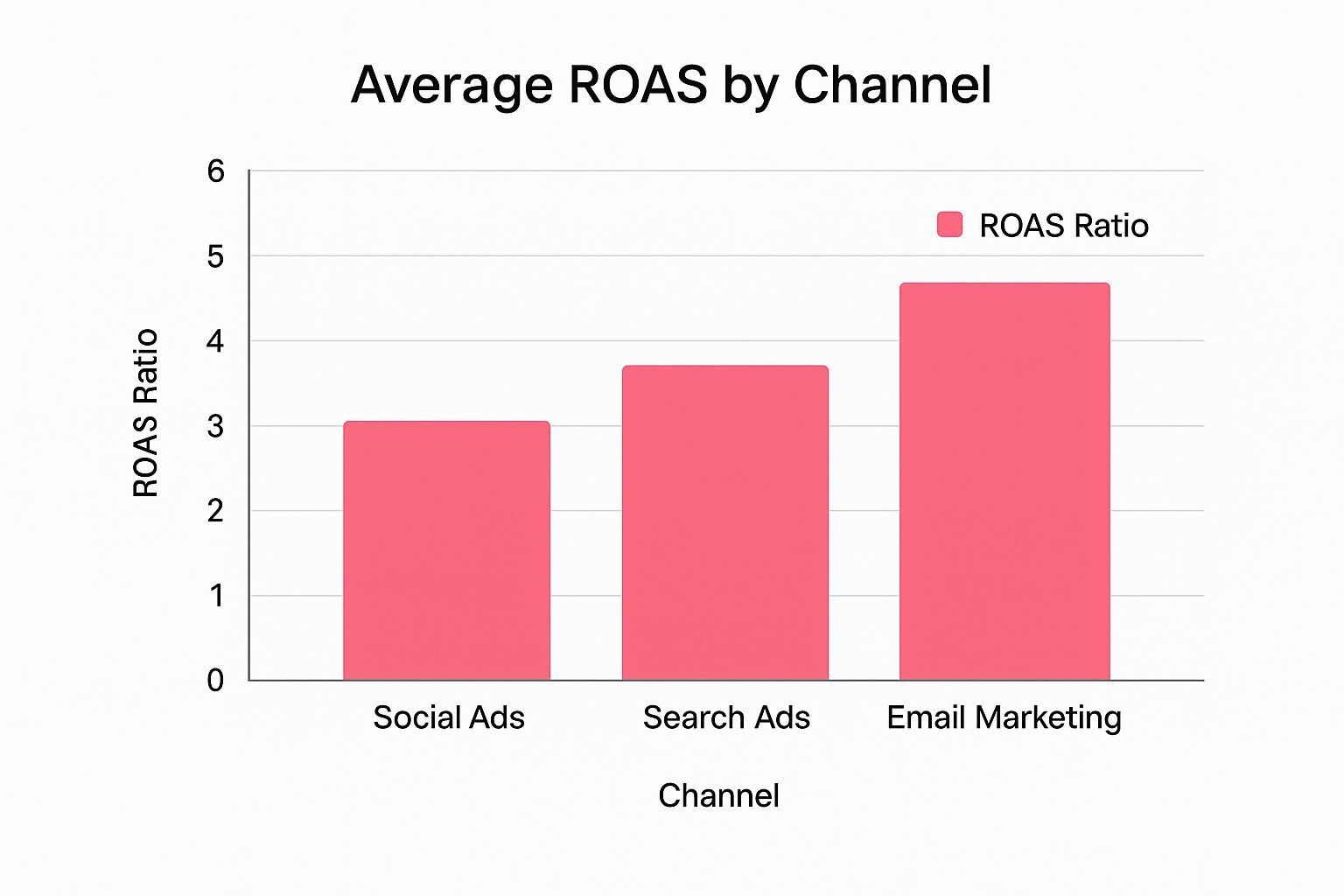
This just reinforces what the data tells us: channels like email marketing often deliver a much higher return than paid search or social ads. It’s a powerful reminder of why having a smart, multi-channel strategy is so important for long-term success.
The Key Levers That Control Your ROAS

Your Return on Ad Spend isn’t some random number that just happens. It’s the direct result of several key factors you can, and should, be actively managing. Think of your ad campaign as a machine with different levers. Pulling the right ones cranks up efficiency and output, while ignoring others can bring the entire operation to a grinding halt.
Getting a handle on these levers is the first step toward building truly profitable campaigns. The best marketers know that a killer ROAS isn’t about luck; it’s about carefully tuning each of these interconnected parts until they work together flawlessly.
Ad Creative and Audience Targeting
The two most powerful levers you have are your ad creative and your audience targeting. Get this: even a perfectly crafted ad will fall flat if it’s shown to the wrong people. On the flip side, the right audience won’t convert if your ad copy and visuals are boring or confusing.
Imagine you’re selling high-end running shoes. Targeting a broad audience of “fitness enthusiasts” is a start, but it’s sloppy. You’ll end up wasting a chunk of your budget showing ads to people who are more into yoga or weightlifting.
A much smarter move is to target a custom audience of past buyers or people who have visited specific product pages. This kind of precision makes sure your message actually connects, dramatically improving your chances of a sale and boosting your ROAS.
This isn’t just a minor tweak; it’s fundamental. By focusing your budget on high-intent audiences, you can cut your expenses way down. In fact, fine-tuning your targeting is one of the most effective ways to reduce customer acquisition costs and get more mileage out of every single dollar.
Landing Pages and Bidding Strategy
Your ad’s job is to get the click. But it’s your landing page’s job to close the deal. You can have the best ad in the world, but if it leads to a slow, confusing, or just plain ugly landing page, your ROAS will tank. A smooth, convincing post-click experience is non-negotiable.
Don’t forget about your bidding strategy, either. Just aiming for the lowest cost-per-click isn’t always the winning move. Smart strategies that optimize for actual conversions or value can deliver a much higher ROAS, even if the individual clicks cost a bit more upfront.
Actionable Strategies to Dramatically Improve Your ROAS
Knowing your ROAS is just the first step. The real magic happens when you start improving it. Boosting your return isn’t about finding one secret trick; it’s about making a series of smart, targeted adjustments across your entire customer journey.
Think of it like tuning a high-performance car. Small tweaks to the engine, the aerodynamics, and the fuel mixture all add up to a massive boost in speed and efficiency.
These strategies aren’t just theories—they are practical, hands-on steps you can take right now to squeeze more revenue out of every dollar you spend on ads.
Refine Your Audience Targeting
The quickest way to drain your ad budget is to show your ads to people who couldn’t care less. For a healthy ROAS, you have to get laser-focused on who you’re talking to. Stop casting a wide net and start zeroing in on high-intent customers.
- Build Lookalike Audiences: Take the data from your best customers—the ones who buy repeatedly and have a high lifetime value—and let the ad platforms find new people just like them. It’s one of the most powerful ways to find users who are primed to convert.
- Utilize Negative Keywords: For any search campaigns, you need to be aggressively adding negative keywords. This simple move stops your ads from showing up for irrelevant searches, which can save a huge chunk of your budget from being wasted on clicks that will never turn into sales.
When you narrow your focus, you make sure your message lands in front of people who are genuinely interested. That’s how you maximize the impact of every ad dollar.
A/B Test Your Ad Creative Relentlessly
Never, ever assume you know which ad is going to be a winner. The only way to find out what really connects with your audience is through constant A/B testing.
Test one thing at a time to get clean data. It could be the headline, the main image, the video hook, or the call-to-action button. You’d be amazed how even tiny changes can lead to huge jumps in click-through rates and, ultimately, a much higher ROAS.
A campaign with a 2% conversion rate is twice as profitable as one with a 1% conversion rate. A/B testing is how you find those small wins that literally double your return.
This isn’t a one-and-done task. It’s a continuous cycle of testing and iterating that keeps your ads fresh and performing at their absolute peak.
Optimize Your Landing Page Experience
You can have the best ad in the world, but if it sends people to a clunky, confusing, or slow landing page, you’ve just thrown your money away. The sale is won or lost after the click.
A bad post-click experience will absolutely murder your ROAS, no matter how great your ad creative or targeting is. For a deep dive into fixing this, check out these proven conversion rate optimization tips to make sure your pages are actually built to turn visitors into buyers.
Frequently Asked Questions About ROAS

As you start weaving ROAS into your day-to-day marketing, you’ll probably bump into a few common questions. Getting these details straight from the get-go helps you use the metric the right way and avoid making bad calls based on misinterpreted numbers.
What Is the Difference Between ROAS and ROI?
This is a big one. Think of ROAS (Return on Ad Spend) like a magnifying glass focused on one thing: how much gross revenue you made for every single dollar you spent on ads.
ROI (Return on Investment), on the other hand, is the wide-angle camera lens. It looks at the bigger picture, measuring your actual profit after you’ve paid for everything—the ads, your product costs, shipping, salaries, the whole shebang.
You could have a fantastic ROAS, but if your profit margins are razor-thin, you might still end up with a negative ROI. It’s crucial to watch both.
How Do I Track ROAS Accurately?
Good tracking all comes down to using conversion pixels or tags on your website. Tools like the Meta Pixel or the Google Ads tag are your best friends here. These little bits of code are what connect the dots between someone seeing your ad and making a purchase.
For an e-commerce store, it’s absolutely vital that your platform sends the exact sale amount back to your ad platform. If you’re generating leads, you’ll need to figure out what a lead is worth in dollars and cents to get any kind of meaningful ROAS calculation.
Can your ROAS be too high? It sounds crazy, but yes. An astronomically high ROAS might be a red flag that you’re playing it too safe with your budget. You might only be targeting a tiny group of hyper-responsive customers, leaving a ton of profitable growth on the table.
The real goal isn’t just a high ROAS; it’s finding that sweet spot where your ROAS is healthy and you’re scaling your ad spend to maximize your total profit.
Ready to turn abandoned carts into revenue and boost your ROAS on autopilot? CartBoss uses powerful SMS campaigns to bring lost customers back, recovering sales you thought were gone for good. Discover how it works at https://www.cartboss.io.