


Think of an automated marketing strategy as a plan that lets you use software to handle marketing tasks automatically, triggered by what your customers do. This isn’t about setting up spam bots; it’s about saving time, making your marketing more relevant, and personalizing interactions without doing everything by hand.
Understanding Your Automated marketing strategy
A great way to picture it is like a pilot using autopilot. The system handles the routine stuff—maintaining altitude, staying on course—so the pilot can focus on the big picture, like navigating tricky weather or preparing for landing. In the same way, automation takes care of the repetitive marketing tasks. This frees you up to think about strategy, get creative, and have those high-value conversations with customers that truly matter.
This isn’t about replacing marketers with machines. It’s about giving them a supercharged toolkit to create personalized experiences at a scale that would be completely overwhelming to manage manually.
Core Functions of Marketing Automation
So, what does a good automated marketing strategy actually do? At its heart, it’s designed to build and nurture relationships, guiding potential customers along their journey with very little direct involvement from you.
Here are a few key tasks that automation nails every time:
- Sending Welcome Emails: Greet new subscribers the moment they sign up, making a great first impression.
- Audience Segmentation: Automatically sort your contacts into groups based on their behavior, interests, or demographics.
- Lead Nurturing: Drip out a sequence of helpful content to educate prospects and gently move them toward making a purchase.
- Abandoned Cart Recovery: Instantly trigger follow-up messages, like an SMS notification from CartBoss, to people who left items in their cart.
The real magic is in delivering the right message to the right person at the perfect time. It makes every single interaction feel intentional and personal.
To give you a better sense of how these pieces fit together, here’s a quick breakdown of the core components.
Table: Key Components of an Automated Marketing Strategy
| Component | Function | Example |
|---|---|---|
| Triggers | An event or action that initiates an automated workflow. | A customer abandons their shopping cart. |
| Actions | The specific marketing task executed by the software. | An automated SMS reminder is sent 15 minutes later. |
| Workflows | A sequence of actions and conditions that map out a customer journey. | A multi-step email sequence for new subscribers. |
| Segmentation | Dividing your audience into smaller groups based on shared traits. | Grouping customers who have purchased more than twice. |
| Analytics | Tracking and measuring the performance of your automated campaigns. | Monitoring open rates, click-through rates, and conversions. |
Each of these elements works together to create a system that responds to your customers in a way that feels natural and helpful, not robotic.
Businesses are catching on fast. The global marketing automation industry was valued at $4.79 billion in 2021 and is expected to rocket to $13.71 billion by 2030. That kind of growth shows just how critical automation has become.
Ultimately, a solid strategy ensures no lead gets forgotten and every customer feels noticed. And you don’t need a massive operation to make it work. To see how you can get started, even on a smaller scale, check out our guide on marketing automation for small business.
How Automation Supercharges Your Marketing
Putting marketing automation to work does a lot more than just shave a few hours off your week. It completely changes how you connect with your audience. By taking over all the repetitive, manual tasks, it frees up your team to focus on what they do best: thinking creatively, strategizing, and building real relationships with customers.
Instead of getting bogged down in manually sending follow-up emails one by one, your team can now design the entire customer journey from start to finish. This is a massive shift. You’re no longer just reacting to what customers do; you’re proactively anticipating their needs and guiding them with timely, relevant messages.
Operational Efficiency and Scalability
Picture this: a customer is browsing your e-commerce store and leaves a few items in their cart. Instantly, an automated workflow kicks in and sends them an SMS reminder—maybe with a small discount to sweeten the deal—bringing them right back to complete their purchase. This happens 24/7 without a single person on your team lifting a finger. It turns potential lost revenue into sales, even while you sleep.
That level of efficiency is a total game-changer. It means you can scale up your marketing efforts without having to proportionally increase your headcount. Your system can manage hundreds or even thousands of individual customer interactions at the same time, each one personalized to that specific user’s actions.
An automated marketing strategy acts as your most diligent employee—one that never gets tired, never misses a follow-up, and executes flawlessly every single time.
This isn’t some far-off concept; it’s the new normal. In fact, 76% of marketers are already using automation tools in some capacity. Digging deeper, about 79% of companies automate at least some part of their customer journey, showing just how widespread this has become.
Deeper Personalization and Better Leads
Automation unlocks a level of personalization that’s flat-out impossible to do manually. Think about a B2B company trying to land a high-value client. An automated system can nurture that lead for months, sending perfectly timed case studies, whitepapers, and webinar invites based on exactly how that person interacts with your content. No one needs to set a reminder to follow up; the system handles it, ensuring a consistent and valuable conversation.
This steady nurturing warms up leads so that by the time they talk to a sales rep, they’re far more qualified and ready to convert. To see how these kinds of strategies generate quality leads, check out this fantastic digital marketing lead generation guide.
- Improved Lead Nurturing: Deliver the right content at just the right moment to guide prospects smoothly through your funnel.
- Enhanced Customer Retention: Automatically send personalized post-purchase messages, anniversary offers, or loyalty rewards to keep them coming back.
- Consistent Brand Messaging: Make sure every single customer gets a cohesive brand experience, no matter where or how they interact with you.
These automated workflows do all the heavy lifting, making sure every opportunity is captured. To see how these ideas look in the real world, you can explore some powerful marketing automation workflow examples.
Building Your Automation Engine
A great automated marketing strategy is much more than just a piece of software; it’s a finely-tuned engine with every part working in perfect sync. Think of it like a high-performance car. You wouldn’t just drop a powerful V8 into a car and expect it to work without a transmission, drivetrain, and wheels to get that power to the road. It’s the same with automation. Your tools need a solid strategy behind them to actually get you anywhere.
Each component has a very specific job, and they all have to work together. The whole system is designed to grab customer attention, understand what they want, and talk to them in a way that feels personal and effortless. Let’s pop the hood and look at the essential parts that make this engine roar.
The Core Technology Stack
At the heart of your automation engine are two critical pieces of tech that handle all the data and do the heavy lifting.
- Customer Relationship Management (CRM): This is the brain of the whole operation. Your CRM is the central database where you store every single piece of information you have on your leads and customers—their contact details, what they’ve bought, how they’ve clicked around your website, you name it. It’s your single source of truth that fuels every automated action.
- Marketing Automation Platform: If the CRM is the brain, this is the muscle. Tools like HubSpot, Marketo, or ActiveCampaign plug right into your CRM and actually do the work. They’re the ones sending the emails, firing off the SMS messages, and updating customer profiles based on the rules you set.
This infographic shows you exactly how these core pieces fit together to turn raw data into real action.
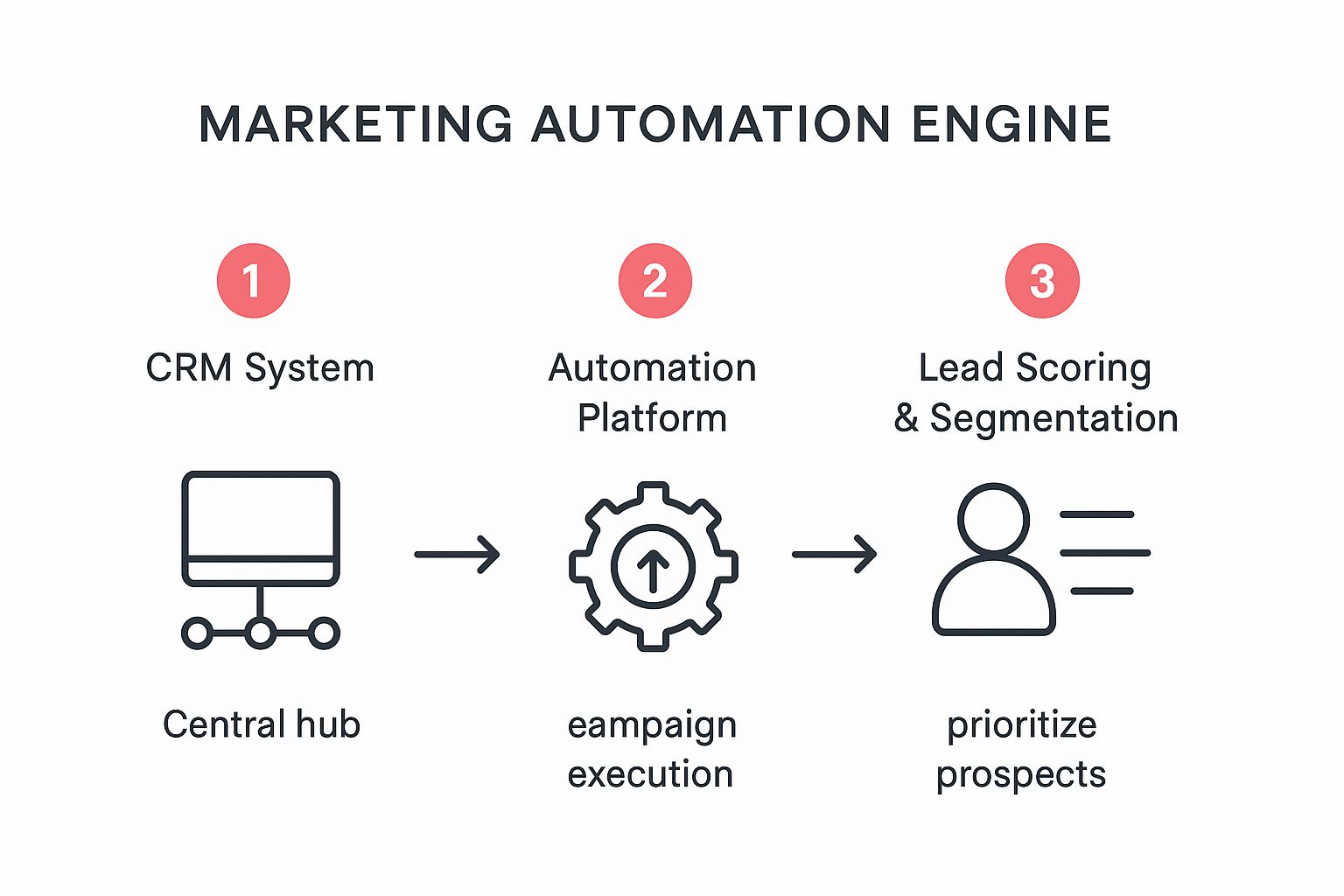
As you can see, there’s a clear flow from storing data in the CRM to running campaigns and prioritizing your efforts. This is the absolute backbone of your strategy.
The Strategic Blueprint
Here’s the thing: technology by itself is useless. You need a blueprint that tells the engine what to do, who to talk to, and when to do it. This is where your strategic components come in.
A successful automated marketing strategy is built on a foundation of technology and intelligence. The software executes the tasks, but your strategic models provide the crucial “why” behind every action.
These models make sure your messages are always relevant and your team is focused on the hottest opportunities. Key elements include:
- Lead Scoring Models: This is how you separate the window shoppers from the serious buyers. You assign points to leads based on who they are and what they do (like visiting your pricing page or downloading a guide). This model automatically flags your most sales-ready prospects so your team can jump on them right away.
- Segmentation Criteria: You wouldn’t talk to a brand new visitor the same way you’d talk to a loyal customer, right? Segmentation lets you group your audience based on rules you define—things like purchase history, engagement level, or location. This lets you deliver super-personalized content that actually connects with each specific group.
- Content Mapping: This involves planning out your content for every single stage of the buyer’s journey. By mapping specific content to specific triggers in your workflows, you make sure leads get the right information at exactly the right time, gently guiding them from just looking to making a purchase.
For a deeper dive into putting all these pieces together, check out our guide on how to set up marketing automation. It provides a step-by-step framework. And to see how specialized tools fit into a specific business model, you can explore guides on dropshipping automation tools.
At the end of the day, combining the right tech with a smart plan is what turns a clunky machine into a revenue-generating powerhouse.
Crafting Your First Automated Marketing Strategy
Alright, so you get the theory behind marketing automation. But moving from understanding the pieces to actually building your first strategy can feel like a huge jump. It’s not as daunting as it sounds. With a simple, step-by-step approach, you can go from idea to execution without breaking a sweat. This is where you build the machine that will work for you 24/7.
The first step has nothing to do with technology. It’s all about clarity. Before you even glance at a piece of software, you have to define what a “win” looks like for your business. Fuzzy goals like “get more leads” won’t cut it. You need to be specific.
Start with Clear and Measurable Goals
Think of your goals as the North Star for your entire strategy. They’ll guide every workflow you create, every piece of content you write, and every metric you track. A good goal is something you can actually count.
Here are a few examples of solid, actionable goals:
- Increase lead conversion rates by 15% in the next quarter.
- Slash shopping cart abandonment by 25% within the next 60 days.
- Get 20% more first-time customers to come back for a second purchase over the next six months.
Once you know exactly where you’re going, you can start drawing the map to get there. The next step is figuring out who you’re talking to.
Identify Your Audience and Map Their Journey
You can’t automate a conversation if you don’t know who’s on the other end of the line. This is where getting smart about audience identification and segmentation is an absolute must. You have to move beyond basic demographics and really dig into your customers’ behaviors, what keeps them up at night, and what gets them excited.
When you segment your audience well, you can send messages that actually feel relevant. For instance, a first-time visitor needs a completely different conversation than a loyal customer who’s bought from you five times. To get this right, you’ll want to get comfortable with different customer segmentation techniques; it’s the best way to start creating truly meaningful groups.
After you’ve sorted your audience, map out their journey. What are the typical steps they take, from first hearing about you to becoming a die-hard fan? Pinpointing these key moments shows you exactly where an automated message can make the biggest impact.
Choose Your Tools and Channels
With your goals set and your audience defined, it’s finally time to pick the tech that will bring your strategy to life. The tools you choose will really depend on your budget, your team’s tech skills, and what you’re trying to accomplish.
For any e-commerce store, channels that are immediate and get high engagement are king. Email is a classic for a reason, but SMS automation gives you an incredibly powerful, direct line to your customers—we’re talking open rates that often blow past 98%.
A great automation tool does more than just blast out messages. It makes the entire customer experience smoother, removes friction, and makes it dead simple for a customer to do what you want them to do.
Platforms like CartBoss are built from the ground up for exactly this, zeroing in on high-impact moments like recovering an abandoned cart.
Just look at how a tool like CartBoss gives you a clean, easy-to-read dashboard for managing your SMS campaigns.
The interface puts your most important numbers front and center, so you can see what’s working at a glance and make smart decisions fast.
Build Your First Automation Workflow
Now for the fun part: building it. My advice? Start small. Pick one high-value workflow that directly tackles one of your main goals. Don’t try to automate your entire business on day one. Get one sequence running perfectly before you start adding more layers.
Here are two classic workflows that are perfect starting points:
- The Welcome Series: This kicks in the moment someone subscribes to your newsletter. You can set up a few automated messages to introduce your brand, show off your best-selling products, and maybe offer a small discount to nudge them toward that first purchase.
- The Abandoned Cart Sequence: This is non-negotiable for any e-commerce store. When a shopper adds an item to their cart but bails before buying, a simple sequence of one or two automated messages can remind them what they left behind and give them a little push to finish the job.
By taking this practical, one-step-at-a-time approach, you’ll build an automated marketing machine that’s both powerful and effective from the get-go.
How AI Is Reshaping Marketing Automation
If you think of traditional marketing automation as setting up a perfect line of dominoes, adding Artificial Intelligence is like giving each domino a brain. It takes a static, rule-based system and makes it a dynamic one that learns, adapts, and makes smarter decisions on the fly. This isn’t just a small tweak; it’s the next evolution of an automated marketing strategy.
Instead of just blindly following “if this, then that” commands, AI brings a layer of predictive intelligence to the table. It’s like upgrading from a simple calculator to a personal marketing assistant that knows what your customers want before they do. This opens up a level of personalization and efficiency that was simply impossible before.
From Reactive Rules to Predictive Actions
The real magic of AI is its ability to chew through massive amounts of data and spot patterns that no human ever could. This superpower directly plugs into your automation efforts in a few game-changing ways.
- Predictive Lead Scoring: AI doesn’t just count actions; it understands them. It can analyze thousands of data points to figure out which leads are red-hot and ready to convert, letting your sales team focus their energy where it matters most.
- Dynamic Content Personalization: Imagine your website, emails, and product recommendations changing in real-time for every single visitor based on what they’re doing. AI makes that happen, making every interaction feel uniquely relevant.
- Optimized Send Times: Forget generic “best time to send” advice. AI can pinpoint the exact moment to send an email or SMS to each person based on their unique habits, seriously boosting open and click-through rates.
Integrating AI into marketing automation isn’t some futuristic idea anymore—it’s a competitive must-have. It shifts your strategy from just doing tasks to anticipating outcomes and constantly optimizing for success.
This smarter approach is fueling some serious growth. The AI marketing market is on track to double from $20 billion in 2022 to a whopping $40 billion by 2025. Companies that are already on board are reporting conversion rate increases of around 25%. If you want to dive deeper into the numbers, you can discover more insights about AI marketing statistics.
At the end of the day, an AI-powered automated marketing strategy doesn’t just save you time. It builds a smarter, more adaptive marketing engine that gets better and better all on its own.
Measuring Your Automation Success
An automated marketing strategy is only as good as the results it brings in. Firing up a new workflow is just the first step; the real magic happens when you start tracking its performance and making smart, data-driven tweaks along the way.
To do this right, you need to look past the flashy, surface-level numbers like impressions or social media likes. Those are vanity metrics—they feel good, but they don’t pay the bills.
Instead, you need to zero in on Key Performance Indicators (KPIs) that tie directly back to business growth. These are the hard numbers that prove your automation efforts are actually making you money. Without them, you’re just guessing, unable to see what’s working, what’s a waste of time, and where your biggest opportunities are hiding.
Tracking What Truly Matters
To get a crystal-clear picture of your success, you should build a simple dashboard that tracks your most important metrics. This is your command center, helping you spot bottlenecks and fine-tune your automated engine for the best possible return on your investment.
Here are a few of the most important KPIs to keep an eye on:
- Funnel Conversion Rates: This is the percentage of people moving from one stage of your marketing funnel to the next. It’s a fantastic way to pinpoint exactly where you’re losing potential customers.
- MQL to SQL Ratio: How many of your marketing-qualified leads (MQLs) are good enough to become sales-qualified leads (SQLs)? A high ratio here is a great sign that your automation is nurturing high-quality prospects that your sales team will love.
- Customer Lifetime Value (CLV): This metric tells you the total amount of money you can expect to make from a single customer over time. Good automation should absolutely increase your CLV by keeping customers happy and coming back for more.
The real goal here is to connect every single automated action to a measurable business result. When you can confidently say, “This workflow increased our Customer Lifetime Value by 15%,” you’re speaking a language everyone understands: results.
Keeping a close watch on these numbers gives you the power to refine every part of your strategy. For a deeper dive, you can learn more about how to measure marketing campaign success and apply those same principles to all of your automated workflows.
Essential KPIs for Automated Marketing
To really dig into your performance, here’s a quick breakdown of the essential metrics you should be tracking. These KPIs give you a complete view of how your automation is performing, from initial contact all the way to long-term customer loyalty.
| KPI | What It Measures | Why It Matters |
|---|---|---|
| Lead Generation Rate | The number of new leads captured through automated channels over a specific period. | Shows the effectiveness of your top-of-funnel automation in attracting new prospects. |
| Conversion Rate | The percentage of users who complete a desired action (e.g., sign-up, purchase). | Directly measures how well your automation persuades users to take the next step. |
| Customer Acquisition Cost (CAC) | The total cost of marketing and sales efforts needed to acquire one new customer. | Helps you understand the financial efficiency of your automated campaigns. A lower CAC means a better ROI. |
| Customer Lifetime Value (CLV) | The total predicted revenue a single customer will generate throughout their relationship with your brand. | Great automation boosts retention and repeat purchases, which directly increases CLV. |
| Email/SMS Open Rate | The percentage of recipients who open your automated messages. | A basic but crucial indicator of how engaging your subject lines and preview text are. |
| Click-Through Rate (CTR) | The percentage of recipients who clicked on a link within your message. | Measures how compelling your message content and call-to-action are. |
| Return on Investment (ROI) | The total revenue generated from your automation efforts divided by the total cost. | This is the ultimate bottom-line metric that proves whether your strategy is profitable. |
By regularly reviewing these numbers, you move from guesswork to a clear, actionable strategy. You’ll know exactly what to adjust, what to double down on, and what to cut loose, ensuring your automated marketing machine is always running at peak performance.
Got Questions? We’ve Got Answers.
Jumping into marketing automation can feel like learning a new language. You’re bound to have questions. Here are some of the most common ones we hear, with straight-up answers to help you get your strategy rolling with confidence.
What’s The Biggest Mistake People Make?
Hands down, the biggest pitfall is the old “set it and forget it” mindset. Too many businesses get their automations running and then never look at them again. That’s a huge mistake.
Your marketing automation isn’t a crockpot; it’s a living part of your business. You need to be checking in, looking at the numbers, and tweaking your campaigns. Customer tastes change, market trends shift, and what worked last month might not work next month. Keep an eye on it, and it’ll keep working for you.
How Much Is This Going To Cost Me?
That really depends on what you need. The price tag on marketing automation tools can swing wildly.
You can get started with simple, focused tools for email or SMS for a very reasonable price—some even have free plans or let you pay as you go. On the other end, massive all-in-one platforms can run from a few hundred to thousands of dollars every month.
The key is to stop thinking about the cost and start thinking about the return on investment (ROI). A solid automation strategy shouldn’t be an expense; it should be a money-maker that pays for itself through more sales, better efficiency, and happier, repeat customers.
A good rule of thumb? Start small. Find a tool that solves your most painful problem right now—like recovering abandoned carts—and then build out your tech stack as you grow.
How Long Does It Take To See Results?
This is the classic “how long is a piece of string?” question. Some results are lightning-fast, while others are a slow burn. It all depends on the type of automation you’re running.
For instance:
- Abandoned Cart SMS: You could literally see recovered sales roll in within a few hours of turning it on.
- Welcome Email Series: Give this one a few weeks. You’ll need to see enough new subscribers go through the whole sequence to know if it’s boosting those crucial first-time purchases.
- Long-Term Nurturing: If you’re in B2B, a lead nurturing campaign could take months to guide a prospect from curious to customer.
Patience is your best friend here. Keep an eye on the early signs of success, like open rates and clicks, while you wait for the big revenue numbers to catch up.
Ready to turn abandoned carts into your biggest revenue source? CartBoss uses powerful, automated SMS campaigns to bring customers back and boost your sales on autopilot. Stop losing money and start recovering it effortlessly. Discover how CartBoss can transform your store today!