


When we talk about opting in versus opting out, it all comes down to a single, simple idea: permission.
Opting in means a customer has to give you their explicit “yes” before you can send them a single message. Opting out is the complete opposite—it assumes you already have permission, and the customer has to hunt down the “unsubscribe” button to make you stop.
Why Permission Is Everything in SMS Marketing
Let’s think about it like a party.
The opt-in approach is like sending out invitations and only adding people to the guest list once they RSVP. You know for a fact that everyone who shows up wants to be there, which makes for a much better party.
The opt-out approach is like adding your entire phone book to the guest list and just assuming they’ll all show up unless they call to cancel. You’re probably going to end up with a lot of no-shows and more than a few annoyed friends.
In the world of SMS marketing, that difference is critical. Your goal isn’t just to blast out messages; it’s to start real conversations with people who are actually interested in what you have to say.
The Power of the Opt-In Model
The opt-in model, sometimes called affirmative consent, is the gold standard for a reason. It’s built on being upfront and respecting your customer’s choice. When someone ticks a box or texts a keyword to join your list, they’re raising their hand and saying, “Yes, I want to hear from you.”
This simple act of asking first brings some major wins for your business:
- Sky-High Engagement: People who choose to join your list are already warmed up. They’re interested in your brand, which translates directly to better open rates and more clicks.
- Builds Real Trust: Asking for permission shows you respect your customers’ privacy. That small gesture goes a long way in building a positive brand reputation that lasts.
- Keeps You Compliant: In most parts of the world, getting explicit consent isn’t just a nice-to-have; it’s a legal must-have for sending text messages.
To get a better handle on the different ways you can ask for permission, you can learn more about single vs. double opt-in strategies here: https://www.cartboss.io/blog/opt-in-double-opt-in/
The Downside of the Opt-Out Model
On the flip side, the opt-out model runs on assumed consent. It shoves the responsibility onto the customer to figure out how to stop messages they never asked for in the first place. This is the classic pre-checked consent box, and it’s a huge problem.
The biggest issue with the opt-out model is that it puts your convenience ahead of your customer’s choice. This goes against everything modern privacy laws stand for and is one of the fastest ways to kill trust.
This approach almost always leads to you messaging an unengaged, and often irritated, audience. The results are predictable: high unsubscribe rates, spam complaints, and a damaged sending reputation. Sure, you might build a list faster this way, but it’s a low-quality list that won’t deliver any real value.
For a deeper look into why stronger consent methods are so crucial, you might be interested in understanding the robust practice of double opt-in.
Navigating the Legal Maze of SMS Consent
Jumping into SMS marketing without a solid grasp of the rules is like driving blind—it’s a massive risk that can land your business in serious hot water. When we talk about opting in opting out, it’s not just about being polite; it’s about following strict laws that come with some seriously hefty penalties. These regulations are all about protecting consumer privacy, and ignoring them can cost you a fortune.
Every region has its own rulebook, but they all boil down to one simple idea: you need to get clear permission before you hit “send” on any marketing texts. For any e-commerce store with customers around the globe, understanding these legal lines in the sand is absolutely critical.
This flowchart neatly sums up the two main paths consent can take, showing the huge difference between asking for a “yes” and just assuming you have it.
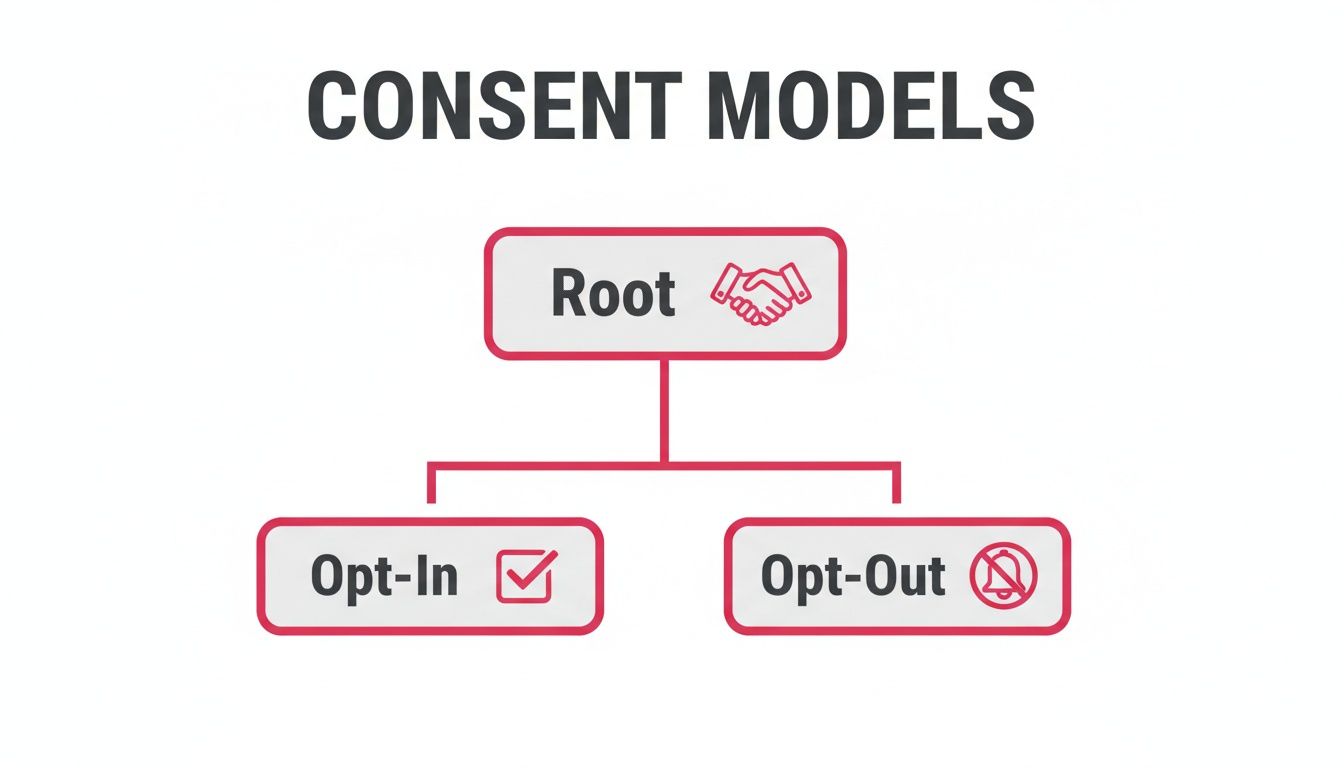
As you can see, that consent handshake can go one of two ways. The opt-in path is all about the customer taking a clear, positive step to say, “I’m in.”
The Big Three of SMS Compliance
When it comes to SMS consent, three major laws really set the standard. They might have different names and nuances, but they all demand that you can prove a customer knowingly agreed to get your texts.
- TCPA (Telephone Consumer Protection Act) in the U.S. This is the big one for anyone marketing in the United States. The TCPA demands “express written consent” before you send automated marketing texts. Don’t worry, this doesn’t mean you need a pen and paper; an electronic “signature” like checking a box on your website totally counts.
- GDPR (General Data Protection Regulation) in the EU. If you have customers in the European Union, the GDPR raises the bar even higher. It requires “unambiguous consent,” which has to be freely given, specific, and informed. It also has to be a clear, affirmative action—which means those sneaky pre-checked boxes are a definite no-go.
- CCPA/CPRA (California Consumer Privacy Act/California Privacy Rights Act). California’s laws are famous for giving consumers the right to opt out of having their data sold, but they also beef up the need for clear consent. These rules put more power in the consumer’s hands and require businesses to honor opt-out requests, no questions asked.
Getting this wrong can lead to eye-watering fines. A single TCPA violation can cost you anywhere from $500 to $1,500 per text message. For a large campaign, you can see how that could spiral into a multi-million dollar mistake in no time. If you want to get into the nitty-gritty, check out our deep dive on TCPA and text messages.
What Does Real Consent Actually Look Like?
So, what does it take to get legally sound consent? It’s more than just grabbing a phone number. You need to create an undeniable record that the customer gave you permission. Regulators want to see that the person knew exactly what they were signing up for.
Simply collecting a phone number at checkout without explicit consent for marketing texts is not enough. The law requires clear and conspicuous disclosure at the point of collection, informing the user about the nature of the messages they will receive.
This means your opt-in language has to be perfectly clear. You need to spell out who you are, what kind of texts they’ll get (like promotions or cart reminders), roughly how often they’ll hear from you, and how they can easily opt out whenever they want.
The Broader Picture of Data Privacy
These rules for opting in opting out are just one piece of a much larger puzzle. They’re part of a global shift toward giving consumers more control and transparency over their personal data. While we’re focused on SMS here, these principles are anchored in the bigger idea of developing a comprehensive privacy policy.
At the end of the day, making your way through this legal maze is all about one thing: putting your customer’s choice first. When you build your SMS strategy on a rock-solid foundation of explicit, informed consent, you’re not just dodging legal bullets. You’re also building a base of loyal, engaged customers who actually want to hear from you. It’s the smarter, safer, and much more profitable way to grow your brand.
Why Explicit Opt-In Drives Better Business Results
It’s tempting to use opt-out tactics to quickly build a massive SMS list. We’ve all seen it. But this is a classic case of chasing quantity over quality, a shortcut that almost always backfires. This approach stuffs your list with uninterested contacts, leading to abysmal engagement and a tarnished brand reputation.
The gold standard for sustainable growth is an explicit opt-in strategy. You need voluntary consent.
When you secure clear permission before sending a single text, you’re building a list of people who actually want to hear from you. These aren’t just random numbers; they’re warm leads who have actively raised their hands. The result is a dramatic lift across all your key metrics—from engagement and conversions to your return on investment.
Cultivating a High-Quality Engaged Audience
Think of your SMS list like a garden. An opt-out strategy is like carelessly scattering seeds everywhere and just hoping for the best. Sure, you’ll get a lot of something, but most of it will be weeds.
An opt-in strategy, on the other hand, is like carefully planting seeds in fertile, prepared soil. You might get fewer plants initially, but they’re the ones that will actually grow, flourish, and bear fruit.
This trust-first model delivers some powerful long-term benefits:
- Significantly Lower Unsubscribe Rates: When people choose to be on your list, they’re far less likely to leave. This stability cuts down on list churn and the constant, expensive grind of acquiring new contacts.
- Enhanced Brand Reputation: Simply asking for permission shows you respect your customers’ privacy. It’s a small act that builds massive trust and positions your brand as one that values its customers.
- Improved Message Deliverability: Mobile carriers and spam filters favor senders with low complaint rates and high engagement. A clean, opt-in list helps ensure your messages actually land in your subscribers’ inboxes, not their spam folder.
At the end of the day, a smaller, highly engaged list of brand fans is infinitely more valuable than a huge, indifferent audience.
The Power of Default Choices in Consent
The difference between opting in opting out isn’t just a legal detail; it taps into a powerful psychological principle. The default option has a massive influence on human behavior.
For example, a 2012 study on organ donation revealed that countries with an opt-out (presumed consent) system had dramatically higher donation rates. Spain, a leader in this model, hit around 46.9 donors per million people in 2019, while many opt-in nations struggled to even reach double digits.
While this shows just how powerful defaults can be, SMS marketing is a different ballgame. We operate under strict legal frameworks like the TCPA and GDPR, which make explicit opt-in mandatory. Trying to skirt these rules isn’t just bad practice; it’s illegal.
By focusing on explicit opt-in, you align your marketing with both legal requirements and customer expectations. You build a foundation of trust that transforms subscribers from passive recipients into active, loyal customers.
Turning Consent into Conversions
A high-quality list built on explicit consent directly translates to better business results. It’s that simple. Engaged subscribers are far more receptive to your promotions, new product launches, and abandoned cart reminders. They actually click your links, use your discount codes, and complete their purchases at a much higher rate.
This isn’t just theory; it’s a proven formula for success in e-commerce. You can dive deeper into the nuts and bolts in our guide on how to properly implement SMS opt-in strategies for your store. By prioritizing clear consent from the start, you create a powerful marketing channel fueled by an audience that’s eager to engage—leading to a stronger, more profitable business.
Putting Consent into Practice with User-Friendly Workflows
Knowing the rules of opting in and opting out is one thing. Actually putting them into practice is where the real work begins. Moving from legal theory to real-world application means designing user experiences that are not only compliant but also genuinely effective at encouraging sign-ups.
Your goal is to make saying “yes” a no-brainer and saying “no” just as simple and respected.
This means creating clear, straightforward touchpoints where customers can give you the green light without any confusion. From the checkout page to pop-up forms, every element should be designed to build trust while legally capturing permission. When you get it right, the process feels like a natural part of their shopping journey.

Let’s break down the best ways to collect consent and show you exactly what they look like in action.
Crafting the Perfect Checkout Opt-In
The checkout page is prime real estate for earning an SMS subscriber. A customer is already engaged, typing in their details, and focused on the purchase. It’s the perfect moment to ask for their permission to stay in touch.
But be warned: the language you use here is absolutely critical for staying compliant.
Your opt-in checkbox must be crystal clear and, importantly, unchecked by default. Vague phrases like “Sign up for updates” just won’t cut it and can land you in hot water.
Here’s a solid example of a compliant checkbox and disclosure language right at checkout. Notice how it explicitly states what kind of messages they’ll get (order updates, promotions), mentions the use of an automated system, and links out to the fine print.
Example Checkout Disclosure Language:
“By checking this box and entering your phone number, you consent to receive marketing text messages (such as promotion codes and cart reminders) from [Your Brand Name] at the number provided, including messages sent by autodialer. Consent is not a condition of any purchase. Message and data rates may apply. Message frequency varies. You can unsubscribe at any time by replying STOP or clicking the unsubscribe link (where available) in one of our messages. View our Privacy Policy and Terms of Service.”
This wording covers all the legal bases required by the TCPA and GDPR, ensuring the consent you get is fully informed and defensible.
High-Converting Pop-Ups and Forms
Pop-up forms are another powerhouse for building your SMS list. They grab a visitor’s attention and let you dangle a juicy incentive for signing up. The secret to a great pop-up is a strong value proposition. Give them a reason to hand over their phone number.
- Offer an immediate discount: “Get 15% off your first order when you sign up for texts!”
- Provide exclusive access: “Join our VIP list for early access to new arrivals.”
- Run a giveaway: “Enter to win a $100 gift card by signing up for SMS alerts.”
Just like the checkout box, the disclosure language on your pop-up must be unmissable and placed right next to the submission button. Automating these interactions is a key part of scaling your e-commerce store, and you can explore more strategies in our guide to SMS marketing automation.
Keyword Opt-Ins for On-the-Go Engagement
Keyword campaigns are a fantastic way to capture opt-ins from offline channels like packaging inserts or your social media marketing. You’ve probably seen this in action: “Text DEALS to 12345 to get exclusive offers!”
When someone texts the keyword, they are the ones starting the conversation—a clear and easily trackable form of consent. Your automated response must then confirm their subscription and provide all the necessary compliance info.
Example Keyword Flow:
- User texts: “DEALS” to 12345.
- Automated Reply: “Thanks for signing up for [Your Brand Name] alerts! Get 10% off your next order with code VIP10. Msg frequency varies. Msg&data rates may apply. Reply HELP for help, STOP to cancel.”
This simple two-step dance ensures the user’s intent is obvious and that they immediately get both the promised value and the required legal disclosures.
The Crucial Opt-Out Process
Handling the opt-out is just as important as the opt-in. When a customer decides to leave, the process has to be instant, automated, and totally hassle-free. Failing to honor an opt-out request isn’t just bad form—it’s a major legal violation that can destroy brand trust in seconds.
Your system must automatically recognize standard keywords like STOP, UNSUBSCRIBE, CANCEL, END, and QUIT. The moment one of these keywords hits your system, two things need to happen immediately:
- The user’s number is removed from all marketing lists.
- A final confirmation message is sent.
Example Opt-Out Confirmation:
“You have successfully been unsubscribed from [Your Brand Name] marketing messages. You will receive no more messages from this number. Reply START to resubscribe.”
This final message provides closure, confirms you’ve respected their choice, and leaves the door open for them to come back later. A smooth opt-out experience preserves your brand’s reputation, even as a subscriber is on their way out.
Understanding Universal Opt-Out and Automated Privacy Signals
The whole conversation around opting in and opting out is getting a major upgrade. We’re moving beyond just ticking a box on a single website. A new wave of privacy tech is here, letting users set their privacy preferences once and have them broadcast everywhere they go—and forcing businesses like yours to pay attention.
This is the new world of automated privacy signals, and it’s completely changing the compliance game.
Leading the charge is the Global Privacy Control (GPC). The easiest way to think about it is like a digital “do not track” sign that a user flips on in their browser. Once they do, it automatically tells every website they visit that they don’t want their personal data sold or shared.
And this isn’t just a friendly suggestion anymore. In many places, it’s a legally binding command.

The Rise of Legally Mandated Automated Opt-Outs
For years, the privacy burden was dumped entirely on the customer. They had to hunt down “Do Not Sell My Information” links on every single site. Universal Opt-Out Mechanisms (UOOMs) like GPC completely flip that model. Now, the responsibility is on you, the business, to automatically detect and honor these signals.
This isn’t some far-off trend; it’s happening right now. Between 2023 and 2025, U.S. states really started putting their foot down on this. As of July 1, 2025, at least ten states—including heavy hitters like California, Colorado, and Texas—now require businesses to recognize GPC signals, with many more lining up to join them.
The main takeaway is simple: If you’re doing business in any of these states, your website has to be technically able to see a GPC signal and act on it. Ignoring it is the same as ignoring a direct legal request from a consumer, which puts you in a very risky spot.
To see just how quickly this is becoming the standard, take a look at the deadlines that have been rolling out across the US.
Mandatory GPC Signal Recognition Deadlines In US States
| State | Effective Date For GPC Recognition |
|---|---|
| California | July 1, 2024 |
| Colorado | July 1, 2024 |
| Connecticut | July 1, 2025 |
| Montana | October 1, 2024 |
| Oregon | July 1, 2025 |
| Texas | July 1, 2025 |
These dates show how quickly regulatory expectations are shifting. It’s no longer enough to just have a link in your footer; your systems must be ready for automated communication.
Preparing Your E-commerce Store for GPC Compliance
So, what does all this technical jargon actually mean for your store? Honoring GPC signals isn’t as simple as tweaking your privacy policy. It takes a real, coordinated effort between your tech and marketing teams to get your systems up to speed.
Here are the essential things you need to get done:
- Detect the Signal: Your website’s code needs to be able to spot the GPC header that a user’s browser sends. This usually means looping in your developers or, even better, using a consent management platform (CMP) that already has this feature built in.
- Translate Signal to Action: Once your site sees the signal, it has to do something. That “something” is automatically stopping any transfer of that user’s data to third-party ad platforms or data brokers. It also means you can’t show them targeted ads.
- Maintain Records: Just like you keep records of opt-ins, you have to document that you received and honored an opt-out signal. This paper trail is your best friend if a regulator ever comes asking questions.
These automated signals are a huge piece of modern personal text message privacy laws and data protection rules. Regulators in states like California and Colorado are already actively searching for non-compliant businesses. The only way to stay safe is to get your systems ready to handle these requests automatically.
Closing the Gap Between Opt-Out Law and Reality
Having a compliant privacy policy is one thing. Actually making it work is another story entirely. There’s often a huge disconnect between what the law says about opting in and opting out and what many businesses actually do on their websites.
While regulations like the CCPA and GDPR are crystal clear that customer opt-out requests must be honored, the real-world execution often falls flat. This creates some serious legal and reputational risks that e-commerce brands just can’t afford to ignore.
The Real-World Consequences
This isn’t just some theoretical problem. Recent studies have found alarming rates of non-compliance, where companies keep tracking users or sending marketing texts long after someone has clearly said “no thanks.” This failure to turn policy into practice completely undermines consumer privacy, erodes trust, and practically invites regulators to come knocking.
Ignoring these requests—whether you mean to or not—is a direct violation of the law. The consequences are a lot more painful than a simple slap on the wrist.
- Regulatory Investigations: Privacy watchdogs are getting more aggressive. They’re actively running “sweeps” to catch businesses that don’t respect automated signals like the Global Privacy Control (GPC).
- Major Fines: Getting caught can lead to massive financial penalties, often calculated per violation. If you have a lot of customers, those fines can stack up frighteningly fast.
- Brand Damage: This might be the biggest cost of all. When a user opts out and you ignore them, you’re telling them their choice doesn’t matter. That’s a surefire way to destroy the trust you’ve worked so hard to build.
Why Is This Still Happening?
So, why does this compliance gap exist? Honestly, it often comes down to money. Businesses sometimes drag their feet on implementing proper opt-out systems because they’re afraid it’ll hurt their data collection and, by extension, their ad revenue. The temptation to keep a large audience for retargeting can lead some to cut corners on their legal duties.
But this is a dangerously shortsighted game. A recent study from Consumer Reports and Wesleyan University put 40 online retailers to the test. They found that 12 of those sites (30%) appeared to keep serving retargeted ads even after receiving a GPC opt-out signal.
That means nearly one in three of the tested retailers were not honoring these legally recognized requests. You can dig into the specifics of these findings on website automatic opt-out signal mandates.
This disconnect is a huge red flag. It’s not enough to just have a “Do Not Sell” link buried in your footer. You have to be certain your tech can actually receive an opt-out signal and act on it automatically, without fail.
At the end of the day, closing this gap isn’t optional. You have to invest in the right technology and processes to make your opt-out systems work flawlessly. This isn’t just about dodging fines—it’s about building a sustainable, trustworthy brand that respects its customers in both word and deed.
Common Questions About SMS Opt-In and Opt-Out
Even after you get the hang of the basics, a few practical questions about opting in and opting out always seem to pop up. We’ve put together some straight answers to the most common ones to clear up any confusion and help you tighten up your compliance game. Think of it as your quick-reference guide for keeping your SMS marketing on the right side of the law.
What Is the Main Difference Between Opt-In and Opt-Out?
It all boils down to permission. With an opt-in model, a customer has to take a clear, positive step to join your list—like ticking an empty checkbox. It’s a definite “yes” from them.
An opt-out model, on the other hand, just assumes you have their permission until they do something to take it away, like unchecking a box that you already checked for them. When it comes to SMS marketing under heavy-hitting regulations like TCPA and GDPR, explicit opt-in is the only way to go.
Can I Use a Pre-Checked Box for SMS Marketing Consent?
Absolutely not. Major privacy laws like the TCPA in the U.S. and GDPR in Europe are extremely clear on this: using pre-checked boxes for marketing consent is a big no-no. A pre-checked box simply doesn’t count as a clear, affirmative action from the user.
Consent has to be unmistakable and started by the customer. Relying on pre-checked boxes is a huge compliance risk that can land you in hot water with some serious fines, because you can’t prove the user knowingly agreed to anything.
How Do I Properly Handle SMS Opt-Out Requests?
You’re legally required to honor opt-out requests instantly and automatically. When a subscriber texts a standard keyword like STOP, UNSUBSCRIBE, CANCEL, or END, your system needs to do two things without any delay:
- Remove the Number: Their phone number has to be immediately scrubbed from all your active marketing lists. No more messages, period.
- Send Confirmation: A final, automated text should go out to confirm they’ve been unsubscribed. This message proves you’ve honored their request and serves as a clear record for both of you.
Dropping the ball on processing these requests is a serious violation of consumer rights and communication laws.
What Records Must I Keep to Prove Opt-In Consent?
Keeping detailed records is your best defense if you’re ever questioned. If a complaint ever comes up, the burden of proof is on you to show you had permission. Your records need to be rock-solid and include:
- The subscriber’s phone number.
- The IP address they used when they signed up.
- The exact date and timestamp of when they gave consent.
- The specific disclosure language the user saw and agreed to.
This paper trail creates an undeniable audit log, proving that your process for opting in and opting out is fully compliant and above board.
Ready to turn your abandoned carts into revenue with a fully compliant SMS solution? CartBoss handles all the complexities of consent and opt-out management automatically, so you can focus on making sales. Start recovering lost sales today.
