


To figure out your customer retention rate, you’ll need a simple but powerful formula.
Just take the number of customers you have at the end of a period, subtract any new customers you gained during that time, divide that by the number of customers you started with, and multiply by 100.
The formula looks like this: [(Ending Customers – New Customers) / Starting Customers] x 100. This gives you the exact percentage of customers you’ve managed to keep around.
Why Customer Retention Is Your E-commerce Superpower
Focusing on keeping your existing customers isn’t just a nice-to-have strategy; it’s one of the most profitable moves you can make for your e-commerce store.
While chasing new leads always feels productive, the real engine for sustainable growth lies in nurturing the relationships you’ve already built. It’s all about turning those one-time buyers into loyal advocates for your brand.
The numbers don’t lie. Acquiring a new customer can cost anywhere from 5 to 25 times more than holding onto an existing one. On top of that, repeat customers often spend 67% more than first-timers, making them incredibly valuable over the long haul.
This is exactly why tools like CartBoss, which recover abandoned carts with automated SMS, are so effective. They re-engage interested buyers at a critical moment, directly feeding your retention efforts. For a deeper dive into these stats, The Sales Collective offers some great insights.
The Core of Sustainable Growth
A high retention rate is the bedrock of sustainable growth because it has a direct impact on how you increase customer lifetime value. Each customer you keep represents a predictable stream of future revenue, which helps stabilize your cash flow and reduces your dependency on expensive, hit-or-miss marketing campaigns.
Think of it this way: every dollar spent on acquiring a new customer is fighting for attention in a ridiculously crowded market. Marketing to an existing customer, however, is like having a warm conversation with someone who already knows, likes, and trusts you.
That trust is your most valuable asset.
“Your existing customers are your most profitable segment. They’ve already overcome the biggest hurdle—choosing you the first time. Your job is to make it an easy decision for them to choose you again.”
Breaking Down the Retention Formula
Getting comfortable with the components of the retention formula is the first real step toward mastering this metric. Each variable tells a piece of your store’s story over a specific period, whether that’s a month, a quarter, or a full year.
To get a better handle on this, check out our in-depth guide on the best practices for customer retention.
For now, here’s a quick-reference table to help you understand what each part of the formula means.
Customer Retention Rate Formula Breakdown
| Variable | Description | Example |
|---|---|---|
| Starting Customers (S) | The total number of customers you had at the very beginning of your chosen time frame. | You had 1,000 customers on January 1. |
| Ending Customers (E) | The total number of customers you had at the very end of that same time frame. | You have 1,150 customers on January 31. |
| New Customers (N) | The number of brand-new customers you acquired during the period. | You acquired 200 new customers in January. |
With these three numbers, you have everything you need to calculate your retention rate and start making smarter, more profitable decisions for your business.
Calculating Your Retention Rate with Real-World Examples
Alright, you get the variables. But theory is one thing—putting the customer retention rate formula into practice is where the magic happens. It’s actually a pretty straightforward process, and the number you get is a powerful snapshot of your business’s health.
Let’s walk through two practical examples. We’ll use a fictional Shopify store, “Artisan Home,” which sells handcrafted home decor. This will show you exactly how to calculate your retention rate and, more importantly, what the results really mean for your store.
Setting Up Your Calculation
Before you can start plugging in numbers, you need to define three key pieces of information. Being consistent here is absolutely critical if you want to track your progress accurately over time.
- Choose Your Time Period: First, decide if you’re measuring retention monthly, quarterly, or annually. For most e-commerce stores, monthly is a great starting point because it gives you frequent feedback. We’ll use a single month—May—for our example.
- Gather Your Customer Counts: Next, you’ll need the total number of unique customers you had at the very beginning and the very end of that time period.
- Identify New Customers: Finally, count up how many brand-new customers made their first purchase during that same month.
This infographic breaks down the simple flow of variables you’ll be using.
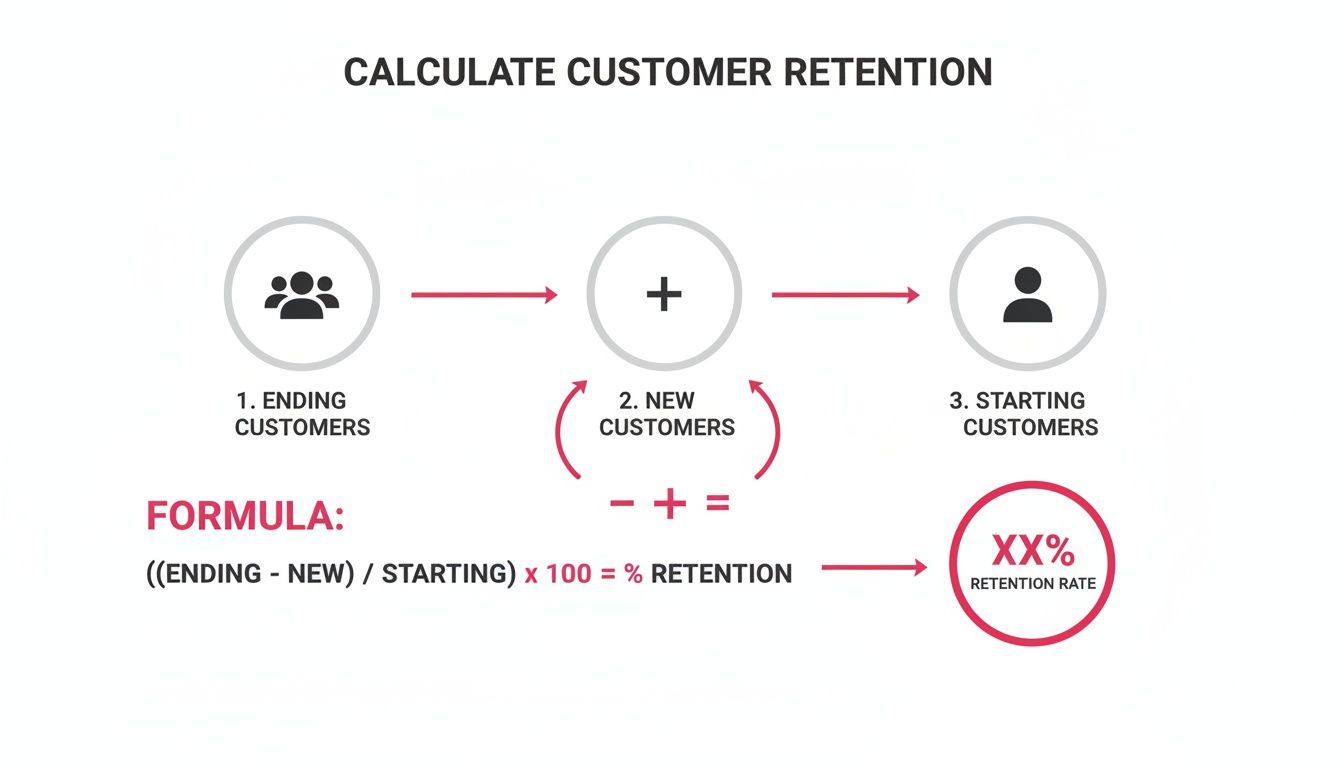
As you can see, you start with your ending customer count, subtract the new folks to isolate your returning customers, and then see how that group stacks up against your starting customer base.
Example 1: A Strong Retention Scenario
Let’s imagine Artisan Home had a great May. They doubled down on their email marketing and offered a small “thank you” discount to previous buyers.
Here are their numbers for the month:
- Customers at the start of May (S): 1,000
- Customers at the end of May (E): 1,250
- New customers acquired in May (N): 300
Now, let’s plug those into the formula: [(E – N) / S] x 100
- First, figure out how many customers stuck around: 1,250 (E) – 300 (N) = 950
- Next, divide that by your starting number: 950 / 1,000 (S) = 0.95
- Finally, turn it into a percentage: 0.95 x 100 = 95%
Boom. Artisan Home hit a customer retention rate of 95% for May. That’s an excellent result. It tells them their existing customer base is incredibly loyal and whatever retention strategies they used are clearly paying off.
Example 2: A Scenario Needing Improvement
Now for a different story. Let’s look at June for Artisan Home. Maybe this month they poured their entire budget into paid ads to get new customers, completely forgetting about their existing audience.
Here’s how June shook out:
- Customers at the start of June (S): 1,250
- Customers at the end of June (E): 1,400
- New customers acquired in June (N): 400
Let’s run the calculation one more time:
- Find the number of retained customers: 1,400 (E) – 400 (N) = 1,000
- Divide this by the starting customer count: 1,000 / 1,250 (S) = 0.80
- Convert to a percentage: 0.80 x 100 = 80%
In June, Artisan Home’s retention rate dropped to 80%. On the surface, they grew their total customer base, but a big chunk of their previous customers didn’t come back. This is a red flag. It shows that focusing only on acquisition can really hurt your loyalty.
If you want to skip the manual math, you can use a dedicated customer retention rate calculator to speed things up.
So, you’ve run the numbers and have a percentage staring back at you. Now what? This is where the real work begins, because a number without context is just data. Answering the question, “Is this good?” requires looking beyond your own dashboard to understand where you actually fit in the market.
The hard truth is, a “good” retention rate isn’t some universal figure. It shifts dramatically from one industry to another. Some sectors just naturally inspire more loyalty, and setting your goals based on the wrong benchmark can be incredibly misleading.
Benchmarking Against Your Industry
Before you celebrate or panic, you need to see how you stack up against your peers.
For e-commerce, the landscape is incredibly diverse. Travel and hospitality might see an average retention rate of around 55%, while broader e-commerce sectors often hover closer to 38%. Even the size of your business plays a role—it’s not uncommon for smaller companies to retain about 40 customers out of every 100 after the first month.
Comparing your rate to these benchmarks gives you a realistic starting point. If you sell subscription boxes (a naturally high-retention model), aiming for a rate typical of fast fashion means you’re leaving money on the table. On the flip side, if you hit a 40% retention rate in a low-loyalty vertical, you might actually be crushing your competitors.
E-commerce Retention Rate Benchmarks by Industry
To give you a clearer picture, here’s a look at some typical monthly retention rates across different sectors. Use this table to find the benchmark closest to your business.
| Industry Sector | Average Monthly Retention Rate | Notes |
|---|---|---|
| Subscription Services | 65-80% | High due to recurring billing model. |
| Beauty & Cosmetics | 45-55% | Strong brand loyalty and repeat purchases. |
| Food & Beverage | 40-50% | Driven by consumable goods and regular needs. |
| Apparel & Fashion | 30-40% | Highly competitive; trends change quickly. |
| Consumer Electronics | 25-35% | Infrequent, high-value purchases. |
| General Retail | 35-45% | Varies widely based on product diversity. |
Seeing where you land helps you set goals that make sense for your business, not someone else’s. For more detailed stats, you can find some great user retention benchmarks on Pendo.io to see how you stack up.
A “good” retention rate is less about hitting a magic number and more about consistently improving upon your own baseline and staying competitive within your specific industry.
Looking Beyond the Percentage
While industry benchmarks provide crucial context, there’s an even more important question to ask: who are you retaining?
A high retention rate isn’t always as healthy as it looks if you’re keeping the wrong kind of customers around.
Imagine two online stores, both with an identical 85% retention rate:
- Store A retains customers who make one small purchase every quarter, usually a low-margin clearance item. They stick around, but their financial impact is minimal.
- Store B retains customers who make frequent, high-value purchases. They buy new arrivals, engage with marketing, and have a significantly higher lifetime value.
See the difference? Both stores have the same top-level retention metric, but Store B has a much healthier, more profitable business. This is exactly why you have to dig deeper. A truly good retention rate is one that reflects loyalty from your most valuable customer segments.
When you start analyzing retention this way, you connect it directly to profitability. This is where you can see how loyal customers truly impact your bottom line. To get a handle on this, check out our detailed guide on how to calculate customer lifetime value and see how these two critical metrics work together.
It’s this deeper understanding that transforms a simple percentage into a powerful strategic tool for genuine growth.
Common Pitfalls When Calculating Retention
Calculating your customer retention rate seems straightforward on the surface, but a few common missteps can give you a completely skewed picture of your business’s health. And if you get this wrong, you risk making major strategic decisions based on faulty data—a recipe for wasted time and money.
One of the most frequent errors I see is using inconsistent time periods. If you calculate retention monthly one quarter and then switch to a weekly view the next, you’re not comparing apples to apples. This makes it impossible to spot genuine trends, leaving you guessing whether your new marketing campaign is actually moving the needle.
Another big one is misclassifying your customers. The retention formula is very specific: you have to subtract new customers acquired during the period. Accidentally lumping them in with your “retained” group will artificially inflate your number and can easily mask a growing loyalty problem.

Confusing Retention with Churn
It’s easy to assume retention and churn are just two sides of the same coin. While they are definitely related, this oversimplification can be dangerous because they tell different parts of the story.
- Retention Rate: This tells you the percentage of existing customers you successfully kept over a specific period.
- Churn Rate: This measures the percentage of customers you lost during that same period.
Sure, a 90% retention rate often implies a 10% churn rate, but focusing only on one metric means you might miss critical nuances. For example, your churn rate might be low, but what if your retention efforts aren’t engaging your most valuable customers? You could still be losing ground where it hurts most. Understanding both gives you a much richer perspective.
To dig deeper, check out our guide on how to reduce customer churn effectively.
The real danger lies in looking at your overall retention rate in a vacuum. A single, top-level percentage can hide serious issues simmering just beneath the surface with specific customer segments.
The Problem with a Single Number
Your aggregate retention rate is just an average. It lumps everyone together—from your die-hard brand fans to the one-time discount shoppers who will never buy again. This can create a false sense of security.
Imagine your overall retention is holding steady at a respectable 80%. You might think things are humming along just fine. But if you were to dig into the data, you might discover that your high-value, loyal customers are leaving at an alarming rate. Their loss is simply being masked by retaining a larger group of low-spend, infrequent buyers.
This is exactly why cohort analysis is so important. By grouping customers who signed up in the same month or bought a specific product, you can see how retention differs between these segments. This approach uncovers which groups are truly loyal and which ones need more attention, allowing you to focus your efforts where they’ll have the biggest impact.
Proven Strategies to Improve Your Customer Retention

Figuring out your retention rate is just the first step—it’s the diagnosis. The real growth happens when you start taking action to improve it. This is what separates a store that just gets by from one that truly thrives.
The good news? You don’t need a huge budget to make a real difference. You just need a smart, focused plan.
It all starts with appreciating just how valuable retention is. A classic study from Harvard Business Review found that a mere 5% increase in customer retention could skyrocket profits by as much as 100%. That insight is as true today as it ever was, highlighting why every single customer you keep is a massive win.
Personalize Your Post-Purchase Communication
The moments right after a customer hits “buy” are pure gold. This is your prime opportunity to turn a one-time transaction into a long-term relationship. Ditch the generic, automated “thank you” email and build a communication sequence that actually adds value.
Think about sending things like:
- Targeted Content: Did they buy a coffee maker? Send them a blog post or a quick video on how to pull the perfect espresso shot.
- Exclusive Offers: A small, exclusive discount on a future purchase is a great way to say “thanks for being a customer.”
- Feedback Requests: A week or so after the product arrives, politely ask for a review. It shows you care what they think.
Personalization makes customers feel like individuals, not just another order number. This simple shift can make a huge difference in whether or not they come back for a second purchase. For more ideas, you can dig into these effective ecommerce customer retention strategies.
Use Technology for High-Impact Moments
The right tech can put your retention efforts on autopilot, letting you connect with customers at the most critical points in their journey. One of the best examples of this is tackling abandoned carts—a make-or-break retention moment.
An abandoned cart isn’t just a lost sale; it’s a customer who was this close to buying. An automated SMS cart recovery tool like CartBoss can step in and re-engage these shoppers almost instantly. By sending a timely, helpful text message—maybe with a small incentive—you can turn that near-miss into a sale and a positive brand experience.
It’s not just about clawing back one sale. It’s about showing proactive, helpful customer service that reminds shoppers why they chose you in the first place, giving them every reason to come back again.
Putting these tactics into practice can transform your retention rate from a number you just track into a powerful engine for growth. To get the full picture of what works, check out these other proven ecommerce customer retention strategies.
Questions That Always Come Up About Customer Retention
Once you start tracking your customer retention rate, a few questions almost always bubble to the surface. Let’s walk through the most common ones I hear from store owners.
Getting clear on these points is crucial. It’s the difference between just crunching numbers and actually understanding the story your data is telling you about your business.
How Often Should I Be Calculating This?
The right rhythm really depends on your business and how quickly things move. For most e-commerce brands, pulling this number monthly is the sweet spot. It gives you timely feedback on your marketing campaigns and customer service efforts without driving you crazy.
That said, looking at it through different lenses can be incredibly valuable:
- Quarterly: This smooths out any weird spikes or dips from a single month, giving you a more strategic, high-level view of where things are heading. It’s perfect for spotting longer-term trends.
- Annually: An annual calculation is a must-have for big-picture planning and reporting to stakeholders. It clearly shows your year-over-year progress (or lack thereof).
The most important thing? Be consistent. Pick your timeframes and stick to them so you’re always comparing apples to apples.
Wait, Isn’t This the Same as Repeat Purchase Rate?
This is a big one. People often use these two terms interchangeably, but they measure very different, though related, things. Mixing them up can give you a completely skewed picture of customer loyalty.
- Customer Retention Rate: This tells you what percentage of your existing customers you managed to keep over a certain period, regardless of whether they bought anything.
- Repeat Purchase Rate: This one is simpler. It just measures the percentage of your customers who have bought from you more than once.
A customer can absolutely be “retained” without making a purchase in a given month. Retention is about the overall relationship, while repeat purchase rate is about the immediate action of buying again.
Think about it this way: A customer who hasn’t bought in six months is still technically retained until you decide they’ve churned. Their repeat purchase rate for that period is zero, but they’re still counted in your retention calculation.
Is a 100% Retention Rate Even Possible?
In a single word: no.
Chasing a 100% retention rate is a recipe for frustration. It’s just not realistic. Customers will churn for reasons that have absolutely nothing to do with you. They might move, their financial situation might change, or they simply might not need what you sell anymore. It’s a natural part of business.
Instead of aiming for an impossible perfection, focus on progress. A much healthier goal for an e-commerce brand is to consistently beat its own past performance and stay competitive in its niche. Moving the needle from 80% to 83%, for example, is a real win. That’s a sustainable and motivating target to shoot for.
Ready to turn those at-risk shoppers into loyal fans? CartBoss automatically recovers abandoned carts with perfectly-timed SMS messages, giving your retention efforts a direct boost. See how it works at https://www.cartboss.io.