



Customer engagement models are the strategic blueprints that map out how your business talks to and interacts with customers at every single step of their journey. These aren’t just about sending a few emails or running a social media campaign; they guide every touchpoint to build real, long-term relationships that create loyalty and drive growth.
What Are Customer Engagement Models, Really?

Let’s ditch the dry, academic definitions for a moment. Think of a customer engagement model as the game plan for your brand’s relationship with its audience. Are you building a quick, transactional handshake, like a vending machine, or a trusted, long-term partnership, like a dedicated financial advisor? These frameworks give you the structure for every single interaction.
They dictate how you greet a new visitor, nurture a potential lead, and celebrate a loyal, repeat customer. The whole idea is to be intentional about designing the customer experience instead of just letting it happen randomly. A solid model ensures every touchpoint is consistent, relevant, and valuable.
The Philosophy Behind Engagement Frameworks
At their core, these models are about making a crucial shift: moving from a purely transactional mindset to a relational one. A transaction is a one-and-done event, but a relationship is an ongoing connection built on trust and mutual benefit. This fundamental difference is what separates brands that are here today and gone tomorrow from those that last for decades.
For example, a transactional approach is all about closing the sale right now. A relational approach, guided by a smart engagement model, focuses on making sure the customer is so thrilled with their purchase that they come back again and tell all their friends. This philosophy is absolutely essential for sustainable growth. You can dive deeper into the nuts and bolts of the consumer engagement model to see how this plays out in the real world.
A strong engagement model acts as your brand’s compass, ensuring every department—from marketing to customer service—is pointing in the same direction and working together to create a cohesive customer experience.
Why a One-Size-Fits-All Approach Fails
Every business is different. You have different products, different goals, and a unique customer base. Trying to slap a generic engagement strategy on top of your business is like trying to use the same key for every lock—it just won’t work. The right model for you depends on a few key factors:
- Your Business Type: An e-commerce store selling fast-fashion needs a completely different model than a B2B software company with a six-month sales cycle.
- Customer Expectations: Do your customers want to be part of a community, or do they just want speed and efficiency?
- Brand Identity: Is your brand personality playful and informal, or is it more authoritative and professional? Your model has to match your vibe.
The industry’s focus on figuring this out is exploding. The global market for customer journey analytics, a critical piece of building effective customer engagement models, is expected to hit a massive $47.06 billion by 2032. This shows a huge investment in getting every customer touchpoint right. Choosing the right framework isn’t just a marketing task; it’s a core business strategy that directly impacts your customer loyalty and, ultimately, your bottom line.
Breaking Down the Core Engagement Models
Let’s move from the “what” to the “how.” It’s one thing to know what a customer engagement model is, but the real magic happens when you see them in action. We’ll skip the textbook definitions and instead look at four different models through real-world scenarios to see how each one shapes the customer journey.
Think of it like choosing how to travel. Sometimes you need a speedboat—it’s fast, direct, and gets the job done. Other times, a cruise ship is the better choice—it’s all about the long-term experience and building a community. The model you pick sets the entire tone for your customer’s trip with you.
The Transactional Model: Efficiency First
The transactional model is the speedboat of customer engagement. It’s built for one thing: getting the customer from discovery to purchase as quickly and smoothly as possible. This approach puts convenience above everything else, keeping interactions minimal to ensure zero friction.
This model is a perfect match for businesses selling commodity products or where the buying decision is pretty straightforward. Think of a fast-food chain’s mobile app, an online ticket seller, or a budget airline. The customer isn’t there to build a deep, meaningful relationship; they just want a good price and a checkout process that doesn’t waste their time. Success here is all about conversion rates, low cart abandonment, and transaction speed. The experience feels clean and reliable—like a well-oiled machine.
The Community Model: Building a Tribe
On the complete opposite end, the community model is all about creating a sense of belonging. It’s less about a single sale and more about building a space where customers can connect with the brand and, more importantly, with each other. This model turns customers from simple buyers into active members of a tribe, all brought together by shared interests.
This is the go-to approach for brands with a powerful identity or a product that thrives on user-generated content and peer support. Look at a brand like GoPro, where users are constantly sharing their adventure videos, or a gaming giant like Blizzard, which has built massive online communities around its games. The metrics that matter here aren’t just sales figures; they’re things like forum activity, social media engagement, and how long users stick around. The customer experience feels inclusive and collaborative.
A thriving community turns your brand into more than just a product; it becomes a part of your customer’s identity. This deep-seated loyalty is something transactional models can rarely achieve.
To get a sense of how different models drive results, the chart below shows the average engagement rates for transactional, collaborative, and proactive strategies.
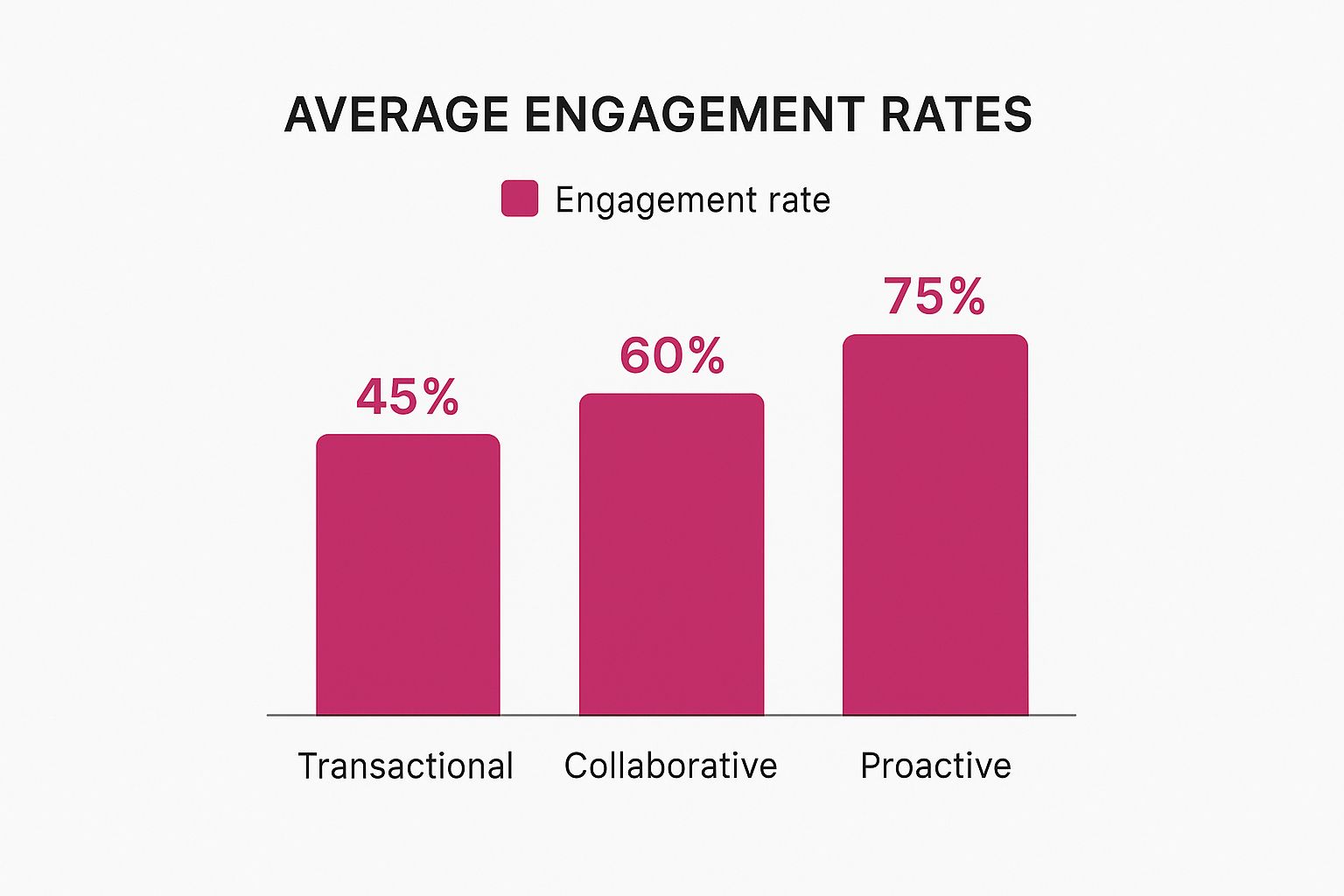
As you can see, the more a brand moves from simple transactions toward more involved and predictive engagement, the more customers interact.
The Value-Added Model: Becoming an Essential Resource
The value-added model is all about providing real utility and expertise that goes beyond your core product. The goal is to make your brand an indispensable resource by offering helpful content, tools, or support that solves a customer’s bigger problems. You’re not just selling a thing; you’re selling a complete solution.
This is a fantastic strategy for companies in complex fields or those selling high-ticket items. A financial services firm offering free budget planners, a hardware store with a massive library of DIY videos, or a software company like HubSpot that gives away tons of free marketing education are all perfect examples. Here, you measure success by content downloads, webinar sign-ups, and the quality of leads generated from these resources. The customer experience feels educational and trustworthy.
The Proactive Model: Anticipating Needs
Finally, we have the proactive model, the most forward-thinking of the bunch. This approach uses customer data to predict needs, problems, and desires—often before the customer even realizes they have them. Instead of waiting for a customer to get in touch, the brand reaches out first with relevant, timely, and personalized solutions.
This model works wonders for subscription services, e-commerce stores with repeat buyers, and tech companies. Think of Amazon suggesting products based on your browsing history or Netflix recommending a show you end up loving. It’s also the engine behind an e-commerce tool like CartBoss, which can automatically send an SMS reminder—complete with a helpful discount—to someone who left items in their cart. Key metrics here include customer lifetime value (CLV), churn rate, and repeat purchase rate. The experience feels personal, intuitive, and almost like magic.
Comparison of Key Customer Engagement Models
To help you figure out which approach is the best fit for your business, here’s a quick side-by-side comparison of these four foundational models.
| Model Type | Core Philosophy | Best For | Key Metrics |
|---|---|---|---|
| Transactional | Make it fast and easy. | Commodity products, low-involvement purchases (e.g., fast fashion, online ticketing). | Conversion Rate, Transaction Speed, Cart Abandonment. |
| Community | Create a sense of belonging. | Brands with passionate users, lifestyle products (e.g., fitness gear, gaming). | User-Generated Content, Forum Activity, Social Engagement. |
| Value-Added | Be a helpful expert. | Complex industries, B2B services (e.g., SaaS, financial services). | Content Downloads, Lead Quality, Webinar Attendance. |
| Proactive | Anticipate customer needs. | Subscription services, e-commerce with repeat buyers (e.g., streaming services). | Customer Lifetime Value (CLV), Churn Rate, Repeat Purchase Rate. |
In reality, most businesses don’t stick to just one model. They often blend elements from different ones to create a unique strategy. For instance, an e-commerce brand might rely on a transactional model for its checkout but use a proactive model for abandoned cart recovery and a community model on social media. The key is to be intentional and pick the elements that align with your brand’s goals and what your customers actually want.
How AI Is Reshaping Customer Engagement

Technology is no longer just a background player; it’s the very engine driving modern customer engagement models. And when it comes to game-changers, nothing is making a bigger impact than Artificial Intelligence (AI). It’s fundamentally rewiring how brands talk to their audience, shifting the dynamic from simply reacting to customers to proactively starting personalized conversations on a massive scale.
Think of AI as a hyper-competent personal assistant assigned to every single one of your customers. It remembers what they like, anticipates what they might need next, and knows the perfect moment to check in. This is exactly what allows businesses to run sophisticated engagement models—like the proactive model—without needing an army of people to manage it all.
From Manual Guesswork To Predictive Insights
One of the biggest shifts AI brings to the table is its ability to interpret “digital body language.” This isn’t some sci-fi concept; it’s all the little clues customers leave behind as they browse—every click, scroll, and hesitation over a product page. In the past, this was just a mountain of data that was too overwhelming to make sense of.
Now, AI algorithms can sift through these behaviors in real-time. This means a brand can actually predict what a customer might be interested in next or spot the exact moment they’re about to lose interest and bounce. It takes raw, messy data and turns it into a clear story about what the customer truly wants.
AI’s true power is in its ability to listen at scale. It can process thousands of customer signals at once, letting brands move beyond broad assumptions to make freakishly accurate, individual-level predictions.
For example, an e-commerce shop can use AI to notice a shopper who keeps coming back to look at a specific category of products. Instead of hitting them with a generic newsletter, it can automatically trigger a personalized email or SMS message showcasing new arrivals in that exact category. The chances of a sale just went way, way up. Applying these kinds of AI-driven tactics is a core part of many advanced digital marketing strategies.
Hyper-Personalization That Feels Human
AI is the secret ingredient to making personalization feel genuine instead of creepy or robotic. It lets brands build a unique experience for every person by tailoring everything from the content on the website and product recommendations to the timing and channel of their messages.
This isn’t just about plugging a customer’s first name into an email. It’s about creating an experience that feels like it was built just for them. Just look at these examples:
- AI-Powered Chatbots: Today’s chatbots are miles ahead of the clunky, pre-programmed bots of the past. They can instantly pull up a customer’s order history to provide relevant support 24/7, which frees up your human agents to tackle the really tricky problems.
- Dynamic Content: AI can literally change the images and offers a customer sees on your homepage based on what they’ve looked at before. The website becomes more relevant with every single visit.
- Predictive Recommendations: This is the classic “you might also like” feature on steroids. AI analyzes buying patterns from millions of other shoppers to make suggestions that are often uncannily accurate.
The Future Is Proactive And Automated
At the end of the day, AI makes it possible for brands to adopt a proactive engagement model with stunning efficiency. Instead of just waiting for a customer to ask for help or abandon their cart, AI can step in first. This proactive move not only builds a stronger connection but also recovers sales that would have otherwise been lost for good.
This isn’t just a fleeting trend—it’s a fundamental change in what customers expect. In fact, a whopping 86% of customer experience leaders believe AI will completely reshape how they interact with customers. Thriving brands are already using these tools to build real relationships, not just process transactions, as detailed in this global customer engagement review. AI gives businesses the power to create more meaningful and profitable customer relationships.
Building Your Customer Engagement Framework
Knowing the different customer engagement models is one thing, but actually putting that theory into practice? That’s where the real growth happens. Building a framework from the ground up can feel like a massive project, but it’s really just a step-by-step process. Think of it as creating a custom-made roadmap that guides people from their very first click to becoming your biggest fans.
This process forces you to be strategic instead of just guessing. Rather than throwing different tactics at the wall to see what sticks, you’ll build a cohesive system where every single action has a clear purpose. Let’s walk through the essential stages of building a powerful framework that actually works for your business.
Step 1: Map the Entire Customer Journey
Before you can engage anyone, you have to know exactly where they are and where they’re going. Mapping the customer journey is all about visualizing every single step a person takes with your brand—from the moment they first hear about you, to the point of purchase, and way beyond. This isn’t just about the sale; it includes post-purchase support, asking for feedback, and encouraging repeat business.
Start by sketching out the main phases your customers typically go through. A common journey might look something like this:
- Awareness: How do people even find out you exist? (Think social media ads, blog posts, or a friend’s recommendation.)
- Consideration: What are they doing while they’re kicking the tires? (Reading reviews, comparing your prices, digging into product pages.)
- Purchase: What’s the checkout experience like? Is it dead simple or a frustrating mess?
- Retention: What happens after you have their money? (Follow-up emails, quick support, loyalty programs.)
- Advocacy: How do you turn happy customers into a volunteer marketing team?
Imagine a new subscription box service. Their journey map would track a user who sees an Instagram ad (Awareness), browses the different box options (Consideration), signs up for a monthly plan (Purchase), gets their first box and a follow-up survey (Retention), and then shares their unboxing video on TikTok (Advocacy).
Step 2: Pinpoint Key Touchpoints
Once your journey map is laid out, it’s time to zero in on the most critical touchpoints in each phase. These are the specific moments of interaction where you have the biggest opportunity to shape a customer’s perception and guide their next move. Not all touchpoints are created equal; some are way more important than others.
A “touchpoint” can be anything from a customer clicking on a Facebook ad to them physically unboxing their order. The trick is to identify the moments that truly matter. For our subscription box example, the make-or-break touchpoints might include:
- The landing page they see right after clicking an ad.
- The confirmation email that hits their inbox.
- The physical packaging and presentation of the box itself.
- A customer support chat they start to ask about an item.
Focusing your energy on these pivotal moments gives you the highest return on your engagement efforts. Nailing just one or two of these key interactions can create a positive ripple effect across the entire customer experience.
Step 3: Segment Your Audience by Behavior
Treating all your customers the same is a recipe for mediocre results. Truly effective engagement feels personal, and personalization always starts with smart segmentation. Forget just using basic demographics; you need to segment your audience based on their actual behaviors and where they are in their journey.
Behavioral segmentation groups customers based on what they do, such as:
- New Visitors: People who just stumbled upon your brand.
- Cart Abandoners: Users who got this close but didn’t finish checking out.
- First-Time Buyers: Customers who just made their first purchase and are ripe for a great experience.
- Loyal Repeat Customers: Your VIPs who buy from you again and again.
When you segment this way, you can tailor your message perfectly. A cart abandoner for the subscription box could get a targeted SMS from a tool like CartBoss, reminding them of the awesome stuff they’re missing out on—maybe even with a little discount to sweeten the deal. A loyal customer, on the other hand, might get an exclusive sneak peek of next month’s box. For a full playbook on this, check out this fantastic customer engagement strategy template.
Step 4: Choose the Right Technology
Finally, you need the right tools to bring this whole framework to life. Technology is what will automate your processes, gather crucial data, and let you engage with customers at scale. Without the right tech stack, even the most brilliant plan will fall flat. If you’re looking for more ideas, reviewing these actionable student engagement strategies can offer some surprisingly relevant insights for building your own framework.
The specific tech you need will depend on your model, but a few tools are almost always essential:
- Customer Relationship Management (CRM): The central hub for all your customer data and interaction history.
- Email Marketing Platform: For sending newsletters, promos, and automated follow-up sequences.
- SMS Marketing Tool: Perfect for high-impact, immediate messages like abandoned cart reminders.
- Analytics Software: To track what customers are doing and measure whether your efforts are actually working.
By following these four steps—mapping the journey, identifying touchpoints, segmenting your audience, and choosing your tech—you can build a customer engagement framework that is both robust and incredibly effective. This structured approach takes you from guessing what customers want to knowing exactly how to deliver it.
Focusing on Your Most Valuable Customers
Let’s be honest: not all customers are created equal. While it feels nice to treat everyone the same, a smart, performance-first strategy recognizes a simple truth. Concentrating your efforts on your most valuable customers delivers a much, much higher return. Casting a wide, generic net is just inefficient and expensive.
This approach is all about identifying and nurturing the customers most likely to become long-term, high-spending advocates for your brand. Instead of spreading your marketing budget thin trying to win back everyone, you double down on the relationships that actually drive growth. It’s a strategic shift from quantity to quality.
Identifying Your High-Value Segments
First things first, you have to figure out who these VIPs are. Modern data platforms and predictive analytics are your best friends here, helping you look past single purchases to see the bigger picture of customer lifetime value (CLV). You can spot these valuable segments by tracking a few key behaviors.
- Purchase Frequency: How often are they actually buying from you?
- Average Order Value (AOV): Do they consistently spend more than others?
- Repeat Purchase Rate: Do they keep coming back for more?
- Product Engagement: Are they exploring and buying a wide range of your products?
By analyzing these patterns, you can build a crystal-clear profile of your ideal customer. This data-driven approach is way more effective than just guessing based on simple demographics. If you’re just getting started, this guide on how to segment customers breaks down the process beautifully.
This focus on high-value customers is a huge trend shaping modern customer engagement models. Recent analysis shows a major shift towards data-driven segmentation. Instead of diluting resources, companies are now zeroing in on customers whose buying habits signal long-term potential. This is all powered by advanced customer data platforms that are constantly tweaking segments as new behaviors pop up. You can read more about these 2025 engagement trends to see how this is playing out across the market.
Tailoring Engagement for Your Best Customers
Once you know who your most valuable customers are, you have to treat them differently. This isn’t about ignoring everyone else, but about creating an elevated experience for your top tier that makes them feel seen and appreciated. This special treatment is what cements their loyalty and encourages them to become true brand champions.
An exclusive experience for your top customers isn’t just a reward; it’s an investment in your most profitable relationships. It reinforces their decision to choose you and transforms them from buyers into advocates.
Here are a few ways to roll out the red carpet for this crucial group:
- Exclusive Benefits and Early Access: Give them first dibs on new products, special sales, or exclusive content that isn’t available to just anyone.
- Hyper-Personalized Communication: Go way beyond just using their first name. Send recommendations based on their specific purchase history or acknowledge milestones like their customer anniversary.
- Proactive and Prioritized Support: Offer them a dedicated support line or faster response times. Anticipating their needs before they even have to ask shows you genuinely value their business.
By focusing your best efforts on your best customers, you create a powerful feedback loop. They feel valued, so they spend more and tell their friends, which in turn brings more high-value customers right to your doorstep. This targeted approach is the cornerstone of any smart, profitable engagement strategy.
How to Measure Your Engagement Success

Running an engagement strategy without clear metrics is just guessing. If you want to know if your customer engagement models are actually working, you have to look past vanity metrics like social media likes and zero in on the Key Performance Indicators (KPIs) that directly affect your bottom line.
These are the numbers that tell the real story of your customer relationships. They show you whether you’re building genuine loyalty or just ringing up one-off transactions. By tracking the right data, you get a solid framework for judging performance and making smart, data-driven tweaks to get better results.
Core Metrics That Truly Matter
To get an accurate read on your success, start with these three essential KPIs. Each one gives you a unique peek into the health of your customer relationships and how well your engagement efforts are landing.
- Customer Lifetime Value (CLV): This is the big one. CLV predicts the total amount of money you can expect to make from a single customer over their entire relationship with you. A rising CLV is a fantastic sign that your engagement strategies are hitting the mark, encouraging repeat buys and building long-term loyalty.
- Churn Rate: This metric tracks the percentage of customers who walk away from your business over a specific period. A high churn rate is a major red flag—it screams that your model isn’t creating the kind of valuable, sticky experience that makes people want to stay.
- Net Promoter Score (NPS): This classic metric measures customer satisfaction with one simple question: “How likely are you to recommend our brand to a friend?” NPS helps you quickly gauge how your customers feel, shining a light on your biggest fans and those who are at risk of leaving.
Measuring these KPIs isn’t just about creating reports; it’s about digging into the ‘why’ behind the numbers. A low NPS score isn’t just a bad number—it’s a direct signal that a part of your customer journey needs immediate attention.
By keeping a close eye on these figures, you can fine-tune your approach and drive much better outcomes. You can dive deeper by exploring different customer engagement metrics that offer a more complete picture of your performance. For more specific insights, you can also explore methods for measuring social media success.
Common Questions About Engagement Models
Putting an engagement model into practice always brings up a few questions. It’s one thing to understand the theory, but it’s another to actually make it work for your brand. Let’s clear up some of the most common things people ask when they’re getting started.
Think of this as your practical FAQ for building a killer engagement strategy.
How Often Should We Review Our Engagement Model?
Your engagement model isn’t something you can just set and forget. Customer habits change, markets shift, and your own business goals will look different a year from now. A solid rule of thumb is to give your model a full, in-depth review at least once a year.
But don’t wait a whole year to see if things are working. You should be keeping a much closer eye on its performance. Check your key metrics—like Customer Lifetime Value (CLV) and churn rate—every quarter. If you see a sudden drop, or after a big company change like a new product launch, it’s time to pull it apart and see what needs updating right away.
Your engagement model is a living, breathing part of your business. It needs regular check-ups to stay effective. This isn’t just maintenance; it’s what keeps your strategy sharp and driving real results.
Can a Small Business Implement a Sophisticated Model?
Absolutely. “Sophisticated” doesn’t have to mean complicated or expensive. A small business can run a really effective, proactive model by being smart and focusing on targeted automation instead of trying to boil the ocean. The secret is to start small and build from there.
For instance, a small eCommerce store could start with something as simple as automated SMS for cart recovery. That one move puts a proactive touchpoint right where it counts, directly boosting sales without needing a huge team or a massive budget. As the business grows, you can start layering in other tactics, like personalized email follow-ups or a simple loyalty program.
What Is the Biggest Mistake Brands Make?
The single biggest mistake is being inconsistent. You see it all the time—a brand has an amazing, slick social media game but then completely fumbles the ball with slow, unhelpful customer support. That kind of disconnect destroys customer trust and makes the entire model fall apart.
Every single interaction a customer has with your brand needs to feel connected. If you’ve decided on a value-added model, your support team better be just as insightful as your blog content. It’s that consistency across every channel that builds a strong brand experience customers can actually count on.
How Do I Choose the Right Model to Start With?
The best place to start is by looking at two things: your customers and your product.
- Selling simple, fast-moving products? The Transactional Model is a great place to start. Your main focus should be on making the checkout process as smooth and frictionless as possible.
- Running a passion-driven or lifestyle brand? You’ll want to lean into a Community Model to build a loyal following that feels like a tribe.
- Dealing with complex or high-ticket items? A Value-Added Model is your best bet. It builds trust by positioning you as the go-to expert in your field.
And remember, you don’t have to be boxed in by just one. Most of the top brands out there are actually mixing and matching elements from different customer engagement models to create a unique hybrid approach that fits them perfectly.
Ready to turn abandoned carts into profit? CartBoss uses powerful, automated SMS messages to bring customers back and boost your sales by up to 50%. Start recovering lost revenue today.