


Every time a shopper interacts with your brand, that’s a customer touch point. From the first ad they see to the shipping confirmation text they receive, each moment is an opportunity to build trust and increase revenue—or create friction and lose a sale for good. Mastering these interactions is the key to turning casual browsers into loyal customers.
This guide will walk you through a step-by-step process to identify, map, and optimize your customer touch points to directly impact your bottom line.
What Exactly Is a Customer Touch Point?
A customer touch point is any interaction a person has with your e-commerce brand. Think of it as a series of digital moments that, when connected, form the entire customer experience. This includes every ad they scroll past, every email they open, and every product page they click on.
A customer’s path to purchase is no longer a straight line. A shopper might see your Instagram ad, visit your site, and leave. Later, they see a retargeting ad on Facebook, click it, come back, and then finally browse reviews before even thinking about buying.
Why Every Single Interaction Matters
Each touch point is a moment of truth. When these moments are positive, helpful, and consistent, they create a smooth path to purchase and lay the groundwork for long-term loyalty. But a single bad experience—like a confusing checkout page or a broken link in an email—can kill a sale on the spot.
By identifying and improving key touch points, you can achieve measurable results:
- Increase Revenue: A smoother journey from discovery to checkout means more completed purchases.
- Reduce Abandonment Rates: Fixing friction points, especially in the cart and checkout, is the fastest way to stop shoppers from leaving.
- Improve Customer Loyalty: Positive, reliable interactions make customers feel valued, giving them a powerful reason to return.
A customer touch point isn’t just a point of contact; it’s an opportunity. It’s the moment you get to prove your brand’s value, build trust, and guide a shopper one step closer to becoming a loyal customer.
Ultimately, mastering your customer touch points means you’re no longer leaving the customer journey to chance. You’re actively designing a better, more profitable experience for every person who interacts with your brand.
How To Map Your Customer Journey Touchpoints
To optimize the customer experience, you first have to see your store from their perspective. A customer journey map is a visual blueprint of every interaction a person has with your brand, from the first ad they see to the follow-up email after their purchase.
Mapping this journey reveals friction points you might have missed and highlights the best opportunities to create a smoother, more profitable path to purchase.
This map shows the basic flow from discovery (an ad or email) to landing on and engaging with your website.
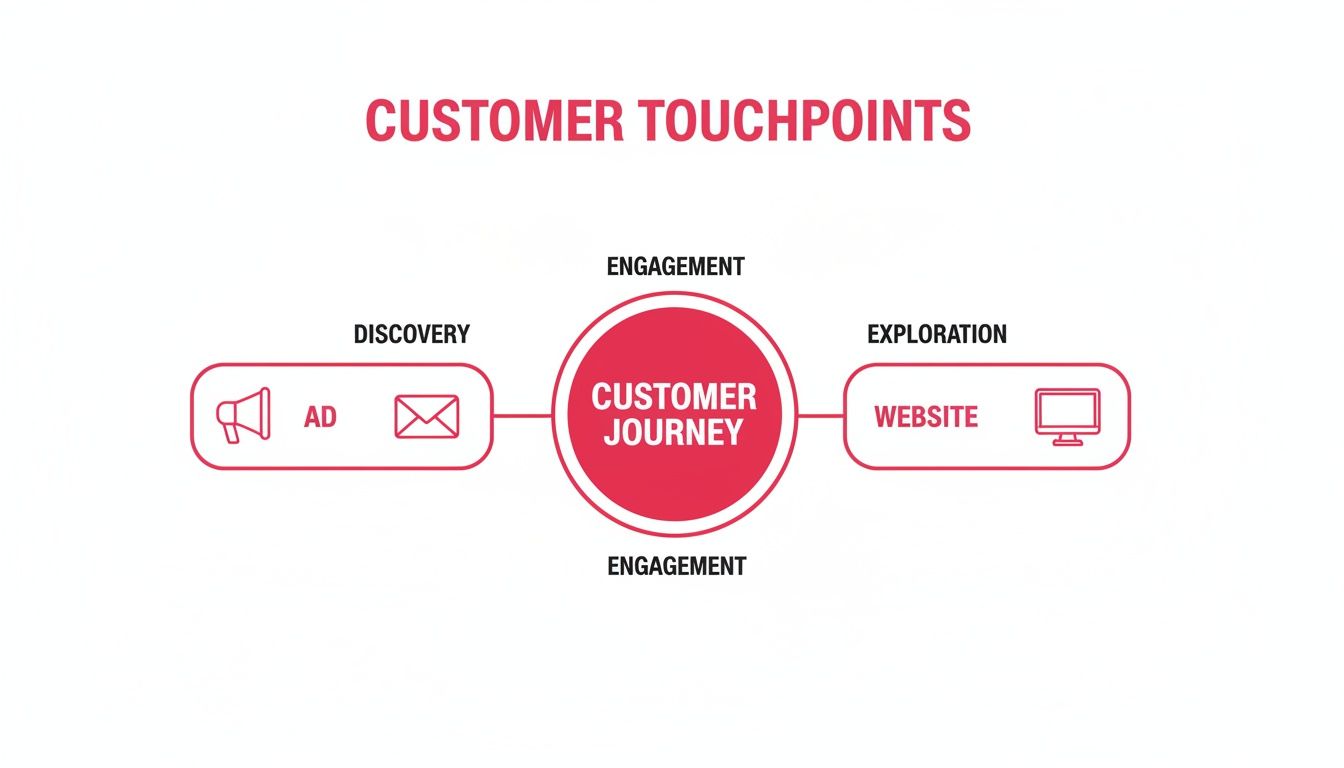
This visual captures how different touchpoints work together to guide someone from initial awareness to actively considering a purchase.
The Five Core Stages of an E-commerce Journey
To make mapping manageable, break the journey into five distinct stages. Each has a clear goal and a set of digital touchpoints you’re likely already using.
- Awareness: The discovery phase. Your goal is to introduce your brand to people who don’t know you exist but have a need you can solve.
- Consideration: Once aware, shoppers dig deeper. They research, compare products, and decide if you’re the best solution. Your job is to provide the information they need to build trust.
- Purchase: The moment of truth. The customer has decided to buy, and your only goal is to make the transaction seamless and secure. Any friction here can lead to an abandoned cart.
- Retention: The journey doesn’t end at payment. Now, you must nurture the relationship to turn a one-time buyer into a repeat customer through great post-purchase support and engagement.
- Advocacy: The ultimate goal. An advocate doesn’t just buy from you repeatedly; they actively promote your brand to their network, leave positive reviews, and become your most valuable marketing asset.
In today’s e-commerce landscape, a single journey can involve 20 to over 500 touchpoints, as shoppers hop between social media, emails, and websites before finally deciding to buy.
A Practical Touchpoint Map for Your Store
Mapping these stages gives you an incredible diagnostic tool for your business. But just listing them isn’t enough; the real power comes from mastering customer journey optimization for e-commerce to make every interaction better.
A customer journey map is more than just a list of interactions; it’s a strategic tool that reveals exactly where you are winning or losing customers. It turns abstract data into an actionable plan for revenue growth.
Use this table as a checklist to audit your store and pinpoint where you can make quick improvements.
E-commerce Customer Journey Touchpoint Map
| Journey Stage | Key Objective | Common Digital Touchpoints |
|---|---|---|
| Awareness | Introduce your brand and capture attention. | Social media ads (Facebook, Instagram, TikTok), SEO/Content marketing (blog posts), Influencer collaborations, Word-of-mouth referrals, Public relations mentions |
| Consideration | Build trust and showcase product value. | Website product pages, Customer reviews and testimonials, Email newsletters, Comparison guides, Live chat support, Retargeting ads |
| Purchase | Provide a seamless and secure checkout experience. | Shopping cart page, Checkout page, Payment gateway options (Stripe, PayPal), Order confirmation emails, Abandoned cart recovery SMS/emails |
| Retention | Encourage repeat purchases and build loyalty. | Post-purchase follow-up emails, Shipping and delivery notifications (SMS/email), Loyalty programs, Exclusive offers for existing customers, Customer support interactions |
| Advocacy | Turn happy customers into brand promoters. | Review request emails/SMS, User-generated content campaigns, Referral programs (“Give $10, Get $10”), Social media shoutouts, Community forums or groups |
This map provides a solid foundation. Once you’ve identified your key touchpoints, you can begin optimizing them for maximum impact.
Why a Consistent Experience Is a Game Changer
Imagine a customer clicks on a fun, playful social media ad, only to land on a stiff, corporate-looking product page. That disconnect instantly kills the mood, erodes trust, and makes your brand feel unprofessional.
A consistent experience across every single customer touch point is fundamental to running a successful e-commerce store. When your brand’s voice, design, and message are the same everywhere, customers feel comfortable and secure, smoothing the path to purchase.

Building Trust with Every Interaction
Your brand is the sum of every interaction a customer has with you. A consistent experience proves you’re professional and trustworthy. When an order confirmation email looks and sounds just like your website, it reassures the customer they made the right choice.
Inconsistencies breed doubt. A different tone in a support email or a clunky post-purchase notification can make a customer second-guess your credibility. That hesitation is often all it takes to lose a repeat purchase.
Data shows that consistency is key. A remarkable 65% of consumers say they will remain loyal to brands that deliver positive, uniform experiences. For stores battling the industry average 70% cart abandonment rate, building that kind of loyalty is how you win.
How Consistency Drives Measurable Results
A seamless journey directly boosts your revenue and customer lifetime value (CLV). When shoppers have a smooth, predictable experience, they are far more likely to complete their purchase and return again.
Here’s how consistency translates into real-world wins:
- Increased Conversion Rates: A clear, easy-to-follow path from ad to checkout means fewer people drop off.
- Higher Customer Lifetime Value (CLV): Trust creates loyalty. Loyal customers spend more over time and cost far less to retain than acquiring new ones.
- Stronger Brand Recognition: A consistent look, feel, and voice makes your brand instantly recognizable in a crowded market.
Inconsistency is friction. Friction costs you sales. A consistent experience, however, builds momentum, guiding customers smoothly from one touchpoint to the next and turning initial interest into lasting loyalty.
To nail every interaction, you need to improve ecommerce customer experience. Ultimately, a unified brand experience separates memorable, profitable stores from the rest. Creating an omnichannel customer experience is a powerful way to ensure consistency across all your channels.
Finding and Fixing Your Most Expensive Touchpoints
While every customer touchpoint plays a role, some have a much larger impact on your revenue. Ignoring them is like leaving a tap running—a slow, steady drain on your profits. This is where we stop just mapping the journey and start plugging the leaks.
For nearly every e-commerce store, the single most expensive point of failure is the cart and checkout process. This isn’t just one interaction; it’s a series of high-stakes moments where a motivated buyer can become a lost sale in an instant. When a shopper adds an item to their cart, they’re signaling clear intent to buy. Losing them at this final stage is incredibly costly.
Pinpointing the Leaky Bucket
Think of your checkout flow as a bucket. If it has holes, you’ll lose customers no matter how many you pour in. The data is clear: the average cart abandonment rate is a painful 70%. That means for every ten shoppers who add a product to their cart, seven walk away. This cluster of touchpoints is where the most revenue is lost.
Your first step is to analyze your store’s data to find out exactly where people are dropping off.
- Shopping Cart Page: Are they leaving here? Surprise shipping costs or a hard-to-find “Proceed to Checkout” button are common culprits.
- Customer Information Step: Asking for too much information or forcing account creation is a classic friction point.
- Shipping Method Selection: High or unexpected shipping fees are the #1 reason for cart abandonment.
- Payment Page: Is the sale failing here? A lack of trusted payment options (like PayPal or Apple Pay) or security concerns can kill the conversion.
Your analytics data is a treasure map that leads directly to your most expensive problems. By focusing on the cart and checkout touchpoints, you are prioritizing the fixes that will deliver the highest and fastest return on your effort.
Once you know where the leaks are, you can start patching them. A detailed abandoned cart analysis is the most direct way to understand why customers are leaving and, more importantly, how to bring them back. This is how you turn a costly failure into your most powerful recovery opportunity.
Using SMS to Rescue Lost Sales at a Critical Touchpoint
We’ve identified the cart and checkout process as the most expensive—and leaky—customer touch point. Now, let’s talk about the most effective way to plug that leak and turn lost revenue into measurable profit.
Email has long been the go-to tool for cart recovery, but its effectiveness is waning in cluttered inboxes. SMS, on the other hand, cuts through the noise. With an incredible open rate of up to 99%—most of which are read within minutes—text messages provide a direct and immediate line to your customer. For a time-sensitive issue like cart abandonment, this is a game-changer.
Crafting a High-Converting SMS Recovery Strategy
An effective SMS strategy is more than a simple reminder. It’s about sending the right message at the right time to nudge the customer across the finish line and make completing their purchase feel effortless.
Here’s a simple, step-by-step plan for your SMS cart recovery flow:
- Perfect Your Timing: Send the first text 30 to 60 minutes after abandonment. This is the sweet spot—soon enough that the items are fresh in their mind, but not so fast that it feels intrusive.
- Write Compelling Copy: Keep your message short, personal, and direct. Use the customer’s name, mention a product they left behind, and create a friendly sense of urgency.
- Offer a Smart Incentive: A small, dynamic discount like 10% OFF or free shipping can be the perfect tipping point to drive action.
- Ensure a Frictionless Link: This is critical. The link in your text must take them directly to a pre-filled checkout page. The easier you make it to pay, the higher your recovery rate. With CartBoss, this is handled automatically.
High-Impact SMS Templates You Can Use Today
Your tone should be helpful, not pushy. Here are two battle-tested templates you can adapt for your store to start recovering sales immediately.
Example 1: The Gentle Nudge
Hey [Customer Name]! It looks like you left some great items in your cart at [Your Store Name]. Your order is saved and ready when you are! Complete your purchase here: [Link]
Example 2: The Value Offer
Hi [Customer Name]! Still thinking it over? To help you decide, here’s 10% OFF your order at [Your Store Name]. This offer expires in 24 hours! Finish checking out here: [Link]
These templates are effective because they are personal, have a clear call-to-action, and make the next step simple. The second example adds urgency with a time-sensitive discount, a proven tactic for boosting conversions. For a deeper dive, learn more about how to recover abandoned carts with text messages in our detailed guide.
A well-timed SMS isn’t just a reminder; it’s a premium customer service interaction. By turning a moment of friction into a seamless, helpful experience, you not only recover a sale but also build lasting brand loyalty.
Automating this process is the key to scaling your results. A tool like CartBoss handles everything on autopilot—from detecting the abandoned cart to sending localized, compliant messages. Features like automatic language detection ensure your message always resonates with a global audience, turning this critical customer touch point into a powerful revenue engine.
Frequently Asked Questions
Here are clear, straightforward answers to common questions e-commerce owners have about optimizing every customer touch point.
How Many Customer Touchpoints Should My Store Have?
There is no magic number. A customer’s journey can have anywhere from 20 to over 500 interactions. The goal isn’t to hit a specific number but to focus on the quality and consistency of the essential moments your customers have with your brand.
A handful of smooth, positive touchpoints—from the first ad to the post-purchase follow-up—is far more valuable than hundreds of clunky, disconnected ones.
What’s the Difference Between a Touchpoint and a Channel?
It’s easy to confuse these two. The simplest way to think about it is that a channel is the “where,” while a touchpoint is the specific interaction that happens “there.”
- Channel: The platform you use to communicate (e.g., your website, email, SMS, Instagram).
- Touchpoint: The specific action or moment of connection on that channel (e.g., viewing a product page, clicking “add-to-cart,” opening a shipping notification text).
For example, your website is one channel, but a visitor viewing a product, adding it to their cart, and entering their payment information are three separate touchpoints. Each is a new opportunity to either impress or frustrate them.
Think of a channel as the road and a touchpoint as a specific stop along that road. Each stop influences the overall journey, making it either smooth or bumpy.
How Can I Map My Touchpoints on a Small Budget?
You don’t need expensive software. You can start with a simple audit using a free tool like a spreadsheet or even a whiteboard. The most important step is to see your store through your customer’s eyes.
- List the main journey stages: Awareness, Consideration, Purchase, Retention, Advocacy.
- Act like a new customer: Go through your own buying process from start to finish.
- Document every interaction: Note every ad you see, every page you click, every email you receive, and every button you press.
This simple exercise costs nothing but time and will immediately reveal your store’s most important touchpoints and highlight areas for improvement. As you refine your communications, ensure they are compliant. Our guide to SMS marketing compliance can help you make sure every message is both effective and legal.
Ready to turn your most critical customer touch point—cart abandonment—into your biggest revenue driver? CartBoss uses automated SMS to recover lost sales on autopilot. Start recovering sales today.