


Imagine a customer is about to leave your site. Before they go, they click a checkbox that gives you a clear, enthusiastic “Yes!” to get cart reminders via text.
That, in a nutshell, is express consent. It’s the explicit, unambiguous permission a customer gives your business to send them specific SMS messages. It’s not just a legal requirement; it’s the foundation of a profitable SMS marketing strategy that customers actually love.
Express Consent for E-commerce: Your Quick-Start Guide
For any e-commerce store owner, understanding express consent isn’t just about avoiding fines. It’s about building a high-quality list of shoppers who want to hear from you, leading to higher engagement, more recovered carts, and increased revenue.
Think of it like this:
- Express Consent: You’re an invited guest at a party. You’re welcomed, listened to, and more likely to build a positive relationship.
- No Consent: You’re a party crasher. You’re annoying, unwelcome, and will probably get kicked out (unsubscribed).
What Makes Consent “Express”?
For consent to be valid and legally compliant, it must be:
- Clear: Your customer knows exactly what they’re signing up for. Use simple language, not confusing jargon or hidden fine print.
- Affirmative: They must take a specific action to agree, like actively checking an unchecked box. This can’t be a condition of purchase.
- Specific: The consent should apply to a particular type of message, like “cart reminders” or “exclusive deals.”
This is the polar opposite of implied consent, which is a risky assumption based on a customer’s other actions (like making a purchase). Relying on implied consent for marketing texts is a fast track to annoying customers and violating laws like the TCPA.
Express vs. Implied Consent: A Simple Breakdown
Understanding this difference is crucial for building a sustainable SMS marketing channel. Here’s a quick comparison.
| Attribute | Express Consent (Your Goal) | Implied Consent (Avoid This) |
|---|---|---|
| How It’s Given | Customer takes a clear action (e.g., checks a box, texts a keyword). | Inferred from other actions (e.g., making a purchase without an opt-in). |
| Clarity | The purpose is stated upfront: “Yes, send me SMS cart reminders.” | The customer may not even realize they’ve “agreed” to receive marketing texts. |
| Legal Standing | Compliant with major regulations like TCPA and GDPR. It’s your legal safeguard. | Fails to meet the requirements of most data privacy laws. Legally dangerous. |
| Business Impact | Builds a high-quality, high-ROI marketing list and fosters brand trust. | Leads to high unsubscribe rates, spam complaints, and potential fines. |
The bottom line for your store: Always get express consent. It’s the only way to build a profitable SMS channel that customers appreciate.
How This Directly Impacts Your Revenue
When a customer gives you express consent, they’re raising their hand and telling you they’re interested in what you have to offer. This creates a pre-qualified audience that is far more receptive to your messages.
Express consent isn’t just a legal checkbox; it’s a strategic asset. It became the global standard with the rollout of the General Data Protection Regulation (GDPR) on May 25, 2018, which requires a clear, active “yes” from the user.
This high-quality permission is essential for using powerful tools like abandoned cart SMS reminders. Without it, you can’t legally or effectively text customers who have left items behind.
By focusing on express consent, you build an audience that delivers a much higher return on investment and strengthens your brand. You can learn more about what an opt-in means in our detailed guide. This shift in focus—from simply collecting numbers to building relationships—is the key to sustainable e-commerce growth.
How Express Consent Drives Measurable Revenue Growth
Treating express consent as just a legal hurdle is a massive missed opportunity. For smart e-commerce marketers, it’s a powerful engine for revenue growth. It’s not about dodging fines; it’s about building a list of high-intent customers who are ready to buy.
When a shopper gives you explicit permission to text them, they pre-qualify themselves as a warm lead. That direct line of communication is pure gold, especially since SMS marketing open rates can hit an incredible 98%. An audience that engaged is a goldmine for any store.
The Direct Link Between Trust and Sales
A foundation of trust built on clear consent translates directly into recovered sales and higher customer lifetime value (LTV).
Customers who willingly opt-in are far more receptive to your reminders and offers. They see your texts as helpful nudges, not intrusive spam. This positive relationship is what turns a one-time browser into a loyal, repeat buyer. A compliant SMS strategy becomes a reliable tool for clawing back revenue that would otherwise be lost forever.
By focusing on customers who explicitly agree to receive messages, you create a marketing channel with unparalleled engagement. You’re not just sending texts; you’re starting a conversation with people who are already listening.
This is why tools like CartBoss are so effective. We only message shoppers who have given clear, unambiguous consent. This ensures your cart recovery texts land with a receptive audience, dramatically increasing your chance of making the sale while respecting customer boundaries.
Turning Abandoned Carts Into a Profit Center
Cart abandonment is a major challenge, with the global average rate hovering around 69.8%. Express consent unlocks the single most effective solution: timely, personalized SMS reminders.
Stores that get proper express consent for SMS see up to 30% higher conversion rates compared to those relying on email alone. Automated, compliance-first tools like CartBoss consistently recover up to 50% of lost sales for our users by sending these consent-based reminders.
Here’s a step-by-step look at how this boosts your bottom line:
- Get Clear Consent: A shopper checks a box at checkout to receive cart reminders.
- Automate the Reminder: If they abandon their cart, an automated SMS is sent.
- Recover the Sale: The text includes a direct link to their pre-filled cart, making it easy to complete the purchase.
This simple, compliant flow leads to:
- Higher Conversion Rates: You’re messaging shoppers who are already interested, leading to more completed checkouts.
- Increased ROAS: Focusing your marketing spend on an engaged list means less waste and a much higher return.
- Improved Customer LTV: Building relationships on trust encourages repeat purchases and strengthens brand loyalty.
Investing in a proper consent strategy is an investment in a more profitable business. Learn more about the financial impact in our guide on calculating the ROI of SMS marketing for your e–commerce store.
A Plain-English Guide to TCPA, GDPR, and CCPA Compliance
Legal acronyms like TCPA, GDPR, and CCPA can feel overwhelming. But you don’t need a law degree to get this right. The core principle behind all of them is the same: you must get clear, enthusiastic consent before sending automated marketing texts.
Let’s break down what each of these major regulations means for your e-commerce store in simple, actionable terms.
TCPA: The Key Regulation in the United States
The Telephone Consumer Protection Act (TCPA) is the main U.S. federal law governing SMS marketing. Its golden rule is that you must obtain prior express written consent before sending an automated marketing text.
This means a customer must take a clear, deliberate action—like checking an empty box—to say, “Yes, text me!” The penalties for getting this wrong are severe, with fines ranging from $500 to $1,500 per text message.
Here’s your TCPA action checklist:
- Use an Unticked Checkbox: Ensure your opt-in requires a clear, affirmative action from the customer.
- State the Purpose Clearly: Your opt-in form must explain that they are agreeing to automated marketing texts.
- Include a “Not Required” Clause: State clearly that agreeing to SMS marketing is not a condition of purchase.
- Provide an Easy Opt-Out: Offer a simple way to unsubscribe, like replying with “STOP.”
For a deeper dive, check out our complete guide to TCPA rules for text message marketing.
GDPR: The Gold Standard in the European Union
The General Data Protection Regulation (GDPR) sets a high bar for consent in the EU, defining it as freely given, specific, informed, and unambiguous.
Under GDPR, consent must be an active, affirmative choice. This means pre-checked boxes are strictly forbidden. The law gives individuals full control over their data, including the right to withdraw consent as easily as they gave it.
A simple rule of thumb for GDPR: If it’s harder for a customer to unsubscribe than it was to subscribe, your process is non-compliant.
Here’s your GDPR action checklist for stores with EU customers:
- No Pre-Ticked Boxes, Ever: The user must physically check the box to opt in.
- Use Specific Consent: Ask for separate permission for different message types (e.g., cart reminders vs. weekly newsletters).
- Keep Detailed Records: You must document who consented, when, and how.
CCPA: Giving Control to Californians
The California Consumer Privacy Act (CCPA), now enhanced by the CPRA, empowers California residents with more control over their personal information. While its opt-in rules are less strict than GDPR or TCPA, it is built on transparency and user control.
The law requires you to inform consumers what data you’re collecting and why. A clear and comprehensive Privacy Policy is your best tool for explaining your data practices.
Here’s your CCPA action checklist:
- Be Transparent: Clearly state in your privacy policy that you collect phone numbers for SMS marketing.
- Honor Opt-Outs Immediately: Provide a clear and easy way for users to stop receiving messages.
- Secure the Data: Protect the personal information you collect from subscribers.
Key SMS Consent Rules by Regulation
This table summarizes what each major law means for your SMS opt-in process and the key action you need to take to stay compliant.
| Regulation | What It Means for Your SMS Opt-In | Key Action Required |
|---|---|---|
| TCPA (U.S.) | Requires “prior express written consent.” The user must knowingly and clearly agree to receive automated marketing texts. | Implement an unticked checkbox or another clear affirmative action. Disclose that consent is not a condition of purchase. |
| GDPR (EU) | Consent must be “freely given, specific, informed, and unambiguous.” It must be a clear affirmative act. | Use unticked checkboxes. Allow users to give separate consent for different message types. Keep detailed records of consent. |
| CCPA (California) | Focuses on transparency and the right to opt out. Users must be informed about data collection and its purpose. | Clearly disclose your SMS marketing practices in your privacy policy and provide an easy way for users to opt out. |
While each regulation has its nuances, they all point to the same goal: a transparent, user-first opt-in process. Platforms like CartBoss are designed with these rules built-in, automatically managing consent records and opt-out requests so you can focus on growing your business.
Designing a High-Converting (and Compliant) Opt-In Process
Knowing the rules is one thing; implementing them effectively on your store is another. The goal is to design consent collection points that are both legally sound and optimized to get that “yes.”
Let’s walk through the practical steps to make subscribing an easy, transparent, and compelling choice for your customers.
Step 1: Craft Compelling Opt-In Language
The words you use at the point of consent are critical. Vague language will hurt your sign-up rates and could invalidate your consent. Be direct, be honest, and clearly state the value for the customer.
Here are a few templates for your checkout page checkbox that balance compliance and conversion:
- Simple & Direct: “Text me with news, offers, and cart reminders. I agree to the terms and privacy policy.”
- Benefit-Oriented: “Get exclusive deals and order updates straight to your phone. Check here to opt-in to SMS messages.”
- Urgency-Focused: “Yes, text me about my order and send a reminder if I forget something in my cart!”
Each example clearly states the purpose of the messages (offers, updates, reminders) and requires a deliberate action from the customer.
Step 2: Follow Best Practices for Forms and Checkboxes
How you ask for permission matters just as much as what you say. A clunky design can sink your opt-in rates.
Follow these essential rules for any opt-in point on your site:
- Never Use Pre-Checked Boxes: The customer must perform the action themselves. A pre-checked box assumes consent, which is a major violation under GDPR and other regulations.
- Place Disclosures Clearly: The required legal text, like “Message and data rates may apply,” must be placed directly next to the checkbox. Don’t hide it.
- Separate from Terms & Conditions: Your SMS consent must be a separate checkbox from your general T&Cs. They are two different agreements.
- Keep it Visible: On pop-ups or forms, make sure the opt-in field and button are visible without scrolling.
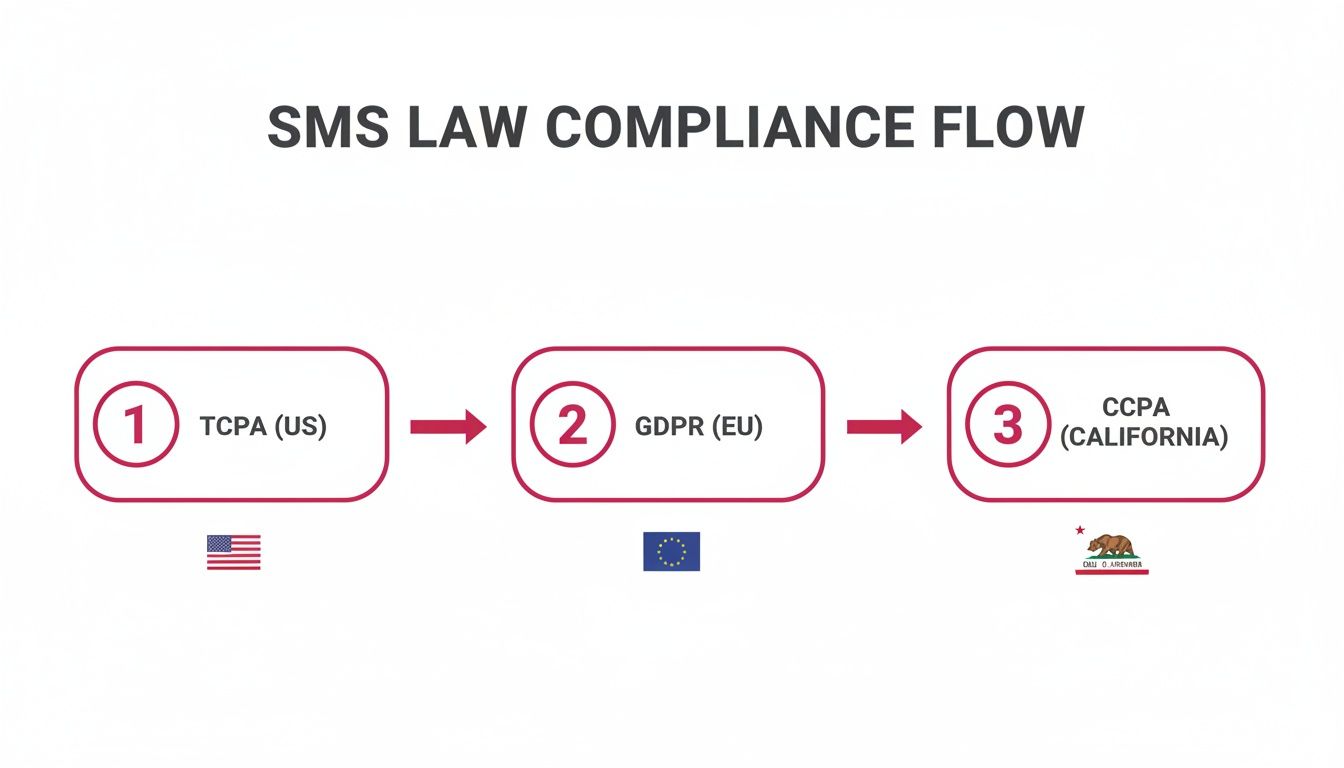
This infographic gives a quick visual of the major regulations—TCPA, GDPR, and CCPA—that inform these best practices.
Step 3: Optimize the User Experience for Maximum Opt-Ins
A compliant opt-in process doesn’t have to be boring. By focusing on the user experience, you can increase sign-ups while building trust. Learn more about crafting the perfect opt-in message in our dedicated article.
Treat the opt-in as a value exchange. You’re asking for permission to enter a personal space—their text inbox. In return, offer clear value, like exclusive discounts, early access to sales, or convenient order updates.
A frictionless process is also vital. For example, after a customer opts in, a platform like CartBoss can send a cart recovery message with a pre-filled checkout link. This removes friction and makes it incredibly easy for the shopper to finish their purchase, boosting your recovery rate.
To further improve your forms, dive into website conversion optimization strategies. Applying these principles will help you design an opt-in flow that not only meets legal standards but also becomes a powerful engine for growing your subscriber list.
How to Document Consent and Manage Subscribers
Getting a customer to check that opt-in box is just the beginning. In SMS compliance, if you can’t prove you have express consent, it’s as if you never got it. Meticulous record-keeping is your critical safeguard.
Think of your consent records as a digital paper trail. If a complaint ever arises, this documentation is your first line of defense.
The Anatomy of a Perfect Consent Record
To build an airtight record for every subscriber, you need to capture a few key data points.
Your records must include:
- Who Consented: The subscriber’s phone number.
- What They Agreed To: The exact opt-in language they saw.
- When They Agreed: A precise timestamp (date and time).
- How They Agreed: The source of the opt-in (e.g., “checkout page checkbox,” “website pop-up”).
Trying to track this manually is nearly impossible at scale. This is where automated platforms are essential. CartBoss automatically captures and logs all of this information for every subscriber, creating a compliant audit trail without you lifting a finger.
Best Practices for Subscriber Management
Once a subscriber is on your list, your next job is to manage that relationship respectfully. This means honoring their preferences and making it easy to opt out.
A healthy subscriber list is about engagement and respect, not just size. Honoring opt-out requests instantly is a non-negotiable practice that builds brand trust and improves your SMS program’s effectiveness.
This is more than good manners—it’s a legal requirement. When a customer texts “STOP,” you must process the unsubscribe request immediately. For a full rundown, our SMS compliance checklist for e-commerce is an invaluable resource.
Key Features That Simplify Compliance
Modern SMS platforms have features designed to automate these best practices, keeping your list healthy and your customers happy.
Look for tools with:
- Instant Opt-Out Processing: The system should automatically recognize and process keywords like STOP, UNSUBSCRIBE, or CANCEL.
- A ‘Do-Not-Disturb’ Feature: This functionality, built into CartBoss, prevents you from sending messages during late-night hours, respecting local time zones.
- Global Compliance Tools: Ensure your system can handle different regional rules for opt-outs and list management.
By combining meticulous record-keeping with respectful subscriber management, you build an SMS channel that is both compliant and profitable, leading to higher conversion rates and a stronger ROI.
Common (and Costly) Express Consent Mistakes to Avoid
The fastest way to master compliance is to learn from common mistakes. Even with the best intentions, it’s easy to fall into traps that can invalidate your consent records and put your business at risk.
The need for clear permission isn’t new. TCPA amendments in 1991, for example, slashed unsolicited marketing complaints by 45% within five years by reinforcing consent rules. You can learn more about the history of consent on ipc.nsw.gov.au.

Here are the top pitfalls and how to steer clear of them.
Mistake #1: Burying Consent in the Fine Print
This is a classic error: hiding your SMS opt-in language inside your general Terms and Conditions checkbox. Most customers check this box without reading it, meaning they haven’t given clear, informed consent specifically for SMS marketing.
How to fix it: Always use a separate, standalone checkbox for SMS consent. Make it completely obvious what the customer is agreeing to.
Mistake #2: Using Pre-Checked Opt-In Boxes
A pre-checked box isn’t asking for consent; it’s assuming it. Major regulations like GDPR explicitly forbid this because it eliminates the required “affirmative action.”
The customer must be the one who physically checks the box. The act of opting in must be a deliberate choice, not an oversight.
How to fix it: Ensure all your SMS opt-in checkboxes are unchecked by default.
Mistake #3: Making the Opt-Out Process a Puzzle
Getting consent is only half the battle. If a subscriber has to hunt for opt-out instructions, you’re creating a terrible user experience and violating compliance rules.
How to fix it: The process to unsubscribe must be simple. The industry standard is replying “STOP.” Ensure your system processes these requests instantly and automatically.
Quick Site Audit Checklist
Use this checklist to audit your store for common compliance gaps:
- Is your opt-in language specific? Does it state what kind of messages they’ll get (e.g., “cart reminders and marketing offers”)?
- Is consent unbundled? Is the SMS opt-in checkbox completely separate from your main Terms and Conditions checkbox?
- Are disclosures visible? Is the mandatory language like “Message and data rates may apply” displayed clearly next to the opt-in field?
- Does your opt-out work instantly? Have you tested your “STOP” functionality to confirm it’s automatic?
With a tool like CartBoss, these compliance checks are handled for you. Our platform is built from the ground up to collect and document consent properly, so you can focus on growing your business with confidence.
Got Questions About Express Consent? We Have Answers.
Getting the details of express consent right can bring up a few questions. Here are clear, practical answers to the most common ones we hear from e-commerce store owners.
Do I Need Separate Consent for Different Types of Messages?
Yes, it’s a best practice. A customer agreeing to receive a text about their abandoned cart isn’t necessarily signing up for your weekly promotional blasts.
Being specific about what people are opting into—whether it’s cart reminders, promotional deals, or shipping updates—is not only compliant but also builds trust and leads to higher engagement.
What’s the Real Penalty for Texting Without Consent?
The financial risk is significant. Under the TCPA in the U.S., fines can range from $500 to $1,500 for a single text message.
Beyond the fines, sending unsolicited texts damages your brand’s reputation, leads to high opt-out rates, and can even get your phone number blacklisted by carriers. It’s simply not worth the risk.
Does Express Consent Expire?
Technically, express consent is valid until a customer opts out (e.g., by replying “STOP”). However, you can’t just set it and forget it.
A good rule of thumb is to periodically clean your list to remove inactive numbers. Phone numbers get reassigned, and regularly maintaining your list helps you avoid texting someone who never gave you permission in the first place.
This practice, known as list hygiene, ensures your list remains engaged and compliant over the long term.
Ready to turn abandoned carts into revenue the right way? CartBoss automates SMS cart recovery with full TCPA and GDPR compliance built-in. Start recovering lost sales on autopilot today at https://www.cartboss.io.
