


When we talk about customer experience in ecommerce, we’re looking at the entire journey a shopper takes with your brand. It starts the moment they see your ad and covers every touchpoint, from browsing your site and making a purchase to unboxing their order and contacting support.
Why Your Customer Experience in Ecommerce is a Revenue Driver
Think about a physical store. If it’s messy, prices are unclear, and the checkout line is a mile long, you won’t go back. The same is true online. A slow website, a confusing checkout, or poor customer support will send shoppers directly to your competitors.
In today’s crowded market, you can’t just compete on product or price. The experience you deliver is what sets you apart and builds a loyal customer base. A great journey turns a one-time buyer into a repeat customer, while a bad one costs you a sale and future revenue.
The Direct Impact on Your Bottom Line
Investing in a top-notch customer experience isn’t just a “nice-to-have” — it’s a direct driver of measurable business growth. A smooth, enjoyable shopping process builds the trust that encourages customers to spend more and shop with you again.
A thoughtful customer journey is the most sustainable path to growth. It’s not about one-off marketing tricks; it’s about building a foundation of loyalty that pays dividends over the long term by increasing customer lifetime value and reducing acquisition costs.
Conversely, neglecting the customer experience actively hurts your revenue. A massive 89% of eCommerce consumers report that bad customer service ruins their shopping experience. In a global market projected to hit $7.5 trillion by 2025, losing customers over simple friction points is a mistake you can’t afford.
To stand out, you need practical strategies. For some great, actionable advice, check out this guide on how to improve ecommerce customer experience.
Key Benefits of a Strong Ecommerce CX
Focusing on customer experience delivers tangible results that strengthen your business. As highlighted in the top ecommerce trends reshaping the digital marketplace, CX is no longer optional.
Here are the biggest wins you can expect:
- Increased Customer Loyalty: Happy customers are far more likely to stick with you, even if a competitor is slightly cheaper.
- Higher Conversion Rates: A smooth path from browsing to buying reduces abandoned carts and secures more sales.
- Improved Brand Reputation: Positive experiences generate powerful word-of-mouth marketing, bringing in new customers for free.
- Greater Customer Lifetime Value (CLV): By encouraging repeat business, you boost the total revenue each customer generates over time.
The Pillars of an Unforgettable Online Shopping Journey
A great customer experience is built with purpose. It rests on several core pillars that work together to make the entire shopping journey feel smooth, intuitive, and trustworthy. If one pillar is weak, the whole structure feels shaky.
Let’s break down the foundational components every successful eCommerce store needs to master.
Pillar 1: Site Performance and Seamless Navigation
Your website’s performance is your digital storefront. Slow-loading pages are a massive conversion killer. If a customer has to wait more than a few seconds, they’re gone—often for good.
Navigation must be equally sharp. Customers should find what they need with zero effort. This means clear categories, a functional search bar, and logical product filters. A confusing layout creates friction and stops a sale before it starts. For a deeper dive, our guide on ecommerce UX best practices will help you optimize your site’s usability.
Pillar 2: A Frictionless Checkout Process
The checkout is where most stores lose money. A complicated, long, or untrustworthy checkout process is the number one reason for cart abandonment. This pillar is about removing every barrier between the “buy” decision and the final confirmation screen.
Actionable Steps for a Better Checkout:
- Minimize Form Fields: Only ask for what you absolutely need to process the order.
- Offer Guest Checkout: Do not force account creation. It’s a major conversion blocker.
- Provide Multiple Payment Options: Include popular methods like PayPal, Apple Pay, and Google Pay.
- Display Trust Signals: Show security badges and a clear return policy to build confidence.
A smooth checkout reassures customers and provides an immediate boost to your conversion rate.
Pillar 3: Crystal-Clear Product Presentation
In eCommerce, your product page is the fitting room. Since customers can’t physically touch your products, your visuals and descriptions must do the heavy lifting. High-quality images from multiple angles, zoom functions, and product videos are non-negotiable.
This is especially true in visual industries like fashion. Exceptional apparel product photography helps a customer visualize the item and confidently click “add to cart.”
Your product descriptions need to do more than just list features. They should sell the benefits. Tell a story. Help the customer see how this product solves a problem or improves their life.
Pillar 4: Transparent Shipping and Fulfillment
Nothing kills trust faster than surprise shipping costs or unexpected delays. This pillar is about setting clear expectations and meeting them. Be upfront about shipping fees and delivery estimates before the customer reaches the checkout.
Once an order is placed, proactive communication is key. Send timely updates via email or SMS for order confirmation, shipping, and delivery. A reliable and transparent fulfillment process turns potential anxiety into an opportunity to prove your brand is dependable.
Pillar 5: Responsive and Accessible Customer Support
Even with a perfect website, customers will have questions and issues. Making your support team easy to reach is a critical pillar of the customer experience. Don’t make people hunt for your contact info.
Offer multiple support channels to meet different needs:
- Live Chat: For instant answers to quick questions.
- Email Support: For more detailed or less urgent problems.
- A Detailed FAQ Page: To empower customers to find solutions on their own, 24/7.
Fast, empathetic, and effective support can turn a frustrated customer into a loyal advocate.
How to Measure Customer Experience with Actionable Data
You can’t improve what you don’t measure. To build a better customer experience in ecommerce, you need to move from guesswork to data-driven action. This means tracking specific metrics that reveal how customers really feel about your brand. These numbers are direct signals telling you what’s working and what’s broken.
The Three Core Customer Experience KPIs
To get a complete picture, you need to measure customer sentiment from a few different angles. These three key performance indicators (KPIs) are industry standards because they are simple to implement and deliver powerful insights.
- Net Promoter Score (NPS): Measures long-term loyalty by asking, “On a scale of 0-10, how likely are you to recommend our brand?” This KPI segments customers into Promoters (9-10), Passives (7-8), and Detractors (0-6), giving you a clear view of brand advocacy.
- Customer Satisfaction (CSAT): Measures short-term happiness with a specific interaction (e.g., a purchase or support ticket). The question is typically, “How satisfied were you with your recent experience?” measured on a simple 1-5 scale. It’s perfect for pinpointing friction at specific moments.
- Customer Effort Score (CES): Asks, “How easy was it to get your issue resolved?” A low-effort experience is one of the strongest predictors of repeat business and loyalty.
Pro Tip: By tracking all three, you get a 360-degree view. NPS tracks long-term loyalty, CSAT provides immediate feedback, and CES reveals how much friction customers face.
Connecting Metrics to Real-World Problems
These KPIs are only useful when you connect them to business outcomes. For example, a low CSAT score right after checkout is a massive red flag for your payment process. A high CES for support tickets tells you your help desk is frustrating customers.
This data-driven approach is no longer optional. With 85% of global consumers now shopping online, competition is fierce. At the same time, 40% refuse to buy due to data privacy fears, showing how critical trust is. As eCommerce grows to capture over 20% of retail sales by 2025, a smooth, secure, and measurable experience is non-negotiable.
Beyond Surveys: Your Store’s Behavioral Data
Direct feedback is crucial, but your store’s analytics provide objective insights into what customers do, not just what they say. This hard data reveals where the friction really is.
| KPI | What It Measures | Why It Matters for CX |
|---|---|---|
| Cart Abandonment Rate | The percentage of shoppers who add items to their cart but leave before completing the purchase. | A high rate is the ultimate sign of friction. It points to issues like unexpected shipping costs, a confusing checkout, or a lack of trust signals. |
| Conversion Rate | The percentage of website visitors who make a purchase. | A low conversion rate, especially on mobile, is a clear signal of usability problems, a weak value proposition, or a broken user journey. |
| Customer Lifetime Value (CLV) | The total revenue a single customer is predicted to generate over their entire relationship with your brand. | A rising CLV means your CX efforts are working. You’re successfully building loyalty that increases long-term profitability. |
| Repeat Purchase Rate | The percentage of customers who have made more than one purchase. | This is a powerful, direct indicator of customer satisfaction. Happy customers come back for more. |
By monitoring both survey-based KPIs and behavioral metrics, you create a complete feedback loop. Use hard data like cart abandonment to find where a problem is, then use qualitative feedback from NPS to understand why it’s happening.
For a more detailed breakdown, check out our guide on important customer engagement metrics.
Using SMS to Rescue Lost Sales and Delight Customers
A shopper adds items to their cart, gets to the checkout… and then disappears. This is one of the biggest frustrations for store owners, but it’s also your single greatest opportunity to deliver a fantastic customer experience.
While email has been the traditional tool for cart recovery, most messages get lost in cluttered inboxes. This is where SMS marketing changes the game. Text messages have an immediacy no other channel can match. With open rates exceeding 99%, SMS gives you a direct line to re-engage shoppers who were moments away from buying. It’s not just about sending a reminder; it’s about making their return to your store effortless.
The Power of an Automated SMS Cart Recovery Sequence
A well-crafted SMS sequence feels like helpful, one-on-one service, not a pushy sales pitch. You’re giving a gentle nudge and making it incredibly simple for them to complete their purchase.
The key is automation. You need your message to land at the perfect time without you lifting a finger. Tools like CartBoss handle this entire process for you. It automatically detects an abandoned cart and triggers a pre-written (and pre-translated) SMS designed to win them back, turning a leaky sales funnel into a powerful revenue engine.
Think of it as a simple, continuous loop for optimization.
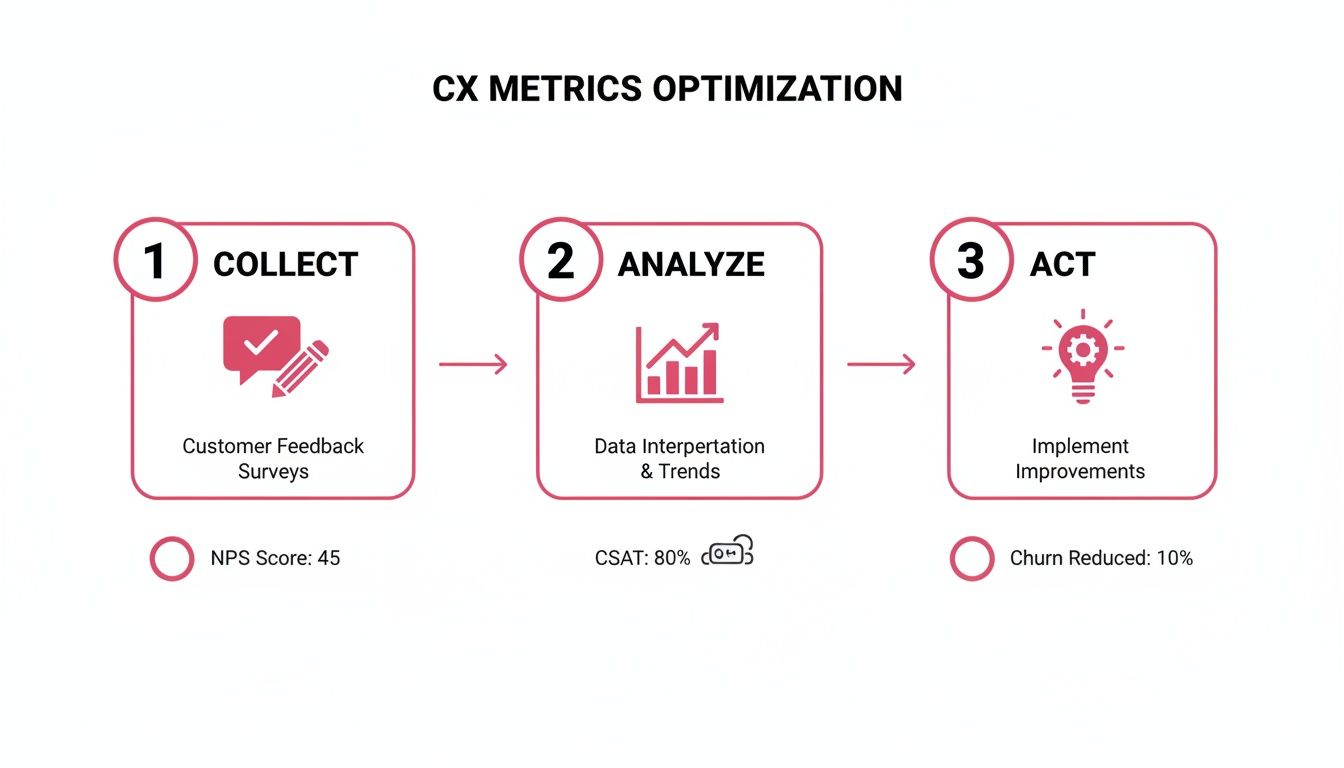
You collect data, analyze it to spot patterns, and act on those insights to make real improvements.
A Step-by-Step Playbook for Your SMS Campaign
Building an effective SMS cart recovery flow is simple. It comes down to timing, tone, and a clear path back to checkout. Follow this structure for a sequence that recovers sales and enhances the customer experience.
- Message 1 (Send 30-60 Minutes After Abandonment): This is a friendly, low-pressure reminder. The purchase is still fresh in their mind. The goal is to be helpful, not pushy.
- Template: “Hey [Name], did you run into any trouble at checkout? Your items are still here for you: [Cart Link]”
- Message 2 (Send 24 Hours Later): If they haven’t converted, introduce a small incentive. A discount or free shipping can be the push they need.
- Template: “Still thinking it over? Here’s 10% off to help you decide. Your cart expires soon! [Cart Link]”
- Message 3 (Send 48-72 Hours Later): This is your final message. Create friendly urgency by letting them know the offer is expiring.
- Template: “Last chance, [Name]! Your cart and your 10% discount expire tonight. Don’t miss out: [Cart Link]”
The magic is in the progression: it starts as a helpful check-in, becomes a value-add, and finishes with a clear call to action, all without being annoying.
Best Practices for Compliant and Effective SMS
To ensure your texts are welcomed, follow these ground rules:
- Get Permission First: This is non-negotiable. Always get explicit opt-in from customers before sending marketing texts. This is a legal requirement under regulations like GDPR and TCPA.
- Keep It Personal and Conversational: Use the customer’s name and write like a human. SMS is a personal channel, and your messages should feel authentic.
- Provide a One-Click Path to Checkout: This is critical. Use a tool that generates a link to a pre-filled checkout, where their items and info are already loaded. This removes all friction.
- Offer an Easy Opt-Out: Every message must include a simple way to unsubscribe (e.g., “Reply STOP”). This shows respect and builds trust.
For a deeper look at setting up these campaigns, learn more about how to recover abandoned carts with text messages in our detailed guide.
Building Loyalty with Proactive and Personalized Communication
Fixing problems as they arise is expected. To build a brand that customers love, you must get ahead of the game. The best customer experience in ecommerce is proactive—it anticipates shopper needs before they even have to ask. This approach turns a simple transaction into a memorable moment that builds real loyalty.
Instead of waiting for a customer to send a “Where is my order?” email, you proactively send an SMS the moment their package ships. That simple text transforms potential anxiety into a feeling of being cared for, building trust from the ground up.
Anticipate Needs with Smart Personalization
Today’s shoppers expect more than a generic, one-size-fits-all approach. Smart personalization uses customer data—like purchase history and browsing behavior—to deliver genuinely useful content and recommendations.
This goes beyond just using their first name. Real personalization means:
- AI-Driven Product Recommendations: Suggesting items that complement a customer’s recent purchase. If someone buys an espresso machine, a follow-up offering coffee beans or a cleaning kit feels helpful, not pushy.
- Tailored Post-Purchase Follow-Ups: Sending useful content related to their purchase, such as a setup guide, styling tips for clothing, or product care instructions.
- Segmented Campaigns: Grouping customers based on behavior (e.g., first-time buyers vs. VIPs) and sending offers that are relevant to their stage in the customer journey.
The goal of personalization isn’t to be clever; it’s to be helpful. When you anticipate a customer’s next need, you make their life easier and prove your brand is a partner.
Choosing the Right Channel for the Right Moment
Proactive communication is only effective if it reaches your customer in the right place at the right time. Email is great for longer content like newsletters, but for urgent, can’t-miss updates, nothing beats SMS. With open rates often exceeding 98%, text messages cut through the digital clutter.
A multi-channel approach is crucial. You need to meet customers where they are. Our guide on building customer loyalty shows how powerful these channels can be when used together.
| Feature | SMS | |
|---|---|---|
| Open Rate | Averages around 20-25% | Averages over 98% |
| Immediacy | Low (read hours or days later) | High (read within minutes) |
| Best For | Newsletters, detailed confirmations, content marketing, non-urgent promotions. | Shipping updates, flash sales, cart recovery, two-factor authentication. |
| Message Length | No practical limit | Short and concise (160 characters) |
| Customer Perception | Formal business communication | Personal, direct, and immediate |
By using each channel for its strengths, you create a communication strategy that feels helpful, not annoying.
Your Actionable Ecommerce CX Improvement Checklist
It’s time to move from theory to action. Use this practical checklist to improve your customer experience and drive measurable growth.
Stage 1: Pre-Purchase Optimization (Your First Impression)
- Optimize Mobile Page Speed: Aim for under 2 seconds. Compress images and leverage caching. A slow site kills conversions.
- Simplify Navigation: Use clear categories and ensure your search bar provides relevant results quickly.
- Enhance Product Pages: Use high-quality images, write benefit-driven descriptions, and display real customer reviews.
- Be Transparent with Costs: Show shipping rates and delivery estimates before checkout. No surprises.
Stage 2: Purchase Streamlining (The Final Step)
- Shorten Checkout Forms: Cut fields to the absolute minimum. Always offer guest checkout.
- Offer One-Click Payments: Integrate Apple Pay, Google Pay, and PayPal to reduce friction.
- Display Trust Badges: Show secure payment icons to reassure shoppers.
- Use Pre-filled Checkouts: Implement tools like CartBoss to send recovery links that take shoppers to a pre-populated cart, making it effortless to complete their purchase.
Stage 3: Post-Purchase Activation (Building the Relationship)
- Send Proactive Shipping Updates: Use SMS to notify customers about their order status and reduce “Where is my order?” inquiries.
- Launch an SMS Cart Recovery Campaign: Set up an automated flow with a tool like CartBoss. Our guide on how to recover abandoned carts with text messages can help.
- Automate Confirmations: Ensure order and delivery confirmation messages are clear, helpful, and include a call-to-action like “Track Your Order.”
- Ask for Feedback: Send a simple CSAT or NPS survey after each purchase to gather valuable insights.
Stage 4: Loyalty Building (Creating Lifelong Fans)
- Send Smart Recommendations: Suggest relevant products based on past purchases.
- Segment Your Customers: Group customers by behavior and send them tailored offers via email or SMS.
- Reward Your Best Customers: Implement a loyalty program with points or VIP discounts.
- Create Helpful Post-Purchase Content: Add value beyond the product with setup guides, styling tips, or how-to videos.
Stage 5: Automation and Measurement (Driving Growth)
- Integrate Automation Tools: Use a platform like CartBoss to handle SMS cart recovery and shipping alerts automatically.
- Set Up Workflows: Automate cart abandonment, win-back, and feedback request campaigns.
- Track Key KPIs: Monitor your conversion rate, cart abandonment rate, Customer Lifetime Value (CLV), and repeat purchase rate.
- Review Analytics Weekly: Analyze what’s working, then tweak your messages, timing, and offers accordingly.
Investing in customer experience isn’t just a nice-to-have; it’s the most sustainable path to real growth.
Pick one task from this list and complete it today. Small, consistent improvements lead to significant growth over time.
Visit CartBoss.io to get set up for free and see results in less than an hour. No coding needed.
Frequently Asked Questions
I’m on a tight budget. What are the best first steps to improve customer experience?
You don’t need a massive budget to make a real impact. Focus on high-impact, low-cost tweaks that pay for themselves quickly.
The best place to start is your checkout process and mobile page speed. These two areas are notorious for losing sales.
Actionable First Steps:
- Audit Your Own Store: Walk through your site as if you were a first-time customer. This will quickly reveal friction points that are free to fix.
- Simplify Your Forms: Cut your checkout form down to the absolute essentials. The fewer fields, the higher the conversion rate.
- Improve Mobile Speed: Aim for a load time under 3 seconds on mobile. Compress images and use a content delivery network (CDN).
- Implement Live Chat: A basic live chat or AI chatbot can provide instant answers and prevent customers from leaving in frustration.
What are some common pitfalls I should avoid?
The biggest pitfall is ignoring data compliance regulations like GDPR and TCPA. You must get explicit opt-in before sending marketing messages via SMS or email. Failure to comply can result in hefty fines and destroy customer trust.
Another common mistake is trying to be everywhere at once. Don’t stretch yourself too thin across every social and communication channel. Start with one or two channels, master them, and then expand.
Realistically, how long until I see results from these changes?
You can see the needle move surprisingly fast.
An SMS cart-recovery workflow can show results within the first few weeks, often boosting revenue by 15-25% in the first month. It’s one of the quickest ways to see a tangible ROI.
More foundational improvements, like a full UX overhaul, typically show clear returns in about 3-6 months. This gives you enough time to gather data and measure the impact on KPIs like NPS, CSAT, and your cart abandonment rate.
“Consistent upgrades to your checkout and messaging can drive a 30% uplift in repeat purchases over time.” – Leading ecommerce strategist.
How do I maintain momentum and keep improving?
The secret is to never stop testing and measuring. Don’t just “set it and forget it.”
Continuously run A/B tests on your SMS message timing, discount offers, and checkout button colors. This creates a powerful feedback loop where you are always learning and refining.
By combining these data-driven tweaks with smart tools like CartBoss’ pre-filled checkout links and automated SMS flows, you build a sustainable cycle of insight and action. This is how you gain the confidence to scale your CX strategy and turn good results into great ones.
Ready to transform lost carts into profit and boost your revenue? Try CartBoss right now.