


You can have a clean checkout, strong conversion rates, and still be one regulator email away from a mess. That is the part most store owners miss, because the problem is not just did someone tick a box, it is whether your SMS stack can prove permission, honor suppression, and stop sending the moment a customer withdraws consent. For gdpr and ccpa compliance, the work happens inside the event pipeline, not on a privacy page.
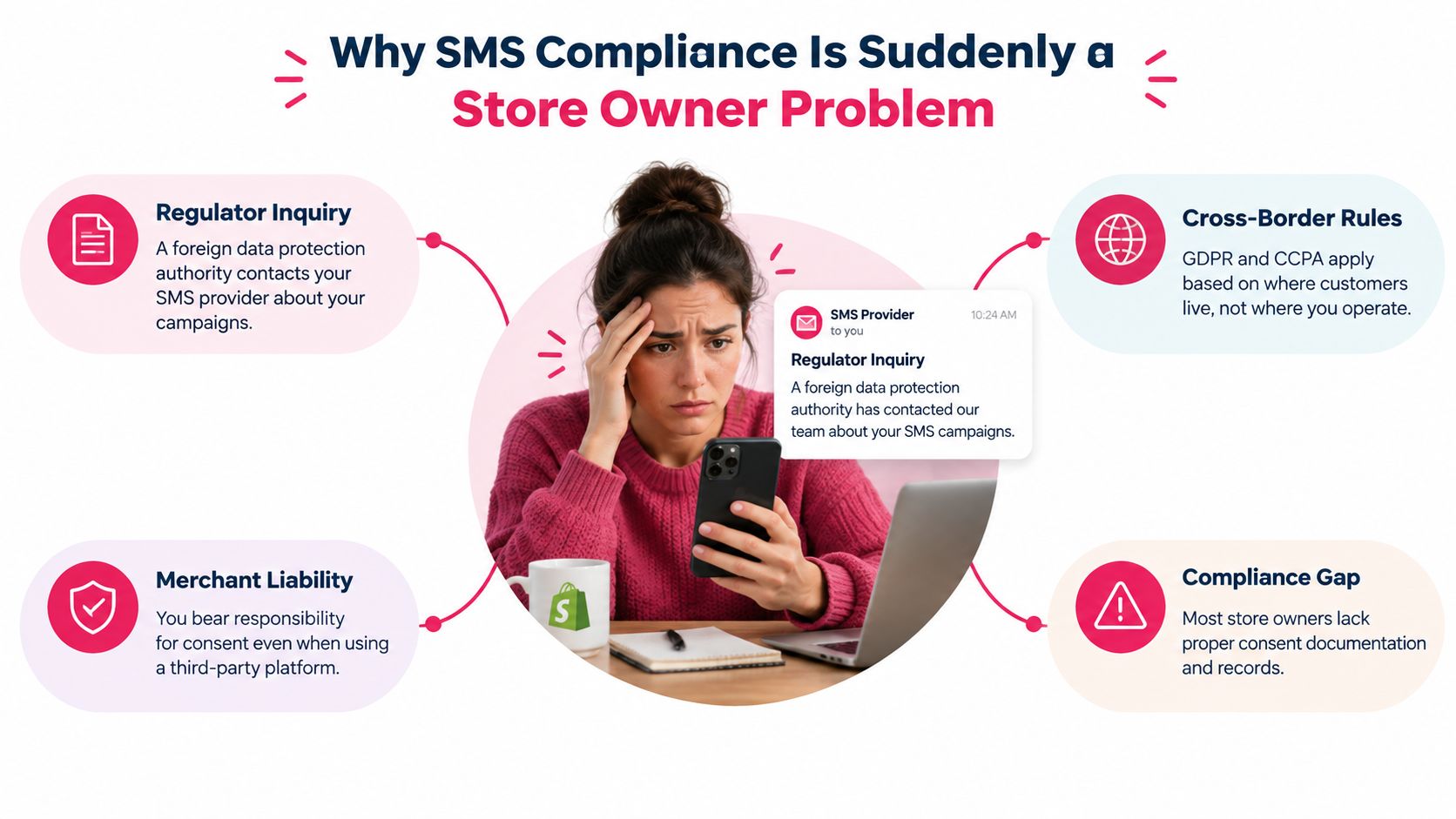
Table of Contents
- Why SMS Compliance Is Suddenly a Store Owner Problem
- GDPR and CCPA Side by Side in Plain English
- Building a Defensible Consent Record Before You Send
- Handling Consumer Rights Without Breaking Your Cart Recovery
- A Send-Time Decision System That Stays Compliant on Autopilot
- Your Weekly Compliance Routine for E-commerce SMS
- Common Misconceptions Store Owners Bring to SMS Compliance
Why SMS Compliance Is Suddenly a Store Owner Problem
A Shopify merchant wakes up, opens an email from the SMS provider, and sees a regulator inquiry from another country. Nothing in the store changed overnight, but the campaign did. A cart-recovery text that looked routine in the admin panel now sits inside a cross-border privacy review, and that’s exactly why this channel gets attention.
GDPR reaches beyond geography, because it governs relevant processing of personal data connected to EU activities, and the CCPA applies through California-specific thresholds and rights. SMS adds a second layer, because channel rules also matter. If you treat privacy law as the whole story, you’ll miss the separate question of whether the message itself was authorized under SMS rules.
Practical rule: if the system can’t prove consent and can’t suppress fast, don’t send.
The mistake is thinking the checkout phone number is enough. It isn’t. A phone number only tells you that someone typed digits into a form, not that they agreed to promotional cart-recovery texts or that the business can keep using that permission after a withdrawal.
The right response is operational, not theatrical. Build the store so every abandoned-cart event hits a consent check, a suppression check, and a purpose check before the message ever leaves the queue. If any one of those checks fails, the system blocks the send and keeps an audit record.
For store owners who want a broader SMS-law overview, the CartBoss guide to personal text message privacy laws is a useful companion read. It fits best after you’ve accepted the core point: privacy compliance and SMS permission are separate problems, and both must be solved.
GDPR and CCPA Side by Side in Plain English
GDPR and CCPA solve different problems, and stores get into trouble when they force both into one checkbox. GDPR is built around whether you have a lawful basis to process personal data tied to EU activity. CCPA starts with whether your business falls inside California’s thresholds, then judges how you disclose data use, honor requests, and manage sharing. For SMS, that difference shows up in the event pipeline. One rule asks, “Why are you allowed to send this?” The other asks, “Did you honor this person’s rights before the send fired?”
The downside is not theoretical. Under GDPR, authorities can impose administrative fines of up to €20 million or 4% of worldwide annual turnover, whichever is higher, and European authorities jointly issued more than €1.2 billion in GDPR fines in 2024 (GDPR history and enforcement overview). California’s 2025 inflation-adjusted figures set the maximum administrative or civil penalty at $2,663 per violation and $7,988 for intentional violations or minors under 16 (CPPA inflation adjustment).
GDPR vs CCPA at a Glance
| Dimension | GDPR (EU/UK) | CCPA/CPRA (California) |
|---|---|---|
| Scope | Broad extraterritorial reach for relevant EU-related processing | Applies when statutory business thresholds are met |
| Consumer rights | Access, deletion, objection, correction, portability, restriction | Access, deletion, correction, opt-out of sale or sharing, limit sensitive use |
| Consent model | Consent must be freely given, specific, informed, and unambiguous | Opt-out framework with strong notice and request obligations |
| Penalties | Up to €20 million or 4% of worldwide turnover | $2,663 per violation, $7,988 for intentional or under-16 violations |
| Operational focus | Lawful basis, evidence, suppression, retention | Threshold checks, notices, opt-outs, vendor governance |
Here’s the operating reality. GDPR pushes the proof burden to the front of the workflow. If your abandoned-cart trigger cannot show valid permission for promotional SMS at send time, the automation should stop. California is looser on collection, but stricter than many teams expect on downstream handling. If a consumer opts out, limits use, or exercises a request, your queue has to suppress that number before the cart reminder goes out. That is why compliance belongs in the send logic, not in a footer link.
The 2026 California amendments make this even more practical for e-commerce teams. If you run abandoned-cart automation, review every handoff between checkout, CRM, SMS platform, and suppression list now. The weak point is rarely the policy page. It is the stale audience sync, the missed opt-out, or the vendor event that still fires after a rights request.
A useful outside reference on rights handling is LA Law Group’s demand letter for debt collectors. The context is different, but the discipline is the same: evidence, deadlines, and handoffs decide whether your process holds up.
For an SMS-specific view of how those GDPR rules translate into real campaign setup, read the CartBoss SMS marketing GDPR examples guide. It explains the part generic privacy summaries miss, how legal standards become checkout logic and send-time controls.
Building a Defensible Consent Record Before You Send
A defensible record is not “we collected the phone number.” It’s proof that the right person saw the right disclosure, took the right action, and agreed to the right purpose. Under GDPR, consent has to be freely given, specific, informed, and unambiguous, and withdrawal must end processing based on consent (European Commission guidance on consent withdrawal).
What the record must contain
At minimum, store these fields together:
- Normalized phone number so the same person isn’t logged in three formats.
- Timestamp with time zone so audit trails survive cross-border reviews.
- Exact consent wording and version so you can show what was accepted.
- Source page or checkout step where the opt-in happened.
- Channel and purpose, such as SMS promotional cart recovery.
- Jurisdiction or market, because one consent flow doesn’t fit every country.
- Withdrawal or opt-out history, including STOP replies and support requests.
That’s the evidence layer regulators care about. The page design is secondary if the record can’t prove who consented, when, how, and to what.
A compliant opt-in example is straightforward:
“Yes, send me CartBoss store updates and promotional texts. Message frequency varies. Consent is not a condition of purchase. Reply STOP to opt out.”
A bad example bundles everything together, uses a preselected checkbox, and hides the marketing purpose inside general terms. That doesn’t give the customer a real choice, and it won’t age well in an audit.

The cleanest way to use pre-filled checkout tools is to treat them as a consent capture point, not a shortcut. If the phone number came from checkout but the SMS permission wasn’t explicit, the message still shouldn’t go out. CartBoss-style workflows should preserve the evidence, not assume it.
For teams that want a deeper operational template, the CartBoss guide to express written consent is the right internal reference point. Use it to tighten the wording, not to loosen the standard.
Handling Consumer Rights Without Breaking Your Cart Recovery
A customer replies STOP while an abandoned-cart sequence is queued. Another submits a deletion request through a privacy form. Both events must reach the same suppression state across the store, SMS platform, CRM, analytics tools, and campaign queue. Most failures happen in disconnected systems, where a rights request never propagates beyond one tool.
Map each right to a system action
GDPR access requires the store to locate personal data and provide it within the applicable timeframe. Erasure requires deletion or suppression unless another lawful basis permits retention. CCPA covers access, deletion, correction, opting out of sale or sharing, and limiting the use of sensitive personal information. Your request router must identify the applicable rule before assigning the action. The CPPA threshold and rights overview explains California coverage and consumer rights.
FCC requirements create a separate control layer. Commercial robotexts require written consent, recipients may revoke consent through any reasonable method, and autodialed texts to wireless numbers are regulated communications (FCC text message guidance). A STOP reply must therefore update the global suppression record, not only the campaign that received it.
California stores should also process Global Privacy Control. A user-enabled browser signal can operate as an opt-out of sale or sharing, so ad-tech and messaging decisions need to read that state before selecting an audience. Vendor policies do not replace your own controls. Review the privacy details for Pinterest marketing tool as an example of why third-party privacy language must align with your suppression rules.
Use this operational sequence:
- Receive the request. Record access, deletion, correction, opt-out, or STOP.
- Verify identity only when needed. Do not add unnecessary friction to an opt-out.
- Propagate the change. Update the store, SMS tool, CRM, analytics systems, campaign queue, and suppression list.
- Confirm the state. Test that the customer is blocked before any queued message can leave.
- Record the evidence. Preserve the request, system updates, and final suppression state for support and audit.
The CartBoss CCPA and abandoned cart recovery guide gives useful operational context for this workflow. A right is handled only after every downstream copy and campaign reflects it.
A deletion request that updates only the CRM is unfinished work. Stop the cart flow, update suppression everywhere, and retain evidence that each system changed.
A Send-Time Decision System That Stays Compliant on Autopilot
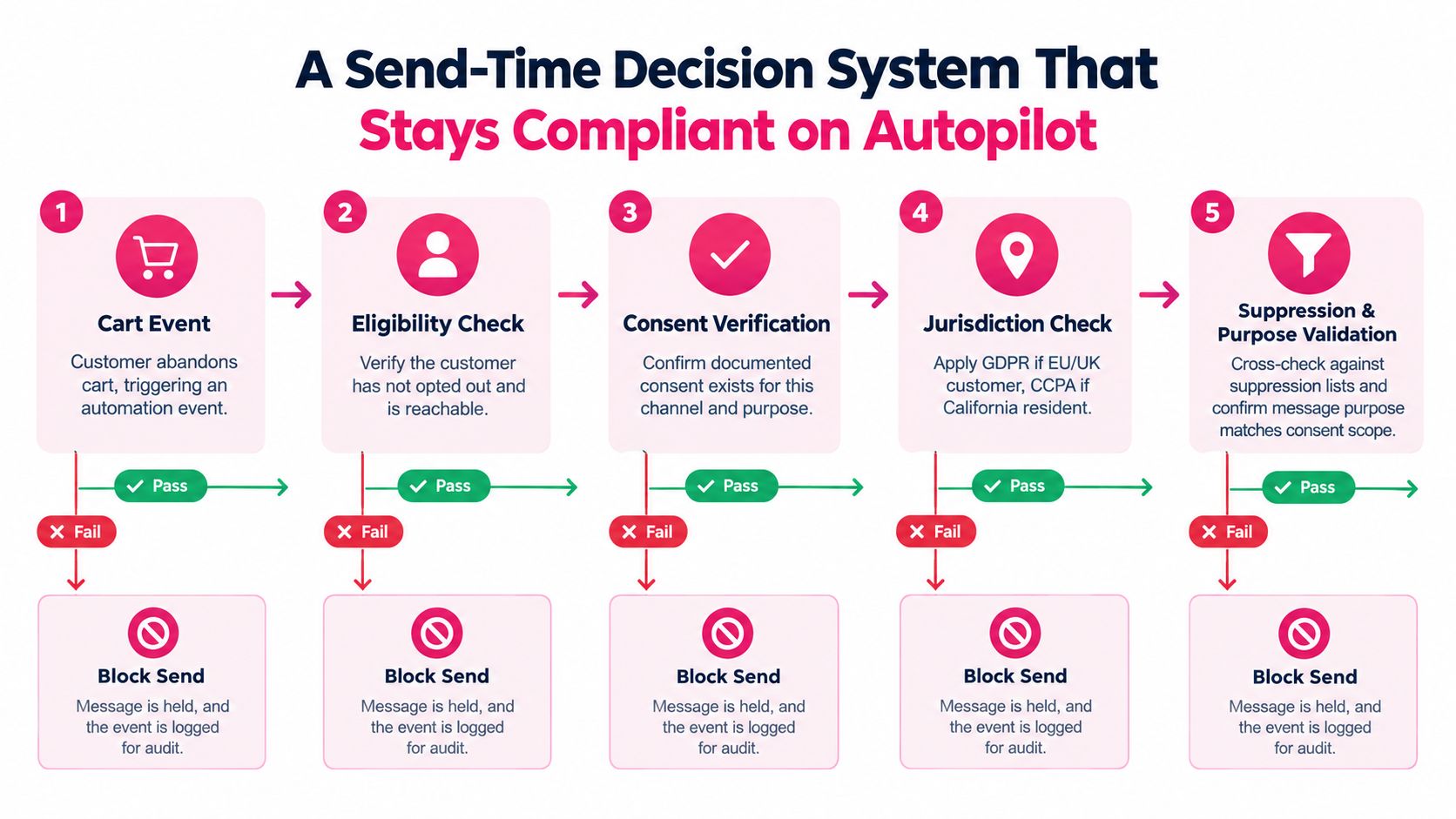
The cleanest compliance design is a send-time gate. Cart event comes in, eligibility gets checked, consent gets verified, jurisdiction gets applied, suppression gets tested, and only then does the message leave. If you don’t automate that order, the workflow will eventually send something it shouldn’t.
Build the pipeline, not a checkbox
This is the architecture I’d trust:
- Cart event. The abandoned cart starts the automation.
- Eligibility check. Confirm the customer is reachable and not already suppressed.
- Consent verification. Confirm the SMS record exists for that purpose and channel.
- Jurisdiction check. Apply EU or California logic based on the customer record.
- Suppression and purpose validation. Cross-check the message against opt-outs, withdrawals, and the approved purpose.
- Block send if anything fails. Log the event for audit.
The reason this matters has changed in California. Updated regulations effective January 1, 2026 expand the practical workload around sensitive personal information, minors, consent withdrawal, and automated decision-making risk, and personal information about consumers under 16 is treated as sensitive personal information when the business knows the consumer’s age (Latham & Watkins summary of updated CCPA obligations). If your checkout collects age signals, you can’t leave them floating around your SMS logic without a retention and purpose rule.
The wrong setup is a marketing tool that sends first and reconciles later. That creates avoidable exposure when a STOP reply lands minutes before a scheduled send. The right setup sees the STOP, updates suppression everywhere, and blocks the message before dispatch. That’s not just safer, it’s cleaner for deliverability.
CartBoss belongs in this discussion as one implementation option because it includes automatic do-not-disturb handling, branded sender IDs, translated messages, and GDPR and CCPA compliance support in its SMS recovery workflow. Tools like that matter only if they enforce the gate at send time, not if they just make campaign creation easier.
For a supporting view on how consent and preferences should be centralized, the CartBoss preference center guide is worth reviewing. The core point is the same, automation reduces risk only when it automates suppression and evidence preservation, not just message delivery.
Your Weekly Compliance Routine for E-commerce SMS
Compliance works when someone owns it every week. A monthly fire drill is too slow for a live cart-recovery system, because the errors show up in dispatch logs, not in legal memos. Keep the routine tight and boring.
Run the following checks on a fixed schedule:
- Consent log integrity. Confirm new opt-ins have timestamp, wording version, source, and purpose.
- Suppression list audit. Verify STOP replies, withdrawals, and support requests are blocking sends.
- Vendor review. Check that processors, service providers, and contracts still match the actual data flow.
- Threshold reassessment. Recheck California applicability against current revenue and data-sharing activity.
- Retention enforcement. Separate marketing-consent evidence from operational order records and delete what no longer needs to stay.
- Signal testing. Validate that browser-level opt-out signals still stop the right flows.
- Request simulation. Send test access, deletion, and correction requests through the full path.
Do a real test, not a paper review. A minor at checkout should not slip through a promotional opt-in flow. A Global Privacy Control signal should block the right advertising and sharing logic. A deletion request should stop an active abandoned-cart sequence before the next SMS goes out. A STOP reply during a scheduled send should suppress the contact immediately, not after the campaign finishes.
Operational truth: if you can’t prove the control with a test, you don’t really have the control.
This routine also protects deliverability. Cleaner suppression means fewer complaints, and fewer complaints mean fewer reasons for platforms to look hard at your account. It also makes audits easier because the evidence is already sitting where it belongs, tied to the control that produced it.
Common Misconceptions Store Owners Bring to SMS Compliance
A checkout phone number gives you a contact detail, not permission to send marketing SMS. Abandoned-cart automation needs consent tied to the purpose and channel, with a record your system can retrieve before sending.
“My email unsubscribe link covers SMS too.” Email and SMS require separate suppression logic. A customer who replies STOP must be removed from SMS sends immediately, including messages already queued for delivery.
“We’re below the California threshold, so CCPA does not matter.” Treat that as an annual applicability check, not a permanent exemption. California coverage can depend on gross annual revenue, the number of California consumers or households whose information was bought, sold, or shared, or the share of revenue from selling or sharing personal information. Recheck each measure against your current business model and data flows.
“GDPR only matters if we have an EU office.” GDPR can apply when a store targets people in the EU or processes their personal data. Selling to EU customers can bring the rules into your SMS and cart-recovery design.
The reliable operating rule is simple: keep privacy consent and SMS consent as separate gates. At send time, check both, apply the latest suppression signal, and retain the evidence behind the decision. That event-pipeline approach keeps cart recovery running without turning a checkbox into your compliance system.
CartBoss can centralize abandoned-cart messages, opt-out handling, and delivery rules for stores that need automation tied to consent and suppression records. CartBoss supports that workflow without requiring every campaign to be reviewed manually.
