



To really get a handle on churn, you have to understand why customers are leaving in the first place. Then, you can build smart, targeted strategies to fix the leaks and improve their experience from top to bottom.
It all starts with measuring your churn rate accurately. From there, you can dig into the root causes with real feedback and start building loyalty through better onboarding, smart personalization, and effective win-back campaigns.
Understanding and Measuring E-Commerce Churn
Before you can tackle customer churn, you need to know exactly what you’re up against. Churn isn’t just another metric on a dashboard; it’s a direct signal of your customer’s happiness and a major red flag for the long-term health of your store.
Ignoring churn is like trying to fill a bucket with a giant hole in it. You can keep pouring new customers in, but you’ll always be losing valuable business out the bottom.
The real cost of churn goes way beyond just a single lost sale. It chips away at your Customer Lifetime Value (LTV) and drives up your Customer Acquisition Cost (CAC), forcing you to spend more just to tread water.
The Two Faces of E-Commerce Churn
It’s crucial to know that not all churn is the same. For most e-commerce stores, churn shows up in two key ways, and you absolutely need to track both to see the full picture.
-
Customer Churn: This is the most straightforward one. It’s the percentage of customers who stop buying from you over a set period. It answers the simple question, “How many people did we lose?”
-
Revenue Churn: This one tracks the percentage of revenue lost from your existing customer base during that same time. It answers the more painful question, “How much money did we lose from those customers?”
Why does this matter? Imagine you lose ten customers who each spent $20 last month. Your customer churn is ten, but your revenue churn is $200. Now, what if you lose just one customer who spent $500? The customer churn number looks great, but the financial hit is much, much worse. Tracking both helps you see where the real damage is happening.
How to Calculate Your Churn Rate
Calculating your churn rate is the first real step toward getting it under control. The good news is the basic formula is simple, and you can pull the data right from your Shopify or WooCommerce dashboard.
Churn Rate Formula:
(Number of Customers Lost in a Period ÷ Total Customers at the Start of the Period) × 100
Let’s say you started the month with 1,000 customers and lost 50 of them by the end. Your monthly churn rate would be 5%.
(50 ÷ 1,000) × 100 = 5%
You can use this exact same formula for revenue churn, just swap out customer numbers for your revenue figures. You can’t improve what you don’t measure, so getting this calculation right is non-negotiable. For a deeper dive, check out our guide on the customer retention rate formula and its variations.
Digging Deeper with Key Metrics
Beyond the basic churn rate, a few other metrics will give you a much richer understanding of why customers are leaving.
| Key Churn Metrics for E-commerce Stores |
| :— | :— | :— |
| Metric | What It Measures | Why It Matters for Churn |
| Customer Lifetime Value (LTV) | The total revenue you can expect from a single customer account. | A dropping LTV is a clear sign that customers are churning faster and spending less over their lifetime. |
| Repeat Purchase Rate (RPR) | The percentage of customers who have made more than one purchase. | This metric directly shows how well you’re retaining customers. A low RPR means churn is high after the first order. |
| Time Between Purchases (TBP) | The average amount of time that passes between a customer’s purchases. | If this timeframe starts getting longer, it could be an early warning sign that customers are losing interest and are at risk of churning. |
| Average Order Value (AOV) | The average amount a customer spends per transaction. | A decreasing AOV, especially among repeat buyers, can indicate dissatisfaction or that they’re finding better deals elsewhere. |
Tracking these alongside your main churn number gives you the context you need to figure out not just if people are leaving, but how and why.
Setting Realistic Churn Benchmarks
So, what’s a “good” churn rate? This is where it gets tricky. The honest answer is: it depends entirely on your industry, products, and business model.
E-commerce is a tough game for retention. Industry benchmarks show the average eCommerce retention rate is only 31%. For online retail specifically, it drops to a painful 22%. That means a staggering 76-78% of customers don’t come back for a second purchase.
Fashion and apparel stores often get hit the hardest, with annual churn rates soaring to 70-80%. Electronics do a bit better, but still see churn around 65-75%.
Instead of getting fixated on some universal number, focus on your own trends. The real goal is to consistently lower your own churn rate, month after month. That’s the only benchmark that truly matters.
Diagnosing Why Your Customers Are Leaving
Knowing your churn rate is one thing. Understanding why it’s happening is a whole different ball game. The raw numbers won’t give you the full story, and if you start guessing, you’ll just waste time and money on “solutions” that don’t actually fix the root problem.
To really reduce your churn rate, you have to put on your detective hat. It’s about digging into the real reasons customers are walking away, moving past assumptions, and getting to the truth. This means gathering direct feedback, analyzing what people actually do on your site, and spotting the patterns that reveal the real friction points. Only then can you start plugging the actual leaks in your bucket.
Gathering Direct Customer Feedback
The most direct route to understanding why people leave? Just ask them. But how you ask is everything. The key is to make it dead simple for them to give you honest, unfiltered feedback without making them jump through a bunch of hoops.
Here are a few low-effort, high-impact ways to do it:
- One-Click Exit Surveys: When someone cancels a subscription or unsubscribes, hit them with a simple multiple-choice question. Think: “What’s the main reason you’re leaving?” with easy options like “Prices are too high,” “Found a better alternative,” or “Product didn’t meet expectations.”
- Post-Purchase Feedback: A week or two after an order arrives, send a quick, automated email. A simple “How was your experience?” can uncover issues with shipping, product quality, or even packaging long before a customer decides never to come back.
- Support Ticket Analysis: Your customer support inbox is an absolute goldmine. Sift through support tickets for common complaints. Are people constantly confused about your return policy? Are they complaining about product sizing? These are churn warnings in plain sight.
By pulling together these different feedback channels, you build a much clearer picture of the customer journey. You stop reacting to one-off complaints and start seeing the systemic issues that are driving customers away.
Learning how to properly set up a customer feedback management system can turn all of this scattered feedback into organized, actionable data.
Analyzing Customer Behavior Data
While feedback tells you what customers say, behavior data shows you what they actually do. Your e-commerce analytics hold all the clues about where your customer journey is falling apart. You’re looking for patterns that pop up right before a customer churns.
Start by creating a segment of customers who have churned. Then, rewind the tape and look at their actions leading up to their last purchase (or lack thereof). What red flags do they have in common?
This kind of analysis often highlights that churn isn’t about one single bad interaction. It’s usually the result of a poor overall experience, confirming that you need to look at everything from service interactions to on-site behavior to get the full story.
Pinpointing Specific Churn Triggers
Once you have both the “what they say” and “what they do” data, you can start connecting the dots. The goal here is to isolate the specific events that most often send a customer running for the hills.
Keep an eye out for these classic e-commerce churn points:
- Post-First Purchase Drop-Off: A huge chunk of customers never come back after their very first order. This is a massive red flag that you’re failing to meet expectations. Was the product not as described? Did shipping take way longer than you promised? Or did you just go completely silent after taking their money?
- Negative Support Interaction: A customer has a problem, reaches out for help, and has a terrible experience. They’re not coming back. This is a clear sign that your support processes are broken and need immediate attention.
- Price Sensitivity: You notice customers only ever buy when you’re running a massive sale. The second prices go back to normal, they’re gone. This suggests they don’t see enough value in your products to pay full price, which is a value proposition problem.
By diagnosing these specific triggers, you can finally stop fighting churn with generic tactics. Instead, you can build precise, data-backed solutions that tackle the root cause and set you up for a major boost in your retention metrics.
Proactive Strategies to Prevent Churn Before It Starts
The best way to slash your churn rate is to stop customers from ever wanting to leave in the first place. Sure, reactive win-back campaigns are a necessary tool in your arsenal, but the real magic happens when you build loyalty from the very first click. It’s all about creating an experience so seamless that shopping elsewhere doesn’t even cross their mind.
This is where you shift from a purely transactional mindset to one focused on delighting customers at every turn. From the moment they land on your site to that anxious wait for a package, you have opportunities. By anticipating and smoothing over potential friction points, you transform moments of doubt into moments of unshakable trust.
Craft a Welcome Series That Makes an Impact
A customer’s first interactions post-purchase say a lot about your brand. If all they get is a generic receipt followed by radio silence, you’re training them to see you as just another faceless online store. A killer welcome email series completely flips that script.
Don’t just send one email. Think of it as a short, value-packed onboarding flow.
- Email 1 (Immediately after purchase): This should be more than a standard order confirmation. Reassure them they made a smart choice, let your brand’s personality shine, and tell them exactly what to expect next.
- Email 2 (1-2 days later): Share your brand story or mission. You could link to some of your best blog content or showcase user-generated content from social media to start building that sense of community.
- Email 3 (3-5 days later): Offer genuine value. This is the perfect spot for a quick-start guide, product care instructions, or exclusive content that helps them get the most out of their purchase.
This simple sequence turns a one-off transaction into the beginning of a real relationship, making customers feel valued right from the get-go.
Turn Post-Purchase Communication into a Strength
That gap between a customer clicking “buy” and the package arriving on their doorstep? It’s often filled with anxiety. This “shipping gap” is a massive churn risk if you handle it poorly, but it’s an even bigger opportunity if you get it right. Don’t leave your customers in the dark.
Over-communicate every single step. Send an update when the order is processed, another when it ships (with the tracking link, of course), and maybe even a quick notification on the day of delivery. This level of transparency builds incredible trust and eases customer stress.
Proactive shipping updates do more than just cut down on “Where is my order?” support tickets—they prove you care about the experience even after you have their money. It’s a small touch that pays off big in loyalty.
A core part of any churn prevention plan is to constantly refine the entire customer journey and learn how to proactively improve ecommerce customer experience.
Leverage Personalization to Prove You Understand Them
Generic marketing blasts are a one-way ticket to the unsubscribe list. Customers now expect experiences that feel like they were made just for them. Personalization isn’t a “nice to have” anymore—it’s essential to reduce your churn rate. Use the data you have to show customers you’re paying attention.
Think about a customer who just bought a pair of running shoes. Sending them a generic email about your entire shoe collection is a wasted opportunity. What if you instead:
- Sent targeted product recommendations a few weeks later for running socks, hydration packs, or performance apparel?
- Shared relevant content, like a blog post on “5 Tips to Improve Your 5K Time”?
- Segmented them into a “Runners” list for future campaigns, so they only get offers that align with their passion?
This thoughtful approach shows you actually get them. If you’re looking for more ways to build this kind of connection, checking out these proven customer retention strategies to drive loyalty can give you some great ideas.
The e-commerce world is exploding, with global sales projected to hit $6.86 trillion in 2025. This growth means online retail now accounts for about 21% of all retail sales worldwide. In such a crowded market, proactive and personalized engagement is what separates the brands that thrive from those that bleed customers. By mastering these strategies, you’re not just stopping churn; you’re building a loyal following that will stick around for the long haul.
Crafting Win-Back Campaigns That Actually Work
Even with the best customer experience, some shoppers will eventually drift away. That’s just the nature of e-commerce. But this doesn’t mean they’re gone for good. Think of it as an opportunity to reignite the relationship with a smart, targeted win-back campaign that reminds them why they bought from you in the first place.
The goal isn’t to just blast every inactive customer with a generic “we miss you” plea. It’s about being strategic—reaching out to the right people, with the right offer, through the right channel. Get this mix right, and you can seriously reduce your churn rate by turning those lapsed buyers back into loyal, repeat customers.
Your Secret Weapon: SMS
In a world of overflowing email inboxes, SMS is a breath of fresh air. A win-back email might get buried under dozens of others and go unread for days, but a text message cuts straight through the noise. It’s almost impossible to ignore. This is especially true now that mobile shopping is king.
Mobile devices are on track to make up about 59% of all global e-commerce sales by 2025. This is where tools like CartBoss really shine, using the incredible 99% open rate of SMS to connect with customers on the device they use most. When you consider that smartphone users are 17.7% more likely to make weekly retail purchases, SMS isn’t just another channel for win-backs—it’s arguably the most powerful one you have.
Segmentation Is Everything
Sending the same “We want you back!” message to every lapsed customer is a surefire way to get ignored. To make your win-back campaigns truly effective, you absolutely have to segment your inactive customers based on their past behavior. This lets you tailor your offers so they feel personal and relevant, not like a desperate, automated blast.
Here are a few essential segments to start with:
- One-Time Buyers: These customers made a single purchase and vanished. They took a chance on you once, but something stopped them from coming back. They might need a slightly more aggressive incentive to give your brand another shot.
- Former VIPs: These were your rockstars—loyal, high-spending customers who have suddenly gone quiet. A generic 10% off coupon might even feel insulting. They deserve an exclusive offer that acknowledges their past loyalty and makes them feel special.
- Category-Specific Shoppers: These are the customers who only ever bought from one particular product category, like “skincare” or “men’s shoes.” Your win-back message should tempt them with new arrivals or special deals within that same category.
By segmenting your audience, you can craft messages that actually resonate, dramatically boosting your chances of winning them back.
SMS Templates That Get Results
A great win-back text is short, creates a sense of urgency, and makes it incredibly easy for the customer to act. With a platform like CartBoss, you can automate these messages and even send links to a pre-filled checkout to remove every possible bit of friction.
Here are a couple of templates you can adapt right away:
For the One-Time Buyer:
“Hey [Customer Name]! We’ve missed you at [Your Store]. As a thank you for giving us a try, here’s 20% OFF your next order. It expires in 48 hours! Shop now: [Pre-filled Checkout Link]”
For the Former VIP:
“Hi [Customer Name], it’s been a while! As one of our best customers, we’ve reserved a special gift for you. Claim your FREE [Product Name] with any purchase this week. Your exclusive link: [Pre-filled Checkout Link]”
See the pattern? Each message is personalized, creates urgency with a deadline, and gives them a direct, frictionless path to purchase. That’s the winning formula. For more ideas, check out our deep dive on how to win back lost customers.
How Do You Know if It’s Working?
To figure out if your campaigns are actually reducing churn, you need to track the right metrics. Don’t get distracted by vanity numbers like link clicks. Focus on the data that directly impacts your bottom line.
While email has its place, the data shows a clear winner for grabbing immediate attention and driving action.
Email vs SMS for Win-Back Campaigns
| Feature | Email Marketing | SMS Marketing (e.g., CartBoss) |
|---|---|---|
| Open Rate | ~20% | ~99% |
| Click-Through Rate | 2-3% | 15-30% |
| Response Time | Hours or days | Minutes |
| Personalization | Good | Excellent (with pre-filled checkouts) |
| Effort to Act | Multiple clicks, manual checkout | One-click, pre-filled checkout |
As the table shows, SMS delivers far more immediate engagement, which is critical for re-capturing a customer’s interest before it’s gone for good.
Here are the key performance indicators (KPIs) you should be watching:
- Reactivation Rate: What percentage of inactive customers made a purchase after receiving your campaign?
- Revenue Recovered: How much total sales did your win-back efforts generate?
- Return on Ad Spend (ROAS): For every dollar you spent on the campaign (like SMS costs), how much revenue did you bring in?
Tracking these KPIs will give you a clear picture of which segments and offers are driving results. This allows you to stop guessing, continuously refine your strategy, and turn what was once lost revenue into a reliable engine for growth.
Building Your Roadmap for Continuous Improvement
To really make a dent in your churn rate for the long haul, you have to stop thinking of it as a one-off project. It’s a constant cycle: listen to your customers, test new ideas, and refine every single touchpoint. The goal is to build a culture of retention where every decision gets filtered through the lens of customer loyalty.
This means you need to move past one-shot campaigns and build a sustainable roadmap. You’re not just plugging the most obvious leak in the dam; you’re strengthening the entire structure. Taking this proactive stance turns churn reduction from a reactive headache into a core part of your growth strategy.
Prioritize Your Efforts with an Impact vs. Effort Matrix
After diagnosing your churn problem, you’ll probably have a laundry list of potential fixes—everything from a complete onboarding email overhaul to launching a brand-new loyalty program. If you try to do it all at once, you’ll burn out your team and get mediocre results. You need a smarter way to prioritize.
A simple but incredibly powerful tool for this is the Impact vs. Effort Matrix. Just plot every potential initiative on a grid with “Potential Impact” on one axis and “Effort Required” on the other. This visual makes it immediately obvious where you should start.
- Quick Wins (High Impact, Low Effort): These are your no-brainers. Think A/B testing a new SMS win-back message or adding a quick exit survey to your cancellation flow. Get these done first.
- Major Projects (High Impact, High Effort): These are the big swings, like rolling out a tiered loyalty program. They need serious planning but can deliver massive returns down the line.
- Fill-ins (Low Impact, Low Effort): These are small tweaks you can knock out when you have a spare moment, like refreshing the copy on a post-purchase email.
- Time Sinks (Low Impact, High Effort): Just don’t. These are the projects that drain your resources for almost no reward. Avoid them at all costs.
Using this framework takes the guesswork out of planning and ensures your team’s limited time is spent on activities that will actually move the needle.
Constantly Test and Optimize Your Strategies
In e-commerce, assumptions are the enemy of growth. What you think will work often doesn’t. That’s why rigorous, continuous testing is an absolute non-negotiable part of your retention roadmap. A/B testing shouldn’t be an occasional thing; it should be standard practice.
Never stop running an experiment.
- Win-Back Campaigns: Test different discount levels (15% off vs. 20% off), play with urgency (“offer ends in 48 hours” vs. “this week only”), and experiment with different calls to action.
- Onboarding Emails: Tweak your subject lines. Try sending different kinds of content, like your brand story versus practical product tips. Mess with the timing of your welcome series.
- Loyalty Offers: Figure out what actually drives engagement. Is it a points-based system? Tiered rewards? Exclusive access to new products? Test it and find out.
By constantly testing, you’re gathering real-world data on what actually motivates your customers to stick around. This data-driven mindset is what allows your retention strategy to evolve and improve over time. As you build this roadmap, remember it’s one piece of a larger puzzle that includes effective ecommerce growth strategies.
Track the Right KPIs to Measure Success
So, how do you know if your roadmap is actually working? You have to track the right Key Performance Indicators (KPIs). These numbers don’t just measure your success; they also help you spot new trends and opportunities to squash churn even further.
Go beyond your headline churn rate and keep a close eye on these KPIs:
- Repeat Purchase Rate: The percentage of customers who’ve bought from you more than once. This is a direct reflection of your retention efforts.
- Customer Lifetime Value (LTV): As churn goes down, LTV should steadily climb. It’s proof that customers are staying longer and spending more.
- Time Between Purchases: If the average time between purchases is shrinking, it’s a great sign that customers are becoming more engaged with your brand.
- Win-Back Rate: What percentage of lapsed customers are you successfully bringing back? This metric shows you the direct impact of your win-back flows.
This simple visual breaks down a powerful win-back flow: it starts with smart segmentation, moves to personalized outreach, and ends with recovered revenue.
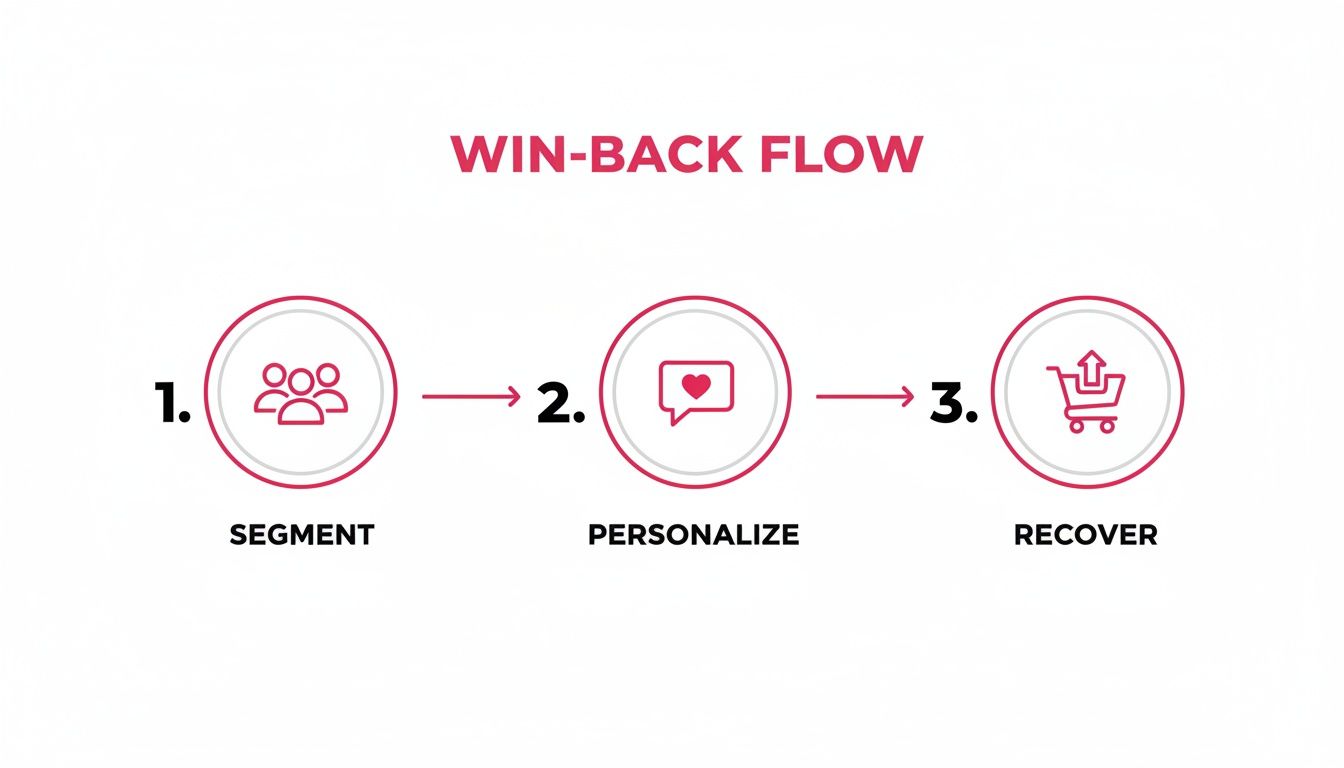
As the graphic shows, successful recovery isn’t about blasting everyone with the same offer. It’s a structured process that hinges on understanding who you’re talking to before you send a single message. If you want to really nail this process, this customer journey mapping template guide provides a great framework to build from.
Ultimately, building this roadmap transforms retention from an afterthought into a predictable, scalable engine for your business’s long-term health.
Got Questions? We’ve Got Answers
Diving into customer retention can bring up a lot of questions. We get it. Here are some clear, straightforward answers to the common queries we hear from store owners working to cut down their churn.
What’s a Good Churn Rate, Anyway?
This is the million-dollar question, and the honest answer is: it depends.
A “good” churn rate looks wildly different depending on your industry and business model. For subscription e-commerce stores, a monthly churn rate somewhere between 5-7% is a pretty healthy benchmark to aim for.
But for traditional retail where one-off purchases are the norm, looking at your repeat customer rate is a much smarter move. The industry average hovers around 31%, which means a whopping 69% of customers never come back for a second purchase.
Instead of getting hung up on a universal number, your real goal should be to consistently improve your own store’s rate, month after month. That’s the only target that truly matters.
How Can SMS Specifically Help Reduce Churn?
Think of SMS as your direct line to your customer’s pocket. It’s a powerhouse for fighting churn because of its immediacy and unmatched visibility. Emails get lost in overflowing inboxes, but with open rates hitting 99%, text messages just don’t get ignored.
Here’s how it makes a real difference in your churn-fighting efforts:
- Abandoned Cart Recovery: You can send a perfectly timed message with a direct link to a pre-filled checkout. This makes it almost effortless for a distracted shopper to finish what they started.
- Win-Back Campaigns: Re-engage customers who’ve gone quiet with an exclusive, time-sensitive discount sent straight to their phone. Sometimes, a little nudge is all it takes.
- Proactive Engagement: Use SMS for the good stuff, too. Send shipping updates and loyalty program notifications to keep your brand top-of-mind and build genuine trust.
This direct connection is essential for both stopping churn before it starts and winning back customers who have already lapsed.
What’s the Difference Between Voluntary and Involuntary Churn?
This is a crucial distinction because you can’t fix both problems with the same solution. Each one points to a completely different breakdown in your customer journey.
Voluntary churn is when a customer actively decides to leave you. Maybe they were unhappy with a product, had a frustrating customer service experience, or just found a better deal somewhere else. It’s a direct signal that something about your customer experience missed the mark.
On the other hand, involuntary churn is almost always an accident. It usually comes down to a technical glitch, most often a failed payment. The classic example is an expired credit card or outdated billing info.
You need a two-pronged attack. To fight voluntary churn, you have to dig in and improve your products and overall customer experience. To stop involuntary churn, the fix is much simpler: set up automated payment reminders and dunning management to catch those billing issues before they cause a customer to drop off unintentionally.
Ready to stop losing sales to abandoned carts? CartBoss uses the power of automated SMS to bring customers back and boost your revenue on autopilot. With a 99% open rate, it’s the most effective way to recover lost sales. Start converting more with CartBoss today!