



Small business text marketing is your direct line to customers. It’s a simple, powerful way to send promotions, reminders, and updates right to their phones using SMS. What makes it so effective? Texts get opened almost instantly, making it a fantastic tool for getting people to act now and boosting your sales.
Why Text Marketing Is a Non-Negotiable Tool for Growth
Feeling like your emails are just gathering dust in a crowded inbox? Are your social media posts getting lost in the algorithm? You’re not alone. The digital world is noisy, but there’s a much more direct way to cut through it all.
Text marketing for your small business isn’t just another channel to manage. Think of it as a direct line to your customer’s pocket, delivering messages that get seen almost immediately.
This is how a local boutique announces a flash sale and sees a rush of customers within the hour. It’s how an online store pulls back a lost sale with a single, perfectly timed message. The real magic of SMS is that it feels personal and urgent—more like a note from a friend than a corporate broadcast.
The Unmatched Power of SMS Engagement
The numbers don’t lie. When you look at the data, SMS marketing has a clear and massive advantage over other channels.
For starters, SMS messages have an incredible 98% open rate. Compare that to email, which hovers somewhere between 20-42%, and you can see why it’s such a big deal. People don’t just open texts; they read them fast. In fact, 60% of SMS messages are read within the first five minutes.
This immediate engagement is gold for e-commerce. A whopping 29% of recipients will click on the links you send, and 47% of those clicks lead directly to a purchase. That translates into an average conversion rate of 45%—a figure that can completely change the game for a small business.
SMS vs Email at a Glance
When you put SMS and email side-by-side, the difference in immediacy and engagement becomes crystal clear. While email certainly has its place for newsletters and longer-form content, SMS wins for urgent, action-oriented messages.
| Metric | SMS Marketing | Email Marketing |
|---|---|---|
| Open Rate | Up to 98% | Around 20-42% |
| Response Time | 90 seconds (average) | 90 minutes (average) |
| Click-Through Rate | ~29% | ~2-6% |
| Conversion Rate | Up to 45% | Varies, typically lower |
This isn’t to say you should ditch email entirely, but for driving quick sales and recovering carts, SMS is in a league of its own.
Making Advanced Marketing Accessible
Getting started with text marketing doesn’t mean you need a huge budget or a dedicated marketing team. Modern tools are built for busy small business owners who need results without a massive learning curve. Platforms like CartBoss can automate the entire process, from sending abandoned cart reminders to delivering special offers.
The real beauty of modern SMS tools is that they handle the heavy lifting. You can set up automated campaigns that run 24/7, capturing sales opportunities you would otherwise miss.
By putting automation to work, any business can tap into the high-engagement world of SMS to drive serious growth. If you want to dig deeper into why customers are so open to business texts, check out our detailed article on why consumers are choosing to receive business texts.
Building Your Compliant Subscriber List
Before you even think about sending out killer promotions, you need to lay the groundwork. And in text marketing, that groundwork is a list of subscribers who actually want to hear from you. It’s all built on trust and explicit consent. Skipping this part isn’t just a rookie mistake; it can land you in some serious legal hot water.
This is where regulations like the TCPA (Telephone Consumer Protection Act) in the U.S. or GDPR in Europe come in. Don’t let the acronyms scare you off. The main takeaway is simple: you absolutely must have clear, unambiguous permission from someone before you send them a single marketing text. This isn’t just a box to tick—it’s the very start of a relationship with a potential customer.
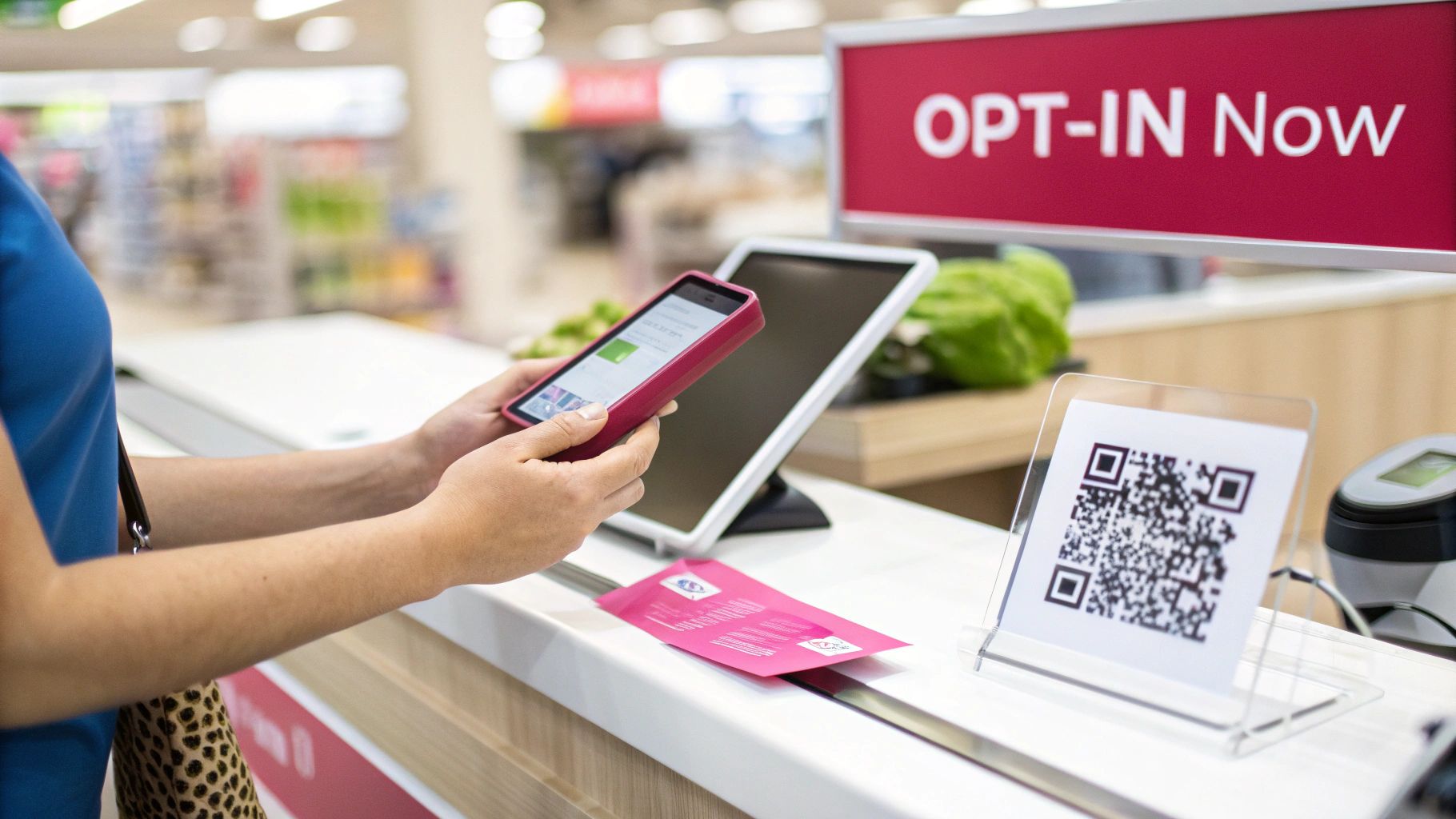
Turning Legal Rules into Trust
Think of your opt-in process as your first handshake with a customer. You want it to be firm, confident, and clear. Vague language or sneaky pre-checked boxes are a definite no-go. When you ask for their number, you have to be upfront about what you’ll be sending them.
Here’s a real-world example of how to do it right on a Shopify or WooCommerce checkout page:
[ ] Yes, I’d love to get exclusive deals and order updates via text! By checking this box, you agree to receive marketing text messages from [Your Brand Name]. Msg & data rates may apply. Reply HELP for help or STOP to cancel.
This little blurb does everything it needs to. It clearly states the purpose (deals and updates), identifies your brand by name, and tells people exactly how to opt out. To really nail this crucial first impression, check out our deep dive on crafting the perfect SMS opt-in strategy.
Actionable Ways to Grow Your List
The best way to grow your list is to make it a no-brainer for people to sign up. It’s a simple value exchange: you give them something good, and they give you their number. This is the secret sauce for any successful small business text marketing program.
Here are a few tried-and-true methods that work:
- Website Pop-Ups: Hit them with an offer they can’t refuse. A pop-up that says, “Get 15% off your first order! Drop your phone number here to get your code instantly” is direct and provides immediate value.
- QR Codes on Signage: If you have a brick-and-mortar store, put QR codes everywhere—at the checkout counter, on your product displays, even on your receipts. A simple sign like, “Scan to join our VIP text club for secret sales and early access!” works wonders.
- Checkout Integration: This one is a powerhouse. Adding a simple, unchecked consent box during the checkout process is the perfect time to capture highly engaged customers right when they’re about to buy.
By focusing on crystal-clear consent and offering real value, you’ll build a high-quality list of people who are genuinely excited to get your texts. That’s how you turn SMS from a line item in your budget into a serious revenue driver.
How to Craft Text Messages That Actually Convert
Alright, let’s move from theory to the fun part: writing texts that grab attention and get people to act. Crafting a great text message is part art, part science. You’re working with a tiny character count, so every single word has to pull its weight to create a message that’s punchy, valuable, and impossible to scroll past.
The best messages have a few things in common. They feel personal, offer something genuinely useful, create a little bit of urgency, and have a crystal-clear call to action. Get these four things right, and you’ll turn your SMS outreach from simple notifications into a real sales engine for your business.
The Anatomy of a High-Impact Text
So, what makes a text message work? Think of it as a simple recipe you can tweak for any campaign, whether you’re trying to win back an abandoned cart or shouting about a flash sale. The real goal is to make the person reading it feel like you sent it just to them, even if it’s part of a bigger broadcast.
A killer text message usually includes these ingredients:
- A Personal Touch: Using their name is a solid start, but referencing an item they were just looking at or a past purchase takes it to the next level.
- A Clear Offer: What’s in it for them? Make the value pop, whether it’s a discount, early access to a new product, or just some helpful info.
- A Sense of Urgency: Phrases like “ends tonight,” “limited stock,” or “your cart expires soon” are gold. They give people a gentle nudge to act now.
- A Direct Call-to-Action (CTA): Don’t be shy. Tell them exactly what to do next, like “Finish your order” or “Shop the sale.”
- A Shortened Link: Always use a link shortener. It saves precious character space and lets you track who’s clicking.
The secret sauce is creating a feeling of exclusivity and immediacy. A simple text like, “Hey [Name], your favorites are almost gone! Complete your order now and get 15% off before they sell out,” combines all these elements perfectly.
This approach isn’t just theory—it gets results. We’ve seen SMS campaigns deliver an incredible 45% conversion rate, completely blowing past what you’d expect from email.
Think about it: nearly half of consumers (50%) make a purchase right after getting a branded text, all because the call-to-action is so direct and lands right in their pocket. For e-commerce stores, this is a game-changer for turning forgotten carts into completed sales with a simple, automated reminder.
Proven Templates for Common Scenarios
You don’t need to reinvent the wheel every time you send a message. Building a small arsenal of reliable templates is the key to launching effective campaigns quickly without tearing your hair out. Platforms like CartBoss often come with pre-written and translated messages ready to go, which saves a ton of time.
To get you started, here’s a look at some common templates we’ve seen work wonders.
High-Converting SMS Message Templates
Here are a few ready-to-use templates for common scenarios. Notice how each one is clear, concise, and drives a specific action.
| Campaign Type | Example Message Template |
|---|---|
| Abandoned Cart | Hi [Name]! Looks like you left some goodies behind. Your cart is waiting! Finish your order now for an extra 10% off: [Link] |
| Flash Sale | SURPRISE! Our 24-hour flash sale is LIVE. Get 30% off everything, today only. Don’t miss out! Shop now: [Link] |
| Welcome Message | Welcome to the club, [Name]! Thanks for signing up. Here’s 15% off your first purchase as a thank you. Code: WELCOME15. [Link] |
| Appointment Reminder | Just a friendly reminder about your appointment with us tomorrow at [Time]. Reply C to confirm or R to reschedule. See you soon! |
These are just a starting point, of course. For even more ideas, check out our guide packed with powerful SMS marketing message examples and templates designed to boost conversions.
Having a solid set of templates like these provides a great foundation for crafting messages that really connect with your audience and, most importantly, deliver results you can actually measure.
Putting Your SMS Marketing on Autopilot
Picture this: you’re generating sales while you’re asleep, packing orders, or even taking a much-needed day off. That’s the real magic of automation in text marketing. It’s not about being lazy; it’s about building a smart system that works for you 24/7, turning missed opportunities into a steady stream of revenue without you having to manually send every single message.
This isn’t about blasting out robotic, generic texts, either. Done right, automation lets you deliver highly relevant messages at the perfect moment. Think of it as your secret weapon for clawing back time and capturing every possible sale.
Building Your Automated Sales Machine
The best automation feels personal, timely, and genuinely helpful to your customer. You can set up specific sequences—often called “flows” or “triggers”—that fire off messages based on what a customer does, or doesn’t do. This creates a responsive system that nurtures subscribers and recovers sales all on its own.
Here are a few essential automation flows every small business should have in its back pocket:
- The Welcome Series: When someone new subscribes, don’t just dump them onto a list. Hit them with a warm welcome text immediately, delivering that discount you promised. This instantly confirms their subscription and gives them a great reason to make their first purchase.
- Abandoned Cart Reminders: This is the undisputed king of SMS automation. A customer adds items to their cart but gets distracted. An automated text sent an hour later is often the exact nudge they need to cross the finish line. It’s a lifesaver for recovering what would otherwise be lost revenue.
- Birthday and Anniversary Offers: If you collect a customer’s birthday at sign-up, you can create a “set it and forget it” campaign that automatically sends them a special treat on their big day. It’s a simple, powerful way to build loyalty and make your customers feel seen.
This simple flow shows just how effective an automated SMS campaign can be.
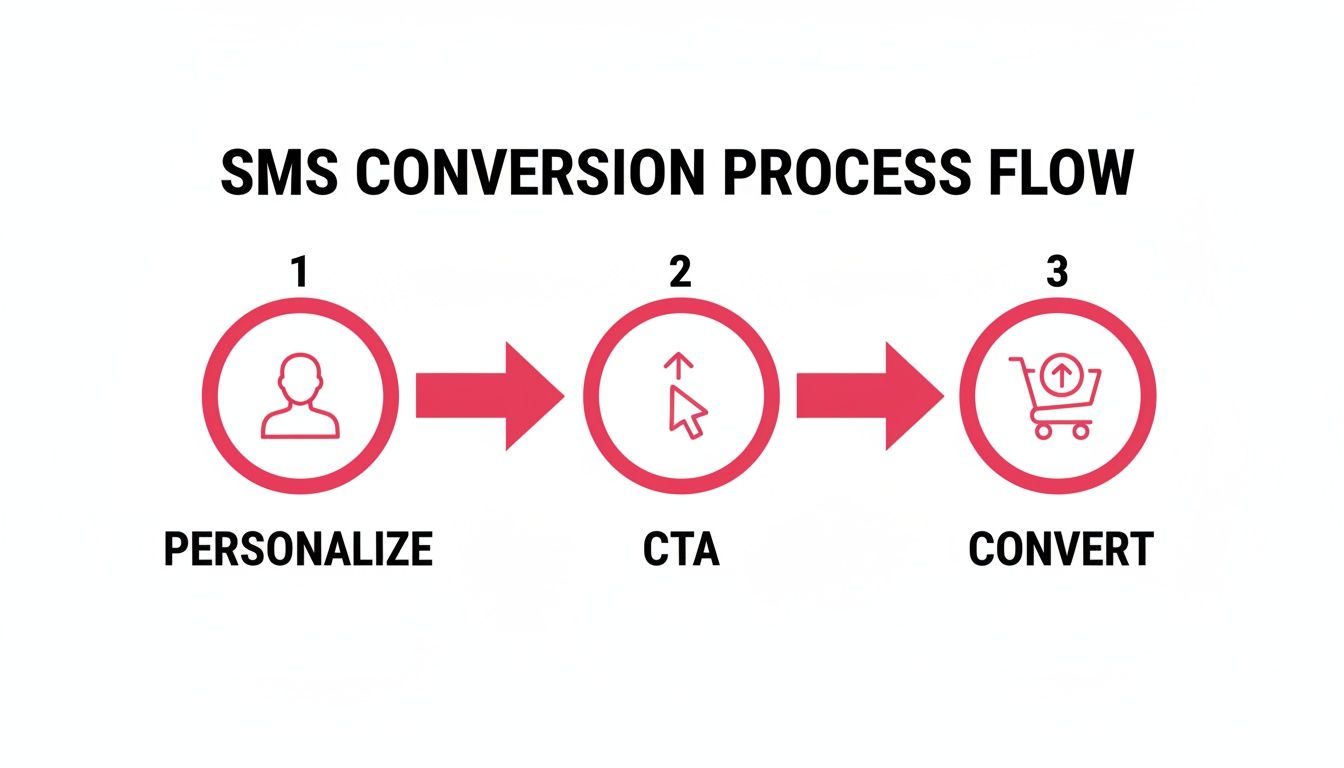
It all boils down to a clear path: personalize the message, give them a strong call-to-action, and lead them straight to a conversion.
Making Advanced Automation Simple
Setting up these flows might sound like a headache, but modern tools are designed to make it incredibly easy. Platforms like CartBoss are built specifically for this, taking what used to be complex features and making them accessible to any business owner, no coding required.
For instance, when an abandoned cart text goes out, it can include a unique link that takes the customer back to a pre-filled checkout form. This removes all the friction and makes it ridiculously easy for them to complete their purchase. Some systems can even auto-detect the recipient’s country and send the message in their native language—a huge win for businesses with an international audience. To dive deeper, check out our complete guide on SMS marketing automation.
The goal is to build a smart, efficient system that works in the background. Good automation doesn’t just send messages; it delivers the right message to the right person at the right time, maximizing your chances of making a sale.
The return on this small investment of time is massive. For every $1 spent on SMS marketing, the return can be anywhere from $21 to $71. Even a tiny spend of $30 on 1,000 texts can pull in $2,500 in revenue with just a 5% conversion rate. That kind of efficiency is a game-changer for budget-conscious businesses.
Measuring What Matters in Your Campaigns
Great marketing runs on data, not guesswork. If you’re not keeping a close eye on your text marketing efforts, you’re essentially flying blind. Tracking the right numbers lets you see what’s actually connecting with your audience and, more importantly, what’s driving revenue.
This isn’t about getting lost in endless spreadsheets. It’s about focusing on a handful of key performance indicators (KPIs) that tell you the real story of your campaigns. Think of these numbers as your roadmap for tweaking your strategy, getting better results, and boosting your bottom line.
Key Metrics to Watch
Your analytics dashboard is the pulse of your campaigns. Tools like CartBoss lay it all out for you with detailed reports, making it simple to see how you’re doing at a glance. Instead of getting overwhelmed, just zero in on the metrics that truly matter.
Here are the essential KPIs you should be tracking:
- Click-Through Rate (CTR): This is the percentage of subscribers who actually clicked the link in your text. A high CTR is a great sign that your message and call-to-action were compelling enough to grab their attention.
- Conversion Rate: This one tracks the percentage of people who followed through and completed the desired action, like making a purchase. It’s the ultimate test of whether your campaign successfully turned a click into cash.
- Return on Investment (ROI): The big one. ROI tells you exactly how much revenue you generated for every dollar you spent. It’s the clearest, most direct indicator of your campaign’s financial success.
- Opt-Out Rate: This shows you the percentage of subscribers who unsubscribed after getting a message. If you see a sudden spike here, it could mean your sending frequency is too high or your content just isn’t hitting the mark.
By consistently monitoring these numbers, you can shift from being reactive to proactive. You’ll spot trends early, fix problems before they get bigger, and double down on the strategies that are proven winners for your business.
Turning Insights into Action
Data is only useful if you do something with it. If one of your metrics is looking a little weak, don’t see it as a failure—it’s a golden opportunity to optimize.
For instance, a low CTR is a clear signal that your message isn’t quite right. That’s your cue to start A/B testing different calls-to-action or maybe try a more urgent tone.
If your conversion rate is lagging, the problem might be with your offer or the landing page itself. Is the discount not juicy enough? Is the checkout process a pain? Knowing how to measure marketing performance and prove its value is vital for refining your strategy and showing just how effective your texts are.
Your Text Marketing Questions Answered
Even with a solid game plan, jumping into a new marketing channel always brings up a few last-minute questions. Getting those sorted is the final step before you can launch with total confidence. Let’s tackle some of the most common things that might be on your mind.
Each of these points is designed to give you a practical, no-fluff answer you can use right away.
How Much Does Small Business Text Marketing Cost?
The great news? Text marketing is incredibly budget-friendly and boasts one of the highest ROIs you can find. It’s a highly scalable channel for any budget.
Most platforms either charge a tiny fee per message—usually around $0.01 to $0.05—or offer monthly subscription plans based on how many texts you send.
You can realistically get started with a budget as low as $30-$50 per month, which is often more than enough to generate thousands of dollars in new revenue.
Some innovative tools, like CartBoss, flip the script entirely with a performance-based model. This means you have zero subscription fees. You only pay a small commission on the sales the platform successfully recovers for you. It’s a completely risk-free way to prove the value of SMS from day one.
What Are the Most Important Legal Rules to Follow?
If you only remember one thing about compliance, make it this: you must get explicit, clear consent before sending a single marketing text. This is the absolute bedrock of laws like the TCPA in the United States and GDPR in Europe.
Your opt-in language has to be unambiguous. People need to know exactly what they’re signing up for.
The second golden rule is to provide a simple and clear way to opt out. Including instructions like “Reply STOP to unsubscribe” in your messages isn’t optional—it’s a requirement. Sticking to these two core principles will keep your campaigns compliant and build trust with your audience.
For a deeper look, our guide on TCPA compliance for text messages is a great resource to have on hand.
Can I Use My Personal Phone for Text Marketing?
While it might seem like an easy shortcut, using your personal number for business texting is a really bad idea. I can’t stress this enough. It’s a path loaded with legal risks and logistical headaches. A dedicated SMS marketing platform is essential for handling the complexities you just can’t manage manually.
Using a professional tool helps you:
- Ensure Legal Compliance by automatically managing opt-outs and keeping records of consent.
- Enable Automation to schedule campaigns, send triggered messages like cart reminders, and run entire marketing flows on autopilot.
- Access Analytics to see what’s working, track your ROI, and make smart decisions to improve your strategy.
- Protect Your Privacy by keeping your personal number separate from your business communications.
What’s the Best Time to Send Marketing Texts?
Timing can make or break your engagement rates. While the perfect time always depends on your specific audience, some general best practices hold true. You’ll want to send messages during normal business hours when people are most active on their phones.
Mid-day (10 AM – 1 PM) and late afternoon (4 PM – 7 PM) tend to be sweet spots.
Crucially, always respect your customers’ time. Avoid sending texts that are super early in the morning or late at night. Most good platforms have built-in “quiet hours” to prevent this from happening automatically.
Don’t be afraid to test a few different time slots to see what gets the best response from your subscribers. For more tailored guidance on your specific strategy, professional services like specialized VoIP SMS consulting can offer some invaluable insights.
Ready to turn those abandoned carts into your biggest revenue source? With CartBoss, you can launch powerful, automated SMS campaigns in minutes. Stop losing sales and start recovering them effortlessly. Get started with CartBoss today and see what you’ve been missing.