



At its core, a Telephone Consumer Protection Act violation happens when a business sends automated calls or texts without getting the right kind of permission first. It also includes contacting numbers on the National Do Not Call Registry or, just as importantly, failing to honor opt-out requests.
These aren’t just minor slip-ups; they come with hefty penalties, ranging from $500 to $1,500 per violation.
The High Stakes of TCPA Compliance

Navigating the Telephone Consumer Protection Act (TCPA) feels a bit like walking a tightrope. One wrong move, and you’re facing a multi-million dollar fall. For modern eCommerce businesses, especially those using SMS for things like cart recovery or promotions, this isn’t just boring legal stuff. It’s the bedrock of sustainable, trustworthy customer communication.
The biggest headache for businesses right now is the explosion in TCPA lawsuits. A single text campaign sent to a few thousand customers without the right consent can quickly snowball into a financially crippling class-action lawsuit.
Why TCPA Matters Now More Than Ever
The stakes have never been higher. The legal world is buzzing with aggressive law firms actively hunting for businesses that miss the small details of consent and communication rules. What you might see as a harmless marketing text could be painted as a clear violation in court.
This guide is designed to cut through the legal noise and tackle these real-world risks. We’ll get into:
- The specific actions that actually count as a TCPA violation.
- How to get ironclad consent from your customers.
- Practical, real-world steps to shield your business from expensive litigation.
The TCPA isn’t just about dodging fines; it’s about respecting your customers’ privacy. A compliant communication strategy builds trust, boosts your brand’s reputation, and leads to more loyal customers who actually want to hear from you.
Think of this article as a clear roadmap to help you use powerful marketing tools without stepping into legal traps. Whether you’re a big-name brand or a growing online shop, getting TCPA compliance right is non-negotiable.
For a deeper dive into how these rules apply specifically to text messaging, check out our detailed article on TCPA and text messages for more targeted insights. Our goal is to give you the knowledge you need to build customer trust and grow your business with confidence.
What Exactly Is a TCPA Violation?
You don’t need a law degree to get the gist of a Telephone Consumer Protection Act (TCPA) violation. At its heart, the law is all about protecting people from unwanted, automated calls and texts. Think of it as a digital “No Soliciting” sign for every person’s phone.
A violation usually happens in one of three ways: you contact someone using an automated system without getting the right kind of permission, you text or call a number on the National Do Not Call Registry, or you don’t give people a clear and easy way to opt out. Each slip-up is a serious compliance miss that can hit your business with some hefty financial penalties.
The Three Main Ways Businesses Mess Up
Let’s cut through the legal jargon. Most TCPA violations fall into one of these three buckets. Getting these down is the first step to building a text marketing strategy that won’t land you in hot water.
- Getting Consent Wrong: This is the big one. Firing off automated marketing texts or making calls without prior express written consent is a direct violation. That consent needs to be crystal clear, specific, and totally unambiguous.
- Ignoring the Do Not Call List: The National Do Not Call (DNC) Registry is exactly what it sounds like—a list of people who’ve said they don’t want telemarketing calls. Contacting anyone on that list for sales is a clear foul.
- Forgetting the Opt-Out: Every single marketing message must have a simple way for someone to say “no more,” like replying “STOP” to a text. If you ignore those requests or take too long to process them, you’re breaking the law.
These three areas are the foundation of TCPA compliance. Drop the ball on any one of them, and you’re opening your business up to legal trouble. For e-commerce stores, understanding the difference between message types is especially crucial.
Consent: The Cornerstone of Compliance
That phrase, “prior express written consent,” is everything. Think of it as a signed permission slip from your customer that you get before sending a single promotional text. You can’t bury it in a massive terms and conditions document or make it a requirement for a customer to buy something.
A compliant consent disclosure has to be unmistakable. It should clearly state that the user is agreeing to get automated marketing messages from your brand at the number they provided, and—critically—that agreeing is not a condition of making a purchase.
This is exactly why the line between transactional and marketing messages is so important. A transactional text, like a shipping update, has a lower consent requirement. But the second a message tries to push a sale—like an abandoned cart reminder with a discount code—it becomes marketing, and that much higher standard of express written consent kicks in.
Why Your SMS Platform Is Considered an Autodialer
Here’s where a lot of businesses get tripped up: the term “autodialer.” While lawyers and courts have debated the precise legal definition, the reality for businesses is simple: most modern SMS marketing platforms are considered autodialers under the law.
Why? Because they have the ability to store phone numbers and dial them automatically, even if a human has to click a “send” button to get the campaign started.
This broad interpretation means almost any automated text message campaign falls under TCPA rules. It’s why you should focus less on the technical details of your software and more on getting rock-solid consent. To dig deeper into how the law affects text marketing, check out our comprehensive guide on the Telephone Consumer Protection Act and text messages. Getting this right is the key to avoiding telephone consumer protection act violations.
To make it even clearer, let’s look at the most common violations, what they require, and what they could cost your e-commerce business.
Common TCPA Violation Types and Their Business Impact
Here’s a simplified breakdown of the most frequent slip-ups in an e-commerce context.
| Violation Type | Required Consent Level | Example Scenario for E-Commerce | Potential Penalty Per Violation |
|---|---|---|---|
| Marketing Texts Without Consent | Prior Express Written | Sending a flash sale SMS to a customer who only provided their number for a shipping update. | $500 – $1,500 |
| Contacting DNC Numbers | DNC Registry Check | A sales agent cold-calls a lead from a purchased list without first scrubbing it against the DNC registry. | Up to $51,744 |
| Ignoring Opt-Out Requests | Immediate Action Required | A customer replies “STOP” to a promotional text, but your system continues to send them messages. | $500 – $1,500 |
As you can see, the penalties add up quickly, especially in a class-action lawsuit where thousands of individual violations are involved. The financial risk is simply too high to ignore.
The Escalating Threat of TCPA Litigation
Knowing the TCPA rules is one thing, but seeing the real-world fallout is another entirely. These regulations aren’t just dusty legal guidelines; they represent a massive and growing financial risk for any business that texts or calls its customers. What was once a distant concern for most companies has ballooned into a primary business liability.
In the last few years, the number of TCPA lawsuits has absolutely exploded. We’re not talking about a small uptick. We’re talking about a dramatic surge that’s turning minor compliance slip-ups into company-ending legal battles. Every business owner, especially in e-commerce, needs to sit up and pay attention.
The Staggering Rise in Class-Action Lawsuits
The numbers tell a scary story. In the first three months of this year alone, courts saw 507 TCPA class actions filed. That’s a jaw-dropping 112% increase from the 239 cases filed during the same time last year.
This trend is a huge deal because nearly 80% of all TCPA cases are now filed as class actions, making it one of the biggest legal threats to American businesses today. You can get a deeper dive into the data to understand the sharp rise in TCPA class actions.
Think about it: a single, misconfigured abandoned cart SMS campaign sent to a few thousand customers without the right consent could easily trigger millions of dollars in damages. This is the new reality.
This wave is being driven by a growing cottage industry of plaintiff’s law firms that specialize in hunting down TCPA claims. They have sophisticated methods for sniffing out businesses with compliance gaps, ready to turn small mistakes into massive paydays.
Why E-Commerce Is a Prime Target
E-commerce stores are walking a tightrope. Their reliance on automated tools like SMS marketing for flash sales and abandoned cart reminders makes them especially vulnerable. Every text is a potential landmine if not handled with extreme care.
- High-Volume Messaging: Online stores often send thousands of automated texts a day. This high volume multiplies the potential damages from even a single mistake.
- Complex Consent Trails: Getting and tracking consent across website pop-ups, checkout boxes, and loyalty programs is messy. It creates plenty of room for error.
- Widespread Confusion: Many store owners are still fuzzy on the details of “prior express written consent,” especially when it comes to marketing texts versus simple transactional messages.
This mix of factors has created a perfect storm. The ease of sending automated messages, combined with the sky-high penalties for each one, makes e-commerce a very attractive target for TCPA lawsuits.
The bottom line is crystal clear: you can’t afford to ignore this. Proactive, obsessive compliance isn’t just a legal chore; it’s a core survival strategy. The financial risk is simply too great to leave to chance. A single oversight can lead to devastating consequences, making a rock-solid compliance plan absolutely non-negotiable for modern marketing.
Common TCPA Pitfalls for E-Commerce Businesses

Knowing the TCPA rules is one thing, but actually applying them in the fast-moving world of e-commerce is where things get tricky. For online stores, some of the most common marketing tactics—like cart recovery texts—carry a surprisingly high risk of landing you in hot water with a telephone consumer protection act violation.
These aren’t some obscure legal loopholes we’re talking about. They are everyday mistakes that are incredibly easy to make without a solid compliance plan. Let’s break down the most common traps and, more importantly, how you can sidestep them.
The Time of Day Trap
One of the clearest rules in the TCPA playbook is the strict time window for marketing messages. You can only send marketing calls or texts between 8 a.m. and 9 p.m.—and that’s based on the recipient’s local time zone. An automated cart recovery text that goes out at 9:05 p.m. their time is a clear-cut violation.
This isn’t a minor detail; it’s a massive driver of recent lawsuits. In fact, “time-of-day” allegations have exploded, with TCPA filings jumping 112% in the first quarter of the year. One firm in South Florida filed over 100 such lawsuits in March alone, many targeting automated text messages. You can find more details on the rise of time-of-day lawsuits on onlineandonpoint.com.
Do this: Your SMS marketing platform absolutely must have a “quiet hours” feature that automatically respects local time zones. No exceptions.
Not that: Sending a nationwide campaign at 8 p.m. EST. That message hits the West Coast at 5 p.m., but as you move across time zones, you risk sending illegal late-night texts.
The Hidden Danger of Reassigned Numbers
This is a sneaky one that catches a lot of businesses off guard. Imagine a customer gives you their consent to send texts. A year later, they change their number, and the carrier reassigns it to someone new. If you keep texting that number, you’re now sending unsolicited marketing messages to a total stranger. That’s a TCPA violation.
- The Problem: Consent is tied to the person, not the phone number. Once that number has a new owner, your consent is instantly void.
- The Solution: You have to regularly “scrub” your contact lists against databases of reassigned numbers. This isn’t a one-time task; it’s critical, ongoing maintenance to keep your lists clean.
Skip this step, and you could face a class-action lawsuit led by someone you’ve never even done business with, all because they inherited an old phone number from a former customer.
Vague or Buried Consent Language
The TCPA requires “prior express written consent,” which needs to be clear, obvious, and impossible to misunderstand. A huge pitfall for online stores is burying consent language in the fine print of a lengthy “Terms and Conditions” page or using wishy-washy phrasing at checkout.
Vague Language Example:
“By providing your number, you agree to our terms and to receive messages.”
This is way too broad. It fails to mention that the user is signing up for automated marketing texts.
Compliant Language Example:
“By checking this box, you agree to receive recurring automated marketing and promotional text messages from [Your Brand] at the number provided. Consent is not a condition of purchase. Reply STOP to cancel. Msg/data rates may apply. View Terms & Privacy.”
See the difference? The second example is specific, transparent, and includes all the required disclosures. Getting this consent right is the bedrock of a compliant SMS program. For more practical tips, check out our guide on how to build a compliant opt-in process for SMS.
By steering clear of these common traps, you can protect your business and build a powerful marketing channel that your customers actually trust and appreciate.
Navigating State-Level Mini-TCPA Laws
Getting your federal TCPA compliance in order is a huge step, but the work doesn’t stop there. You’ve also got to deal with a growing patchwork of state-specific telemarketing laws, often called “mini-TCPAs,” that add another tricky layer of legal risk.
Simply put, what’s perfectly fine in one state could land you in hot water in another. Federal compliance alone is no longer a bulletproof vest; businesses operating nationwide need a much more granular, location-aware strategy to avoid getting blindsided by a state-level lawsuit.
Why State Laws Add So Much Complexity
States like Florida, Texas, and Washington have rolled out their own rules that are often way stricter than the federal TCPA. These “mini-TCPAs” can create a real maze of regulations that can easily trip up even the most careful businesses.
The biggest headaches usually pop up in a few key areas:
- Tighter “Quiet Hours”: Some states shrink the federal 8 a.m. to 9 p.m. window, giving you less time to send marketing messages.
- Broader Autodialer Definitions: A state might classify more of your tech as an “autodialer,” pulling more of your communication systems under its strict rules.
- Unique Consent Rules: The exact wording or method you need to get valid consent can be completely different from state to state.
- Call Frequency Caps: Certain states limit how many times you can even try to contact someone in a given period.
If you don’t account for these local quirks, you could face hefty penalties, even if your campaigns are 100% compliant with federal law.
A business could follow every federal TCPA rule to the letter but still get sued in Florida because its texts fall under the state’s wider definition of an automated system, which has its own unique consent and timing rules.
The Rise of State-Level Enforcement
This isn’t just some theoretical risk—state-level enforcement is seriously ramping up. State Attorneys General are getting much more aggressive about chasing down TCPA-related violations, often teaming up to target both businesses and the tech providers that help send robocalls and texts.
With at least 15 states now having their own mini-TCPAs, the danger of “stacked” liabilities—where a single campaign breaks both federal and state laws—is very real. Texas, for example, aggressively expanded its definition of “telephone solicitation” to cover text messages and graphics, and it even allows for triple damages in some cases. If you want to get a sense of this trend, you can explore how State AGs are increasing robocall enforcement actions.
All this extra scrutiny means you now have to track and follow the strictest applicable law for every single customer based on where they live. Ignoring this tangled web of state regulations is a surefire way to invite expensive lawsuits and tarnish your brand’s reputation. A proactive, state-aware compliance strategy isn’t just a good idea; it’s essential.
Building Your TCPA Compliance Playbook
Knowing the rules is one thing, but actually turning that knowledge into a bulletproof strategy for your business is what really counts. Putting together a solid TCPA compliance playbook isn’t just about dodging lawsuits—it’s about building a communication system that your customers actually trust.
The whole game is about being proactive. Instead of waiting for a potential telephone consumer protection act violation to happen and then scrambling, you want to build a system where mistakes are almost impossible. This means you need a rock-solid process for documenting consent, honoring opt-outs instantly, and keeping your contact lists squeaky clean.
Nail Down Prior Express Written Consent
Everything—and I mean everything—starts with consent. This is the absolute cornerstone of your entire game plan. Without it, every automated text you send is a ticking time bomb.
Prior express written consent needs to be crystal clear. There can’t be any gray area. A customer has to know exactly what they’re signing up for and actively agree to get automated marketing messages from you. For a much deeper look at the nitty-gritty details, check out our guide: learn more about express written consent in our actionable guide for business compliance.
Here are a couple of real-world examples you can adapt for your store:
- For a Checkout Page Checkbox: “☑️ Yes, I want exclusive deals! Sign me up for recurring automated marketing text messages from [Your Brand] at the number I provided. Consent is not a condition of purchase. Msg/data rates may apply. Reply STOP to opt-out. View Terms & Privacy.”
- For a Website Pop-Up: “Get 15% Off! Enter your phone number to receive recurring automated promotional and personalized marketing text messages (e.g., cart reminders) from [Your Brand]. Consent is not a condition of purchase. Reply STOP to cancel. View Terms & Privacy.”
See how both examples are totally transparent? They specify what the messages are (automated marketing), make it clear that buying isn’t tied to consent, and give simple opt-out instructions. That’s the level of clarity the law demands.
Implement Ironclad Opt-Out and DNC Protocols
Getting consent is only half the job. You have to be just as good at respecting someone’s wish to stop hearing from you. Your systems need to handle opt-out requests instantly, without any hiccups.
The classic keyword is “STOP.” When a customer texts that word, your system must automatically and immediately pull them from all marketing lists. There’s no grace period here; it has to be seamless.
Your internal do-not-call (DNC) list is your ultimate source of truth for who has opted out. It needs to contain every single person who has ever revoked their consent. Before any campaign goes out, your main contact list must be scrubbed against this DNC list. No exceptions.
This flow chart gives you a bird’s-eye view of how federal rules trickle down to state laws and, finally, to your own business practices. It really shows why you need to think about compliance on multiple levels.
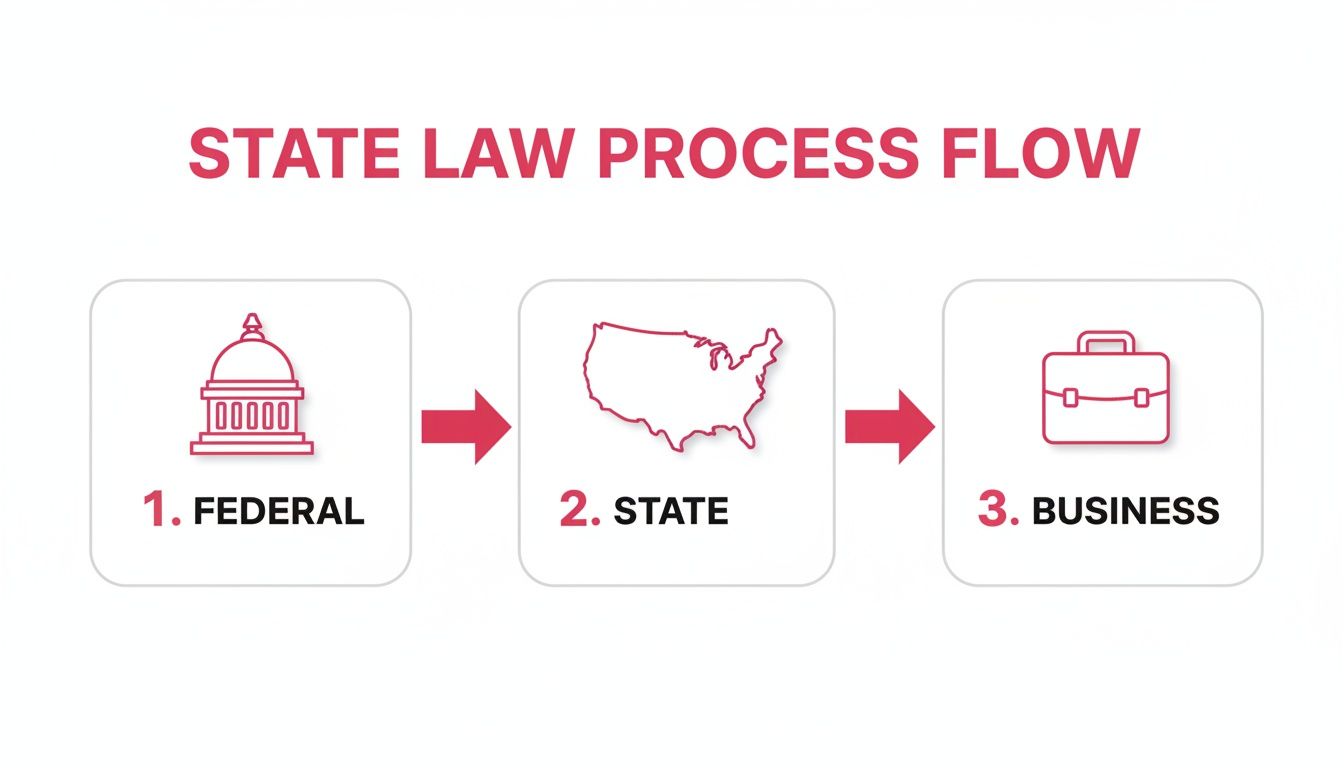
What this really drives home is that you’re juggling both the big federal mandates and the specific state-level rules to stay in the clear.
Maintain Your Lists with Ongoing Diligence
A compliant contact list isn’t something you build once and forget about. It needs constant attention to stay accurate and keep your legal risk low. One of the biggest traps people fall into is texting reassigned numbers—that’s when a customer drops their old number and it gets assigned to someone new.
Here’s what your regular list hygiene should look like:
- Regularly Scrub for Reassigned Numbers: Use a good service to check your lists against databases of recently reassigned phone numbers. You don’t want to be texting total strangers.
- Honor All Opt-Outs Immediately: Make sure your platform is set up to automatically process opt-outs, no matter where they come from.
- Audit Consent Records: Every so often, take a look at how you’re collecting consent. Make sure the language is still clear, compliant, and that you have proper timestamps for every opt-in.
When you’re building out these processes, it pays to look at specific guides, like this one for TCPA Compliance for Automated Outreach. A system like this does more than just keep you out of court; it builds a foundation of respect with your audience.
Still Have Questions About TCPA Violations?
Even when you think you have a solid compliance plan, the tricky details of the TCPA can feel like a pop quiz you never studied for. Business owners and marketers often stumble over the same situations, and getting the answers wrong can lead to some painful telephone consumer protection act violations.
Let’s clear up some of the most common questions we see, giving you direct answers so you can make decisions with confidence.
Can I Text Promotions to a Customer Who Gave Me Their Number for Shipping Updates?
Absolutely not. This is one of the most classic compliance traps out there. Under the TCPA, consent isn’t a universal permission slip you can use for everything.
When a customer hands over their number for a specific, functional reason—like getting a shipping notification—their consent is strictly limited to that purpose and nothing more.
If you want to send them marketing texts, like flash sale alerts or new product announcements, you need a much higher level of permission: prior express written consent. To be safe, this means getting a separate, totally explicit opt-in where the customer clearly agrees to get promotional messages. You also have to state that agreeing to these messages is not a condition of making a purchase.
What Is the Difference Between TCPA and GDPR?
It’s actually pretty simple when you break it down. Think of it like this: TCPA is about the channel you use to communicate, while GDPR is about the personal data itself.
- TCPA (Telephone Consumer Protection Act): This is a U.S. law zeroed in on how businesses can contact people via phone calls and text messages. Its main job is to stop unwanted, automated calls and texts.
- GDPR (General Data Protection Regulation): This is a European Union law that governs how companies collect, store, and handle the personal data of anyone in the EU. It’s way broader than the TCPA and covers all kinds of personal data, not just phone numbers for marketing.
While both laws deal with getting consent, they protect different things and apply in different parts of the world. If your business operates internationally, you absolutely have to comply with both.
How Long Does SMS Marketing Consent Last?
This is a tricky one. The TCPA doesn’t actually put an expiration date on consent, but don’t let that fool you. In the real world, consent isn’t permanent because it’s tied to the person, not the phone number.
The second a customer gives up their phone number and it gets reassigned to someone new, your consent to text that number is instantly gone. If you keep sending messages, you’re now texting a complete stranger without permission—and that’s a direct violation.
Because consent can effectively expire the second a number is reassigned, it is not a “set it and forget it” permission. Regular list hygiene is non-negotiable for ongoing compliance.
To stay on the right side of the law, you have to scrub your contact lists for reassigned numbers on a regular basis. It’s an essential best practice. And, of course, you must honor opt-out requests immediately. The moment someone replies with “STOP,” their consent is revoked for good unless they decide to opt back in down the road. For more tips on keeping your lists clean and compliant, check out this handy SMS compliance checklist.
Ready to turn abandoned carts into revenue without the legal headaches? CartBoss offers fully compliant, automated SMS campaigns that recover lost sales on autopilot. Set it up in minutes and watch your profits grow. Start recovering sales today with CartBoss.
